In 2026, Google AI Overviews expand a query into related sub-queries, retrieve pages for each, generate a brief summary with a language model, and add source links. Source selection differs from ranking: a May 2026 arXiv audit found that nearly 30% of cited domains did not appear on the conventional first results page. Citations are not clicks, so track them separately. Sona AI Visibility connects the prompts and citations behind AI answers to pipeline and revenue, while monitoring AI crawler activity on your site.
How does Google AI Overviews generate an answer, step by step?
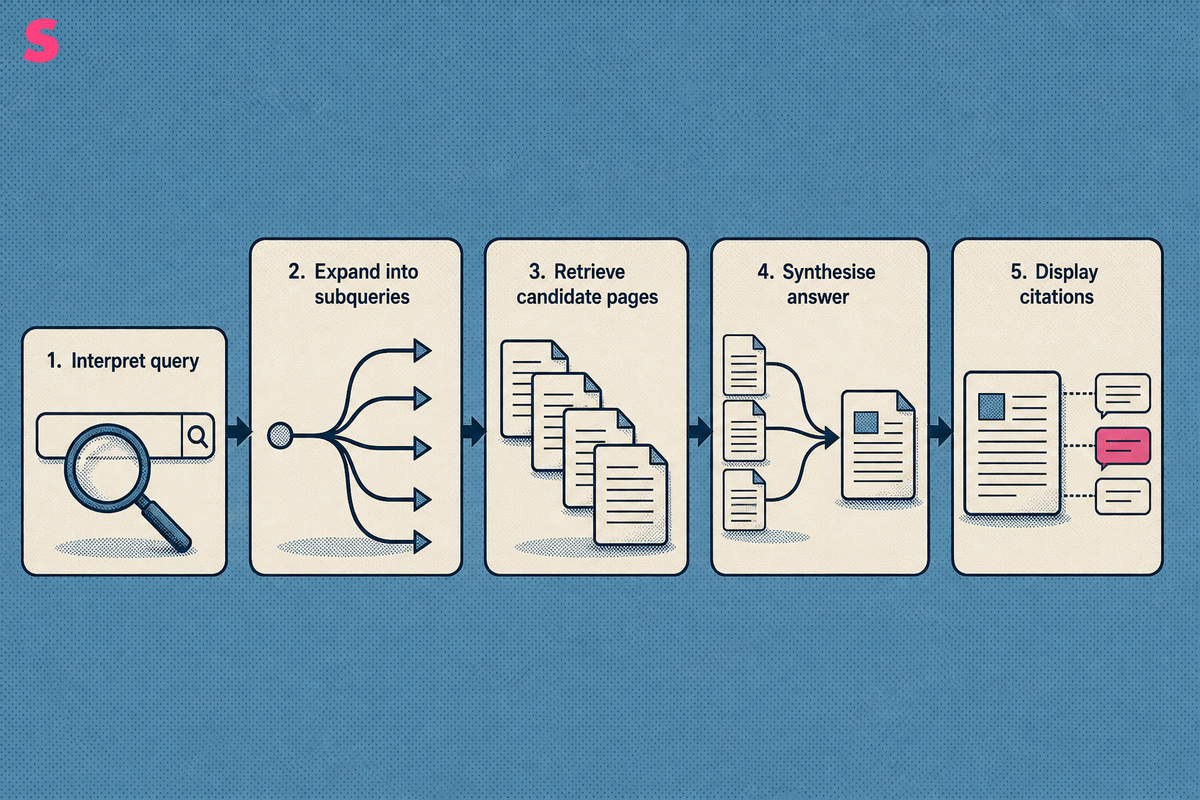
Google AI Overviews are AI-generated summaries that appear in Google Search results and include links for further research, per Google’s support documentation. Google AI Overviews interpret a query, retrieve relevant material, synthesise a response, and display citations beside supporting claims.
For marketing and content teams, the practical question is which sources Google selects. An AI Overview can expose a page to a searcher even when that page does not hold the highest organic position. Google AI Overviews cite 3–8 sources per response, with some analyses finding about five sources, based on analyses published in November 2026.
- Google interprets the query. A search such as “best CRM for a mid-market sales team” can signal needs around pricing, integrations, deployment, and user fit.
- Google expands the research task. The system can break the request into related subqueries, sometimes called query fan-out, to find supporting evidence across several topics.
- Google retrieves candidate pages. Candidate sources can include vendor pages, reviews, documentation, editorial coverage, forums, and other pages relevant to each subquery.
- Google synthesises an answer. The generated summary combines material from retrieved pages into a direct response to the searcher’s request.
- Google displays citations. Citation links let searchers inspect supporting pages and continue their research.
Google AI Overviews do not replace Google Search’s ranked results. They sit alongside classic links and create a second impression opportunity for cited sites. A page can appear as an organic result, a cited source, or both.
How does Google choose which sources an AI Overview cites?
Google has not disclosed the full formula for selecting Google AI Overview citations. The process has three stages: retrieval eligibility, citation selection, and claim grounding. Treating those stages as one ranking system obscures why Google can discover a page without citing it.
Retrieval eligibility determines whether Google can find and use a page for a query or fan-out query. Citation selection determines which retrieved pages appear as visible sources. Claim grounding determines whether the cited passage supports the statement in the generated answer.
An arxiv.org audit published May 28, 2026 issued 55,393 queries across 19 topical categories between March 13 and April 21, 2026. A related analysis covered 61,212 Google AI Overview citations, per phys.org, September 29, 2026, updated November 10, 2026. The evidence indicates that AI Overview source selection relates to conventional ranking but does not mirror it.
For revenue teams, source selection is only the first measurement layer. Sona AI Visibility connects AI citations to pipeline and revenue on one account timeline, and tracks which AI crawlers reach pages through server logs or a lightweight edge worker. Citation monitoring measures exposure. Attribution measures commercial outcomes.
Do you still need a top 10 ranking to be cited in an AI Overview?
No. A top 10 organic ranking is neither necessary nor sufficient for a Google AI Overview citation. Traditional rankings remain evidence of relevance, but Google AI Overviews can cite pages outside the conventional first page and omit highly ranked pages.
The studies are not directly comparable because each uses different query sets, citation parsing rules, and definitions of a ranked URL. Read the figures as directional evidence rather than a universal citation rate.
| Study | Sample or method | Top-10 finding | Interpretation |
|---|---|---|---|
| arxiv.org audit | 55,393 queries across 19 categories, March 13 to April 21, 2026 | Nearly 30% of cited domains were absent from the conventional first results page, per arxiv.org, May 2026. | First-page rankings do not define the full candidate set. |
| Surfer study | Original queries and tested fan-out queries | 67.82% of cited pages ranked outside the top 10, per digitalapplied.com, November 2026. | Fan-out retrieval can surface pages beyond the main-query top 10. |
| First-three-citation subset | Same November 2026 study | 45.86% of pages ranked outside the top 10 when only the first three citations counted, per digitalapplied.com, November 2026. | Visible citation position changes the measured result. |
| Ahrefs comparison | July 2025 study compared with a March 2026 update | Top-10 cited-URL share changed from 76.1% to 37.9%, partly because parsing and citation-selection rules changed, per digitalapplied.com, November 2026. | Method changes can materially shift the reported rate. |
A November 2026 listing found that 52% of cited sources also ranked in Google’s top 10 organic results. The same listing found that 28.7% of citations in a US B2B software sample came from pages ranking in the top 10 for the main query. Sona AI Visibility records prompt-level citations and their commercial impact, letting teams prioritise work beyond a single rank position.
Which page characteristics are associated with being cited in AI Overviews?
Google AI Overview citations are associated with pages that provide extractable, specific, and credible evidence. Those associations are not confirmed Google ranking factors. Conventional visibility helps, but source type and passage-level relevance also affect citation selection.
A November 2026 listing found that 55% of Google AI Overview citations came from the top 30% of a page. The same November 2026 listing found that 59.8% of citations came from brand websites. In a US B2B software sample, vendor websites received 44.1% of 742 citations, per the October 2026 listing.
Social sources also contribute evidence. Fifteen percent of sources in a last-30-day panel were social platforms, including YouTube, Reddit, and LinkedIn, per the November 2026 listing. That pattern does not require every brand to maintain every social channel. It shows that Google AI Overviews can assemble evidence from several formats when a query requires experience, comparison, or community discussion.
Content teams should make product claims easy to verify. Use accurate specifications, current pricing context, clear definitions, and passages that answer a discrete question. Vendor pages, pricing pages, and review pages can change faster than models or indexes reflect them. Outdated claims can create citation risk even when a page remains visible.
What makes Google show an AI Overview for one query and not another?
Google AI Overviews appear when Google determines that a generated summary can help answer the query, but no universal trigger applies to every search. Appearance varies by query type, country, device, date, and available source material.
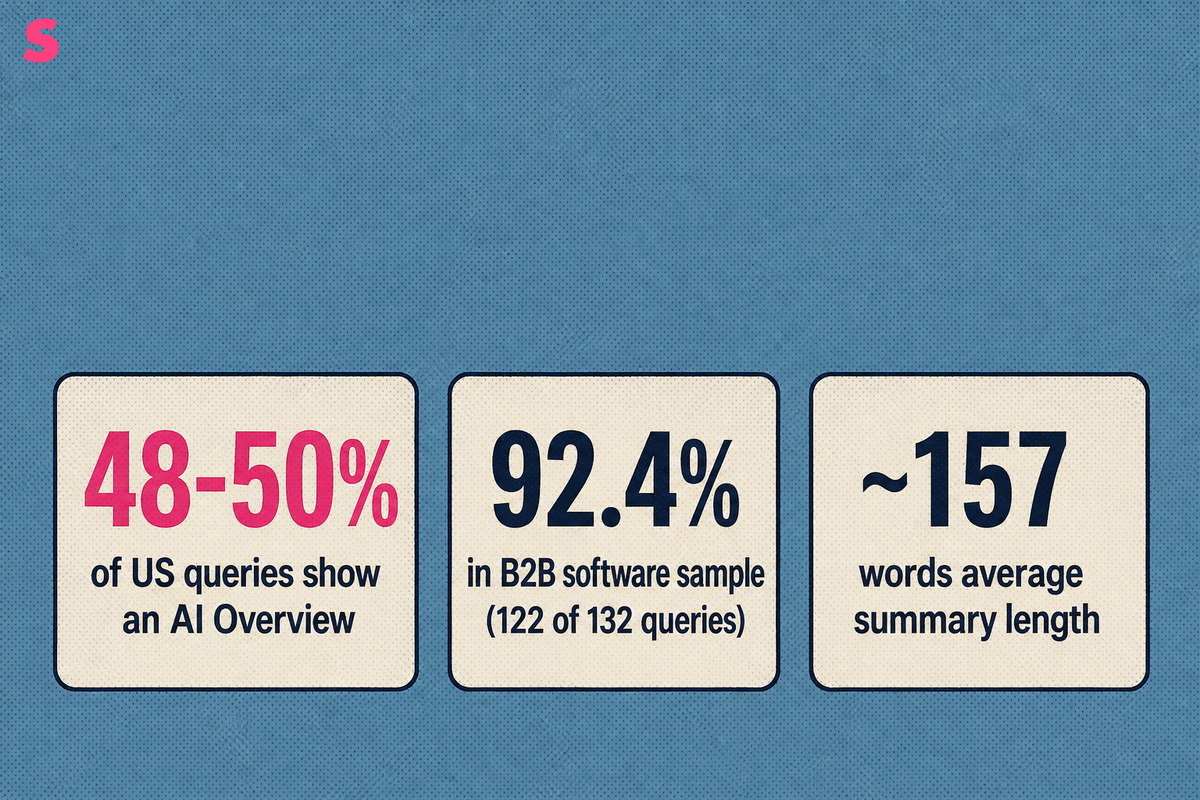
Google AI Overviews appeared on roughly 48–50% of US Google Search queries in analyses published in November 2026. In a separate US B2B software sample, Google AI Overviews appeared for 122 of 132 queries, or 92.4%, per the October 2026 listing. The B2B software rate is not a site-wide benchmark.
Google AI Overviews averaged about 157 words in an analysis of 405,576 summaries, per the November 2026 listing. Longer answers often reflect queries with several components, such as comparison criteria, product capabilities, pricing, and implementation considerations.
Teams should separate query eligibility from page visibility. A query can trigger an Overview without citing a brand. A brand can be cited without receiving a click. Sona AI Visibility connects citations and AI-referred visits to pipeline and revenue, making those outcomes measurable alongside other acquisition channels.
How do AI Overviews differ from featured snippets, AI Mode and classic results?
Google AI Overviews are generated multi-source summaries within a standard results page. Featured snippets extract a passage from one source, Google AI Mode is a separate conversational search experience, and classic results are ranked links rather than generated answers.
| Search feature | Primary output | Source structure | Measurement implication |
|---|---|---|---|
| Google AI Overviews | Generated summary within standard Google Search | Multi-source citations, with 88% citing three or more sources, per Pew Research Center. | A site can earn an organic-result impression and a citation impression. |
| Featured snippets | Single extracted passage | One page is visually foregrounded for the answer. | Measurement focuses on the featured URL and standard organic outcomes. |
| Google AI Mode | Conversational AI search experience | Generated response with citations where available. | Eleven percent of Google AI Overviews lacked citations versus 3% of Google AI Mode responses, per the November 2026 listing. |
| Classic results | Ranked list of links | Individual indexed pages in rank order. | Visibility is primarily assessed through ranking, impressions, and clicks. |
Google’s advanced model capabilities let users use AI agents in Search by asking a question, per blog.google. That capability belongs to the broader Search experience, not to the definition of Google AI Overviews.
Sona AI Visibility treats AI search as a measurable source of visits, citations, pipeline, and revenue. A citation is an exposure event, while a click and a qualified buying journey are separate events.
How much do AI Overviews cut clicks and visibility in different industries?
Google AI Overviews can increase citation visibility while reducing clicks to conventional top-ranking pages. The evidence is strongest for B2B software and cross-category samples. No published figures for retail, health, finance, or news were supplied here, so this analysis makes no industry-specific click claims for those sectors.
| Vertical or sample | AI Overview appearance | Citation pattern | Click effect |
|---|---|---|---|
| US B2B software queries | 92.4%, or 122 of 132 queries, per the October 2026 listing. | Vendor websites received 44.1% of 742 citations, per the October 2026 listing. | No verified B2B software click figure supplied. |
| US B2B software citations | Same 132-query sample, per the October 2026 listing. | 28.7% came from pages ranking in the main-query top 10, per the October 2026 listing. | Visibility and qualified traffic require separate measurement. |
| Cross-category audit | 55,393 queries across 19 categories, per arxiv.org, May 2026. | Nearly 30% of cited domains were absent from the conventional first results page, per arxiv.org, May 2026. | No category-level click figure supplied. |
| Top-ranking content | No vertical-specific appearance rate supplied. | No vertical-specific citation pattern supplied. | Clicks fell by up to 58% in measurements published in November 2026. |
A citation can earn an impression without producing qualified traffic. Sona AI Visibility connects AI citations and AI-referred visits to pipeline and revenue, so teams can distinguish visibility from business impact rather than treating citation share as demand generation.
How reliable are AI Overview citations, and why do they produce errors?
Google AI Overview citations can support useful answers, but a visible citation does not guarantee that cited text fully supports every generated claim. Errors arise when retrieval finds a relevant page but the selected passage does not ground the precise statement in the summary.
A study applying HallOumi tested whether Overview claims were supported by cited text. The arxiv.org audit published May 28, 2026 also examined claim fidelity across its 55,393-query sample. These studies distinguish citation presence from citation support, which require different tests.
Publish claims that can stand alone in the surrounding text. Keep product data current, define qualifiers, and avoid relying on an ambiguous paragraph to support a precise commercial statement. Sona AI Visibility connects citations to business outcomes, but teams should still review the cited page and generated claim before treating a citation as validated messaging.
How do you test and measure AI Overview citations in a repeatable way?
Measure Google AI Overview citations with a fixed prompt set, a consistent market and device setting, daily observations, and separate records for citations, clicks, and pipeline. A repeatable process turns changing AI answers into a comparable operating log rather than a one-time screenshot.
- Build a fixed prompt set. Include category, comparison, pricing, implementation, and branded research prompts that reflect real buyer questions.
- Record the test context. Log the date, market, device, engine, and whether Google AI Overviews appeared.
- Capture source-level evidence. Record cited URLs, citation share, answer inclusion, and source type for every observed Overview.
- Record downstream outcomes separately. Track clicks, AI-referred visits, conversions, pipeline, and revenue outside the citation record.
- Review patterns, not isolated moves. A team that runs the same prompt list daily can identify patterns that a weekly snapshot averages away. A change that holds for four days is a trend. A one-day spike is noise.
An AI Overview simulator can estimate likely fan-out queries and candidate sources. It cannot reproduce Google’s private retrieval, personalisation, ranking, or generation systems. Use a simulator to form hypotheses, then validate those hypotheses against observed Google Search results.
A single brand-level visibility score is a dated snapshot, not a work item. A prompt-level view identifies which prompts produce citations, which sources appear, and where a page is absent. Sona AI Visibility connects prompts and citations to pipeline and revenue, while AI Search Insights shows tracked prompts, cited sources, and page performance.
Use a monthly or quarterly clock for a positioning review and competitive benchmark report. Keep the prompt log daily. Sona AI Visibility also tracks AI crawler activity from server logs or a lightweight edge worker, helping teams connect source accessibility with citation and referral evidence.
What are frequently asked questions about Google AI Overviews?
Are Google AI Overviews and Google AI Mode the same thing?
No. Google AI Overviews are generated summaries at the top of a standard Google Search results page. Google AI Mode is a separate conversational experience. In measurements published in November 2026, 11% of Google AI Overviews lacked citations, compared with 3% of Google AI Mode responses.
How many sources does a Google AI Overview cite?
Google AI Overviews cite 3–8 sources per response, with some studies finding about five sources, based on analyses published in November 2026. Pew Research Center found that 88% of summaries cited three or more sources and 1% cited a single source.
Does ranking first on Google guarantee a citation in an AI Overview?
No. Nearly 30% of cited domains were absent from the conventional first results page in the arxiv.org audit published May 2026. Citation rates differ across studies because the studies use different query samples, citation-selection rules, and parsing methods.
Is a citation in an AI Overview the same as a click?
No. A citation is an impression within a generated summary, while a click is a visit to the cited site. Clicks to top-ranking content have fallen by up to 58% in measurements published in November 2026, so citations, traffic, and pipeline need separate records.
Can an AI Overview simulator show which sources Google will cite?
Only approximately. An AI Overview simulator can estimate likely fan-out queries and candidate sources. It cannot reproduce Google’s private retrieval, ranking, personalisation, or generation systems, so observed Google Search results remain the validation standard.
Do Google AI Overviews cite social platforms such as Reddit and YouTube?
Yes. Fifteen percent of Google AI Overview sources in a last-30-day panel were social platforms, including YouTube, Reddit, and LinkedIn, per the November 2026 listing. Social citations show that Google AI Overviews can draw from several content formats for one answer.
Summarize this article with AI: ChatGPT · Claude · Perplexity · Google AI Mode
Last updated: November 2026