


Google AI Overviews analyzer software logs the sources and brands cited in Google AI Overviews across a fixed query set, then monitors those citations over time. Prioritize raw answer capture, cited URLs, location and device controls, and prompt allowance rather than an AI visibility label. Sona AI Visibility goes further by linking prompts and citations with pipeline and revenue. Test each shortlisted tool using the identical prompt set before paying.
What does an AI Overviews analyzer do, and what does it show?
An AI Overviews analyzer captures Google AI Overviews for selected prompts, identifies cited URLs, and records whether a brand appears in the answer. It turns a changing Google result into evidence a marketing or SEO team can review and act upon.
Google AI Overviews are generative AI responses integrated into Google Search, per en.wikipedia.org, and they can appear before organic listings, per digitalmarketinginstitute.com. They can include short paragraphs, lists, images, and product carousels. Google AI Overviews expanded to more than 200 countries and territories in May 2025, per blog.google.
Consider a tracked query such as “best customer data platform for B2B SaaS”. An analyzer stores the AI Overview text, extracts each cited URL, flags whether your brand or domain appears, and records competing brands named in the response. If the Overview cites three comparison pages and your product page does not appear, the result is a source-selection gap rather than a conventional ranking loss.
An AI Overviews analysis tool does not track Google’s former Search Generative Experience label. Google AI Overviews is the current product name in Search results. The practical questions are which prompts produce an answer, which sources Google cites, and whether those sources include your brand.
How is an AI Overviews analyzer different from a rank tracker or a broader AI visibility platform?
An AI Overviews analyzer measures generated answers and citations, while a rank tracker measures positions in organic search results. Sona AI Visibility connects AI citations and prompts to pipeline and revenue, while Agent Analytics tracks AI crawler and agent activity from server logs or a lightweight edge worker. Broader platforms can also compare answers across ChatGPT, Perplexity, Gemini, Claude, and other answer engines.
Sona's own AI visibility data, September 2026, measured an archive that counted 8 answer surfaces on that date: ChatGPT, Google AI Overviews, Perplexity, Google AI Mode, Gemini, Mistral, Qwen and Claude. That archive count is a September 2026 measurement, rather than the October 2026 plan coverage shown in the comparison table.
Organic position remains useful, but it is not a citation proxy. A page can rank well without being selected as a source, while a cited source can sit outside the visible organic leaders.
- Rank tracking records where a URL appears in standard organic results.
- AI Overview analysis captures the answer, extracts cited URLs, and detects brand mentions.
- Multi-engine AI visibility includes Sona AI Visibility and other platforms that compare answers across Google AI Overviews, Google AI Mode, ChatGPT, Perplexity, Gemini, and other answer engines.
The objection that these products merely repackage rank tracking is fair when they show only a visibility score. Useful analysis preserves the raw response, source list, brand detection result, location, date, and prompt. That evidence lets a team investigate why Google selected a source rather than merely observe a visibility change.
Which Google AI Overviews analyzer tools compare best on brand mentions, citations and price?
The best choice depends on whether the team needs focused monitoring, broader answer-engine coverage, or measurement that connects citations to commercial outcomes. Sona AI Visibility connects AI citations and prompts to pipeline and revenue, while the other products in this comparison focus on answer monitoring, prompt tracking, or source analysis.
The table lists plan terms reviewed in October 2026. Prices, engine counts, prompt allowances, and refresh terms can change. A listed entry price describes access, not equivalent monitoring capacity.
| Tool | Starting price | Agency Plans? | # of Answer Engines Tracked | Answer Engines | # of Daily Tracked Prompts (entry plan) | Cost per Daily Tracked Prompt | Differentiation |
|---|---|---|---|---|---|---|---|
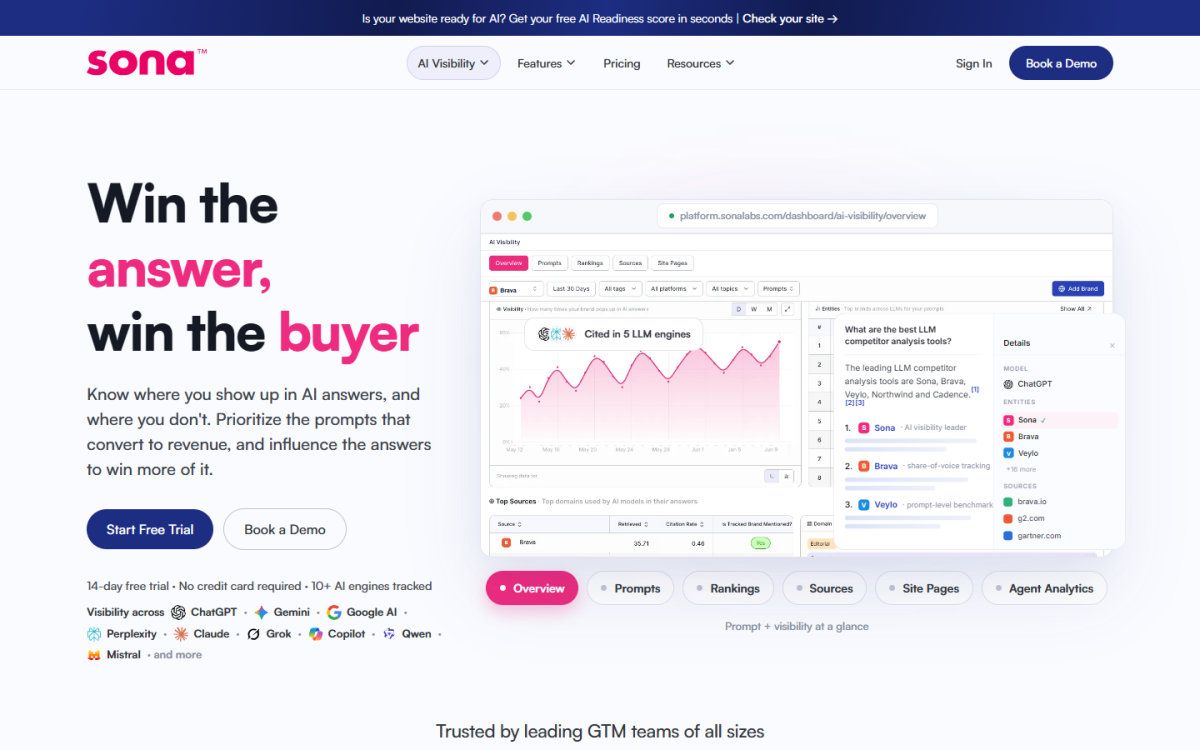
| Sona AI Visibility | From $75/month, billed annually | Yes | 11 | ChatGPT, Gemini, Google AI Mode, Google AI Overviews, Perplexity, Claude, DeepSeek, Grok, Copilot, Qwen, Mistral | 5,000 credits/month, about 166 daily tracked prompts on one model or 56 across three | $0.45 per daily tracked prompt | Connects AI citations and prompts to pipeline and revenue on one account timeline, and tracks AI crawler activity from server logs or a lightweight edge worker. |
| Peec AI | From $95/month | Yes | 3 | Not published | 50 prompts daily | $0.63 per daily tracked prompt | AI visibility tracking across self-serve answer engines. |
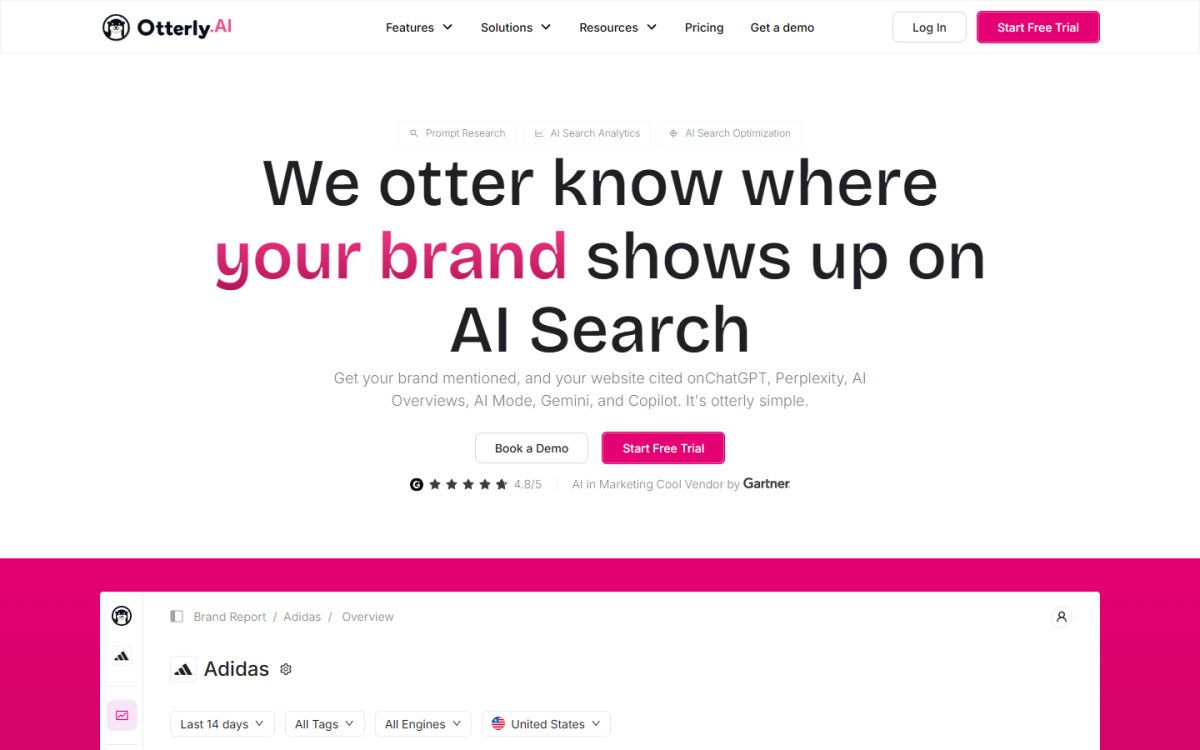
| Otterly.ai | From $29/month | Yes | 4 | ChatGPT, Google AI Overviews, Perplexity, Microsoft Copilot | 15 prompts daily | $0.48 per daily tracked prompt | Tracks brand and content appearance across Google AI Overviews and AI platforms. |
| Scrunch AI | From $250/month | Yes | 4 | ChatGPT, Perplexity, Google AI Overviews, Copilot | 125 prompts; frequency not stated | No refresh cadence published | AI answer monitoring across its Core-plan engine set. |
| AthenaHQ | From $295/month | Yes | 11 | Not published | 3,600 credits/month, unlimited prompts | No refresh cadence published | Credit-based AI response monitoring with an Essential free tier. |
Price comparisons need operating terms beside them. Sona AI Visibility starts from $75/month and includes 11 tracked answer engines, while Otterly.ai starts from $29/month with 15 daily prompts. A lower entry price can suit a narrow prompt list. Broader coverage matters when a team needs more topics, countries, projects, or commercial measurement.
Which metrics and plan limits should you compare when choosing an AI Overviews analysis tool?
Compare citation evidence, prompt coverage, refresh cadence, and geographic controls before comparing headline price. Core metrics include citation frequency, cited URLs, share of voice, brand mentions, mention sentiment, response position, and citation overlap with competing domains.
- Prompt coverage: Which commercial, informational, comparison, and branded prompts can the plan monitor?
- Engine coverage: Does the plan report Google AI Overviews separately from Google AI Mode, ChatGPT, Perplexity, Gemini, and other answer engines?
- Measurement controls: Can you fix country, device, project, and date range?
- History: Does the product retain full responses and cited URLs, or only a current score?
Headline prices do not reveal equivalent monitoring capacity. A plan with a small prompt allowance serves a different operating need from one that covers more prompts, engines, countries, or projects.
A single brand-level visibility number helps with triage, but it does not identify the work required. Sona AI Visibility connects AI citations and prompts to pipeline and revenue, then shows prompt-level performance and cited sources so a team can identify the query and page behind a gap.
How do AI Overviews analysis tools measure citations, prompt visibility and source selection?
AI Overviews analysis tools submit a tracked prompt on a schedule, store the returned response, extract cited URLs, detect brand mentions, and calculate visibility from repeated runs. Visibility is the share of captured answers where a brand, domain, or selected page appears.
- The tool runs a defined prompt for a specified country, device, and Google result format.
- The tool saves the full Google AI Overview response and records whether an Overview appeared.
- The tool extracts cited URLs and maps them to domains, pages, competitors, or content categories.
- The tool detects mentions of the tracked brand and measures its response position or citation presence.
- The tool compares source patterns across prompts to identify pages and domains selected more often.
Source comparison turns raw capture into content-gap analysis. If competitors receive citations for evaluation prompts, inspect the cited pages for topic coverage, evidence, structure, freshness, and the claim each page supports. The goal is to understand the evidence Google selected, not to copy a source.
A simulator or visualizer can help generate hypotheses because it models how content could appear in an LLM-like response. It does not reproduce Google’s live answer. Confirm simulator findings against captured Google AI Overviews because source selection, response structure, and citations change in live Search.
How reliable are AI Overviews measurements when results change by location, device and day?
An AI Overviews analyzer is reliable when it preserves the conditions of every run and makes volatility visible rather than hiding it inside one score. A credible record includes the prompt, date, location, device, engine, full response, cited URLs, and measurement history.
Google AI Overviews can differ by geography, device, query wording, personalization signals, retrieval updates, and changing result formats. A desktop result in one country is not automatically comparable with a mobile result elsewhere. Teams should fix measurement conditions for each prompt set before interpreting movement.
How common are AI Overviews across industries and devices? Prevalence varies by the industry-specific prompt cohort and the device conditions used for measurement. Calculate AI Overview appearance rate separately for each industry, desktop and mobile device, country, and query type: divide prompts that produced a Google AI Overview by all repeated captures in that defined cohort. Keep informational, comparison, branded, and purchase-intent prompts separate so the rate describes a coherent search set.
Track important prompts daily. Repeated daily captures show patterns that a weekly snapshot can obscure. A movement that persists across repeated runs merits investigation, while a one-day spike may reflect a retrieval update, model change, or newly published competitor page.
The output is a log, not merely a score. A dated visibility score is a snapshot, while repeated captures reveal whether citation gains or losses persist under the same measurement conditions. Use quarterly reviews for positioning and competitive analysis, but preserve daily prompt-level resolution for operational decisions.
How can you test an AI Overviews analyzer before you pay for it?
Test an AI Overviews analyzer with the same controlled prompt set across every trial, then compare its captures against live Google results over several days. A fair test scores answer capture, cited-URL extraction, brand detection, history, and geography controls rather than judging a product from one dashboard view.
- Build a fixed prompt set, such as 25 prompts split across awareness, consideration, decision, and purchase stages.
- Fix one geography, device type, language, and brand-detection rule.
- Run the same prompt set in each trial and retain every captured response.
- Manually check a sample of live Google results against stored responses and cited URLs.
- Repeat the comparison across several daily runs, then score capture accuracy, URL extraction, and brand detection.
Review articles require the same scrutiny. A claim that a reviewer tested 100 products means little without the prompt set, sample size, scoring rule, test date, geography, and volatility controls. A useful review states what was tested and what each score measured.
Free options can help with initial exploration, but they often restrict prompt volume, history, location control, or scheduled capture. A free AI readiness checker serves a different purpose: it assesses whether AI engines can crawl and parse a site through technical checks rather than measuring whether a brand appears in Google AI Overviews.
What is the step-by-step workflow for improving citations once an analyzer shows a gap?
Improve AI Overview citations by diagnosing the missing source relationship before changing content. The workflow is: identify the prompt gap, confirm technical eligibility, compare cited sources with your page, choose the right fix, and measure the result through repeated daily runs.
- Find prompts where competing domains are cited and your brand is absent.
- Check whether the relevant page is indexable, accessible to crawlers, canonicalized correctly, available in server-rendered HTML, and free from blocking robots.txt or other access controls.
- Compare the cited sources against your page for the question answered, supporting evidence, scope, structure, recency, and cited claims.
- Choose the gap type: improve an existing page, create a page for an uncovered prompt, or address an authority gap where external evidence favors other sources.
- Change one variable, then run the same prompt list daily and assess the result across repeated captures.
If no Google AI Overview appears, record the prompt as a no-Overview result and do not treat the absence as a citation gap. Continue repeated daily captures and use the cohort’s Overview appearance rate to determine whether the prompt reliably produces an answer.
If a Google AI Overview appears but the page is blocked or non-indexable, correct the relevant technical condition, including robots.txt, crawler access, canonicalization, rendering, or access controls. Use repeated captures of the same prompt to determine whether the page enters the cited-source set after the technical correction.
If competitors are cited while the page answers the wrong intent, revise the page or create a dedicated page that answers the prompt’s actual comparison, evaluation, or implementation question. Use repeated captures to determine whether the revised page begins appearing as a cited source for that prompt.
If the page matches intent but lacks supporting evidence, add the evidence, scope, structure, recency, and claim support that the cited sources provide. Use repeated captures to determine whether the page gains citation presence while the answer continues to appear.
If the page becomes cited but produces no commercial movement, retain the citation record and inspect AI-referred traffic, account activity, signups, opportunities, and closed-won deals. Use repeated captures to confirm that citation gains persist, then use the absence of corresponding account progression to reassess prompt intent and commercial relevance.
Keep technical diagnosis separate from content decisions. Test whether AI crawlers can access the page and identify whether robots.txt, a WAF response, rate limiting, or cloaking blocks retrieval. A blocked retrieval path requires a technical fix before content changes can affect citation evidence.
How do you tell whether AI Overviews citations lead to pipeline and revenue?
AI Overview citations lead to pipeline and revenue only when citation data is read alongside AI-referred traffic, account activity, signups, opportunities, and closed-won deals. A visibility increase without corresponding business outcomes is a discovery signal, not proof of commercial impact.
Most analyzers report mentions and citations. Sona AI Visibility connects prompts and citations to pipeline and revenue on one account timeline, while Agent Analytics tracks AI crawler and agent activity from server logs or a lightweight edge worker without a JavaScript tag. AI Attribution connects AI-referred activity to accounts, pipeline, and closed-won revenue.
Read visibility changes beside traffic and deal data. A citation gain on a high-intent comparison prompt deserves more attention than a gain on a broad educational prompt when associated accounts progress toward demos, opportunities, or revenue. Strong traffic with weak pipeline can indicate a prompt mix that creates attention without purchase intent.
What are the frequently asked questions?
Is there a free AI Overviews analyzer?
Some browser extensions and manual Google checks cost nothing, but free options often limit prompts, historical records, location controls, or scheduled monitoring. Before relying on a free option, check whether it stores full responses, cited URLs, dates, device settings, and country settings. A current-result view without history cannot distinguish a durable citation pattern from a one-day change.
Does ranking in Google’s top 10 mean my page will be cited in an AI Overview?
No. Organic rankings and Google AI Overviews citations are related signals, but they measure different selection systems. Track them separately because a well-ranked page is not automatically selected as a cited source.
Can an AI Overviews analyzer simulate what Google will show?
A simulator or visualizer can model how content could appear in an AI-generated response, but it cannot reproduce Google’s live answer. Use simulation to form content hypotheses, then validate those hypotheses against captured Google AI Overviews for the same prompt, location, device, and date.
How often should an AI Overviews analyzer check my prompts?
Run important and volatile prompts daily. Daily captures show whether movement persists through changes in retrieval, model behavior, and competitor publishing. Weekly checks suit a less urgent monitoring program, but each run should retain the date, location, device, response, and cited URLs so the trend remains comparable.
Do AI Overviews analyzers also cover AI Mode, ChatGPT and Perplexity?
Many platforms cover several answer engines, but plan coverage varies. Sona AI Visibility connects AI citations and prompts to pipeline and revenue while tracking Google AI Overviews, Google AI Mode, ChatGPT, Perplexity, and other answer engines. Check which engines appear at the entry tier and whether additional coverage changes price, prompt limits, or refresh cadence.
How many prompts do I need to monitor to get a useful picture?
Start with a fixed set that spans your primary topics, funnel stages, branded queries, comparisons, and high-value buyer questions. Expand the list after the first trend review. Compare plans by prompt allowance, engine coverage, geography, and checking frequency rather than headline price alone.
Summarize this article with AI: ChatGPT · Claude · Perplexity · Google AI Mode
Last updated: October 2026







