Intent insights in conversational conversion transform a buyer’s statements into a scored signal, such as problem awareness, comparison, or replacement, directing the next action while the conversation remains live. Teams that respond to these signals can qualify more quickly and follow up more relevantly. Published lift figures are largely vendor-reported and correlational, so view them as directional and test them with a holdout group.
What is the role of intent insights in conversational conversion?
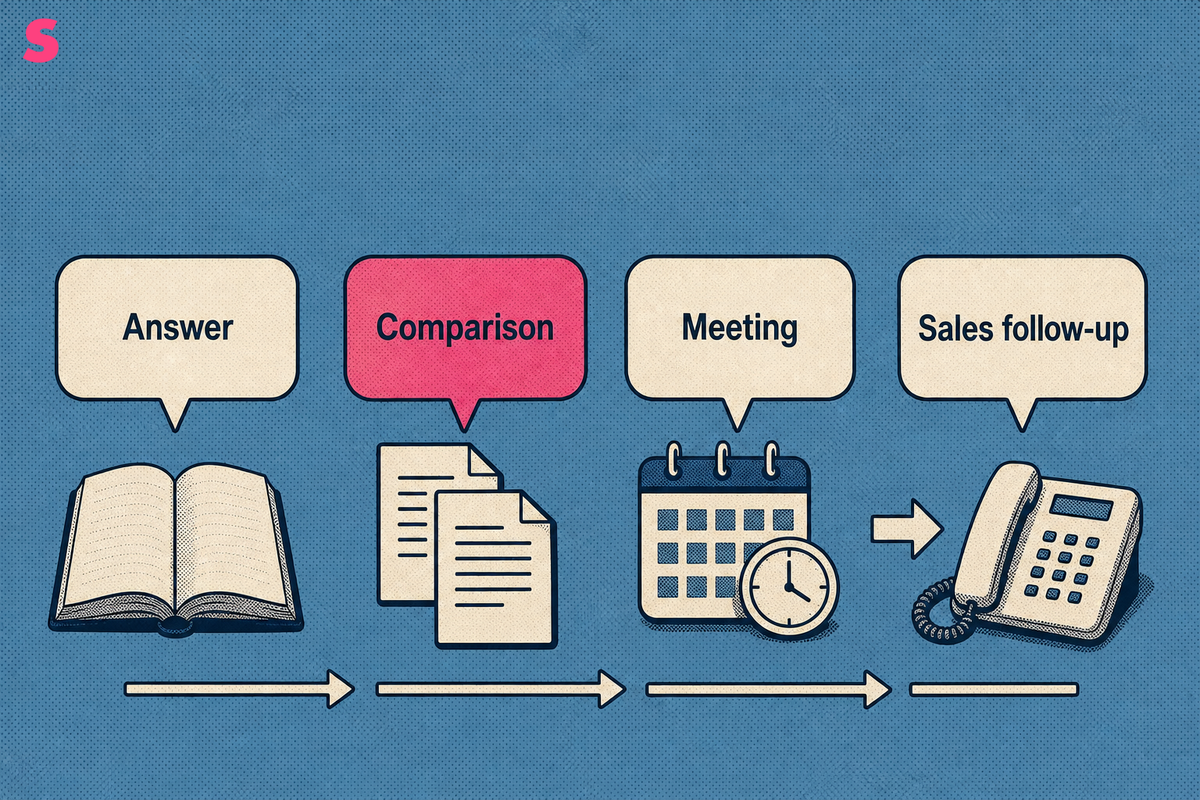
The role of intent insights in conversational conversion is to identify what a buyer is trying to accomplish from what they say, then select the next step. For a B2B SaaS team, that step may be an answer, a comparison, a meeting offer, or sales follow-up.
Intent explains why a buyer asks, not only what they ask. A question about integrations can signal early technical research, an active vendor evaluation, or a support request. The surrounding goal determines the appropriate response.
Conversational conversion moves a buyer one clear step closer to a purchase decision. Intent insights give marketing, sales, and conversational AI systems a basis for selecting that step rather than treating every chat, form response, or AI-referred visit as equivalent.
Sona AI Visibility connects AI citations and AI-referred visits to pipeline and revenue. Its inferred likely prompt behind an AI-referred visit provides adjacent post-click context, rather than a reading of live dialogue.
How do conversational intent insights differ from behavioral, firmographic and third-party intent data?
Conversational intent insights come from a buyer’s own words during an interaction. Behavioral data records actions such as page views, downloads, and return visits. Firmographic data describes the account, including company size and industry. Third-party intent data infers research activity across external sites.
Each signal answers a distinct question. Behavioral data shows what someone did. Firmographic data shows whether an account fits an ideal customer profile. Third-party topic-surge data can identify companies researching a subject before direct engagement. Conversational data reveals the immediate task the buyer wants to complete with your business.
- Conversational intent: stated needs, constraints, objections, priorities, and urgency.
- Behavioral intent: observed engagement with pages, product areas, or campaigns.
- Firmographic fit: account characteristics used for qualification and routing.
- Third-party intent: inferred external research signals before a buyer identifies themselves.
Conversational intent also differs from conversation analytics and conversation intelligence. Conversation Analytics automatically analyzes customer conversations to uncover intent, conversion barriers, and trends. Conversation intelligence analyzes conversations after they occur to identify patterns and customer needs. Real-time conversational intent detection changes the next interaction while the buyer remains engaged.
Cost creates another distinction. Third-party intent-data subscriptions were listed at roughly $30,000 to $100,000 per year in October 2026 listings, while enterprise ABM platforms were listed above $300,000 annually in the same October 2026 listings. Conversational intent can use first-party dialogue already collected in an owned chat, sales interaction, or product-assisted conversation.
Which conversational signals show problem awareness, comparison, replacement or purchase intent?
Conversational signals indicate buying stage when a team reads the buyer’s stated need alongside inferred context and observed behavior. Problem language signals awareness. Named alternatives, replacement language, timelines, and implementation questions signal later evaluation or purchase stages.
Intent insights improve conversion by identifying the barrier preventing progression, then selecting evidence or routing that removes the barrier. Common barriers include technical fit, migration risk, budget, timing, procurement, and unresolved objections. The appropriate next action depends on the barrier expressed in the conversation.
| Conversion barrier | Intent signal | Next action | Conversion effect |
|---|---|---|---|
| Technical fit | Integration or architecture questions | Provide technical documentation or route to a specialist | Reduces evaluation uncertainty |
| Migration risk | Replacement language and implementation concerns | Offer migration guidance and an implementation discussion | Advances replacement evaluation |
| Budget | Pricing, business-case, or contract questions | Provide relevant pricing context or commercial routing | Clarifies purchase feasibility |
| Timing or procurement | Deadline, approval, or purchasing-process language | Route to an accountable commercial owner | Reduces delay before a decision |
| Unresolved objections | Repeated concern about risk, proof, or alternatives | Present matched evidence or comparison material | Removes a stated reason not to progress |
A semantic analysis of 74,800 commercial Reddit inquiries from September to October 2026 classified 34.2% as problem exploration, 28.6% as architectural constraints, 22.4% as direct displacement, and 14.8% as objection validation. The split shows why a generic lead score can obscure the action a buyer needs next.
| Signal type | Example signal | Buying stage | Recommended action | Conversion outcome affected |
|---|---|---|---|---|
| Stated | How do we reduce attribution gaps? | Awareness | Answer the problem and offer relevant education | Qualified engagement |
| Inferred | Repeated questions about implementation constraints | Consideration | Provide technical documentation or route to a specialist | Evaluation progress |
| Stated | We are replacing our current platform this quarter. | Decision | Route to an account owner with replacement guidance | Meeting acceptance |
| Behavioral | Pricing-page return after a comparison conversation | Purchase | Offer a meeting or procurement response | Lead-to-opportunity rate |
Intent remains probabilistic. A question about a competitor can reflect market research, customer support, academic interest, or an active evaluation. Teams should use supporting evidence rather than treating one signal as proof that a buyer is ready for sales.
How does raw dialogue become a confidence-scored intent signal?
Raw dialogue becomes an intent signal when a system identifies the buyer’s goal, buying stage, constraint, and urgency, then assigns confidence to that interpretation. The output should specify one recommended next step, not an opaque label that sales and marketing cannot act upon.
AI prompts average 15–23 words, according to an August to October 2026 listing. That length can provide more commercial context than a short keyword. A buyer asking whether they can replace an attribution tool before renewal without losing Salesforce history has disclosed a goal, replacement context, a technical constraint, and a timeline.
- Read the message for the buyer’s goal, such as learning, comparing, replacing, or purchasing.
- Identify evidence of stage, including alternatives, budget, urgency, technical requirements, or procurement language.
- Assign a confidence score based on how directly the message supports the interpretation.
- Choose one action, such as answer the question, show a comparison, offer a technical review, or route to sales.
In the example, replacement intent could receive high confidence because the buyer names renewal timing and migration risk. A message asking about Salesforce integration has lower confidence because it could reflect early research or active evaluation. Low-confidence cases need a clarifying question about whether the buyer is assessing a current project or exploring future options.
How can a team surface intent insights in real time during a conversation?
A team surfaces conversational intent in real time by processing each message during the exchange, classifying the buyer’s stage, scoring confidence, and triggering one next step. After-the-fact analysis can improve coaching and reporting, but it cannot change the response the buyer receives during the conversation.
The operating sequence requires disciplined handoffs. Capture the message, identify its commercial meaning, select one response, and record the signal in the buyer record. The system should avoid presenting five offers at once. One relevant next step reduces friction.
- Capture each buyer message with conversation context.
- Classify the message as awareness, consideration, decision, or purchase intent.
- Score confidence and identify the strongest supporting evidence.
- Trigger an answer, a comparison, specialist routing, or a meeting invitation.
A short exchange shows the shift. A buyer first asks whether the platform supports multi-touch attribution. The system answers the product question. The buyer then explains that their team needs to replace its current model before the Q4 planning cycle. The conversation has moved from general research to replacement evaluation, so the next response should offer an implementation discussion rather than another generic article.
Speed and handoff quality both matter. An instant response that ignores account context creates noise, while a slow sales handoff loses an engaged buyer. Teams should use immediate automated responses for clear factual questions, then route high-confidence replacement, comparison, timeline, budget, and objection signals to a person with relevant context.
How should intent signals connect to CRM, lead scoring, routing and personalization?
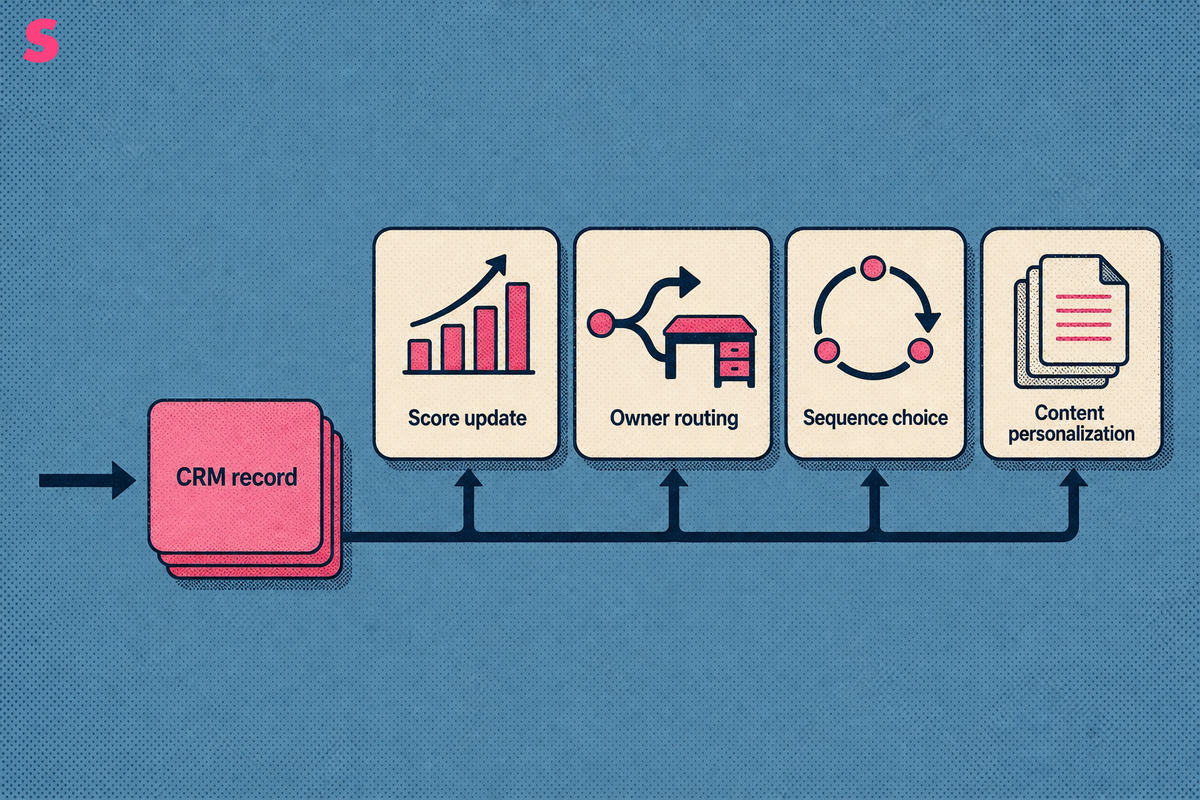
Intent signals should update the CRM record, change lead score, select an appropriate sequence, route the owner, and personalize the next asset or conversation. The value comes from connecting an interpreted buyer statement to a workflow that sales and marketing can execute.
- Score update: add weight for replacement language, urgency, evaluation criteria, or procurement questions.
- Owner routing: send high-confidence decision or purchase signals to the correct account owner.
- Sequence choice: use problem education for awareness and comparison material for evaluation.
- Content personalization: present technical, implementation, or business-case material that matches the stated constraint.
AI-scored leads reportedly convert about 2× faster than manually scored leads, predictive lead scoring reportedly improves conversions by 30–40%, and content personalization reportedly raises engagement by 2–3×, per globenewswire.com, October 2026. Those figures describe reported outcomes, not a guarantee for every prompt set, sales motion, or CRM design.
Sona Marketing Measurement treats AI search as a measurable channel alongside other channels, while Sona AI Visibility connects AI citations and AI-referred visits to accounts, pipeline, and closed-won revenue. Its Intent Signals feature infers the likely prompt behind an AI-referred visit and assigns an account-level intent score, giving CRM workflows a basis for prioritization.
Which metrics show whether intent insights are improving qualification and conversion?
Intent insights are improving qualification and conversion when more leads progress, buyers resolve objections faster, and more relevant follow-up is accepted. Teams should measure these outcomes by intent cohort and compare them with a standard experience during the same period.
- Qualification rate: qualified leads divided by leads receiving conversational follow-up. An increase indicates that routing and response selection are identifying more viable demand.
- Objection resolution speed: time from a stated objection to a resolved next step. A reduction indicates that buyers receive relevant evidence sooner.
- Follow-up acceptance: accepted meetings or replies divided by relevant offers. An increase indicates that the offer matches the buyer’s stage.
- Lead-to-opportunity rate: leads that become opportunities divided by qualified leads. An increase indicates stronger handoff quality.
Companies using intent data reported a 4× increase in lead-to-opportunity conversion rates compared with traditional methods in an October 2026 listing. Treat that as a directional benchmark. The useful internal question is whether a defined intent cohort outperforms a comparable cohort receiving the existing qualification process.
For AI-assisted research, Sona AI Visibility can connect citations and AI-referred visits to pipeline and revenue on one account timeline. That connection lets a team assess whether a prompt category generated commercial progression rather than interaction volume alone.
Does the evidence prove that intent insights cause higher conversion?
No, the available evidence does not prove that intent insights cause higher conversion. High-intent buyers can convert at higher rates because they were already closer to a decision. A credible program separates correlation from incremental impact with a comparable control group.
A 2026 cohort analysis across 2,400 B2B accounts found that intent-sourced leads closed at 18.7%, versus 5.5% for cold ICP-match outreach, per digitalapplied.com, October 2026. Conversational intent signals also showed a 16.8% qualified-pipeline rate versus 2.1% for cold outreach triggered by anonymous IP surges across 24,800 CRM opportunities in an October 2026 listing.
Those comparisons are directional because methodology can remain undisclosed. A team needs the prompt set, control design, sample rules, scoring thresholds, routing rules, attribution window, and opportunity definition before treating a reported lift as causal. The 4× lead-to-opportunity claim in an October 2026 listing has the same limitation.
Run a holdout test instead. Randomly assign comparable eligible conversations or accounts to an intent-informed experience and a standard experience. Keep channel, offer, routing coverage, and measurement period consistent. Compare qualification rate, meeting acceptance, and lead-to-opportunity rate after sufficient volume has accumulated.
How can teams use conversational intent without feeling invasive or breaking privacy limits?
Teams can use conversational intent responsibly by limiting analysis to disclosed interactions they own, acting on the buyer’s stated need, and avoiding language that reveals hidden inferences. Useful personalization responds to the conversation. Invasive personalization exposes assumptions about the buyer.
In an owned chat, demo request, sales conversation, or product interaction, a team can use the information the buyer provides to answer questions, route the conversation, and record a clear next step. Consent and notice should match the organization’s data practices. A team should not imply certainty about a buyer’s budget, seniority, or internal plans when those details were inferred rather than stated.
Third-party AI platforms create a different boundary from an owned conversation. First-party dialogue is available to the business that collects it, while aggregate platform signals do not provide the underlying dialogue. Teams should distinguish between those sources when defining consent, access, and personalization practices.
Monitoring which AI answers mention a brand is only half the job. Sona AI Visibility closes the other loop by connecting AI citations and AI-referred visits to accounts, pipeline, and revenue, so visibility can be evaluated as a measurable channel rather than a standalone mention count.
Frequently Asked Questions
What are intent insights in a conversation?
Intent insights are a scored reading of what a buyer is trying to do, based on what they say. A buyer can be exploring a problem, comparing options, replacing an existing tool, validating an objection, or preparing to purchase. The score expresses confidence in that interpretation and guides the next response.
How are conversational intent insights different from third-party intent data?
Third-party intent data infers interest from research activity across the web. Conversational intent comes from the buyer’s own words in an interaction with your business, making it current, stated, and specific to the question, concern, or purchase task at hand.
What is the difference between conversation intelligence and real-time intent detection?
Conversation intelligence reviews conversations after they end to identify patterns, coaching opportunities, and recurring needs. Real-time intent detection reads each message as it arrives and changes the next step while the buyer remains engaged, such as offering a comparison or routing a replacement evaluation to sales.
Which intent signals should trigger a handoff to sales?
Replacement language, named alternatives, timelines, budget statements, implementation questions, and objection validation are strong handoff candidates. These signals indicate evaluation or purchase stage because the buyer has moved beyond broad problem education and needs an accountable commercial or technical response.
How do you know whether intent insights caused a conversion lift?
Hold out a comparable group that receives the standard experience, then compare qualification rate, follow-up acceptance, and lead-to-opportunity rate between groups during the same period. Keep eligibility rules, routing coverage, offer, and attribution window consistent so the test measures the impact of the intent-informed experience.
Is it a privacy problem to infer buyer intent from conversations?
Privacy depends on consent and on whose conversation is being analyzed. Use data from interactions your organization owns and has disclosed, then respond to the buyer’s expressed need without exposing inferred details such as budget, role, or internal priorities to that buyer.
Summarize this article with AI: ChatGPT · Claude · Perplexity · Google AI Mode
Last updated: October 2026