The best HockeyStack alternatives vary by the need you are replacing: revenue attribution, account intelligence, or enterprise intent and ABM. Costs range from inexpensive monthly plans to custom enterprise agreements, so assess what each platform tracks before evaluating price. Many of these tools overlap only partially, and changing platforms requires integration and reporting reconstruction work that published prices do not show. Use the comparison table and problem-to-solution map to narrow the list to two or three. If revenue attribution is what you are replacing, Sona Marketing Measurement connects every channel, AI search included, to accounts, pipeline and revenue on one identity graph.
Why do B2B teams look for HockeyStack alternatives?
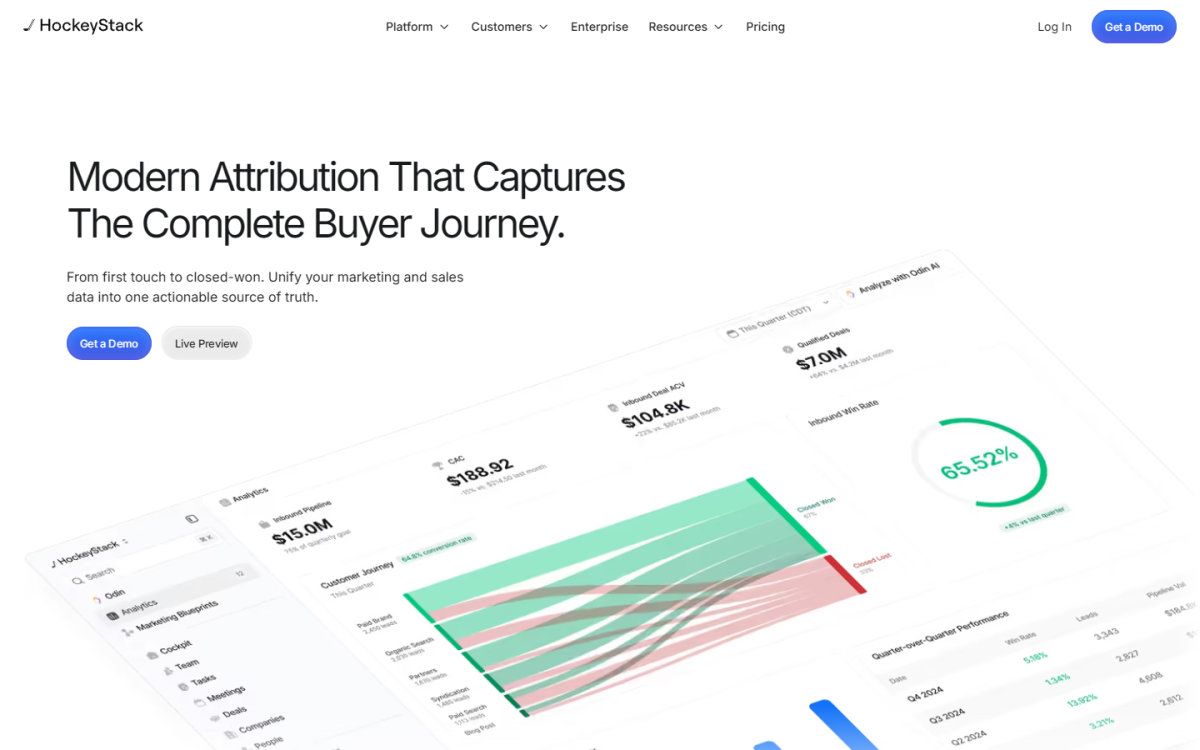
HockeyStack is often replaced when its commercial model, company-level identification, or broad analytics scope no longer matches the measurement requirement. Teams evaluating HockeyStack competitors may need to separate revenue attribution from product analytics, account intelligence, or enterprise ABM orchestration.
- Entry price. HockeyStack has no published price as of November 2026; pricing requires a demo request.
- Identification depth. HockeyStack identifies companies rather than individual contacts, as of November 2026.
- Platform scope. HockeyStack bundles attribution, product analytics, and revenue tracking in one platform, as of November 2026. That scope can exceed the needs of teams buying a focused attribution layer.
- Pipeline activation. Teams reporting pipeline and revenue back to ad platforms need attribution, CRM sync, and conversion activation.
Requirements vary by operating model. A Salesforce-governed marketing operations team has different needs from a demand generation team that requires account-level engagement signals or a revenue team that needs paid-media conversion feedback.
AI search adds another measurement challenge. Buyers may research through AI answers before visiting a website, then return through branded search or direct traffic. Click-only reports can classify that journey as direct or none, although AI search influenced the account before an opportunity existed.
Which HockeyStack alternatives fit which team, and what do they cost?
HockeyStack alternatives include attribution and activation platforms, account analytics products, Salesforce-centered measurement systems, and enterprise intent platforms. The table compares each product by its primary use case, supported integrations, and publicly available starting prices as of November 2026.
| Tool | Best for | CRM and ad-platform integrations | Starting price as of November 2026 |
|---|---|---|---|
| Sona Marketing Measurement | AI-native marketing measurement, identity resolution, attribution, and intent activation | HubSpot and Salesforce sync, plus first-party conversions to Google Ads, LinkedIn Ads, Meta Ads, Microsoft Ads, and ChatGPT Ads | Cross-channel attribution on Enterprise, custom pricing; Growth $599/month billed annually |
| Dreamdata | B2B revenue attribution and customer-journey modeling | HubSpot and Salesforce, plus conversion and pipeline sync to LinkedIn, Google, Meta, Microsoft, and OpenAI Ads | Free plan at $0/month, Advanced at custom pricing |
| Factors.ai | Account analytics and B2B advertising optimization | HubSpot and Salesforce data ingestion, LinkedIn Ads, Google Ads, Meta Ads, and conversion sending to LinkedIn and Google Ads | Lite at $199/month |
| Adobe Marketo Measure | Salesforce-governed multi-touch attribution and marketing ROI reporting | Paid-media touchpoint collection for LinkedIn and Google | Custom pricing |
| 6sense | Enterprise intent data, buying signals, and ABM orchestration | Enterprise integrations are configured through a custom deployment | Not included in this pricing comparison |
| CaliberMind | B2B revenue analytics, segmentation, and engagement scoring | HubSpot and Salesforce write-back, LinkedIn, Google Ads, Meta, plus audience sync to Google Ads and LinkedIn | Custom pricing |
| Usermaven | Web and product analytics with multi-touch attribution | HubSpot and Salesforce data ingestion, plus Google Ads, Meta Ads, LinkedIn Ads, and Microsoft Ads | No published price for Business; Enterprise uses custom pricing |
| HubSpot | Attribution reporting inside an existing HubSpot CRM and Marketing Hub deployment | Native HubSpot CRM context and Marketing Hub reporting | Marketing Hub Enterprise at $3,600/month, plus a one-time $7,000 onboarding fee |
Lower-cost entry points serve narrower jobs. Factors.ai begins at $199 per month, as of November 2026. HubSpot Marketing Hub Professional is $800 per month with an annual commitment, while Marketing Hub Enterprise is $3,600 per month, as of November 2026.
Price does not establish fit. A lower entry plan may cover account analytics or reporting while placing multi-touch attribution, conversion activation, or enterprise governance on a higher tier.
What are the 8 best HockeyStack alternatives for B2B revenue teams?
The best HockeyStack alternative replaces the job your team needs, whether that job is pipeline attribution, account analytics, Salesforce governance, or enterprise ABM. These eight options are organized by operating model rather than a universal ranking.
Sona Marketing Measurement: best for pipeline and revenue attribution across ad platforms and CRM
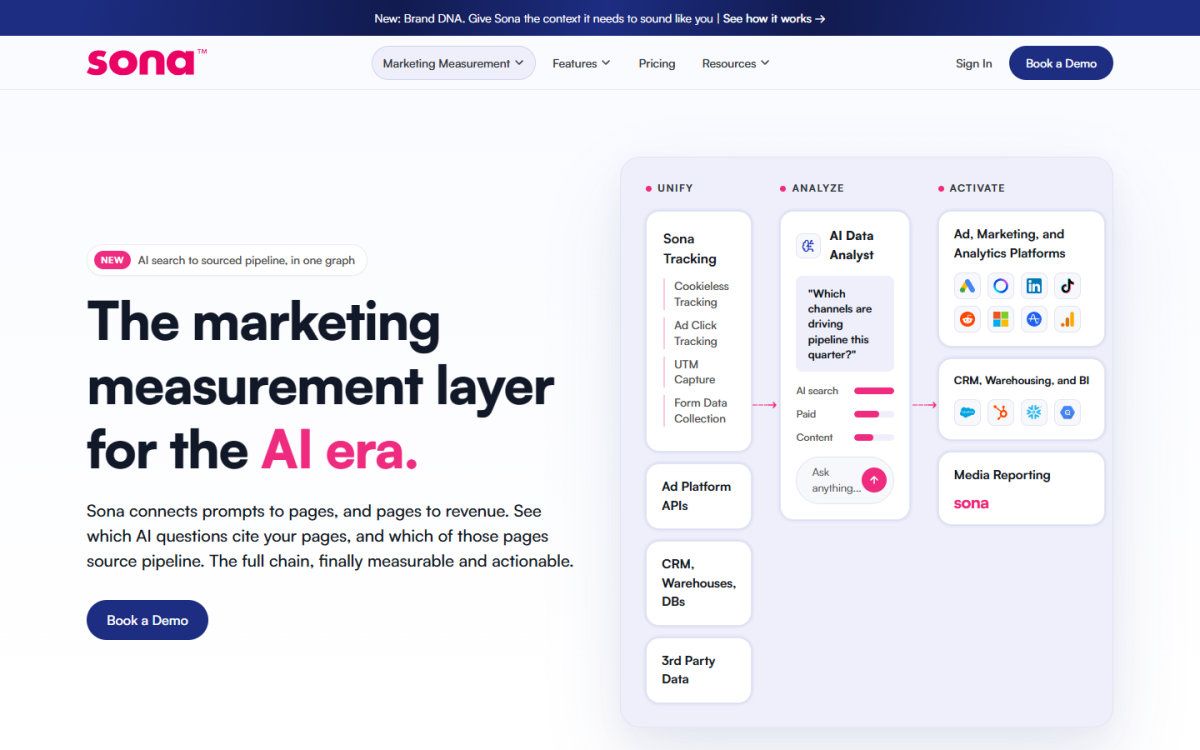
Sona Marketing Measurement serves teams that need AI search, paid media, content, email, and sales activity measured in one identity graph. It resolves anonymous and known traffic at account and person level, supports buyer journeys, and credits influence by stage transition rather than last click. Enterprise includes cross-channel attribution, incrementality testing, and warehouse sync.
Cross-channel attribution is on Enterprise, with custom pricing. Growth costs $599 per month billed annually, or $749 per month billed monthly, as of November 2026, and includes identity resolution, Account360 and Profile360 journeys, intent activation, audiences, API access, and MCP access.
Sona Marketing Measurement fits B2B teams that need contact-level and account-level measurement, CRM sync, and ad-platform conversion activation. Deployment requires a lightweight script, CRM connections, destination setup, and attribution configuration for Enterprise deployments.
Dreamdata: best for B2B revenue attribution and customer-journey modeling
Dreamdata focuses on B2B revenue attribution, customer journeys, and activation across marketing and sales data. It suits teams whose central question is how channels and touches influenced pipeline.
Dreamdata has a Free plan at $0 per month for five seats and two months of user history, as of November 2026. Advanced, which includes attribution and activation, uses custom pricing. A guided free trial is available for Advanced.
Dreamdata suits revenue teams that want journey modeling across HubSpot or Salesforce and paid-media destinations. Migration involves connecting CRM data, mapping lifecycle stages, importing channel data, and defining attribution reporting for the existing pipeline model.
Factors.ai: best for mid-market account analytics and LinkedIn optimization
Factors.ai focuses on account analytics, website engagement, and advertising optimization for B2B teams. It suits teams that need account-level visibility and use LinkedIn, Google Ads, and Meta advertising for demand generation.
Factors.ai Lite costs $199 per month after a free trial, as of November 2026. Basic costs $6,000 a year. Growth and Enterprise use custom pricing, while advanced attribution is sold as an add-on with no published price.
Factors.ai suits mid-market teams that want account activity linked to paid-media action. Migration involves deploying tracking, connecting HubSpot or Salesforce as a data source, integrating ad accounts, and configuring LinkedIn Conversions API or Google Enhanced Conversions workflows.
Adobe Marketo Measure: best for mature Salesforce-governed attribution
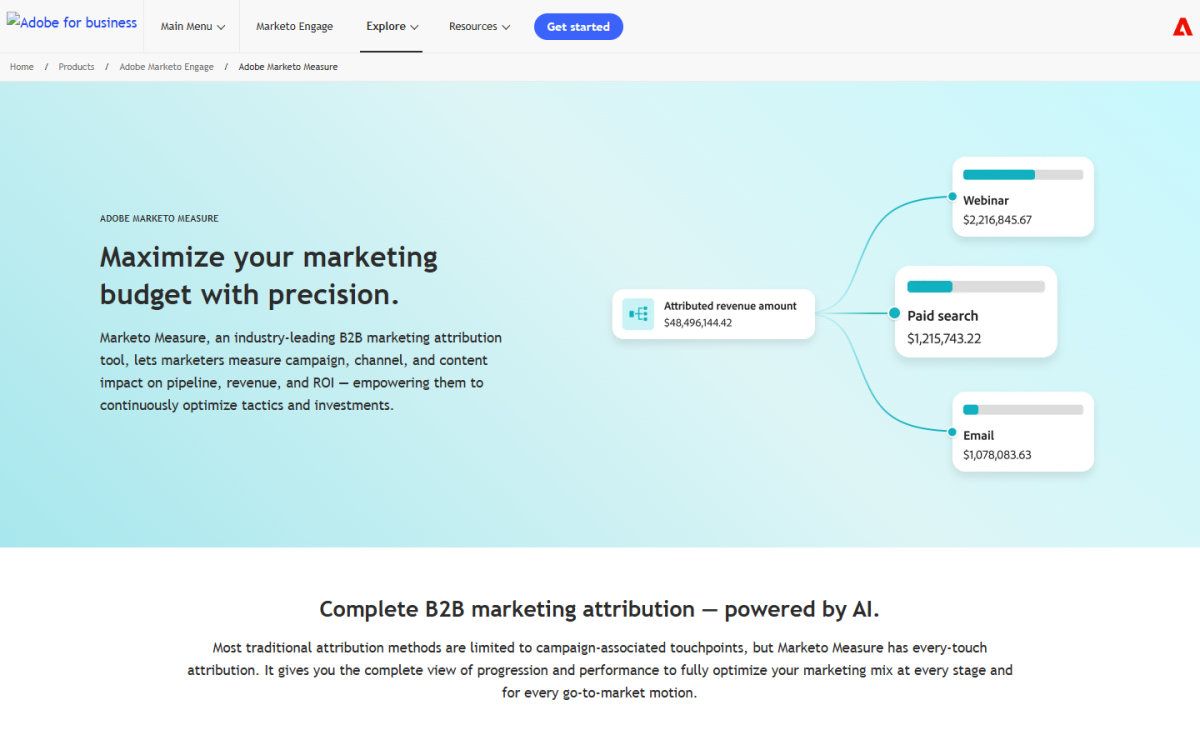
Adobe Marketo Measure, formerly Bizible, focuses on multi-touch attribution and marketing ROI reporting in Salesforce-centered organizations. It suits teams with established Salesforce processes, formal campaign structures, and shared ownership across marketing operations and revenue operations.
Adobe Marketo Measure uses custom pricing, as of November 2026. Its product information describes paid-media touchpoint collection for channels such as LinkedIn and Google.
Adobe Marketo Measure suits mature organizations where Salesforce is the primary system of record for marketing and opportunity reporting. Migration requires Salesforce configuration, campaign governance, touchpoint mapping, and stakeholder alignment around attribution models.
6sense: best for enterprise intent data, buying signals, and ABM orchestration
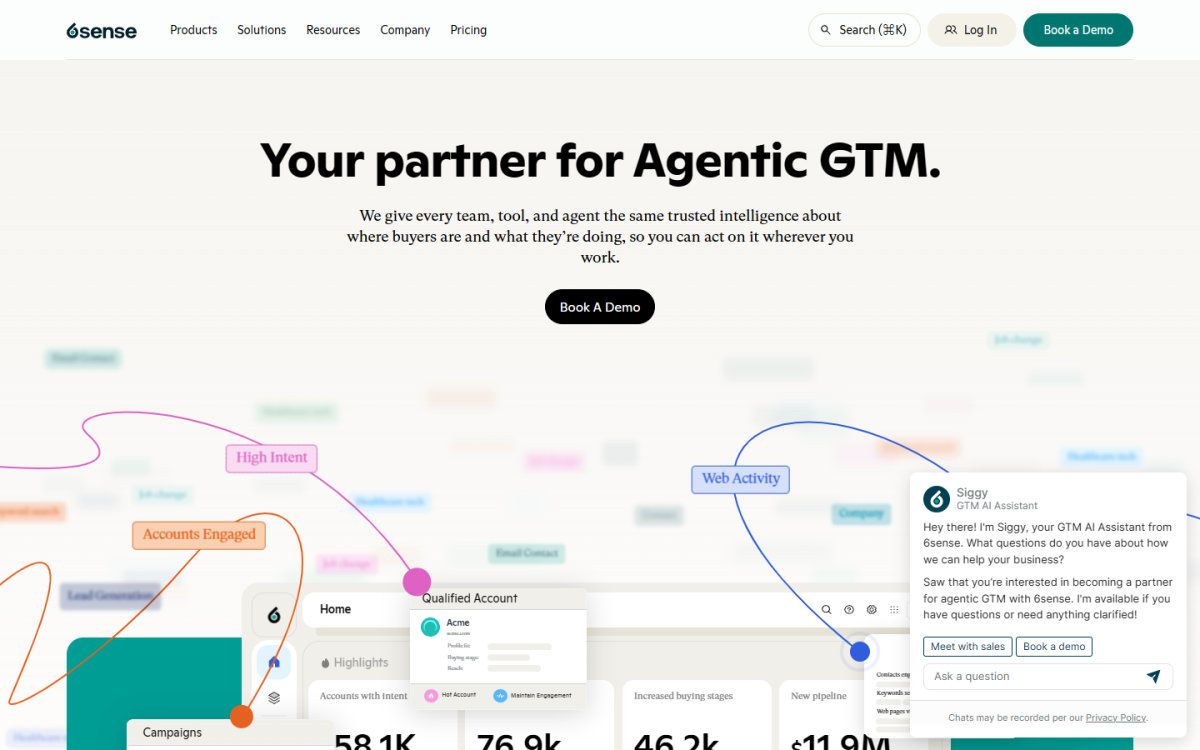
6sense focuses on identifying and engaging buying teams at enterprise scale through intent data, account signals, and ABM orchestration. It suits revenue teams that need account prioritization and coordinated engagement.
6sense suits enterprise ABM programs with defined account segments, coordinated sales development motions, and formal account engagement plays. Migration requires account segmentation, intent-signal configuration, CRM alignment, campaign orchestration, and operating rules for sales and marketing responses to account activity.
CaliberMind: best for B2B revenue analytics and segmentation
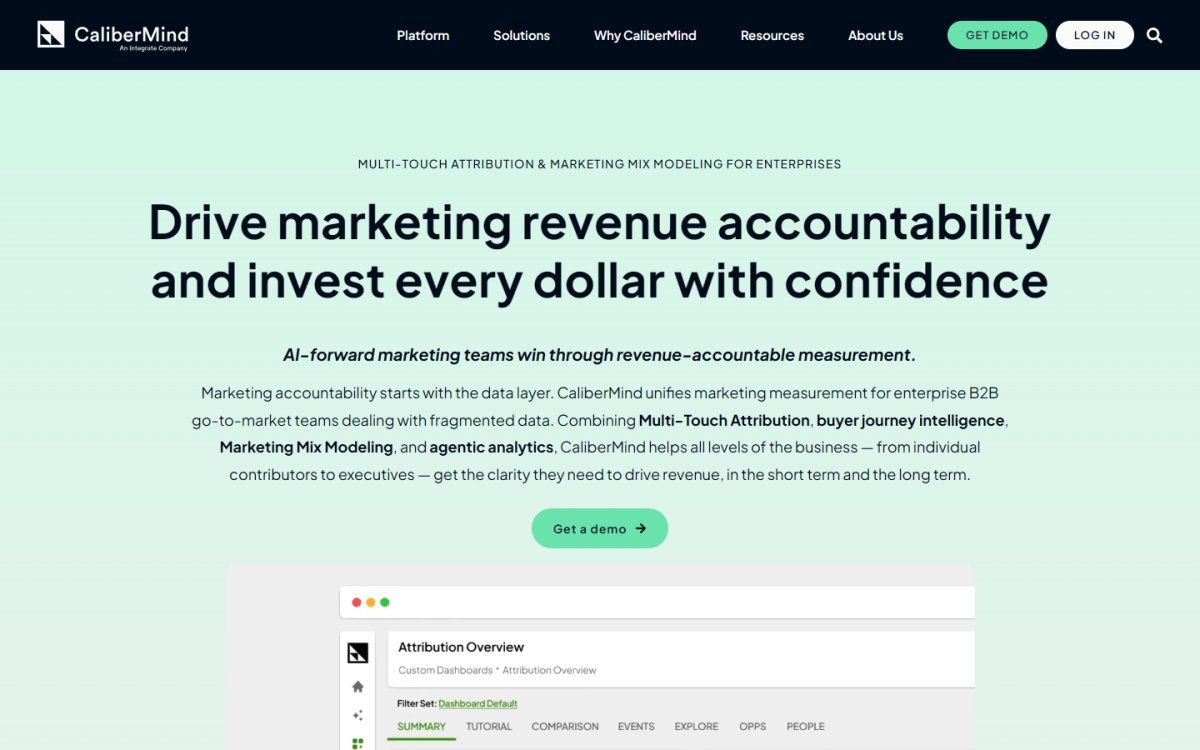
CaliberMind focuses on B2B revenue analytics, segmentation, engagement scoring, and CRM activation. It writes attribution data and engagement scores into CRM fields while supporting audience activation across advertising platforms.
CaliberMind uses custom pricing, as of November 2026. The platform is quoted through a demo-based sales process.
CaliberMind suits teams that want segmentation and measurement connected to HubSpot or Salesforce. Migration requires CRM field mapping, attribution definitions, engagement-scoring logic, paid-media data connections, and audience synchronization rules for LinkedIn and Google Ads.
Usermaven: best for web and product analytics with attribution
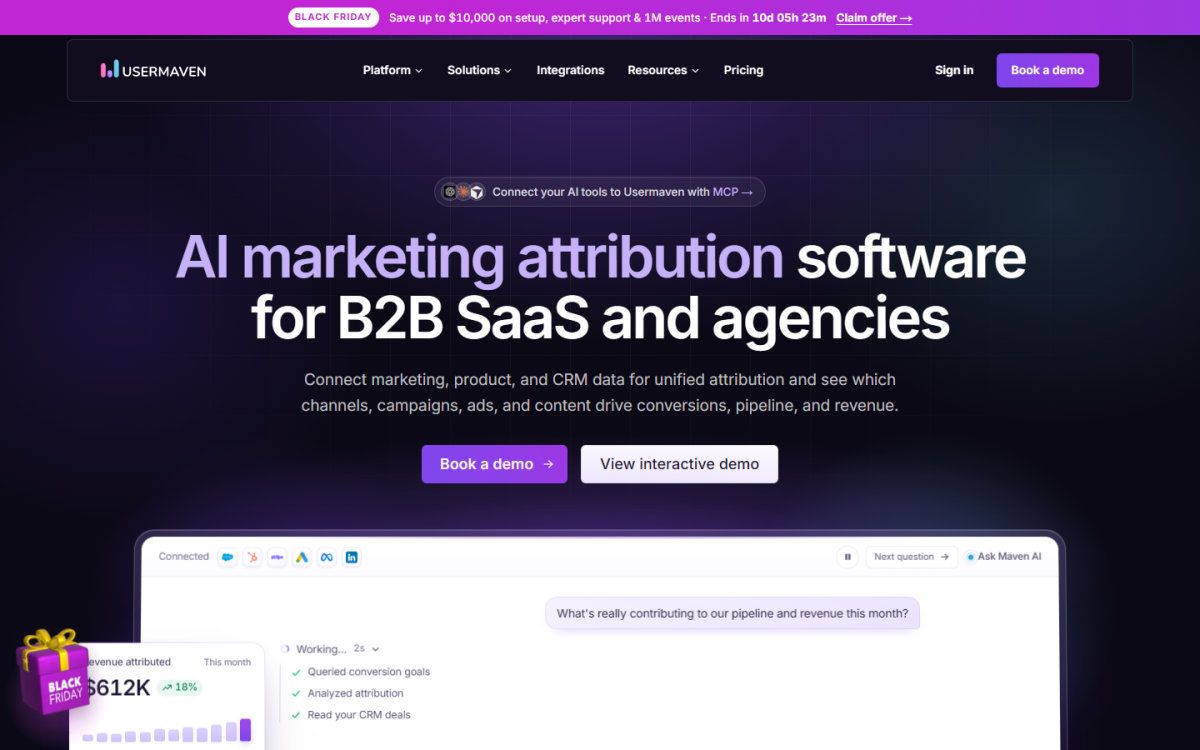
Usermaven combines web analytics, product analytics, and multi-touch attribution for teams that need a broader behavioral analytics view. It supports site and product reporting while retaining attribution context for marketing and CRM outcomes.
No published price is available for the Usermaven Business plan; Enterprise uses custom pricing, as of November 2026. Multi-touch attribution is available in the Business plan.
Usermaven suits teams that want marketing and product behavior in a shared reporting environment. Migration involves implementing tracking, connecting HubSpot or Salesforce outcome data, connecting advertising accounts, and rebuilding dashboards around web, product, and revenue events.
HubSpot: best for attribution inside an existing HubSpot CRM deployment

HubSpot offers attribution reporting within Marketing Hub for teams already operating their CRM, forms, campaigns, and lifecycle stages in the same system. It supports native reporting within an established HubSpot operating model.
Customizable attribution reports are available in Marketing Hub Professional at $800 per month with an annual commitment, as of November 2026. Multi-touch revenue attribution is available in Marketing Hub Enterprise at $3,600 per month for five core seats, plus a one-time $7,000 onboarding fee.
HubSpot suits teams with disciplined CRM data and existing HubSpot ownership. Migration involves standardizing lifecycle stages, campaign naming, source properties, form tracking, and reporting definitions before rebuilding historical dashboards.
How do the leading B2B attribution platforms compare side by side with HockeyStack?
| Tool | Primary use case | Identity level | CRM connections | Ad-platform conversion feedback | Attribution availability | Published pricing status |
|---|---|---|---|---|---|---|
| Sona Marketing Measurement | AI-native marketing measurement, identity resolution, and intent activation | Account and person level | HubSpot and Salesforce sync | First-party conversions to Google Ads, LinkedIn Ads, Meta Ads, Microsoft Ads, and ChatGPT Ads | Cross-channel attribution on Enterprise | Cross-channel attribution on Enterprise, custom pricing; Growth $599/month billed annually |
| HockeyStack | Attribution, product analytics, and revenue tracking | Company level | HubSpot and Salesforce, with bidirectional CRM sync | Pushes conversion and attribution data to ad platforms | Available within its broader analytics platform | No published price; demo request required |
| Dreamdata | B2B revenue attribution and customer-journey modeling | Company level | HubSpot and Salesforce | Conversion and pipeline sync to LinkedIn, Google, Meta, Microsoft, and OpenAI Ads | Advanced plan | Free plan at $0/month; Advanced custom pricing |
| Factors.ai | Account analytics and B2B advertising optimization | Company level | HubSpot and Salesforce data ingestion | Conversions to LinkedIn and Google Ads | Advanced attribution add-on | Lite at $199/month; Basic at $6,000 a year |
| Adobe Marketo Measure | Salesforce-governed multi-touch attribution and marketing ROI reporting | Not stated | Not stated on the product page | Not stated on the product page | Multi-touch attribution | Custom pricing |
Which HockeyStack limitations does each alternative actually solve?
HockeyStack alternatives address distinct operating problems rather than one generic dissatisfaction. The practical question is which operating constraint matters most and what trade-off accompanies the replacement.
- Company-level identity. Sona Marketing Measurement addresses teams that need account and person-level profiles through identity resolution. The condition is that cross-channel attribution requires Enterprise.
- Broad bundled analytics scope. Dreamdata addresses teams that want B2B revenue attribution and customer-journey modeling as the central measurement job. The trade-off is a focused revenue-measurement deployment rather than a combined product analytics environment.
- Published entry pricing. Factors.ai addresses teams centered on account analytics and advertising optimization with Lite at $199 per month, as of November 2026. Advanced attribution is an add-on with no published price.
- Less formal Salesforce governance. Adobe Marketo Measure addresses organizations that require Salesforce-centered attribution and marketing ROI reporting. The condition is a more complex implementation model than HockeyStack's one-code onboarding.
- Revenue measurement rather than ABM orchestration. 6sense addresses enterprise teams that need intent data, buying signals, account prioritization, and coordinated engagement. The trade-off is a primary focus on ABM operations rather than revenue attribution.
- Limited CRM segmentation and field activation. CaliberMind addresses teams that need revenue analytics, segmentation, engagement scoring, and attribution data written into CRM fields. The condition is a demo-based commercial process.
- Company-level reporting rather than shared web and product analysis. Usermaven addresses teams that need web analytics, product analytics, and multi-touch attribution in shared reporting. Multi-touch attribution is available in the Business plan, while Enterprise uses custom pricing.
- Reporting outside the existing CRM. HubSpot addresses teams that need attribution reporting inside an established HubSpot CRM and Marketing Hub deployment. Multi-touch revenue attribution is available in Marketing Hub Enterprise.
Company-level identification fits account-based reporting, but it changes the questions a platform can answer. Teams that need person-level profiles should define their identity resolution standard before comparing dashboards or attribution models.
When is an enterprise ABM and intent platform a better choice than HockeyStack?
An enterprise ABM and intent platform fits when the central job is finding, prioritizing, and engaging target accounts at scale. HockeyStack measures which marketing activities drove revenue, while 6sense focuses on enterprise intent, buying signals, and account orchestration.
Enterprise ABM and intent platforms identify and target accounts, while HockeyStack measures revenue influence. Account selection, targeting, and engagement programs may therefore require an ABM platform alongside an attribution system.
An ABM platform answers which accounts appear active and how to engage them. A revenue attribution platform answers which marketing activities influenced opportunities and closed-won revenue. The two systems can operate as complements.
Procurement should evaluate account coverage, CRM workflows, sales adoption, audience activation, and measurement requirements before treating an intent platform as a direct replacement.
How does HockeyStack compare with the older Salesforce-centered attribution tools?
HockeyStack uses one website code for onboarding, while Adobe Marketo Measure has a more complex implementation model. The implementation models reflect different operational requirements for teams evaluating revenue attribution and Salesforce governance.
HockeyStack combines cookieless fingerprinting and cookie-based tracking across multiple touchpoints. That model suits teams that want a broad analytics layer spanning attribution, product behavior, and revenue tracking.
Adobe Marketo Measure suits mature Salesforce-governed attribution and marketing ROI reporting. Teams with established Salesforce campaign governance, formal attribution ownership, and long-lived reporting requirements often favor a Salesforce-centered implementation.
Implementation complexity affects more than technical deployment. It shapes campaign taxonomy, opportunity-stage definitions, historical reporting, ownership between marketing operations and RevOps, and the time required before leaders trust the numbers.
What does HockeyStack still do better than its alternatives?
HockeyStack remains a fit for teams that want one-code onboarding and a single platform for attribution, product analytics, and revenue tracking. Its combination of cookieless fingerprinting and cookie-based tracking supports broad touchpoint tracking without a separate product analytics deployment.
HockeyStack works well when a team prefers one reporting environment for marketing activity, product behavior, and revenue outcomes. That scope can reduce tool sprawl for organizations that need all three functions.
HockeyStack can also complement another system. A team can retain HockeyStack for revenue measurement while adding an enterprise intent platform for account engagement or using a CRM-centered system for governed attribution processes.
The decision should follow the required job. Replacing HockeyStack makes sense when attribution depth, identity resolution, activation, governance, or commercial structure creates a material operational gap.
How should you choose a HockeyStack alternative, and what do price and review comparisons miss?
Choose a HockeyStack alternative by defining the job to replace before comparing feature lists. Key criteria include attribution scope, CRM and ad-platform integrations, identification depth, governance requirements, activation workflows, and price model.
- Define whether the priority is revenue attribution, account analytics, product analytics, enterprise intent, or CRM-native reporting.
- Confirm whether the platform works at company level, contact level, or both.
- Map required CRM fields, ad platforms, conversion destinations, and warehouse connections.
- Request a written quote that defines onboarding, usage limits, service scope, and contract terms.
- Estimate migration work for integrations, historical models, dashboards, lifecycle definitions, and workflows.
Third-party pricing estimates often differ from contract quotes, so written commercial terms matter more than comparison-page ranges. Review ratings reflect onboarding and support experience as well as analytical quality, making them an unreliable proxy for measurement fit.
Migration cost can exceed savings from a lower subscription price. Attribution data also contains gaps from dark social, offline activity, anonymous research, and incomplete CRM records. Treat ROI figures as directional until the team validates source data and model behavior within its revenue process.
What are the frequently asked questions about HockeyStack alternatives?
What is the best alternative to HockeyStack for B2B attribution?
Sona Marketing Measurement fits teams needing attribution tied to pipeline, CRM activity, ad-platform conversion feedback, and AI search. Dreamdata fits revenue attribution and journey modeling, Factors.ai fits account analytics, and 6sense fits enterprise ABM. Match the platform to the required job.
How much does HockeyStack cost?
HockeyStack has no published price as of November 2026; pricing requires a demo request. Request a written quote that defines commercial terms, implementation needs, service scope, and onboarding requirements.
Is HockeyStack the same kind of tool as an ABM platform?
No. HockeyStack measures which marketing activities drove revenue. Enterprise ABM platforms focus on finding and engaging buyers at scale through account intelligence, intent signals, and orchestration. A team can use both systems when measurement and account activation are separate requirements.
Does HockeyStack identify individual contacts or only companies?
HockeyStack works at company level only, as do several close alternatives, including Dreamdata and Factors.ai. Teams that need contact-level identification should test identity resolution, CRM matching, and person-level reporting before finalizing a shortlist.
Can I use another tool alongside HockeyStack instead of replacing it?
Yes. A platform that solves a different job, such as enterprise intent, account targeting, CRM governance, or product analytics, can operate beside HockeyStack’s revenue attribution. The decision depends on whether the additional system creates a distinct workflow or duplicates reporting.
Is switching attribution tools worth the migration effort?
Switching is worth the effort only when the operational gap is material. Rebuilding integrations, historical models, dashboards, lifecycle stages, and workflows can cost more than a lower list price saves. Define the missing measurement or activation capability before starting a migration.
Summarize this article with AI: ChatGPT · Claude · Perplexity · Google AI Mode
Last updated: November 2026