Conversion rate is the percentage of visitors or users who complete a desired action, such as a purchase, sign-up or form submission, among everyone who could have done so. Calculate it by dividing conversions by the relevant total and multiplying by 100: 10 purchases from 100 visits equals 10%. The metric is only useful when the event and denominator match the question, since a form fill, qualified lead and closed customer are different conversions. Missing or duplicate tracking can distort the rate in either direction. Sona Marketing Measurement connects every channel, AI search included, to accounts, pipeline and revenue, so conversions can be traced past the form fill.
What is the conversion rate definition in marketing?
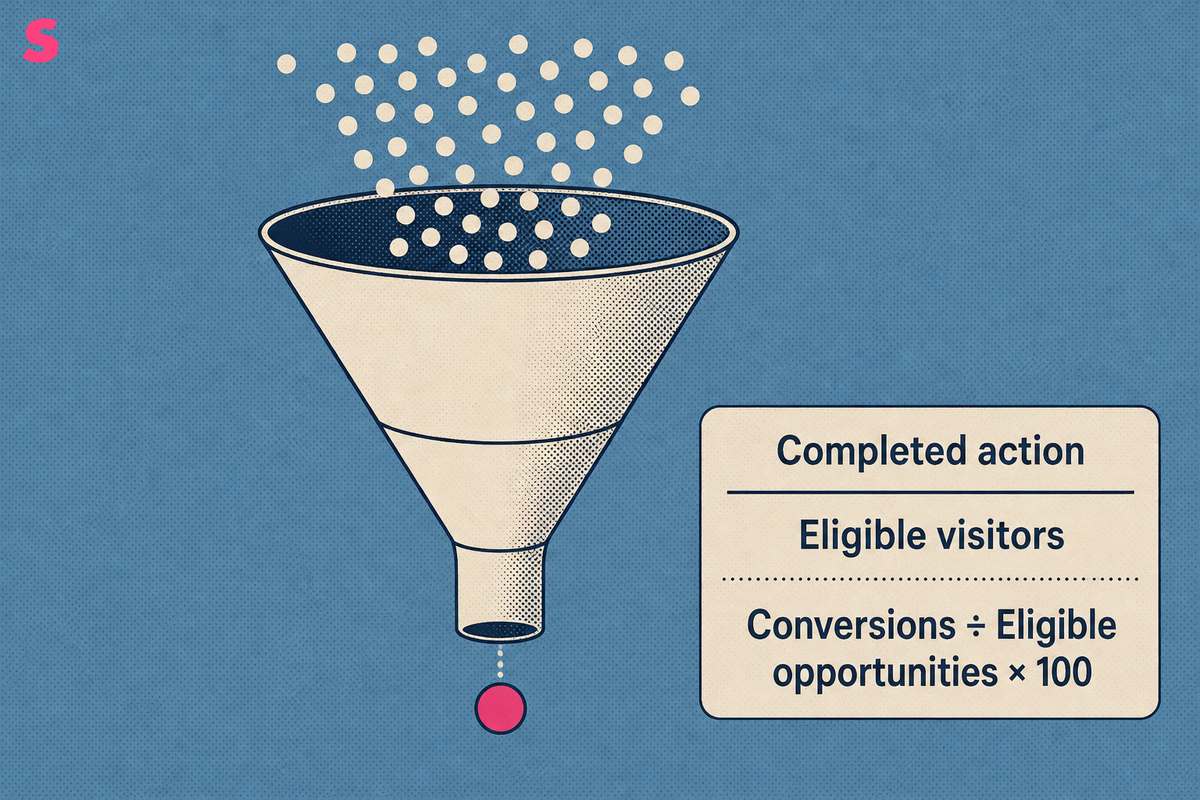
Conversion rate in marketing is the percentage of eligible people who complete a defined action. That action can be a purchase, form submission, demo request, account signup, or another measurable goal.
Conversion rate turns activity into a decision metric. A marketing leader can assess whether a landing page, campaign, audience, or sales handoff moves buyers toward revenue.
A conversion is not always a sale. Per Harvard Business Review, a conversion can include an ad click, app install, signup, or form fill. The right event depends on the buyer journey and the campaign's purpose.
Conversion rate is more than a conversion count. Ten demo requests can look strong or weak depending on whether they came from 100 eligible visitors or 10,000. The denominator gives the result business meaning.
How do you calculate conversion rate?
You calculate conversion rate by dividing conversions by the eligible population, then multiplying by 100. Per Google Ads Help, the denominator can be ad interactions or visits, depending on the measurement goal.
Conversion rate = (number of conversions ÷ number of eligible opportunities) × 100
For example, a landing page receives 100 visits and produces 10 purchases. The conversion rate is 10 ÷ 100 × 100, or 10%. The same formula works for demo requests, trial signups, qualified leads, opportunities, and customers.
Define the event and denominator before reporting the metric. For booked meetings, count completed meetings rather than form starts. For visitor-to-lead performance, use visitors or sessions consistently throughout the reporting period.
- Choose one conversion event, such as a demo request.
- Choose the eligible denominator, such as unique users.
- Use the same date range for both counts.
- Divide conversions by the denominator and multiply by 100.
Should the conversion rate denominator be users, sessions, clicks or leads?
The conversion rate denominator should match the decision you need to make. Users measure people, sessions measure visits, clicks measure ad engagement, and leads measure progression through a B2B funnel.
The wrong denominator can produce a valid calculation with the wrong meaning. A visitor can generate several sessions, and one account can create several leads. Those differences change the percentage without changing the business outcome.
| Denominator | What it measures | Best conversion event | Useful business question |
|---|---|---|---|
| Users | Distinct people in the reporting period | Signup, demo request, purchase | What share of people converted? |
| Sessions | Visits, including repeat visits | Form completion, checkout, content registration | How effective was each site visit? |
| Clicks | Ad interactions that reached a destination | Lead, purchase, app install | How well did ad traffic convert after clicking? |
| Leads | Captured prospects | MQL, opportunity, customer | How well do leads progress through the funnel? |
Use users when repeat visits would distort the result. Use sessions for page and on-site experience. Use clicks for paid media analysis. Use leads for sales funnel analysis, where the population begins after a prospect identifies themselves.
A customer conversion rate needs a stated starting point. Lead-to-customer and visitor-to-customer rates both measure customer conversion, but they describe different funnel stages. For example, if 1,000 visitors produce 30 leads and 6 opportunities, visitor-to-lead is 3%, lead-to-opportunity is 20%, and visitor-to-opportunity is 0.6%.
What counts as a conversion in B2B marketing?
A conversion in B2B marketing is a defined action that signals progress toward a commercial outcome. The event should fit the buyer stage, campaign purpose, and sales process.
B2B buying journeys involve several people, channels, and sessions. A content download can show early interest, while an opportunity created in the CRM shows stronger commercial progress. Neither event is always correct.
| Buyer stage | Example conversion | Primary owner | Why it matters |
|---|---|---|---|
| Awareness | Newsletter signup | Content marketing | Captures permission for further contact |
| Consideration | Demo request | Demand generation | Signals active evaluation |
| Qualification | MQL acceptance | Marketing and sales | Tests fit against agreed criteria |
| Sales | Opportunity created | Sales | Connects marketing activity to pipeline |
| Customer | Closed-won deal | Revenue team | Connects conversion activity to booked revenue |
Per Harvard Business Review, conversion events do not require a monetary transaction. That flexibility can lead teams to optimise low-friction events that create volume without pipeline.
Set primary and secondary conversions. A primary conversion represents the campaign goal, such as an opportunity. Secondary conversions, such as a pricing-page visit or content registration, show where buyer momentum changes.
How is conversion rate different from click-through rate and other metrics?
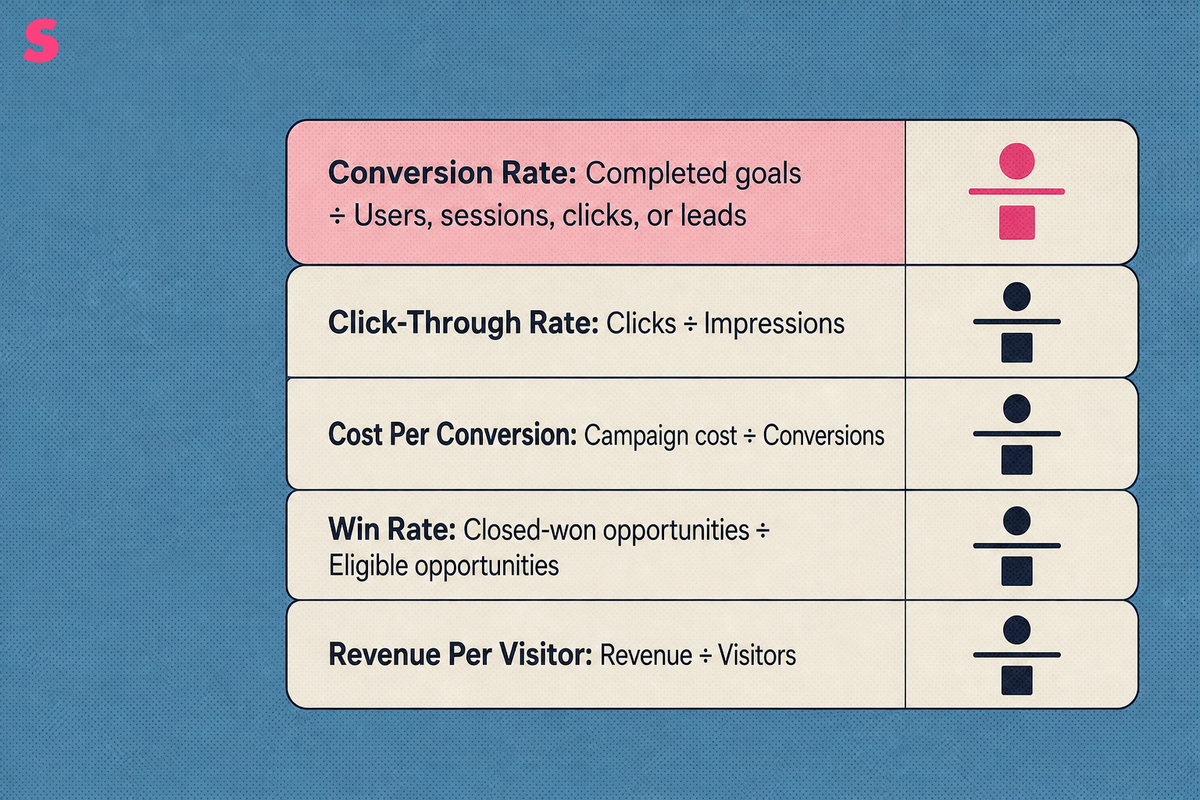
Conversion rate measures completed goals, while click-through rate measures clicks from impressions. The metrics describe different funnel steps and are not substitutes.
Click-through rate, or CTR, is clicks divided by impressions. Conversion rate begins after the click, visit, or lead, depending on the denominator. An ad can have a high CTR and a poor conversion rate when its message attracts the wrong audience.
- Conversion rate: completed goals divided by users, sessions, clicks, or leads.
- Click-through rate: clicks divided by impressions.
- Cost per conversion: campaign cost divided by conversions.
- Win rate: closed-won opportunities divided by eligible opportunities.
- Revenue per visitor: revenue divided by visitors.
Conversion rate is also different from customer acquisition cost, or CAC. CAC measures the cost of acquiring a customer. Conversion rate measures the share that reaches a defined event. One measures progression, while the other measures cost.
Use volume and quality metrics together. A campaign that doubles form fills but reduces opportunity creation has raised a top-of-funnel conversion rate without improving marketing performance.
What is a good conversion rate in marketing?
A good conversion rate in marketing improves qualified pipeline, customer value, or profitable growth for the same audience and funnel stage. No universal benchmark can answer that question.
Conversion rates vary by offer, traffic source, device, industry, buyer intent, sales cycle, and denominator. Visitor-to-lead performance cannot be compared directly with lead-to-customer performance because the second metric starts later in the journey.
Statista reported a 1.6% global average conversion rate for e-commerce website visits during the third quarter of 2026. That figure provides e-commerce context, not a B2B demo-request benchmark or lead-to-customer target.
Channel baselines need separate treatment, even when the conversion event is identical. Branded search often reflects existing demand. High-intent search reflects an active problem. Paid social may introduce a buyer to a category, while referral traffic can arrive with context from a trusted source.
| Channel scenario | Why the baseline differs | Useful comparison |
|---|---|---|
| Branded search | The visitor already knows the company or product. | Compare the same branded terms, audience, and landing page over time. |
| High-intent search | The visitor is actively researching a problem or solution. | Compare queries with similar commercial intent and the same conversion event. |
| Paid social | The campaign may create early interest before active evaluation begins. | Assess downstream qualification and opportunity creation, not form fills alone. |
| Referral traffic | The referring publication, partner, or community shapes visitor intent. | Compare referrals by source, offer, and buyer stage. |
Set an internal benchmark before using an external one. Compare the same conversion event, denominator, segment, and time period. Then assess downstream quality, including qualification, opportunity creation, win rate, pipeline value, and revenue.
- Establish a baseline for the same event and denominator.
- Segment results by channel, campaign, audience, and landing page.
- Check whether higher conversion creates qualified pipeline.
- Move budget only after downstream results support the change.
How do tracking errors distort conversion rate?
Tracking errors distort conversion rate when conversion and denominator counts do not represent the same people, events, or period. The formula remains correct, but the percentage misleads.
Duplicate form events inflate conversions. Missing tags reduce conversion counts. Cross-domain journeys can split one buyer into separate sessions. Consent settings, browser restrictions, and CRM delays also change what each system records.
- Duplicate events: one conversion is counted more than once.
- Missing events: a completed form or purchase is never recorded.
- Incorrect event rules: a page view is counted as a submitted form.
- Date mismatch: conversions and sessions use different reporting windows.
- Identity mismatch: anonymous activity cannot be connected to a known lead.
AI search creates another measurement boundary. Buyers can research in ChatGPT, Gemini, Claude, Perplexity, Copilot, or Google AI Overviews before visiting a site. When they later type a URL or search a brand name, older reports can classify the visit as direct or none.
Sona Marketing Measurement treats AI search as a channel in the same identity graph as paid, content, email, and sales. It resolves anonymous and known traffic into account and contact profiles, then connects buyer journeys to pipeline and revenue.
How do you analyze conversion rate in GA4, a CRM, ad platforms and spreadsheets?
You analyze conversion rate by reconciling one conversion definition across GA4, the CRM, ad platforms, and a controlled spreadsheet. Each system records events at a different point in the buyer journey.
GA4 is useful for site behavior, including sessions, users, and completed website events. Ad platforms assess clicks, spend, and platform-recorded conversions. A CRM provides lead status, opportunities, customers, pipeline, and revenue.
| System | Best use | Typical denominator | Key check |
|---|---|---|---|
| GA4 | Website conversion analysis | Users or sessions | Confirm the event fires after completion |
| CRM | Lead-to-customer analysis | Leads or opportunities | Use consistent lifecycle definitions |
| Ad platform | Campaign and click analysis | Clicks or interactions | Check attribution windows |
| Spreadsheet | Reconciled reporting | Defined population | Match dates and event rules |
Build a conversion-rate analysis with one row per period and columns for the numerator, denominator, formula, source system, and definition. Keep source-specific rates separate before creating an executive view.
Compare GA4 form completions with CRM-created leads. Compare CRM opportunities with closed-won deals. If counts diverge, investigate field mapping, duplicate records, attribution windows, identity resolution, and reporting dates before changing a campaign.
How can you improve conversion rate without lowering lead quality?
You improve conversion rate without lowering lead quality by reducing friction for qualified buyers and measuring pipeline and customer outcomes. More form fills alone do not prove stronger marketing performance.
Start with the conversion path. Match the landing-page message to the ad, email, referral source, or search query that brought the visitor. Remove unnecessary fields, clarify the next step, and ensure the form works across devices.
- Segment conversion rates by channel, campaign, audience, and landing page.
- Find the stage with the largest qualified drop-off.
- Test one change, such as form length, offer, or message match.
- Measure lead quality, opportunity creation, and win rate after the change.
- Keep changes that improve commercial outcomes.
A short form can raise lead volume while reducing qualification. A stricter form can lower volume while increasing opportunity rate. Choose the version that produces stronger pipeline from the audience sales can serve.
Sona Marketing Measurement connects conversion activity to account-level buyer journeys and intent signals. Intent Activation scores accounts, identifies buying stages, and can trigger CRM syncs or audience pushes when an account crosses a chosen threshold.
AI search also changes optimisation work. AI-influenced buyers can arrive through branded search or direct traffic after research without a click. Review self-reported attribution alongside click data, so conversion-rate decisions include demand that referral reports do not show. To tie conversion rate to pipeline and revenue, start the 14-day free trial of Sona Marketing Measurement, with no credit card.
Frequently Asked Questions
What is a conversion rate in simple terms?
A conversion rate is the share of people who take a wanted action out of everyone who could take it. If 100 people visit a website and 10 make a purchase, the conversion rate is 10%.
Is a higher conversion rate always better?
No. Cheap form fills can raise conversion rate while lowering lead quality, pipeline value, or win rate. Check qualification, opportunities, closed-won revenue, and customer value before judging performance.
What is the difference between conversion rate and click-through rate?
Click-through rate counts clicks per impression. Conversion rate counts completed goals per visit, click, user, session, or lead. Click-through rate measures response to an ad or listing, while conversion rate measures progress after that interaction.
What is customer conversion rate?
Customer conversion rate is the share of leads or visitors who become paying customers. State the starting group because lead-to-customer and visitor-to-customer rates measure different funnel stages and can differ sharply.
Does a conversion have to be a sale?
No. Per Harvard Business Review, a conversion can be any desired action, including an ad click, app install, signup, or form fill. A sale is one conversion event, not the only valid event.
Why do two sources report different conversion rates for the same industry?
Two sources often use different conversion events, denominators, audiences, devices, attribution rules, and time periods. Match those definitions before comparing benchmarks. A session-to-lead rate and a lead-to-customer rate are not comparable metrics.
Summarize this article with AI: ChatGPT · Claude · Perplexity · Google AI Mode
Last updated: November 2026