


For agencies, AI visibility platforms versus traditional SEO depends on the question being answered: SEO tracks discoverability in standard search, whereas AI visibility platforms assess whether answer engines mention, cite or leave out a client’s brand. Agencies require both, with the initial purchase guided by gaps among existing clients. Sona AI Visibility links prompts and citations to pipeline and revenue, while also monitoring AI crawler activity. Starting prices seem comparable, but workspace charges and add-ons alter the true per-client cost.
What actually separates AI visibility platforms from traditional SEO for agencies?
AI visibility platforms measure whether a brand appears in generated answers, while traditional SEO measures whether a website earns rankings and clicks from search results. Traditional SEO helps websites rank in Google; AI visibility helps brands appear directly in answers from ChatGPT, Perplexity, and other answer engines, per justbydesign.com.
The distinction lies in the measurement unit and deliverable. SEO work centres on crawlability, canonical tags, content, links, rankings, click-through rate, and organic sessions. AI visibility work centres on prompts, mentions, citations, recommendation placement, cited pages, and omission from answers. AI visibility metrics measure citation frequency and accuracy in generative answers rather than rankings, clicks, and organic traffic, per nicklafferty.com.
Agencies do not need to abandon SEO. Traditional SEO builds authority and organic traffic, while AI visibility measures brand presence in buyer research tools, per linkedin.com. The service model changes when client reporting must explain both a search result and an AI-generated recommendation.
How do AI visibility platforms and traditional SEO compare on the dimensions that decide the choice?
Agencies should use traditional SEO when the immediate objective is organic rankings and traffic, then add AI visibility when clients need evidence of their presence in generated answers. The disciplines share technical foundations but use different units of observation and reporting outputs.
| Dimension | Traditional SEO | AI visibility platforms | Agency implication |
|---|---|---|---|
| Primary unit | Keyword, page, ranking, and click | Prompt, answer, citation, mention, and cited page | Build separate keyword and prompt inventories. |
| Success measure | Rankings, click-through rate, sessions, and conversions | Visibility, citation share, recommendation presence, and AI-referred visits | Do not present one composite score as the full result. |
| Optimisation target | Search results and organic click-through | Extraction of specific answers in generated responses | Map high-value prompts to pages that answer them directly. |
| Reporting cadence | Monthly performance review and periodic technical audit | Daily prompt tracking and periodic interpretation | Separate daily monitoring from quarterly strategic reviews. |
| Team skills | Technical SEO, content strategy, crawling, rank tracking, and web analytics | Prompt-taxonomy design, answer capture, citation validation, and multi-engine monitoring | Train delivery teams to interpret answer evidence alongside search performance. |
| Infrastructure | Crawlers, rank trackers, web analytics, and site-audit workflows | Prompt libraries, capture records, engine monitoring, and workspace governance | Define client-level access, evidence retention, and prompt ownership. |
| Operating workflow | Technical audits, keyword mapping, content production, and ranking reviews | Prompt selection, answer review, citation analysis, AI-attribution QA, and reporting | Add AI visibility QA without replacing established SEO delivery processes. |
Google AI Overviews belong in the AI visibility column because they are generated answer surfaces within Google Search. Agencies should also track ChatGPT, Perplexity, Gemini, Claude, and other answer engines when those systems shape a client’s buyer journey.
Daily tracking of the same prompt list reveals changes that a weekly snapshot can obscure. Retrieval indexes, model updates, and competitor publishing can change an answer quickly. Require repeated movement across consistent captures, inspect the underlying answers, and compare against a fixed prompt set before classifying a change as a trend.
What do AI visibility platforms measure that traditional SEO tools do not, and how far can the scores be trusted?
AI visibility platforms measure whether a brand is mentioned, cited, recommended, or omitted for a defined prompt on a defined answer engine. Traditional SEO tools show page rankings and traffic, but they do not treat a generated answer, its citations, and its brand references as the primary reporting unit.
Trust requires disclosure. An agency should document the engine, prompt wording, geography, date, sampling frequency, citation rule, and visibility calculation for every client-facing result. Google AI Overviews, ChatGPT, Perplexity, Gemini, Claude, and other answer engines can return materially different answers to the same commercial question.
- Engine-specific visibility: the share of tracked answers that include the client.
- Citation share: the share of tracked answers citing the client’s pages or domain.
- Prompt-level evidence: the exact question, answer result, cited sources, and date.
- Competitive context: which brands appear for the same prompt set.
A score is a dated snapshot, not a verdict. The useful output is a comparable result series against a fixed prompt list, with a clear record of changes. Agencies should treat visibility scores as directional measurement and inspect the underlying answers before recommending content or technical work.
Which AI visibility platforms suit agencies, and how do they compare with traditional SEO suites?
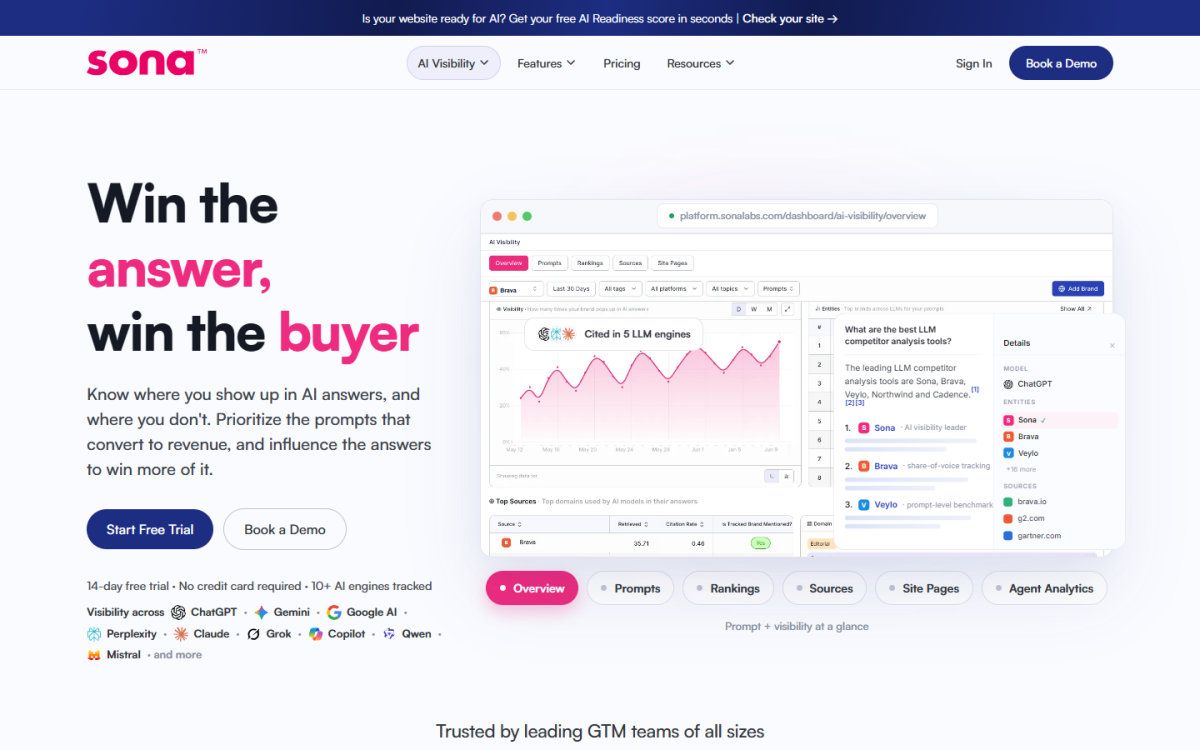
Agencies should shortlist platforms by client workspaces, prompt capacity, engine coverage, reporting, and pricing mechanics rather than a headline visibility score. Sona AI Visibility provides AI search attribution, page-level insights, Agent Analytics, and company-level visitor identification on Growth.
The comparison below uses published entry-plan information as of October 2026. An entry plan is not an agency cost forecast because client workspaces, additional prompts, engines, and reporting requirements can change operating costs.
| Tool | Starting price | Agency Plans? (Yes/No) | # of Answer Engines Tracked | Answer Engines | # of Daily Tracked Prompts (entry plan) | Cost per Daily Tracked Prompt | Differentiation |
|---|---|---|---|---|---|---|---|
| Sona AI Visibility | From $75/month, billed annually | Yes | 11 | Not published | 5,000 credits/month, about 166 daily tracked prompts on one model or 56 across three | $0.45 per daily tracked prompt | Growth adds page-level insights, Agent Analytics, company-level visitor identification, and AI search attribution. |
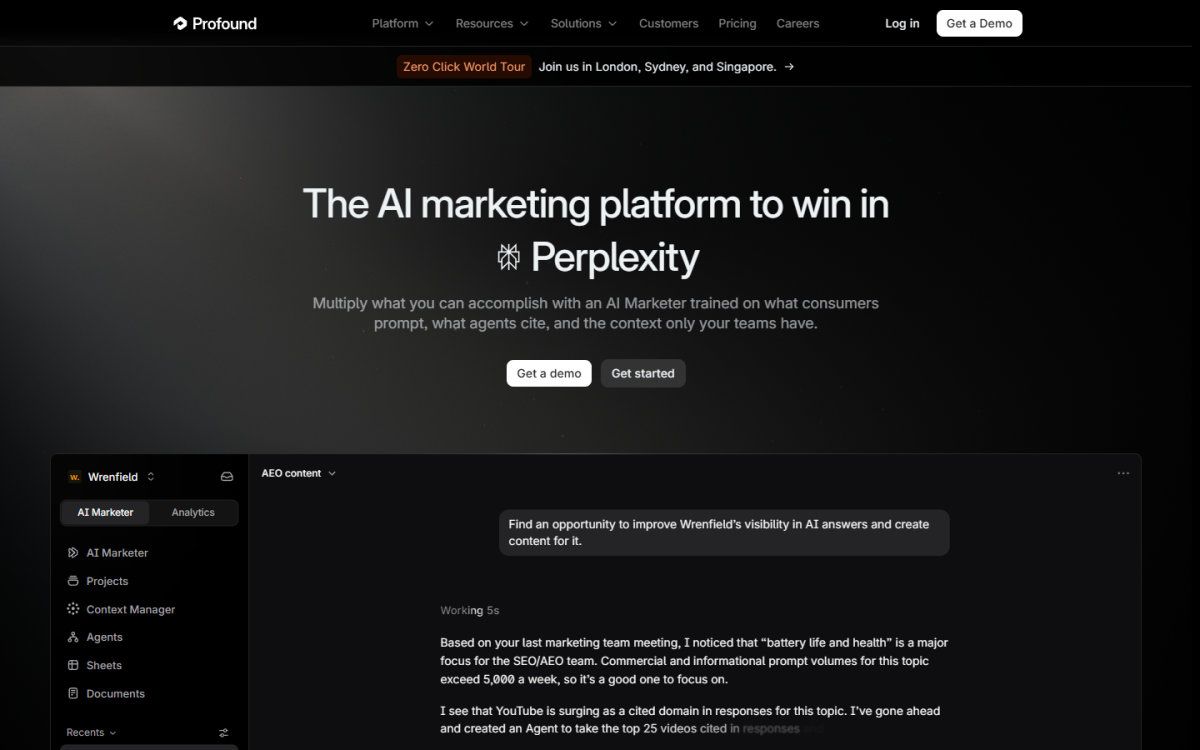
| Profound | From $99/month for Agency Growth | Yes | Not published | Not published | Not published | No refresh cadence published | Agency mode includes brand configurations and pitch environments for multiple client accounts. |
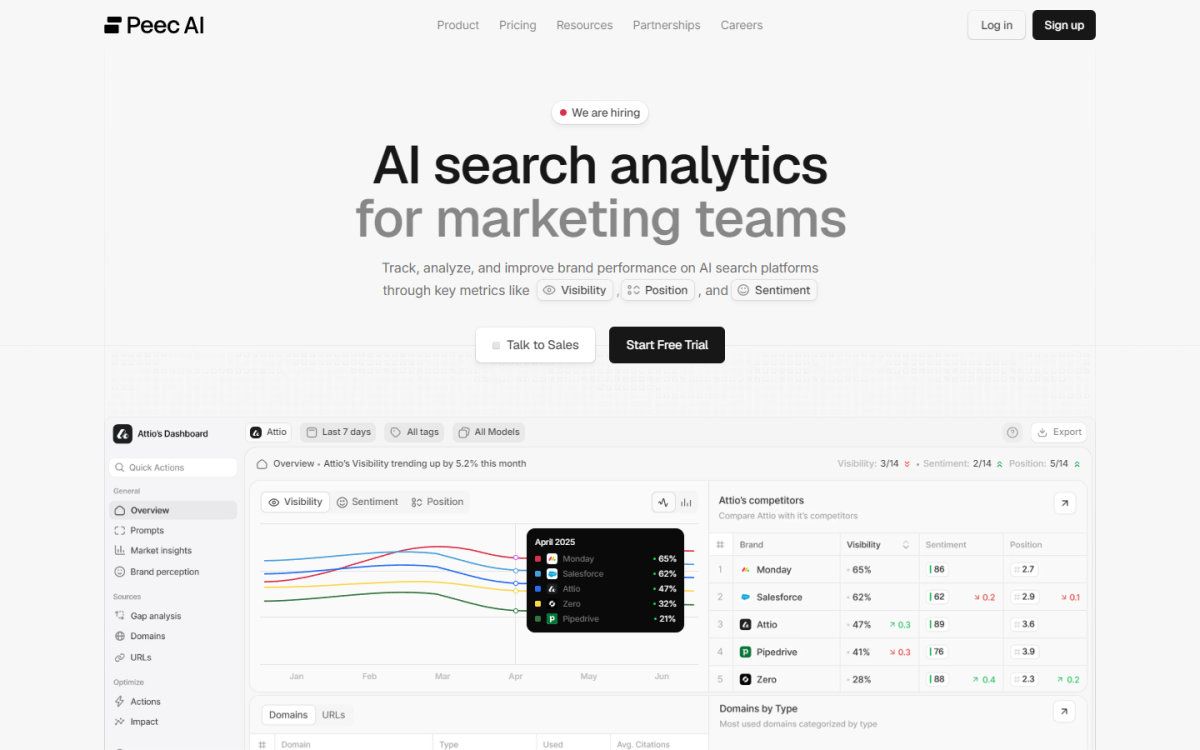
| Peec AI | From $95/month | Yes | 3 | ChatGPT, Google AI Mode, Google AI Overviews | 50 prompts daily | $0.63 per daily tracked prompt | AI visibility tracking across self-serve and agency plans. |
| Otterly.ai | From $29/month | Yes | 4 | ChatGPT, Google AI Overviews, Perplexity, Microsoft Copilot | 15 prompts daily | $0.48 per daily tracked prompt | AI search tracking with agency partner plan options. |
| Scrunch AI | From $250/month | Yes | 4 | ChatGPT, Perplexity, Google AI Overviews, Microsoft Copilot | 125 prompts | No refresh cadence published | AI visibility reporting for brands and agencies. |
| PromptWatch | From $95/month | Yes | Not published | Not published | 50 prompts daily | $0.48 per daily tracked prompt | Prompt monitoring with agency plans and response allowances. |
Traditional SEO suites remain efficient when an agency workflow centres on rank tracking, site audits, backlink analysis, and keyword research. Specialist AI visibility platforms matter when prompt-level evidence, answer capture, citation analysis, or multi-client AI reporting becomes a defined client deliverable.
Why does a low entry price mislead when an agency adds client workspaces?
A low entry price can mislead because agency economics depend on client workspaces, daily prompt volume, engine coverage, white-label reporting, and account management rules. The relevant figure is the effective cost per client and reporting period, not the first monthly price on a pricing page.
Profound’s Agency Growth plan starts from $99/month, as of October 2026, but a complete client workspace is listed at an additional $399/month. That structure can suit a pitch workflow or limited portfolio, but agencies should model active client environments before committing.
Published agency pricing spans wide ranges. Peec AI agency plans start from $245/month, Scrunch AI Agency Core starts from $500/month, and Sona AI Visibility agency plans start from $199/month, all as of October 2026. A market listing dated October 13, 2026 estimated typical pre-enterprise platform spend at $100–$800 per month before additional domains, credits, publisher costs, or enterprise contracts.
- Count active client brands, not just signed retainers.
- Set a daily prompt allowance for each client tier.
- Price required engines and countries separately where applicable.
- Add workspace, reporting, and onboarding costs before setting client margins.
Where does the difference between AI visibility and traditional SEO stop mattering?
The distinction matters less when a client needs technical remediation, durable content quality, or stronger information architecture. Crawlability, server-rendered HTML, structured data, canonical tags, topical coverage, and source credibility support both organic search and AI retrieval.
Traditional SEO is sufficient for a client with no defined AI-search audience, no prompt inventory, and no need to report AI-generated mentions. In that situation, a traditional SEO programme can establish the technical and editorial baseline before the agency adds answer-engine measurement.
Agencies should keep the reporting clocks separate. Track priority prompts daily, run a full technical re-audit monthly or quarterly, and conduct a broader positioning review quarterly. Each activity answers a different operational question.
How should an agency decide whether to start with traditional SEO or AI visibility?
An agency should use a sequential decision process rather than selecting a programme from a single visibility score or entry price.
- Audit the existing SEO baseline, including crawlability, rankings, content coverage, and organic traffic.
- Identify whether buyers use answer engines for commercially important questions, such as vendor comparisons and category research.
- Define the missing KPI or client deliverable, whether that is rankings and sessions, prompt evidence and citations, or both.
- Model effective per-client cost using workspaces, prompts, engines, reporting, and onboarding requirements.
- Classify the client’s maturity and existing SEO investment. A weak foundation usually requires SEO first, while an established programme can support combined reporting.
- Select traditional SEO, AI visibility, or a combined programme based on the commercial objective and delivery capacity.
- Set a review gate for expanding, reducing, or changing the programme after evidence accumulates.
| Client condition | Best starting point | First deliverable | Review rhythm |
|---|---|---|---|
| Weak crawlability, thin content, or unstable rankings | Traditional SEO | Technical audit, keyword map, and content priorities | Monthly |
| Buyers ask vendor-comparison questions in answer engines | AI visibility | Prompt inventory, citation baseline, and source analysis | Daily prompt tracking, monthly interpretation |
| Established SEO programme with unclear AI-search impact | Combined programme | Prompt-to-page map and integrated reporting | Daily prompts, quarterly strategy review |
| Limited budget and no defined reporting need | Traditional SEO | Technical and content baseline | Quarterly |
A combined programme suits mature B2B clients. Traditional SEO and AI visibility serve complementary but distinct purposes, per justbydesign.com. The priority depends on client maturity, buyer behaviour, and reporting expectations.
How can an agency report AI visibility results to clients without overclaiming?
Agencies should report AI visibility as observed answer evidence, not proof of revenue impact or future rankings. A sound client report separates what appeared in an answer, which page was cited, how often the pattern recurred, and the work the agency recommends next.
- Show the exact prompt, engine, geography, and capture date.
- Report brand mention rate and citation share separately.
- Group results by commercial intent and buying stage.
- Include cited pages and omitted high-priority prompts.
- Distinguish observed AI-referred traffic from inferred influence.
Sona AI Visibility provides AI search attribution on Growth, alongside page-level insights, Agent Analytics, and company-level visitor identification. Agencies should identify whether evidence is click-level, self-reported, or modelled from multiple signals.
Use a score as the report cover, not the conclusion. Clients need the prompt series, underlying answers, and severity-ranked fixes attached to pages that moved. That format turns monitoring into a work plan without promising a ranking outcome.
How do the leading AI SEO agencies compare?
Leading AI SEO agencies differ less by whether they mention AEO or GEO than by the technical SEO, content production, digital PR, measurement, and operating model they include. Agencies buying external delivery should compare scope, contract structure, and reporting before comparing retainer prices.
| Agency | Focus | What's included | Pricing |
|---|---|---|---|
| Sona done-for-you services | Done-for-you services added on top of Sona AI Visibility Growth or above | Done-for-you services on top of an AI Visibility Growth plan or above | Launch from $5,500/month, Accelerate $7,500/month, Amplify $9,500/month |
| DerivateX | Full-service SEO and GEO for B2B SaaS | GEO, LLM SEO, entity optimisation, content production, digital PR, backlinks, technical SEO, and migrations | Plans $5,000–$12,000/month; Enterprise scoped individually |
| Breaking B2B | SEO and AI search for B2B and SaaS companies | AEO, GEO, technical SEO, SEO content, link building, Reddit marketing, and YouTube marketing | Growth plans $5,500–$9,700/month; tailored plans from $4,000/month |
| Discovered Labs | Organic search agency for the AI era: AEO/GEO plus SEO for B2B | AEO, Reddit marketing, technical and content SEO, digital PR, link building, and AI Visibility Tracker | Establish €6,995/month, Compete €10,995/month; Outlier & Custom from €15,995/month |
| Omniscient Digital | SEO and GEO for B2B software brands | LLM optimization and citation analysis, GEO technical assessment and roadmap, content production, brand mentions, digital PR, and LLM visibility monitoring | From $10,000/month |
| iPullRank | AI search and GEO through relevance engineering | Relevance engineering, GEO, content strategy, technical SEO, attribution, measurement, and brand monitoring | Not published (quote only) |
| Foundation | GEO agency for B2B companies | GEO strategy, technical SEO, LLM advertising and content distribution, thought leadership, digital PR, attribution, and analytics | Not published (quote only) |
| Siege Media | Full-service GEO agency for brands | Research reports and digital PR, bottom-of-funnel content, Reddit and community presence, affiliate partnerships, and content refreshes | Not published (quote only) |
| TripleDart | AI-native organic growth, SEO plus GEO/AEO, for B2B SaaS | AI visibility, technical and on-page SEO, content briefs, drafts, refreshes, programmatic optimization, and paid media | From $5K/month |
Monitoring AI answers is only half the job. Sona AI Visibility covers the other half with AI search attribution on Growth.
Agency service prices span substantial ranges. AI visibility agencies charge from $1,500 to $40,000 per month, with WebFX listed at $1,500–$5,000 per month and Ignite Visibility higher within that range, per ekamoira.com. Scope, client maturity, content volume, digital PR, and attribution requirements explain much of that range.
What are the frequently asked questions?
Is AI visibility just a new name for SEO?
No. Crawlability, indexation, links, content, and structured data still influence which sources AI systems retrieve. AI visibility adds a separate measurement layer: whether a brand is mentioned, cited, recommended, or omitted in generated answers. Traditional SEO measures rankings, clicks, and organic traffic; AI visibility measures answer presence and citations, per nicklafferty.com.
Do agencies need both traditional SEO and AI visibility in 2026?
Yes. Traditional SEO and AI visibility serve complementary but distinct purposes, per justbydesign.com. Agencies should prioritise technical SEO where sites lack crawlability, rankings, or useful content, then add prompt and citation tracking when AI-answer research is material to the client’s market.
Can AI visibility scores be trusted in client reports?
Only when the platform exposes the engines, prompts, sampling frequency, geography, and scoring rules behind the score. Report engine-specific visibility, citation share, and prompt-level results rather than relying on a single composite measure. A dated score is useful, but the answer record provides the evidence.
Does AI visibility drive traffic that can be attributed?
Many platforms report visibility and citations rather than conversions. Agencies should connect AI visibility data to referral traffic, branded search, assisted conversions, lead quality, and self-reported attribution where tracking permits. That approach separates observed activity from claimed revenue impact.
Should an agency use an SEO suite's AI features or a specialist AI visibility platform?
Integrated suites are efficient for agencies already using them for keyword research, site audits, and rank tracking. Specialist platforms suit agencies that need broader engine coverage, detailed prompt evidence, multi-client workflows, or AI-search reporting as a defined service. The right choice follows the agency’s delivery model.
What should an agency check before buying an AI visibility platform for multiple clients?
Check client management, multi-brand tracking, per-domain pricing, prompt limits, workspace fees, engine add-ons, reporting options, and contract terms. Then calculate the effective cost per client and reporting period. Do not select a platform from the entry price alone.
Summarize this article with AI: ChatGPT · Claude · Perplexity · Google AI Mode
Last updated: October 2026







