


AI visibility products are software tools that measure how frequently, accurately and positively a brand is represented in AI-generated responses, then support improvements. Most tools only report mention totals, but Sona AI Visibility connects prompts and citations with pipeline and revenue while revealing AI crawler and agent activity. Select tools based on engine coverage, prompt sampling quality and SEO integration, not prompt volume. Team type, whether startup, agency or enterprise, further narrows the shortlist.
What are AI visibility products, and what does the industry sell?
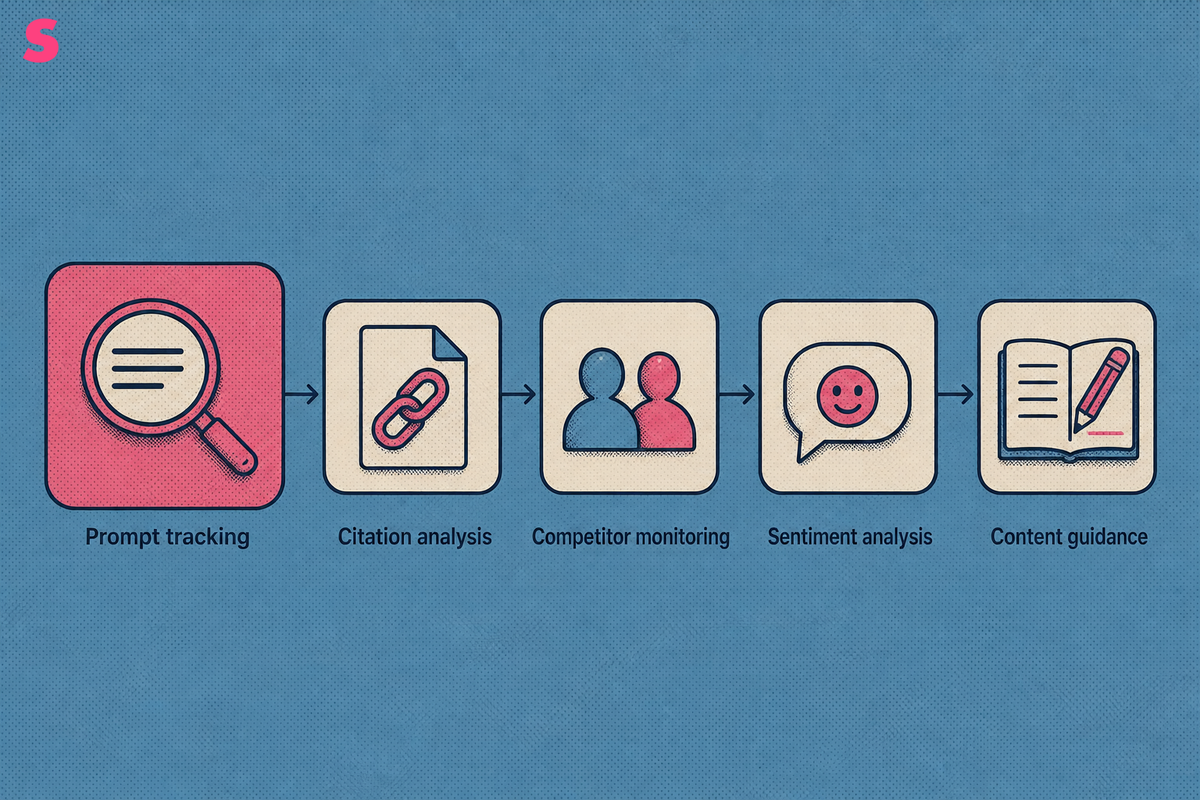
AI visibility products are software platforms that measure and improve how often a brand appears in AI-generated answers. The industry sells prompt tracking, citation analysis, competitor monitoring, sentiment analysis, content guidance, and, in more advanced platforms, attribution for AI-referred traffic.
AI visibility measures how a brand’s information appears in AI-generated outputs and what influences that exposure, per 42dm.net. For marketing leaders, the practical question is whether buyers researching a category in ChatGPT, Perplexity, Gemini, Claude, Google AI Overviews, and other answer engines encounter the brand, its pages, and an accurate description.
An AI visibility SaaS platform runs a defined prompt set, records each generated answer, identifies brand appearances, and logs cited sources, competing brands, position, and language. Some products also flag negative sentiment or competitor gains. The result is a record of where the brand appears and where it does not.
AI visibility is not AI-written content, advertising inside an AI assistant, or a guarantee of citation. It is measurement and operational guidance for generated answers. The category overlaps with SEO software, but the reporting questions differ.
How do AI visibility products track brand mentions in Google AI Overviews and other answer engines?
AI visibility products submit a fixed prompt list to answer engines, capture the answers, and classify whether a brand, page, competitor, or citation appears. Google AI Overviews requires separate checks because the generated result appears within Google Search rather than as a conventional rank position.
A useful workflow starts with prompts buyers would ask. A B2B software company might track a comparison prompt, a category-definition prompt, and a purchase-stage prompt. The platform records whether the company is named, whether its site is cited, which sources appear, and how the response changes over time.
A reviewable capture should retain the prompt, answer engine, generated answer, cited URL, capture date, and region. A mention is a brand name in the generated answer. A citation is a source link or source reference attached to the answer. An absence means the brand or its page appears in neither form.
Daily tracking reveals changes that weekly snapshots can obscure. AI answers shift with retrieval indexes, model updates, location, and newly published competitor content. A sustained change signals a trend, while an isolated result may be noise.
Sona AI Visibility provides AI search attribution, company-level visitor identification, page-level insights, and Agent Analytics on Growth plans and above. As of October 2026, its Starter plan includes 5,000 monthly credits and about 56 prompts tracked daily across three engines.
Which AI visibility metrics can you trust, and which vary by vendor?
The most trustworthy AI visibility metrics are direct observations: whether a brand appeared for a defined prompt, which page was cited, and which answer engine produced the result. Composite visibility scores can serve as dated snapshots, but they require prompt-level evidence and comparable history.
Track four metric classes: presence, prominence, source evidence, and commercial relevance. Presence asks whether the brand appeared. Prominence captures its placement or treatment in the answer. Source evidence identifies cited pages and domains. Commercial relevance separates awareness prompts from comparison or purchase prompts.
- Prompt coverage: the defined prompts, markets, languages, and answer engines included.
- Brand mention rate: the share of tracked answers that name the brand.
- Citation rate: the share of answers that cite a brand-owned page.
- Share of voice: the brand’s presence relative to named competitors in the same prompt set.
- Sentiment and accuracy: how the brand is described, not merely whether it appears.
Vendor scores vary because prompt sets, engine coverage, sampling methods, scoring weights, and treatment of partial mentions differ. AI Search Insights helps teams inspect buyer prompts, cited sources, and page performance rather than relying on one aggregate number. A score is a dated snapshot. A prompt-level series reveals a usable trend.
How is an AI visibility product different from SEO software, and where do the two overlap?
AI visibility products measure whether a brand is named or cited inside a generated answer. SEO software measures rankings, keywords, clicks, and technical search performance. The categories overlap because answer engines still depend on crawlable, useful, authoritative pages and structured information.
Answer engines generally interpret a prompt, retrieve candidate passages, assess relevance and source signals such as accessibility, specificity, corroboration, and freshness, then synthesize an answer. They may attach citations to sources that support the generated response. A brand mention means the answer names the company. A source citation means the answer identifies a supporting page or domain.
SEO starts with a search query and results page. AI visibility starts with a conversational prompt and synthesized answer. A keyword rank can show that a page appears in Google’s results. An AI visibility record can show whether that page was cited when an answer engine summarized the category.
The shared work is substantial: server-rendered HTML, canonical tags, crawlability, content structure, schema markup, topical coverage, and current product information support both SEO and AEO. GEO also benefits from conventional demand research because keyword data identifies topics that buyers may express as longer prompts.
The reporting boundary matters. SEO traffic and ranking reports do not establish whether an AI answer mentioned the brand. AI visibility reports do not replace keyword research, organic traffic analysis, or technical SEO audits. A strong operating model uses SEO demand signals to prioritize pages, then uses prompt and citation data to assess AI-answer coverage.
Does being cited in AI answers lead to pipeline and revenue?
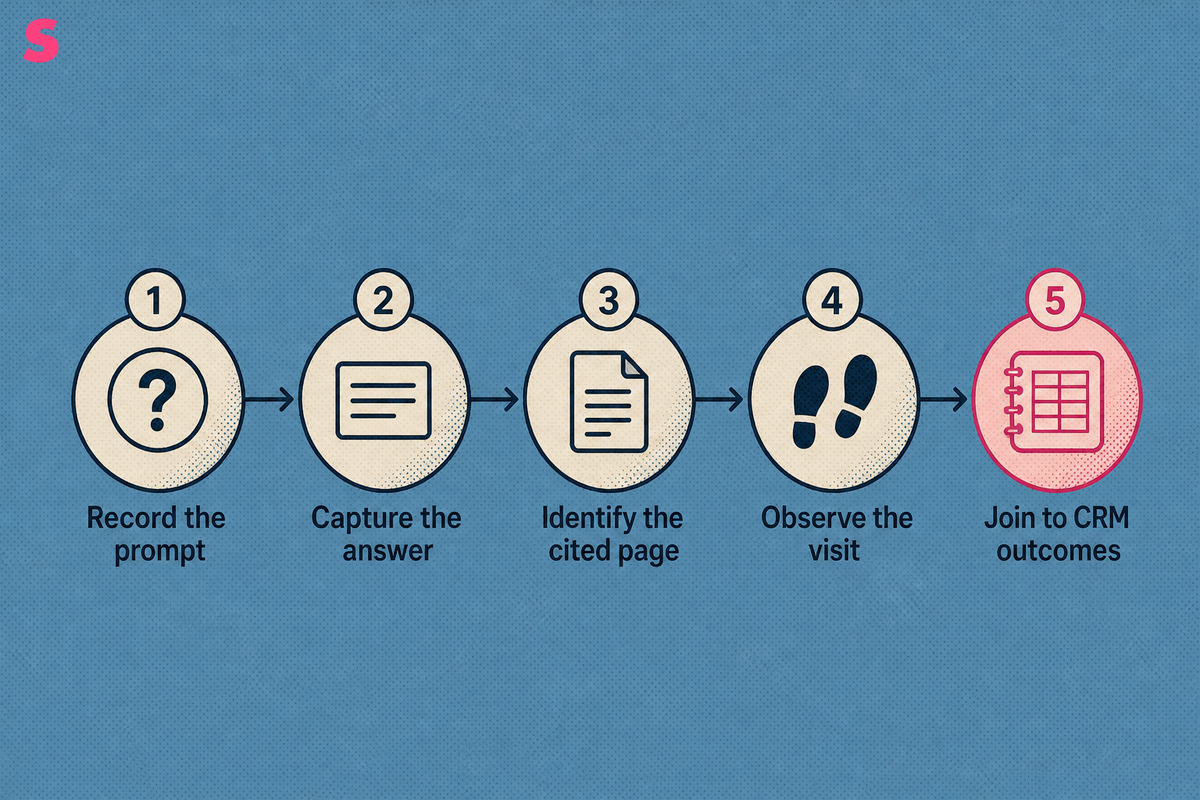
Being cited in AI answers can contribute to pipeline and revenue, but a citation count alone does not prove causation. A brand needs to connect AI-referred visits, self-reported discovery, account activity, opportunities, and closed-won revenue before treating AI visibility as a measurable channel.
Consider a buyer who asks an answer engine for enterprise software options, reads a cited comparison page, then returns later through a direct visit and requests a demo. Web analytics can classify the final visit as direct traffic. The earlier AI research remains invisible unless the business captures it through attribution and account-level journey analysis.
Sona AI Visibility supports AI search attribution and company-level visitor identification on Growth plans and above. Those capabilities help teams investigate whether AI-referred activity corresponds with identifiable accounts and commercial outcomes.
The defensible reporting sequence is clear: record the prompt, capture the answer, identify the cited page, observe the subsequent visit or self-reported source, and join the activity to CRM outcomes. The sequence does not prove that every citation caused a deal. It establishes an auditable path between visibility and commercial activity.
What should you check before choosing an AI visibility tool?
Choose an AI visibility tool by testing its prompt methodology, answer-engine coverage, reporting granularity, refresh cadence, and connection to revenue measurement systems. An intuitive interface cannot compensate for an unrepresentative prompt set or opaque scoring.
- Define the buyer prompts that represent awareness, comparison, evaluation, and purchase research.
- Verify whether the tool tracks Google AI Overviews, ChatGPT, Perplexity, Gemini, Claude, and other answer engines relevant to the market.
- Check whether results show the full answer, cited sources, brand treatment, and historical changes.
- Confirm whether the platform supports daily prompt tracking and whether regional or language settings match the audience.
- Ask how the tool connects AI visibility data to web analytics, CRM records, pipeline, and revenue.
Budget is also a measurement-design decision. Entry-to-mid-market AI visibility platforms generally cost $99–$500 per month, depending on prompt volume, projects, and seats, per October 2026 market listings. Published entry prices across ten popular platforms range from free plans or trials to $295 per month, with many paid plans between $20 and $129 per month, per October 2026 market listings.
As of October 2026, Sona AI Visibility starts from $75 per month billed annually. Its Starter plan includes 5,000 credits monthly and about 56 prompts tracked daily across three engines. The right purchase decision starts with the prompts and outcomes a team needs to measure, not the largest allowance on a pricing page.
Which type of AI visibility tool fits a startup, an agency or an enterprise?
Startups need a focused prompt set and clear page-level actions. Agencies need multi-client workspaces and reporting. Enterprises need broader engine coverage, governance, and attribution to business outcomes. Fit depends on the operating model, not on which tool advertises the most prompts.
| Business type | Suitable tool type | Essential capabilities | Acceptable tradeoffs | Disqualifying gaps | Evidence to test during a trial |
|---|---|---|---|---|---|
| Startup | Focused self-serve tracker | Prompt-level answers, citations, historical tracking, and page-level actions | A narrower engine set or fewer projects | No evidence of the generated answer, cited source, or prompt history | Run the highest-value buyer prompts and verify that captured answers match the target market and region |
| Agency | Multi-client workspace platform | Client workspaces, report exports, prompt governance, and separate brand configurations | A more structured workflow for client access and reporting | No practical way to separate client prompts, outputs, or reports | Create representative client projects and test reporting, permissions, and repeatable prompt setup |
| Enterprise | Governed attribution platform | Regional coverage, source-level evidence, identity resolution, and AI search attribution | A longer implementation and procurement process | No auditable connection between AI activity, accounts, and commercial reporting | Test target regions, account identification, CRM workflow, and evidence for priority prompts |
Pricing and plan details in this comparison were checked from published pricing information in October 2026. Cost per Daily Tracked Prompt uses each vendor’s stated comparison figure, not a separate calculation.
| Tool | Starting price | Agency Plans? (Yes/No) | # of Answer Engines Tracked | Answer Engines | # of Daily Tracked Prompts (entry plan) | Cost per Daily Tracked Prompt | Differentiation |
|---|---|---|---|---|---|---|---|
| Sona AI Visibility | From $75/month, billed annually | Yes | Up to 11 (3 on Starter) | Not published | 5,000 credits/month, about 56 daily tracked prompts across three engines | $0.45 per daily tracked prompt | Growth adds page-level insights, Agent Analytics, company-level visitor identification, and AI search attribution. |
| Peec AI | From $95/month | Yes | Up to 13 (3 of 6 on Starter, plus add-ons) | Not published | 50 | $0.63 per daily tracked prompt | AI visibility tracking for self-serve prompt monitoring. |
| Otterly.ai | From $29/month | Yes | Up to 7 (4 on Lite, 3 as paid add-ons) | ChatGPT, Google AI Overviews, Perplexity, Microsoft Copilot | 15 | $0.48 per daily tracked prompt | Prompt monitoring across its Lite-plan answer engines. |
| Scrunch AI | From $250/month | Yes | Up to 9 (4 on Core) | ChatGPT, Perplexity, Google AI Overviews, Microsoft Copilot | 125 | No refresh cadence published | AI-answer tracking on its Core plan. |
| AthenaHQ | From $295/month | Yes | 11 | Not published | 3,600 credits/month, unlimited prompts stated | No refresh cadence published | Credit-based AI response monitoring. |
| PromptWatch | From $95/month | Yes | Not published | Not published | 50 | $0.48 per daily tracked prompt | Prompt and response monitoring with agency plans. |
| Goodie | From $295/month | Yes | Up to 14 (5 on Core) | Not published | 110 | $0.67 per daily tracked prompt | Multi-model AI visibility monitoring. |
For startups, begin with a limited daily prompt list covering the highest-value buying questions. For agencies, prioritize client workspaces, report exports, and stable prompt governance. For enterprises, prioritize identity resolution, regional coverage, source-level evidence, and the ability to tie AI visibility to the account journey.
How should buyers evaluate AI visibility vendors by segment?
Evaluate AI visibility vendors against the operating model each segment requires. Sona AI Visibility serves revenue-oriented marketing teams that need AI search attribution, company-level visitor identification, page-level insights, and Agent Analytics. Other platforms may prioritize prompt monitoring, agency workflows, e-commerce requirements, or AI-answer coverage.
Startups should evaluate focused self-serve tracking against prompt quality, source evidence, and useful page actions. Agencies should evaluate client separation, reporting workflows, and repeatable configurations. Enterprises should evaluate governance, regional coverage, identity resolution, and whether the reporting can support commercial measurement.
Do not select a vendor solely from a category grid. A platform can fit a narrow segment while remaining unsuitable for a specific buyer journey, geographic coverage, CRM workflow, or reporting model. Run a short evaluation using the same prompt set, target region, and brand terms across each candidate.
Cost varies sharply across the market. AI search visibility tools range from $29–$250 per month across platforms, per industry-lens.com, October 2026. Enterprise contracts can move into four- or five-figure annualized pricing, per October 2026 market listings. Compare usable prompt capacity and evidence quality, not only the advertised starting price.
What can a brand do first to improve its AI visibility?
A brand can improve AI visibility by identifying the buyer prompts it should answer, confirming that answer-engine crawlers can access relevant pages, and repairing the technical and content gaps that prevent those pages from becoming useful sources. Start with pages closest to category, comparison, and product-evaluation questions.
- Build a prompt list from sales calls, site search, category keywords, comparison pages, and support questions.
- Run that list daily across the answer engines relevant to the market and record mentions, citations, source pages, and competitor treatment.
- Check that key pages are crawlable, server-rendered, canonicalized, structured, current, and internally linked.
- Expand pages that answer a buyer’s full question with direct definitions, evidence, use cases, limits, and implementation detail.
- Review the prompt history monthly and conduct a deeper technical audit quarterly.
Use a readiness assessment as a dated baseline, then address the prioritized technical and content findings for each page. The useful output is not a single score. It is a documented list of crawlability, structure, content, and source-evidence improvements.
Monitoring which AI answers mention a brand is only half the job. Sona AI Visibility provides AI search attribution and company-level visitor identification on Growth plans and above, helping teams investigate which visible prompts correspond with meaningful buyer journeys.
What are the frequently asked questions about AI visibility products?
What is the difference between AI visibility and SEO?
SEO targets rankings in a list of links, organic clicks, and search traffic. AI visibility measures whether and how a brand is named or cited inside a generated answer. The disciplines share crawlable content, authority, structured data, and technical quality, so strong SEO work supports AEO and GEO work.
Can an AI visibility product track mentions in Google AI Overviews?
Yes. Many platforms run a fixed set of prompts and record whether the brand or its pages appear in Google AI Overviews alongside ChatGPT, Perplexity, Gemini, and other answer engines. Engine coverage differs by vendor and plan, so verify the included answer engines before buying.
How much do AI visibility tools cost?
Per October 2026 market listings, entry-to-mid-market plans generally run $99–$500 per month, while many paid plans sit between $20 and $129 per month. Enterprise contracts cost far more. Pricing changes frequently, and prompt allowances, engine coverage, projects, and refresh cadence affect the comparable cost.
How many prompts do I need to track?
Most teams need fewer prompts than vendors suggest. Prompt design, sampling quality, regional coverage, and refresh frequency matter more than raw volume. Start with the questions buyers use during category research, comparison, evaluation, and purchase, then expand after daily tracking reveals gaps.
Can I trust an AI visibility score when AI answers keep changing?
Treat an AI visibility score as a trend indicator, not a fixed number. Answers shift by model version, location, retrieval sources, and personalization. Repeated sampling over time is more reliable than a single reading, especially when the report preserves the underlying prompt, answer, citation, and date.
Does a small business need an AI visibility product?
Not always. A small team can start with manual prompt checks and a low-cost tracker, then move to a fuller platform when AI answers begin influencing leads and the team needs to connect visibility to measurable outcomes. The first priority is a disciplined prompt list, not enterprise-scale reporting.
Summarize this article with AI: ChatGPT · Claude · Perplexity · Google AI Mode
Last updated: October 2026







