AI search visibility platforms for SaaS monitor whether ChatGPT, Gemini, Perplexity, Google AI Overviews, and other answer engines mention and cite your product for buyer prompts. Plan pricing differs widely, and prompt limits matter more than the listed price. Sona AI Visibility goes beyond mention counts by connecting prompts and citations to pipeline and revenue while showing AI crawler activity. Choose based on engine coverage, consistent sampling and evidence of business impact.
What do AI search visibility tools do for a SaaS company?
AI search visibility tools SaaS teams use run defined buyer prompts across answer engines and record whether the company, its product pages, and cited sources appear in each response. They create a repeatable record of mentions, positions, citations, and missing answer placements.
The category covers ChatGPT, Perplexity, Gemini, Claude, Google AI Overviews, Google AI Mode, and other answer engines. Unlike traditional rank tracking, the question is not only where a URL ranks. It is whether an AI-generated answer includes the SaaS company, which source supports the answer, and which competing brands appear beside it.
For a SaaS team, the useful output is a prompt-level log. A category prompt such as “best subscription billing software for B2B SaaS” can produce different brand recommendations, cited pages, and comparison framing than a product-category keyword. AI search visibility tools show which pages enter answers, where the company is absent, and which topics need content or technical work.
How should a SaaS team score AI search visibility tools before buying?
SaaS teams should score AI search visibility tools on prompt coverage, answer-engine coverage, citation fidelity, source-level evidence, refresh cadence, and connections to commercial outcomes. A single brand score establishes direction, but it does not tell a content team what to change.
- Prompt coverage: Confirm whether the plan supports category, comparison, implementation, integration, and alternative prompts.
- Answer-engine coverage: Start with the engines buyers use, then verify whether Google AI Overviews, Google AI Mode, and Claude are included or priced separately.
- Citation fidelity: Review whether the system captures the answer buyers see, including cited domains and pages.
- Operating cadence: A daily prompt log gives a SaaS team enough resolution to distinguish sustained movement from a one-day change.
- Commercial measurement: Determine whether AI-referred visits connect to accounts, opportunities, and revenue.
A brand-level visibility number is not a work item. A prompt-level view identifies the question, cited source, and owned page that require attention. Sona AI Visibility connects citations to pipeline and revenue on one account timeline, while showing the prompts and pages behind each visibility result.
Answer engine optimization (AEO) tools for SaaS companies should also fit the operating model. A demand generation team needs pipeline evidence, while an SEO team needs source and page evidence. Agencies need separate client workspaces and reporting controls. The scorecard should reflect the job, not only a large engine count.
Which 7 AI search visibility tools suit SaaS companies best?
The seven tools below support different SaaS measurement needs, from daily prompt monitoring to source analysis and account-level attribution. The right choice depends on whether the team needs a monitoring dashboard, a content-placement workflow, agency support, or evidence that AI visibility contributes to pipeline.
1. Sona AI Visibility: best suited to revenue attribution
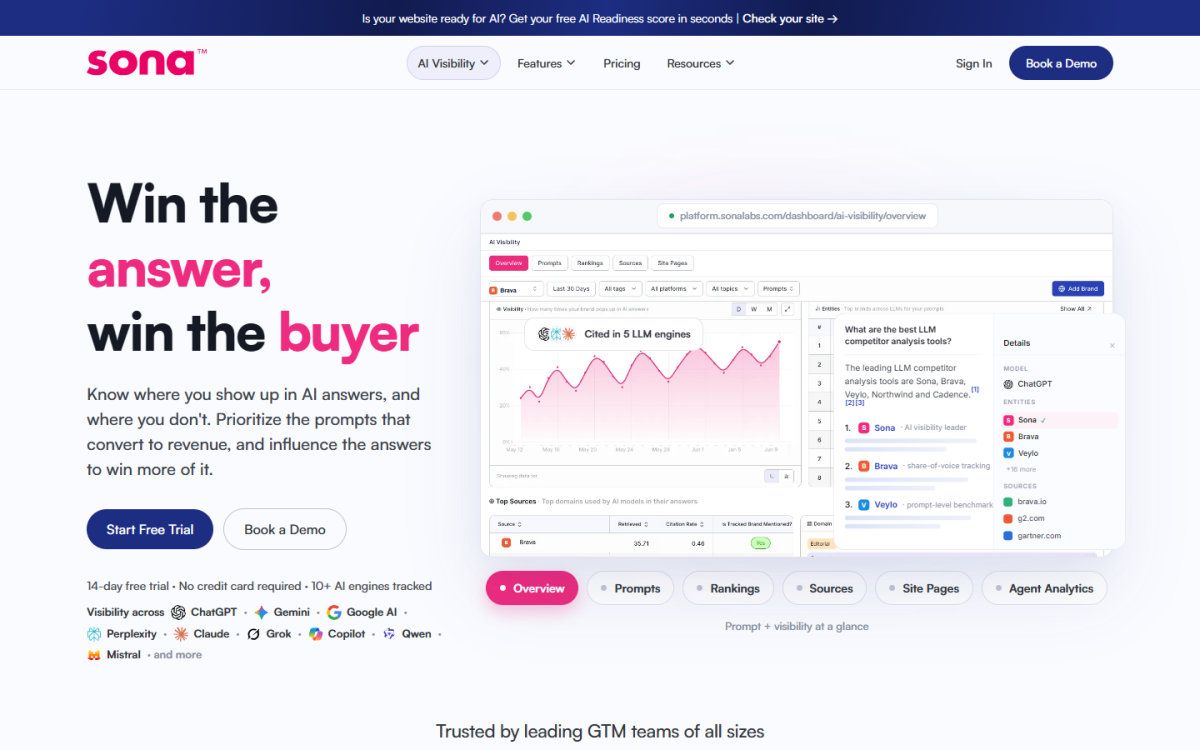
Sona AI Visibility suits SaaS teams that need to connect AI citations and AI-referred visits to pipeline and closed-won revenue. It tracks 11 answer engines and starts from $75/month for brand plans, as of October 2026. Its Growth plan adds company-level visitor identification and AI search attribution.
2. Peec AI: best suited to prompt monitoring across self-serve plans
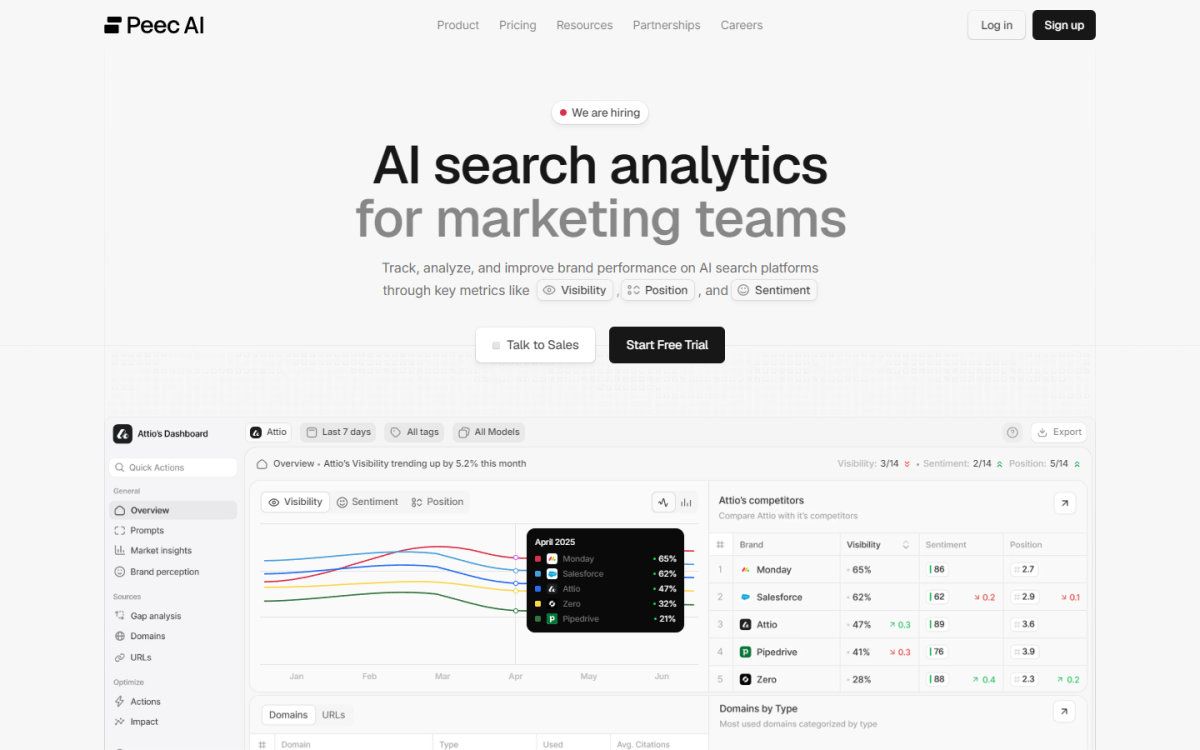
Peec AI has Starter, Pro, and Advanced plans with 50, 150, and 350 daily prompts respectively, as of October 2026. Its self-serve plans list six answer engines, although three are active on Starter. Enterprise supports up to 13 models.
3. Otterly.ai: best suited to entry-level prompt monitoring
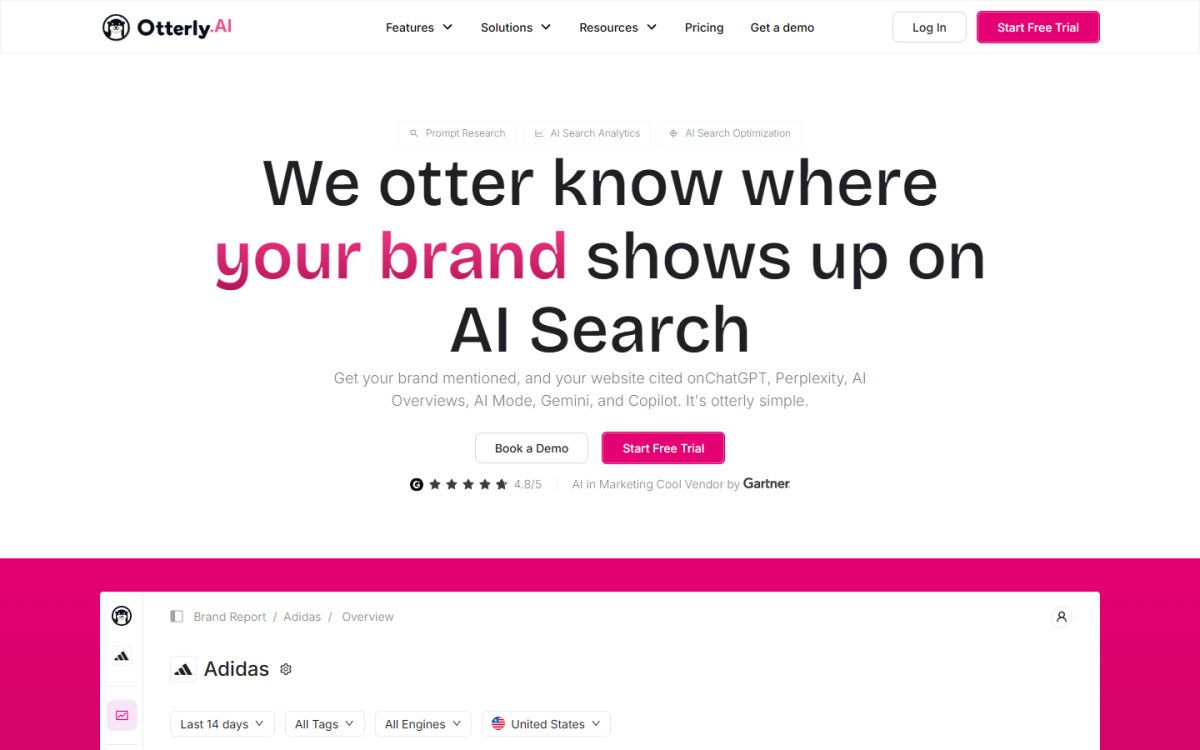
Otterly.ai starts at $29/month for 15 daily prompts on its Lite plan, as of October 2026. Lite covers ChatGPT, Google AI Overviews, Perplexity, and Microsoft Copilot, while Claude, Google AI Mode, and Gemini are available as paid add-ons.
4. Scrunch AI: best suited to citation and answer analysis
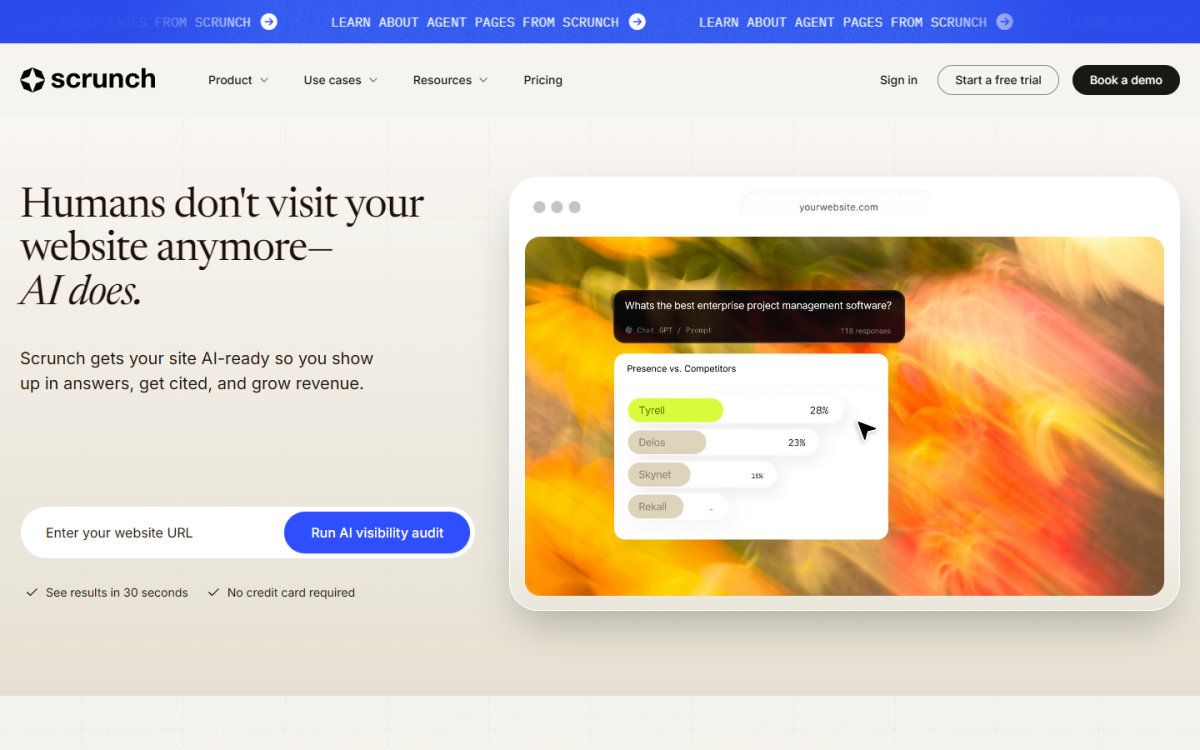
Scrunch AI starts at $250/month for its Core plan, as of October 2026. Core includes 125 prompts and four engines, ChatGPT, Perplexity, Google AI Overviews, and Copilot. Enterprise expands the engine set and uses custom pricing.
5. AthenaHQ: best suited to credit-based answer monitoring
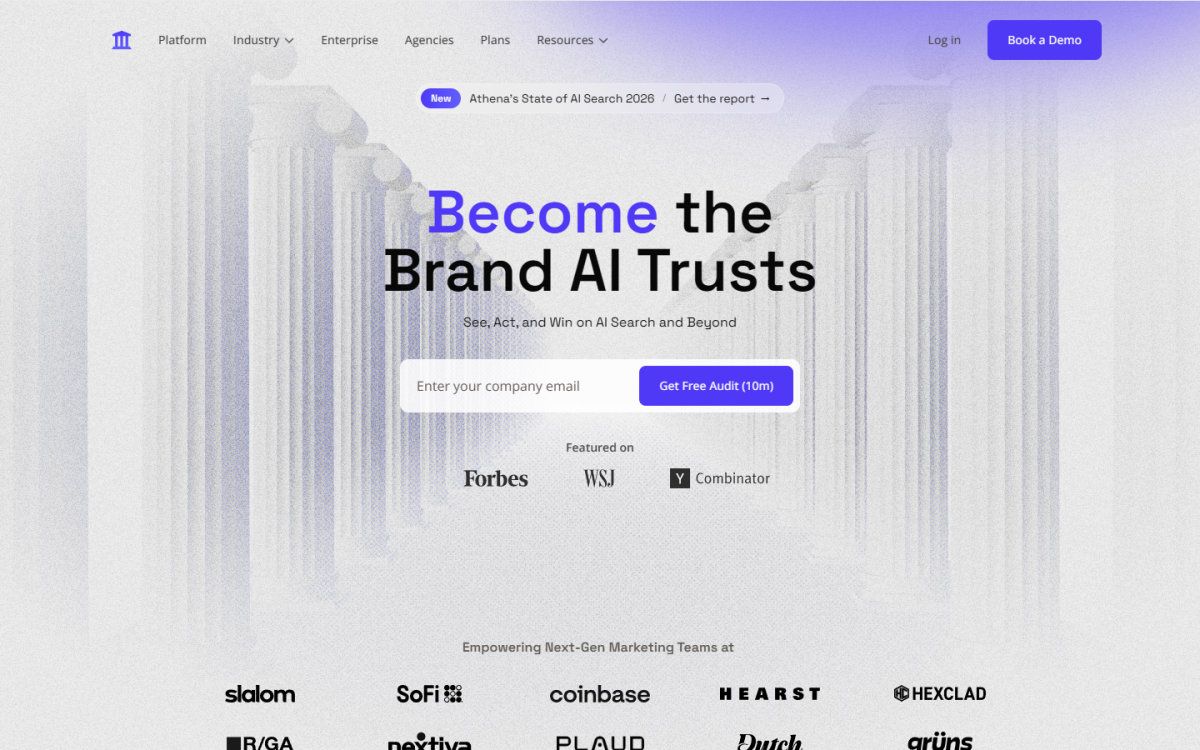
AthenaHQ starts at $295/month for Starter, as of October 2026. Starter includes 3,600 credits each month and 11 models, while the published plan describes prompt access as unlimited. Available pricing details do not publish its refresh cadence.
6. PromptWatch: best suited to response-volume tracking for multi-client work
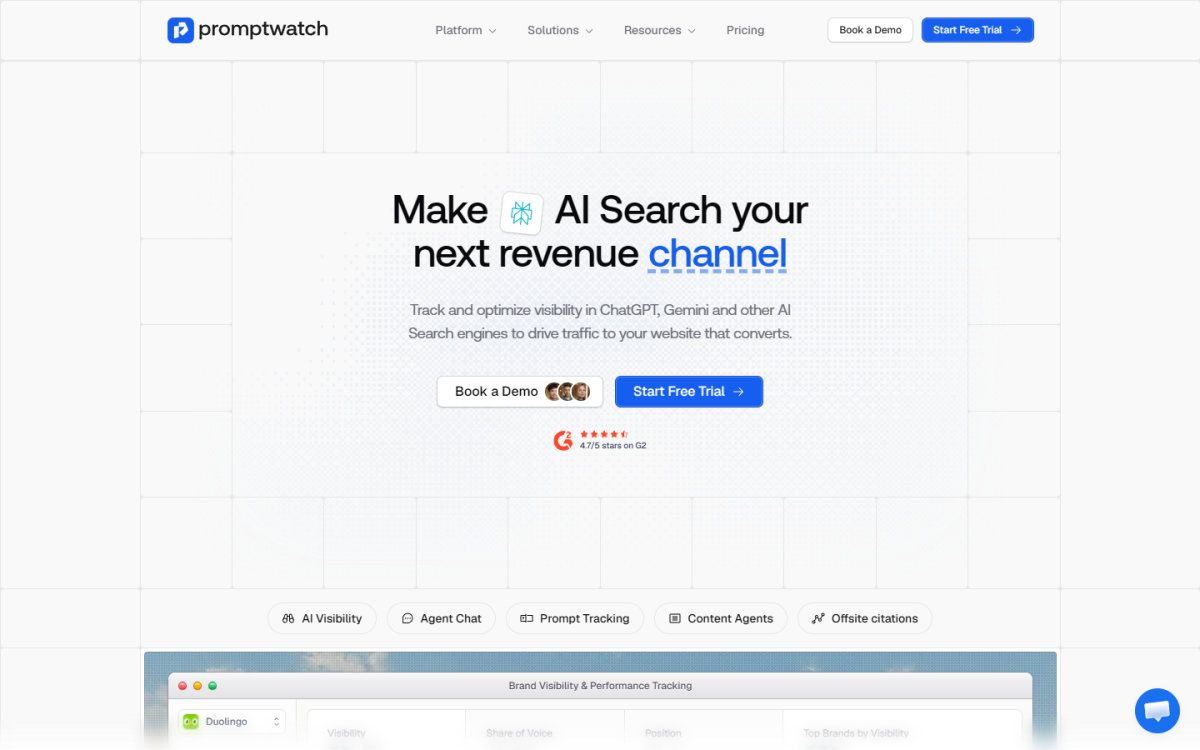
PromptWatch starts at $95/month for Essential, as of October 2026. The entry plan includes 50 prompts, 6,000 monthly responses, and all supported models. Published agency plans begin at $199/month.
7. Goodie: best suited to higher-volume daily prompt coverage
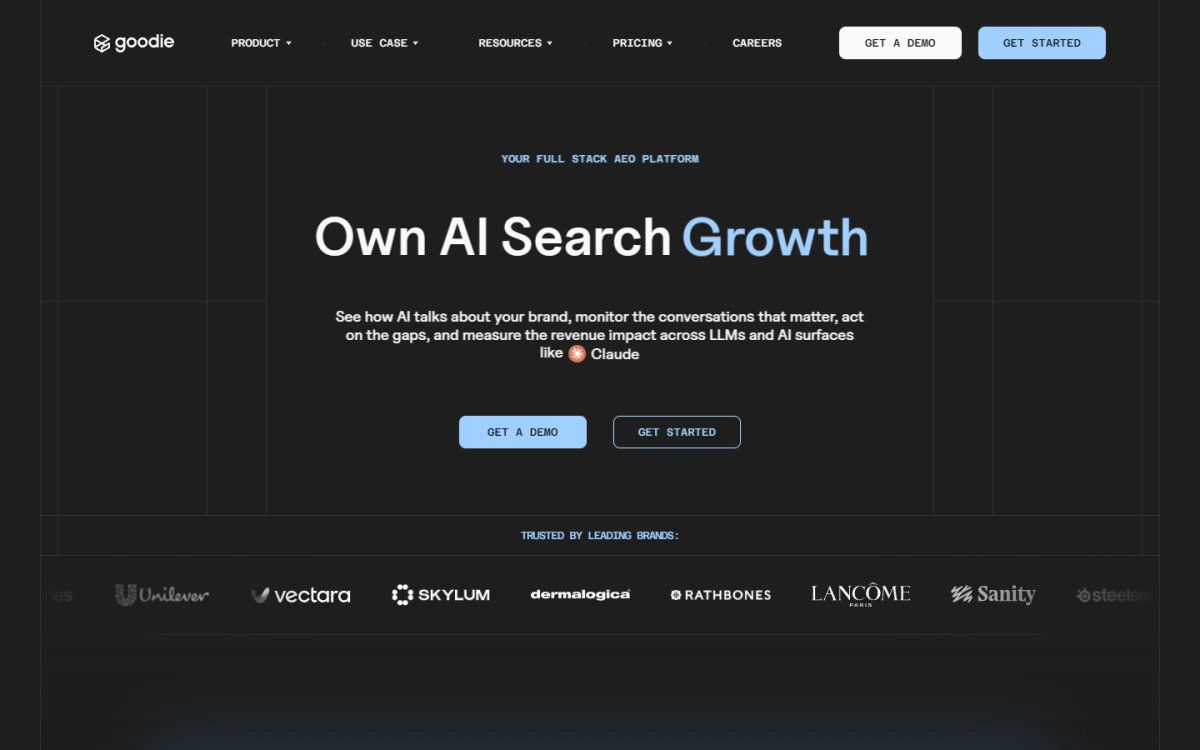
Goodie starts at $295/month for Core, as of October 2026. Core includes 110 daily prompts across five models, while Pro expands to 250 daily prompts and eight models. Published agency plans start at $275/month.
How do these AI search visibility tools compare on price, prompts and engines?
Price comparisons work only when SaaS teams compare the same unit, daily prompt capacity, engine coverage, and plan type. The table uses published entry-plan details as of October 2026.
| Tool | Starting price | Agency Plans? (Yes/No) | # of Answer Engines Tracked | Answer Engines | # of Daily Tracked Prompts (entry plan) | Cost per Daily Tracked Prompt | Differentiation |
|---|---|---|---|---|---|---|---|
| Sona AI Visibility | From $75/month, billed annually | Yes | Up to 11 (3 on Starter) | Not published | 5,000 credits/month, about 56 daily tracked prompts across three engines | $0.45 per daily tracked prompt | Connects AI citations and prompts to pipeline and revenue on one account timeline. |
| Peec AI | From $95/month | Yes | Up to 13 (3 of 6 on Starter, plus add-ons) | ChatGPT, Google AI Mode, Google AI Overviews | 50 prompts daily | $0.63 per daily tracked prompt | Prompt tracking across self-serve and enterprise plans. |
| Otterly.ai | From $29/month | Yes | Up to 7 (4 on Lite, 3 as paid add-ons) | ChatGPT, Google AI Overviews, Perplexity, Microsoft Copilot | 15 prompts daily | $0.48 per daily tracked prompt | Entry plan with daily monitoring and optional engine add-ons. |
| Scrunch AI | From $250/month | Yes | Up to 9 (4 on Core) | ChatGPT, Perplexity, Google AI Overviews, Copilot | 125 prompts, refresh cadence not published | No refresh cadence published | Core plan for citation and AI answer analysis. |
| AthenaHQ | From $295/month | Yes | 11 | Not published | Unlimited prompts, 3,600 credits/month, refresh cadence not published | No refresh cadence published | Credit-based AI response monitoring across 11 models. |
| PromptWatch | From $95/month | Yes | Not published | Not published | 50 prompts daily | $0.48 per daily tracked prompt | Monthly response allowances and published agency tiers. |
| Goodie | From $295/month | Yes | Up to 14 (5 on Core) | Not published | 110 prompts daily | $0.67 per daily tracked prompt | Daily prompt monitoring with Core, Pro, and Enterprise plans. |
Monthly price alone can mislead a SaaS buyer. A low entry price can include fewer daily prompts, fewer engines, or a narrower response allowance. A procurement review should separate the initial monitoring requirement from the larger prompt set required for categories, integrations, competitors, and buyer-stage questions.
How do AI search visibility tools sample prompts and cope with unstable answers?
AI search visibility tools should use a reproducible sampling process because a single answer is unstable evidence. Preserve fixed prompt wording and metadata, then stratify prompts by intent, buying stage, engine, country, and other controlled conditions. Retrieval indexes, models, and competitor content can alter cited sources.
Each prompt run is an observation, not a conclusion. Retain answer snapshots and report successful appearances against the full number of observations for each prompt group. Show variability or confidence intervals where the data supports them, rather than declaring a fixed trend threshold.
Teams should verify every citation URL and confirm that the cited page supports the answer. Label broken, fabricated, redirected, and unsupported citations separately. That record shows whether a change followed a product-page revision, a new competitor citation, or a broader answer-engine shift.
Daily tracking applies to the prompt list. A full technical re-audit or competitive benchmark report should run monthly or quarterly because those reviews require interpretation and prioritisation rather than high-frequency sampling.
How should a SaaS team build the prompt set it tracks?
A SaaS team should build its prompt set from buyer jobs, not branded keywords. Start with the questions buyers ask before a demo request, during vendor comparison, and when implementation teams evaluate integrations, security, pricing, or migration risk.
- Collect high-intent product-category keywords, competitor comparisons, feature questions, and integration terms.
- Rewrite each priority topic as natural-language buyer prompts.
- Tag every prompt by intent and buying stage, such as Awareness, Consideration, Decision, or Purchase.
- Assign an owned page to the prompt, then identify whether that page appears as a cited source.
- Run the stable prompt set daily and add new prompts only when a product, market, or competitor change justifies them.
Sona AI Visibility supports a keyword-to-prompt-to-page chain, which helps teams turn search demand into the buyer questions answer engines receive. Every important commercial topic should have a prompt, an accountable page, and a measurable outcome.
Keep the prompt set small enough to govern. A well-defined prompt collection creates better decisions than a large untagged collection because the team can connect each movement to a page owner and content decision.
What should SaaS teams measure beyond brand mentions?
SaaS teams should measure citation sources, prompt intent, AI-referred visits, identified accounts, pipeline, and closed-won revenue beyond brand mentions. Mentions show exposure. They do not establish whether a relevant buyer saw the answer, visited the site, or entered a sales process.
A practical measurement model has three layers: answer presence, site engagement, and commercial outcome. Standard analytics captures the visit and downstream conversion more easily than the answer that influenced research. AI search monitoring supplies the answer layer, then attribution connects that evidence to the buyer journey.
- Answer layer: brand inclusion, position, citation source, and competitor presence.
- Page layer: the owned page that earns citations or misses relevant prompts.
- Revenue layer: accounts, opportunities, pipeline, and closed-won revenue associated with AI-referred activity.
Sona AI Visibility uses AI Attribution to connect AI citations to accounts, pipeline, and closed-won revenue on one timeline. That distinction determines whether AI visibility remains a reporting metric or becomes a measurable acquisition channel.
What should a SaaS team do with AI visibility data once it has it?
A SaaS team should turn AI visibility data into a prioritised page, prompt, and pipeline workflow. Do not chase every missing mention. Focus on commercial prompts where the product has a credible page, a clear buyer need, and evidence of account activity.
- Review daily changes by prompt, engine, cited source, and buying stage.
- Prioritise pages missing from commercial comparison and evaluation prompts.
- Improve the page’s product evidence, implementation detail, source structure, and recency.
- Recheck the prompt series after the page change rather than relying on one result.
- Review account and opportunity data to identify prompts associated with pipeline.
A score is a dated snapshot. The valuable asset is a comparable series over time, especially when a severity-ranked fix is attached to the page that moved. That gives content, SEO, and demand generation teams a shared work queue.
Sona AI Visibility can connect the prompt and citation record to pipeline and revenue, allowing SaaS teams to prioritise visibility work by commercial evidence rather than mention volume alone. The operational question becomes which AI answer gaps warrant action first.
Who should not buy an AI search visibility tool yet?
AI search visibility tools are not the right purchase for every SaaS company. A team should wait if it lacks a defined product category, has no meaningful organic content or documentation base, cannot assign someone to act on findings, or has no way to evaluate commercial outcomes.
A company with an early product and no established buyer language should first collect customer interviews, sales-call themes, support questions, and product-market evidence. Prompt monitoring becomes useful when the team can define buyer questions and the pages that should answer them.
Teams should also delay a paid platform if they need only a one-time technical read. The Free AI Readiness Checker assesses whether AI can crawl and parse a site. It does not measure brand mentions or citation history.
An AI visibility platform becomes appropriate when a SaaS company has recurring category demand, an accountable content or SEO owner, and a plan to connect answer visibility with qualified traffic or pipeline. Without that operating model, the dashboard becomes another disconnected report.
What are the frequently asked questions about AI search visibility tools?
What is an AI search visibility tool?
An AI search visibility tool runs a fixed set of buyer prompts across answer engines on a schedule and records whether and how a brand is mentioned and cited. It shows where a SaaS product appears in AI-generated answers, which sources support those answers, and where the company is missing.
Can traditional rank trackers measure AI search visibility?
Not fully. Traditional rank trackers report positions in a list of links, while AI answers involve answer inclusion, citation selection, source retrieval, and model-specific behaviour. Specialised AI search monitoring measures those conditions and works alongside SEO rather than replacing SEO.
How much do AI search visibility tools cost for a SaaS team?
Entry pricing across the seven reviewed tools ranges from $29/month to $295/month as of October 2026. Billing periods, prompt capacity, engine coverage, credits, and agency features differ, so teams should compare daily prompt capacity, engine coverage, and refresh cadence rather than monthly price alone.
Which AI engines should a SaaS company monitor first?
Start with ChatGPT, Perplexity, Gemini, and Google AI Overviews. Add Google AI Mode and Claude when buyer research habits justify the extra coverage. Sona AI Visibility tracks 11 answer engines as of October 2026.
Are AI answers too unstable to track reliably?
A single prompt run is unreliable because answers vary by retrieval context, geography, model version, and new source material. Repeated daily sampling creates a usable record when the team preserves controlled prompt conditions, captures answer snapshots, and reports results across the full observation set.
Does higher AI visibility lead to pipeline?
Brand mention counts alone do not show pipeline impact. A SaaS team needs to connect prompts and citations to AI-referred visits, accounts, opportunities, and deals. That measurement separates exposure from revenue impact and requires more than a monitoring dashboard.
Summarize this article with AI: ChatGPT · Claude · Perplexity · Google AI Mode
Last updated: October 2026