


AI brand visibility is whether ChatGPT, Perplexity, Gemini, Claude and Google AI Overviews mention, cite or recommend your company when someone asks a relevant question. It matters because these answers now shape buyer consideration before a website visit ever happens. Sona AI Visibility connects those citations and prompts to actual pipeline and revenue, and tracks the AI crawler activity behind them, rather than stopping at mention counts the way most trackers do.
What is AI brand visibility?
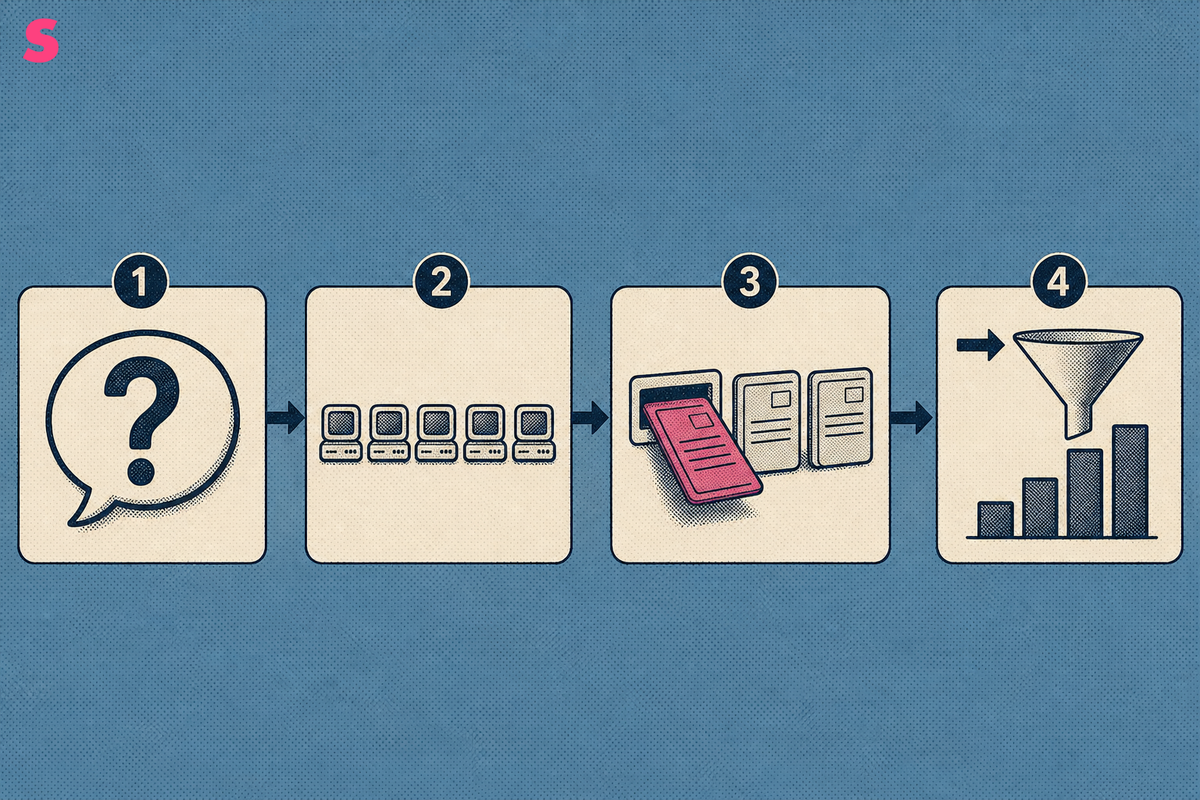
AI brand visibility is whether and how a brand gets named when someone asks ChatGPT, Perplexity, Gemini, Google AI Overviews or another engine a question in that brand's category. It covers whether the brand appears at all, how it is described, which sources the engine leans on, and whether the mention favors the brand or a competitor.
In practice this is a measurement problem: someone has to run the questions buyers actually ask, watch the engines actually used, and log what comes back, because nobody can read every answer an engine might generate on demand. Brand AI visibility is the resulting picture, built from a fixed set of tracked prompts checked on a schedule rather than a single lucky search.
The research happens whether or not a brand can see it. A prospect asks ChatGPT to compare vendors, gets three names, and never visits a search engine at all. If a brand is not one of the three, it loses the deal before its site gets a single visit to measure.
Sona AI Visibility tracks that mention rate and share of voice across the engines a brand's buyers actually use, and connects it to citations, sentiment and, further downstream, to pipeline.
How is AI brand visibility different from SEO and branded search?
AI brand visibility measures whether a brand gets named or summarized inside a generated answer. Search engine optimization (SEO) measures whether a page ranks as a clickable link. Branded search measures how often people type the brand's own name into a search box.
Traditional SEO remains the foundation underneath all of this: an engine has to crawl a page, parse it, and trust it before that page can ever be cited. A page can rank position one on Google and still never appear inside a Google AI Overviews answer, a separate surface built from a different retrieval pass over a narrower source set.
Someone who types a company's name into Google has already heard of it. Brand visibility in AI search measures something upstream: whether an engine surfaces the brand to someone who did not ask for it by name, someone typing "best invoicing software for freelancers" instead. That is a discovery event, not a lookup.
LLM brand visibility is the same concept scoped specifically to large language model chat interfaces, as distinct from AI features bolted onto a traditional search results page. A chat interface like ChatGPT or Claude generates one conversational answer with no ranked list beneath it, while Google AI Overviews sits above ten blue links a reader can still scroll through. A brand can be invisible in one and present in the other on the identical query.
Which AI engines actually matter for brand visibility right now?
Five engines account for almost all measurable AI brand visibility today: ChatGPT, Perplexity, Google AI Overviews, Gemini and Claude, with Google AI Mode growing fast enough to track separately. They differ sharply in how often they name a brand at all, which makes engine choice a methodology decision.
A tracker covering 8,400 commercial prompts found ChatGPT named at least one brand in 71.4% of responses, while Perplexity named one in 84.2% of responses, in data reported May 30, 2026. The same tracker put Gemini at 62.8% and Claude at 58.4%. Perplexity's higher rate fits its design: it is built as a citation-first answer engine, so naming sources is closer to its core behavior than for a general chat assistant.
Traffic share tells a different story from mention rate. StatCounter-based reporting put ChatGPT at 76.85% of AI-search referral share in April 2026, against 9.0% for Gemini, 7.73% for Perplexity, 3.76% for Copilot and 2.66% for Claude, reported June 12, 2026. A high mention rate on a low-traffic engine and a lower mention rate on a high-traffic one can matter equally.
- ChatGPT: the largest referral source by far; a general-purpose assistant, not citation-first by default.
- Perplexity: the highest named-brand rate of the four measured; built around sourcing and citations.
- Google AI Overviews and Google AI Mode: layered onto Google's existing search index and ranking signals.
- Gemini and Claude: lower named-brand rates in the same tracker, still material for specific categories.
Sona's own measurement archive covers eight answer surfaces: ChatGPT, Google AI Overviews, Perplexity, Google AI Mode, Gemini, Mistral, Qwen and Claude, per Sona's own AI visibility data, September 2026.
| Engine | Named-brand rate / referral share | What it measures | Date reported |
|---|---|---|---|
| ChatGPT | 71.4% named a brand; 76.85% of AI-search referral share | General assistant, largest traffic source | May 30, 2026 / June 12, 2026 |
| Perplexity | 84.2% named a brand; 7.73% of referral share | Citation-first answer engine | May 30, 2026 / June 12, 2026 |
| Gemini | 62.8% named a brand; 9.0% of referral share | Google's chat assistant | May 30, 2026 / June 12, 2026 |
| Claude | 58.4% named a brand; 2.66% of referral share | Anthropic's assistant | May 30, 2026 / June 12, 2026 |
| Copilot | 3.76% of referral share | Microsoft's assistant, embedded in Windows and Office | June 12, 2026 |
What makes an LLM mention one brand and not another?
An LLM mentions a brand when its training data or its live retrieval pass surfaces that brand as a strong answer to the underlying question, and that depends on factual consistency, independent coverage and structured content more than on any single page a brand controls. LLM brand visibility is earned evidence, not a placement anyone buys.
Retrieval-augmented engines like Perplexity and Google AI Overviews fetch pages at answer time and weigh them by crawlability, clarity and freshness. A page that blocks crawlers, buries its answer in client-side JavaScript, or has not been updated in a year loses to a fresher, more accessible competitor on the identical topic, even if the underlying product is better.
Chat-trained models like ChatGPT and Claude, absent live retrieval, draw on what got repeated often enough during training: third-party reviews, comparison articles, forum threads, analyst coverage. A brand that only talks about itself on its own site has far less presence in that training signal than one that gets discussed independently across the web. That is why digital PR, review site presence and structured comparison content move the needle in a way that on-page copywriting alone does not.
Brand visibility in AI is not one mechanism but at least two: a training-time reputation effect and a retrieval-time crawlability effect, and a brand has to win both. AI Search Insights tracks citation and source-authority data alongside sentiment, which is the practical way to see which of the two is driving a given brand's results.
How do you build a prompt set that actually represents your category?
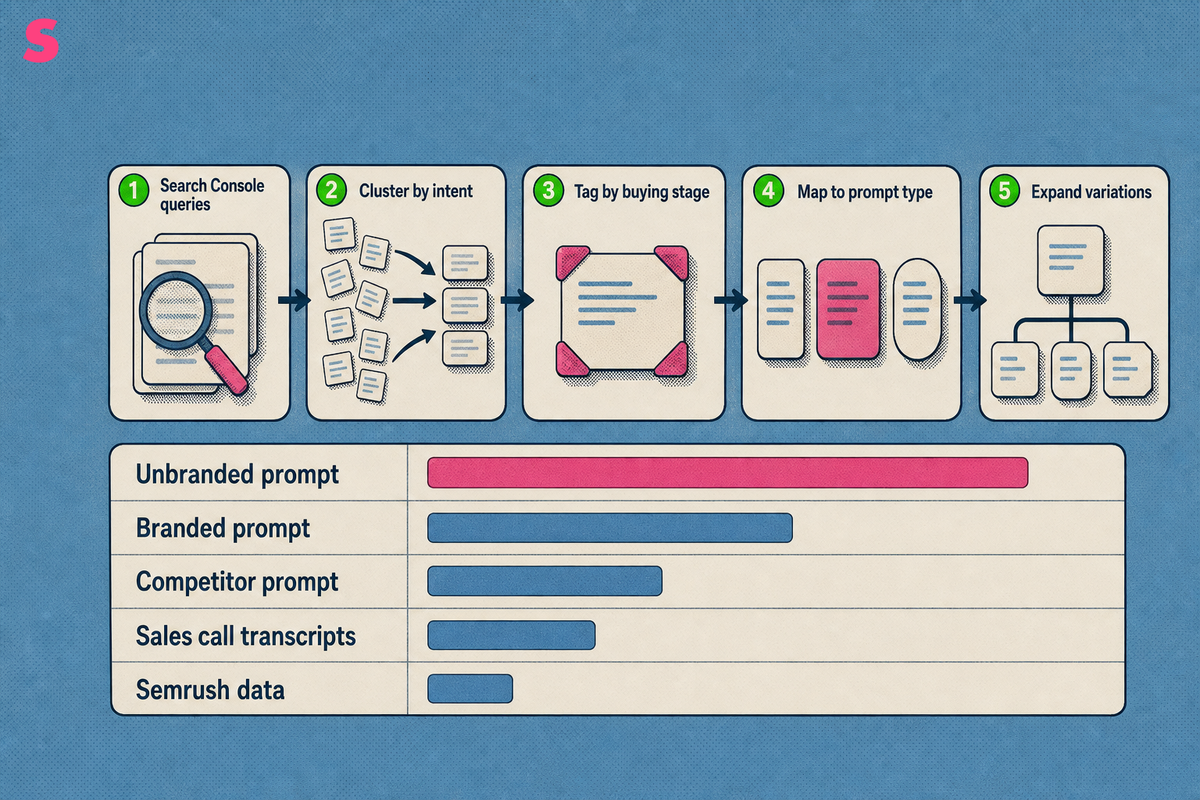
A representative prompt set starts from real buyer language, not from the brand's own keyword list, and covers every stage of the buying journey rather than only the comparison queries a marketing team finds flattering. AI brand visibility search results shift with phrasing, so a narrow prompt set measures a narrow slice of reality.
Build it in a repeatable sequence:
- Pull demand evidence from existing search data: Search Console queries, Semrush keyword data, and sales call transcripts for the phrases prospects actually use.
- Cluster near-duplicate phrasings by intent, then reshape each cluster into one or more natural-language questions a person would actually type into a chat interface, not a keyword fragment.
- Tag each prompt by intent (commercial, informational, transactional, navigational) and by buying stage (awareness, consideration, decision, purchase), since a prompt using "what is" language is worth less than one using "best" or "vs" language.
- Include unbranded category prompts, branded prompts naming the company directly, and comparison prompts naming a named competitor, because each surfaces a different failure mode.
- Expand each core prompt into its natural variations, since a single tracked question rarely matches how differently five different buyers would ask it.
Brand visibility AI search work fails most often at the first step: teams build a prompt list from what they want to be asked rather than what buyers actually ask. Sona's platform runs this as a keyword-to-prompt pipeline, scoring each candidate prompt on commercial intent, demand and winnability so the resulting list is ranked rather than arbitrary.
How should you measure AI brand visibility beyond a single mention count?
A single mention count answers one question: did the brand show up. It says nothing about where in the answer, how favorably, which sources the engine trusted, or whether the prompt that triggered it was worth winning at all.
- Share of voice: the brand's mention rate against named competitors on the same prompt set, not in isolation.
- Position within the answer: named first versus named fourth in a five-brand list is a different outcome even though both count as a mention.
- Sentiment: whether the surrounding language is favorable, neutral or negative, since a mention inside a warning is not a win.
- Citation rate: whether the engine links to or names a specific source page, a stronger signal than an unattributed mention.
- Intent and buying stage of the prompt: a high mention rate on an awareness-stage, informational question is worth less than a lower rate on a decision-stage, commercial one.
A single visibility number for the whole brand tells a team it is doing fine or badly overall; it does not say which prompts, and which sources, are producing that number. AI Search Insights breaks this down to the level of an individual tracked prompt, showing visibility, position, mentions by engine and share of voice on that one row, alongside the buying stage and intent the prompt implies.
Sona AI Visibility connects those same prompt-level results forward into pipeline: which AI-referred visits turned into signups, demo requests or closed revenue, tracked on the same account timeline as every other channel.
How volatile are AI answers, and how do you tell a real gain from noise?
AI answers to the identical prompt vary run to run, day to day, because the retrieval index changes, models get updated, and competitors publish new content that shifts what gets surfaced. A single check on a single day is a data point, not a measurement, and treating it as a trend is the most common mistake in this category.
The fix is cadence, not a smarter single check. Track the same prompt list daily, on the same engines, and read the series rather than any one run. A change that holds for four or more consecutive days is a real move. A spike that appears once and vanishes the next day is noise, most likely a temporary retrieval quirk or an unrelated model update.
This is why plans in this category are metered around daily tracking rather than sold as an occasional audit. A prompt list run once a week averages away exactly the pattern a daily series would reveal, because a week-old answer and today's answer can differ for reasons that have nothing to do with brand strategy.
What a team gets back should be a log, not a single score. The comparable series across many runs is what shows a trend, and the ranked, specific fix attached to whichever page or prompt moved is what makes that series something to act on.
What do AI brand visibility companies and tools actually compare on?
AI brand visibility companies differ on four things: which engines they track, how many prompts the entry plan covers, whether they price for agencies managing multiple clients, and what a tracked prompt actually costs once the unit is normalized. Vendors publish these numbers inconsistently, so a raw price comparison across them is misleading without normalization.
Two collection methods sit underneath these tools. Some capture the end-user experience directly, scraping the prompt response the way a person would see it on screen, ads, formatting and all. Others pull from a vendor's official API, which returns a structured response that does not necessarily match what a real user sees.
The table below prices each tool's entry plan against one shared denominator: cost per prompt tracked daily on one model, computed by dividing the entry price by the daily answers that plan buys. That normalization matters because vendors count prompts differently: a headline "50 prompts" checked across three engines is really 150 daily answers, not 50, and dividing price by the wrong number produces a multiple-fold error.
| Tool | Starting price | Agency Plans? | # of Answer Engines Tracked | Answer Engines | # of Daily Tracked Prompts (entry plan) | Cost per Daily Tracked Prompt | Differentiation |
|---|---|---|---|---|---|---|---|
| Sona AI Visibility | Brands from $75/month, agencies from $199/month, both billed annually. 14-day free trial, no credit card. | Yes | 11 | ChatGPT, Gemini, Google AI Mode, Google AI Overviews and Perplexity on standard, plus Claude, DeepSeek, Grok, Copilot, Qwen and Mistral on premium | 5,000 credits/month, about 166 daily tracked prompts on one model, or 56 across three | $0.45 per daily tracked prompt | Connects citations and prompts to pipeline and revenue on one account timeline, and infers the likely prompt behind an AI-referred visit to score the account on intent |
| Profound | From $99/month (Starter), $399 (Growth), billed yearly | Yes | 1 | ChatGPT only | 50 prompts and 1,500 responses/month | $1.98 per daily tracked prompt | Focus: tracking ChatGPT mentions and responses at scale, with a broader engine set on higher tiers |
| Peec AI | From $80/month (Starter), annual billing | Yes | 3 | ChatGPT, Google AI Mode, Google AI Overviews, Microsoft Copilot, Perplexity, Gemini | 50 prompts tracked daily on 3 chosen models | $0.53 per daily tracked prompt | Focus: prompt tracking across a buyer-selected set of three answer engines |
| Otterly.ai | From $29/month (Lite) | Yes | 4 | ChatGPT, Google AI Overviews, Perplexity and Microsoft Copilot | 15 prompts checked daily | $0.48 per daily tracked prompt | Focus: daily mention checks across a fixed four-engine set with unlimited team members on every plan |
| Scrunch AI | Core $250/month for brands | Yes | 4 | ChatGPT, Perplexity, Google AIO and Copilot | 125 unique prompts | $1.50 per daily tracked prompt | Focus: tracking unique prompts against a four-engine answer set for brand and agency accounts |
| AthenaHQ | From $295/month (Starter) | Yes | 10 | ChatGPT, Perplexity, Google AI Overviews, Google AI Mode, Gemini, Claude, Copilot, Grok and DeepSeek | 3,600 credits/month, where 1 credit is 1 AI response | $2.46 per daily tracked prompt | Focus: broad ten-engine coverage sold on a credit model, with a free tier available |
| PromptWatch | Essential $95/month | Yes | 4 | ChatGPT, Claude, Gemini and Perplexity | 50 prompts and 6,000 responses/month, with 500 agent credits | $0.48 per daily tracked prompt | Focus: prompt and response tracking across four core engines, with agency plans from $199/month |
| Goodie | From $399/month (Explorer) | Yes | 3 | ChatGPT, Google AI Overviews and Perplexity | 100 prompts and 3,000 AI responses/month | $3.99 per daily tracked prompt | Focus: response tracking across three core engines with a seven-day free trial |
Prices were read from each vendor's own pricing page in August and September 2026.
What does a 30, 60 and 90-day AI brand visibility program look like?
A 30, 60 and 90-day AI brand visibility program moves from measurement to content fixes to a repeatable operating rhythm, and each phase has a distinct job. Trying to do all three at once is why most first attempts stall out after the initial audit.
- Days 1 to 30: baseline and audit. Build the prompt set covering unbranded, branded and comparison queries. Run it across the engines that matter for the category. Audit the technical layer, since a page with missing schema markup, a blocked crawler or stale content cannot win a citation regardless of how good the underlying product is. Establish the starting mention rate, share of voice and sentiment as the baseline everything else gets measured against.
- Days 31 to 60: fix and publish. Work the audit findings in priority order: crawlability and structural issues first, since an engine that cannot fetch or parse a page will never cite it no matter what the copy says. Publish or refresh the comparison content, FAQ pages and structured data that retrieval-based engines actually pull from. Expand digital PR and third-party coverage, since chat-trained models lean on independent mentions more than on-site copy.
- Days 61 to 90: measure and operationalize. Compare the daily-tracked series against the day-30 baseline to separate real gains from noise. Fold the prompt list into a recurring weekly or monthly content cadence, keep the technical audit on its own re-audit schedule, and route alerts on lost citations or competitor overtakes to the team that owns the fix.
Sona AI Visibility supports this sequence in one place: baseline tracking, a per-page technical audit scored across crawlability, content structure, content quality, security, performance and accessibility, and automated alerts when a competitor overtakes a tracked prompt.
Frequently Asked Questions
Does AI brand visibility replace traditional SEO?
No. Traditional SEO remains the foundation for crawlability and content quality: an engine still has to find, parse and trust a page before it can cite it. AI brand visibility extends measurement to a different question, namely how that same content gets summarized, cited or recommended inside a generated answer rather than ranked as a clickable link.
Can a brand pay to be mentioned by ChatGPT or Perplexity?
No direct paid placement exists in either engine. Visibility comes from factual consistency, structured first-party content, independent evidence such as reviews and analyst coverage, and third-party coverage that these engines draw on when generating an answer. A brand can influence its odds through better content and stronger independent presence, but it cannot buy a guaranteed mention the way it can buy a search ad.
How often should a company check its AI brand visibility?
Use a fixed prompt set, observed on a regular cadence, across multiple engines rather than checking once. A single query on a single day is not a reliable reading, because AI answers vary meaningfully between runs even for the identical prompt. Daily tracking is what separates a change that holds from a one-day fluctuation that means nothing.
Does a high AI mention rate mean a brand is winning business from it?
Not on its own. A mention is an intermediate signal, not a business outcome, and B2B teams need to connect it to branded search lift, direct traffic, demo requests and influenced pipeline to know whether the visibility is paying off. Sona AI Attribution ties AI-referred visits to that downstream activity on one account timeline.
What counts as a citation versus a mention in AI visibility tracking?
A mention is the brand name appearing anywhere in the generated answer. A citation is the engine linking to or naming a specific source page it drew the answer from, which is a stronger and more actionable signal because it identifies exactly which page earned the engine's trust. Tracking both, rather than mentions alone, is what shows which content is actually doing the work.
What counts as a citation versus a mention in AI visibility tracking?
A mention is the brand name appearing anywhere in the generated answer. A citation is the engine linking to or naming a specific source page it drew the answer from, which is a stronger and more actionable signal because it identifies exactly which page earned the engine's trust. Tracking both, rather than mentions alone, is what shows which content is actually doing the work.
Are AI visibility scores from different vendors comparable?
Not reliably. Vendors use different engines, different prompt sets, different sampling intervals and different definitions of what counts as a mention, so two scores calling themselves the same metric can measure genuinely different things. Buyers should ask any vendor for its methodology, meaning which engines, how many prompts, and how often they run, before comparing a score across tools.
Summarize this article with AI: ChatGPT · Claude · Perplexity · Google AI Mode
Last updated: September 2026







