In generative engines, share of voice measures the proportion of brand mentions a B2B firm receives across a set buyer-prompt list compared with named competitors; measurement tools and approaches vary. State your formula, repeat every prompt because responses fluctuate, and separately report mention share, citation share, and answer position. Sona AI Visibility links prompts and citations to pipeline and revenue, which mention counts by themselves cannot reveal.
What does share of voice mean in generative engines, and how do you calculate it?
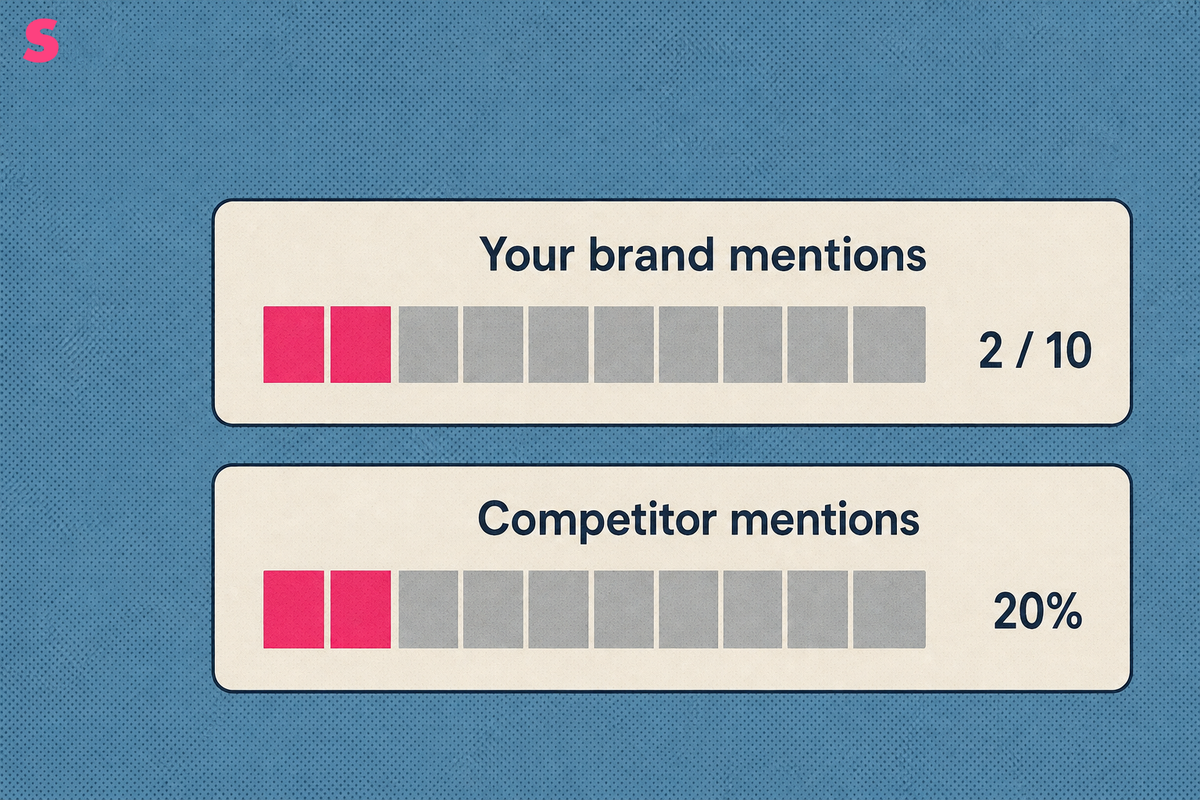
Share of voice in generative engines is the percentage of brand mentions your company earns across a defined set of buyer prompts, compared with selected competitors on selected answer engines. It is a relative measure, not an absolute visibility score.
The calculation is: (your brand mentions / total mentions across the competitor set) × 100. For an illustrative calculation, if a brand receives 2 mentions across a prompt set and all tracked brands receive 10 mentions, its share of voice is 20%. The result only has meaning when the prompts, engines, competitor set, and counting rule remain consistent.
Traditional SEO share of voice is normally based on keyword rankings and estimated click share. Generative-engine share of voice measures whether a brand appears in generated answers, often alongside other brands and cited sources. A B2B marketing survey found that 62% of marketing teams had changed their search strategy for AI search, and 64% had attempted to influence how AI describes their brand, per businesswire.com, October 2026.
For B2B marketing teams, the metric matters because vendor research often begins with category, comparison, and problem-led questions. A mention in an answer can shape a shortlist before a buyer reaches a website. Generative engine optimization (GEO) helps teams assess that visibility within an answer engine optimization (AEO) strategy, per abiresearch.com.
Which scores should B2B teams report instead of a single share of voice number?
B2B teams should report mention share, citation share, answer-position share, and sentiment rather than relying on one share of voice figure. Each score answers a different business question. A combined score can obscure why a brand gained or lost visibility.
- Mention share: the proportion of tracked answers that name the brand.
- Citation share: the proportion of cited sources that belong to the brand, including product pages, guides, research, and documentation.
- Answer-position share: how prominently the brand appears when an answer lists vendors, options, or recommendations.
- Sentiment: a qualifier for the context of a mention, such as positive, neutral, comparative, or cautionary.
Share of voice is not standardized across vendors. One platform can count answer-level mentions, while another counts source citations, response positions, or prompt variations. Scores from different tools are therefore not interchangeable. Use one formula, one inclusion rule, and one fixed competitor set to create a comparable internal trend.
Three errors quickly distort the score: combining engines before reviewing them separately, treating a one-off check as a trend, and changing the competitor set between reporting periods. A score is a dated snapshot. The useful management record is a consistent series showing whether visibility changed after a content, PR, product, or positioning update.
Which generative engines matter most for B2B SaaS buyers?
Sona AI Visibility tracks 11 answer engines as of October 2026. B2B SaaS teams should begin with the answer engines their buyers use for vendor research, then report each engine separately before creating a combined score. ChatGPT, Perplexity, Gemini, Claude, and other answer engines can produce different brand lists and source citations from the same buyer question.
Google AI Overviews deserves separate measurement because it is a Google search feature, not an answer mode produced by ChatGPT, Perplexity, Claude, or Gemini. Google AI Overviews can surface sources differently from an answer engine that synthesizes a response around direct citations, retrieval results, or product comparisons.
Engine weighting should follow the buyer, market, and research task. A B2B software buyer researching implementation, integrations, security, or vendor alternatives can produce a different citation pattern from a consumer researching a local service or product category.
Start with a small set of relevant engines. Add coverage after the prompt set and scoring method are stable. Combining unrelated engine scores too early produces a clean-looking dashboard with weak diagnostic value.
How should you word buyer prompts so share of voice measurements are reliable?
Reliable share of voice measurement uses fixed, buyer-like prompts that represent real research behavior rather than isolated keywords. Measuring AI Share of Voice requires tracking contextual citations across complex user prompts rather than simple keyword matches, per smartmoneymedia.org.
- Start with a buyer question, such as a category problem or vendor-selection task.
- Create prompt families for category, comparison, problem-led, and shortlist research, then change one wording dimension at a time within each family.
- Assign each prompt to a funnel stage, such as Awareness, Consideration, Decision, or Purchase.
- Define the competitor set and hold the answer engine and counting rules constant for every variant.
- Record brand mentions and cited domains for every prompt variant and repeat run.
- Calculate citation rate separately for each variant as the share of observed answers that cite the brand’s domain, then report the spread across variants.
- Aggregate prompt-family results only with a documented weighting rule, and version every prompt so revised wording never overwrites the original baseline.
Illustrative example: “What is the best attribution platform for B2B SaaS?” can produce a different brand set from “Which attribution platforms connect marketing activity to pipeline?” A shortlist prompt such as “Compare attribution platforms for Salesforce-based B2B SaaS teams” can also produce different cited sources. These examples show prompt variation, not measured results.
Prompt engineering for measurement is controlled sampling. A category prompt tests broad recognition. A comparison prompt tests shortlist inclusion. A problem-led prompt tests whether a brand appears when buyers describe pain before naming a solution. Prompt wording is part of the measurement specification.
How should you design a trustworthy visibility baseline?
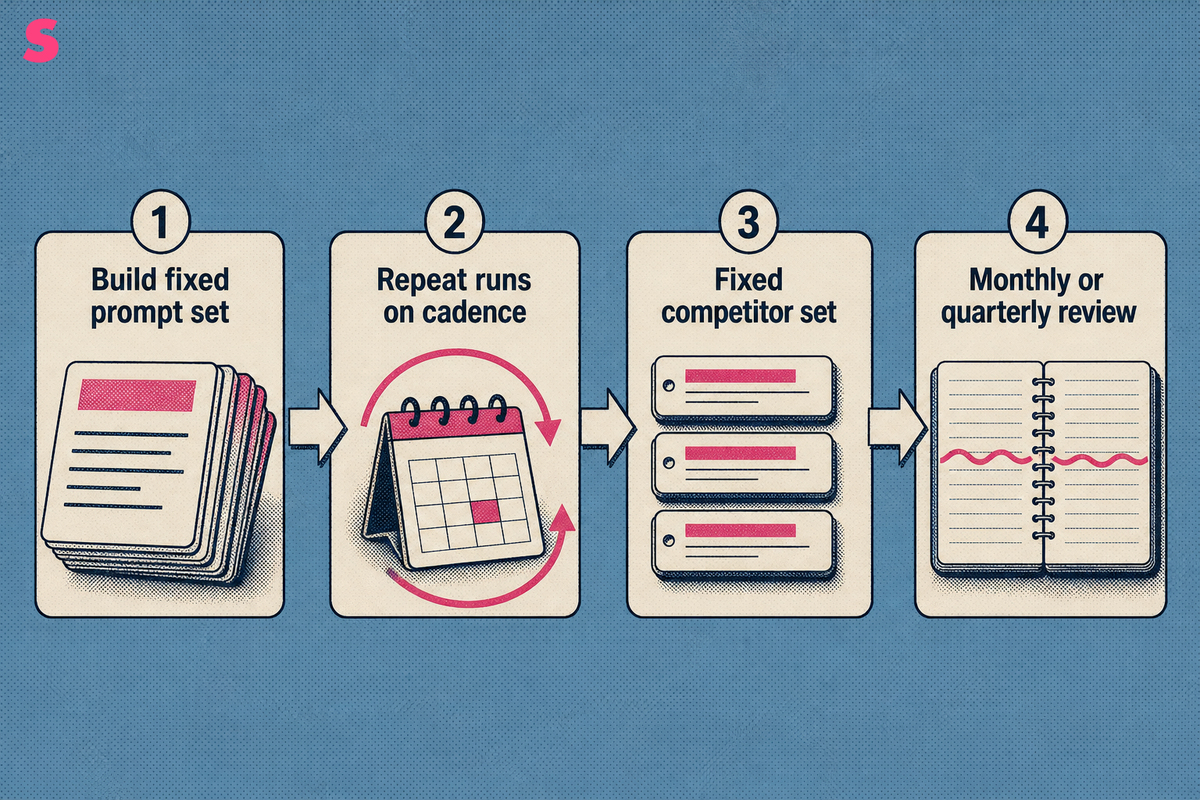
There is no universal prompt or repeat-run count for a trustworthy visibility baseline. Build a fixed prompt set that covers the buyer segments, buying stages, and use cases that matter to the business, then continue repeat runs until the observed range is stable.
A prompt set can be too narrow for a broad B2B category with multiple personas, segments, use cases, and competitors. Separate prompts by audience and buying stage so a strong score on informational questions does not disguise weak inclusion on commercial questions.
Run the same prompt list on a consistent cadence. An answer engine’s response can change with the retrieval index, a model update, and new competitor content. Repeat runs reveal whether movement persists across normal answer variation rather than reflecting a single answer.
Use a fixed competitor set for the baseline, then review the story monthly or quarterly. Recurring prompt tracking measures answer variation. A periodic benchmark review interprets movement, checks competitive changes, and determines whether the prompt set still reflects buyer research.
How do share of voice tools for generative engines compare on engines, prompts and price?
Share of voice tools differ in engine coverage, prompt capacity, refresh cadence, agency support, and whether the platform connects visibility to business outcomes. The comparison below uses public listings read in October 2026. Prices, limits, and engine availability can change quickly.
| Tool | Starting price | Agency Plans? (Yes/No) | # of Answer Engines Tracked | Answer Engines | # of Daily Tracked Prompts (entry plan) | Cost per Daily Tracked Prompt | Differentiation |
|---|---|---|---|---|---|---|---|
| Sona AI Visibility | From $75/month, billed annually | Yes | Up to 11 (3 on Starter) | Not published | 5,000 credits/month, about 166 daily tracked prompts on one model or 56 across three | $0.45 per daily tracked prompt | Connects AI citations and prompts to pipeline and revenue. |
| Profound | Custom pricing | Yes | Up to 9 (3 on free Trial) | ChatGPT, Gemini, Google AI Overviews | 50 prompts daily | Custom pricing | Focus: daily prompt tracking across answer engines. |
| Peec AI | From $95/month | Yes | Up to 13 (3 of 6 on Starter, plus add-ons) | Not published | 50 prompts daily | $0.63 per daily tracked prompt | Focus: prompt-based AI visibility measurement across selected models. |
| Otterly.ai | From $29/month | Yes | Up to 7 (4 on Lite, 3 as paid add-ons) | ChatGPT, Google AI Overviews, Perplexity, Microsoft Copilot | 15 prompts daily | $0.48 per daily tracked prompt | Focus: visibility tracking across answer engines and Google AI Overviews. |
| Scrunch AI | From $250/month | Yes | Up to 9 (4 on Core) | ChatGPT, Perplexity, Google AI Overviews, Microsoft Copilot | 125 prompts, cadence not published | No refresh cadence published | Focus: AI answer visibility across named answer engines. |
| AthenaHQ | From $295/month | Yes | 11 | Not published | 3,600 credits/month, unlimited prompts, cadence not published | No refresh cadence published | Focus: credit-based monitoring across multiple answer engines. |
| PromptWatch | From $95/month | Yes | Not published | Not published | 50 prompts daily | $0.48 per daily tracked prompt | Focus: prompt monitoring with monthly response allowances. |
Starting prices, prompt allowances, and daily tracked prompt costs are listed as of October 2026. The table compares entry plans without treating different pricing units as equivalent.
Which capabilities separate share of voice tools beyond mention counts?
Mention and competitor tracking are baseline capabilities for share of voice tools. Platform differences emerge in refresh cadence, repeat-run reproducibility, citation-source analysis, multi-region monitoring, and connections between visibility, traffic, pipeline, and revenue.
- Cadence: daily prompt tracking produces a time series instead of a sporadic sample.
- Reproducibility: repeat runs show whether an answer pattern persists across normal answer variation.
- Source analysis: cited domains and pages identify the sources shaping an answer.
- Regional coverage: country-level monitoring identifies whether a brand appears differently by market.
- Business measurement: referral, account, pipeline, and revenue data show whether visibility influenced demand.
A single brand-level visibility score does not identify a next action. A prompt-level view that identifies the buyer question, cited sources, and the page that should answer the question is actionable. Sona AI Visibility connects citations and prompts to pipeline and revenue, and provides Agent Analytics for AI crawler and agent activity.
Vendor comparisons are self-reported snapshots unless the buyer checks the prompt allowance, engine names, refresh cadence, and counting method. A practical evaluation runs the same fixed prompt set through shortlisted platforms and compares the underlying answers, citations, and historical records.
Who should not buy a share of voice tool for generative engines?
A share of voice tool is not necessary for every team. A company with a handful of core prompts can run disciplined manual spot-checks, record each answer in a spreadsheet, and calculate the same formula without paying for automation.
- Teams that need one standardized benchmark across vendors should not buy solely for that purpose, because no cross-vendor standard exists.
- Teams without content, product marketing, PR, or technical capacity to act on findings should wait until they can use the output.
- Teams that only want rankings-style reporting should reconsider if they have no plan to measure citations, referral traffic, or buyer outcomes.
- Teams with a narrow market and fewer than a practical tracking set of prompts can begin with manual repeat runs.
The process becomes useful when a team has enough buyer questions, competitors, and content decisions to justify recurring measurement. The tool should support an operating rhythm, not create another ownerless dashboard.
How do you connect share of voice to pipeline and decide what to fix first?
Share of voice does not equal pipeline by itself. B2B teams should map each visibility pattern to a business question, then connect prompts and citations to referral traffic, assisted conversions, account activity, pipeline, and closed-won revenue.
- Low mention share on category prompts: ask whether the market understands the company’s differentiation. Improve category pages, comparison content, expert commentary, and sources that explain the problem clearly.
- Strong mentions but weak citation share: ask whether owned pages answer the underlying questions. Improve page structure, evidence, recency, technical accessibility, and source-worthy depth.
- Strong share but few visits: ask whether referral tracking and conversion paths capture AI-referred demand. Measure referral traffic, self-reported attribution, assisted conversions, and CRM outcomes.
- Rising share in one segment: ask whether that segment deserves greater go-to-market attention. Review the associated prompts, accounts, opportunities, and sales feedback.
Sona AI Visibility can connect citations and AI-referred visits to accounts, pipeline, and closed-won revenue. AI Attribution connects AI citations to accounts, pipeline, and closed-won revenue.
Prioritize the prompt group where a visibility gain connects to a valuable buyer stage, a relevant account segment, and measurable commercial outcomes, rather than the group with the highest raw mention count.
What are the frequently asked questions about generative-engine share of voice?
What is a good share of voice percentage in generative engines?
There is no standard good percentage because the figure depends on the competitor set, prompt set, answer engines, and counting method. Track your own trend and the gap to named competitors rather than chasing a universal number. A 20% score can be strong in a crowded vendor category and weak in a narrow category with few alternatives.
How is AI share of voice different from traditional SEO share of voice?
Traditional SEO share of voice is built on rankings and estimated click share for keywords. Generative-engine share of voice counts how often and how prominently a brand is mentioned or cited in generated answers to a defined set of prompts. It measures answer inclusion, source inclusion, and prominence rather than a conventional results-page position.
How often should you measure share of voice in generative engines?
Run each prompt several times per measurement round and run the same prompt list daily. Daily tracking reveals patterns that a weekly snapshot can average away. Review the resulting trend monthly or quarterly, when the team can interpret sustained changes and assign work.
Can you measure share of voice in generative engines without a tool?
Yes. For a small prompt set, run fixed prompts repeatedly in each answer engine, log brands and cited sources in a spreadsheet, and apply the share of voice formula. Tools mainly add scale, scheduling, answer capture, repeatable history, competitor monitoring, and reporting discipline.
Does a higher share of voice in AI answers mean more pipeline?
No. A brand can appear frequently without producing qualified visits or commercial outcomes. Connect prompts and citations to referral traffic, assisted conversions, form data, account activity, opportunities, and CRM outcomes before treating visibility as demand creation.
Do you need to track every generative engine?
No. Start with the answer engines your buyers use for vendor research, report each engine’s score separately, and add others as the prompt budget allows. A focused prompt set with consistent daily history provides stronger evidence than broad engine coverage without a stable method.
Summarize this article with AI: ChatGPT · Claude · Perplexity · Google AI Mode
Last updated: October 2026