


An AI visibility score is a 0 to 100 measure of how often and how prominently a brand appears in AI-generated answers across engines like ChatGPT, Gemini, Perplexity and Google AI Overviews, compared to others in its industry. Tools calculate it from mention rate, prominence, sentiment and citation frequency, but coverage varies widely by platform. Sona, which connects AI citations and prompts to pipeline and revenue on one account timeline, treats AI search as a measurable channel rather than stopping at a mention count.
What is an AI visibility score?
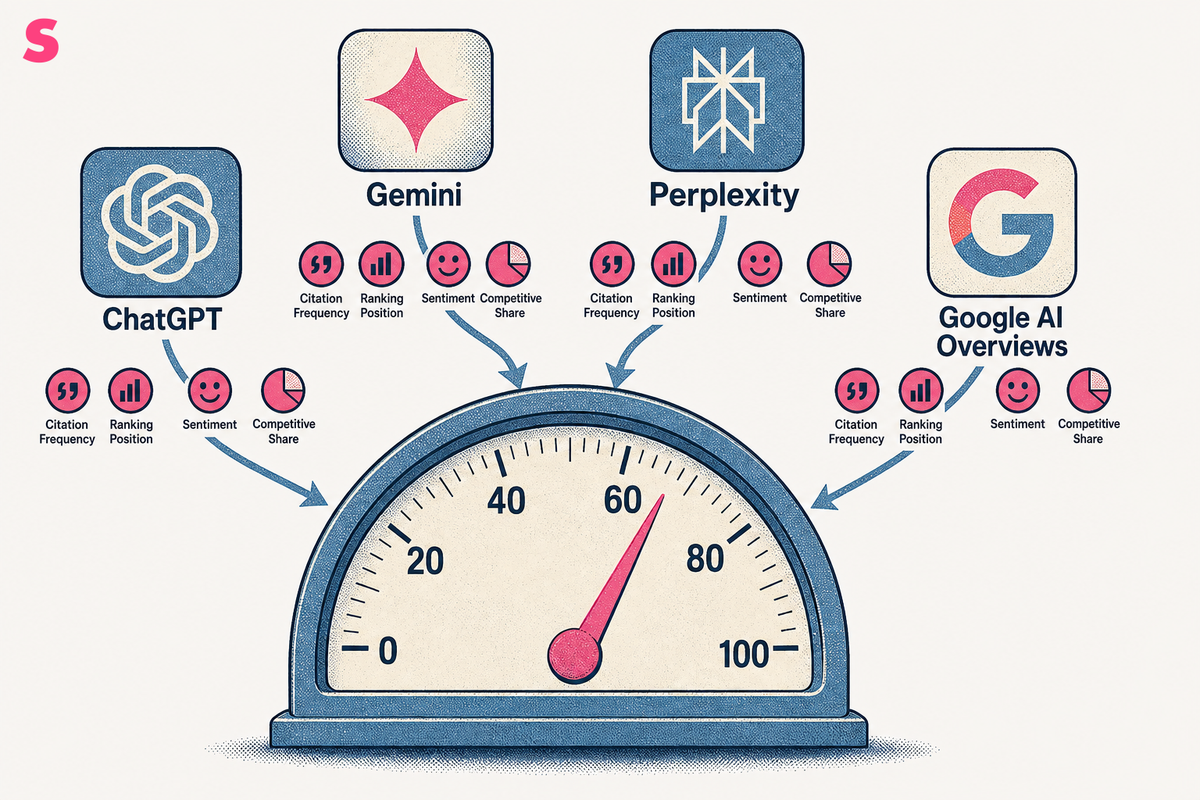
An AI visibility score is a composite measure that represents how often a brand appears in AI-generated answers compared with others in its industry. It condenses citation frequency, ranking position, and competitive share into one figure so a marketing team can track presence across ChatGPT, Gemini, Perplexity, and other answer engines without manually reading through the underlying transcripts.
That composite framing matters: the score is not one signal but several, blended into a single figure for convenience.
AI visibility scores exist because traditional rank tracking cannot answer a simpler question: does a named brand show up when a buyer asks an AI engine for a recommendation? A brand can rank first on Google and still be absent from a ChatGPT answer, because the two systems retrieve and synthesize information differently. The score exists to close that blind spot.
Most vendors calculate the figure by running a fixed set of industry-relevant prompts against several AI engines on a recurring schedule, then counting how often the brand is mentioned, cited, or recommended relative to competitors answering the same prompts. The output is a single benchmark figure that a team can watch move over time.
How does an AI visibility score differ from an LLM visibility score?
An LLM visibility score and an AI visibility score describe the same underlying idea: how often a brand surfaces in machine-generated answers. The terms are used interchangeably by most vendors, though "LLM visibility score" leans toward chat-based models specifically, such as ChatGPT, Claude, and Gemini, while "AI visibility score" is the broader umbrella that also covers Google AI Overviews and AI Mode results built on retrieval rather than pure generation.
That distinction is worth keeping straight because the underlying engines behave differently. A large language model answering a chat prompt draws on training data and, increasingly, live web retrieval. Google AI Overviews sits inside search results and pulls more directly from indexed pages. A tool that only tracks LLM chat answers can miss a brand's presence in AI Overviews entirely, and vice versa.
So what does an AI visibility score capture, in practical terms, once this distinction is made? It captures the wider net: any metric that tries to represent brand presence across the full spread of AI-mediated answers a buyer might encounter, not just one model family. A team evaluating tools should ask exactly which engines are counted before comparing numbers, because "LLM visibility" and "AI visibility" are sometimes used to mean narrower or broader things depending on the vendor.
What signals make up an AI visibility score?
An AI visibility score is built from several distinct signals, not one. AI Visibility tools measure multiple dimensions including rankings, share of voice, sentiment, average position, and platform-level movement, and most published scores are a weighted blend of these rather than a raw mention count.
The core signals worth understanding are:
- Mention frequency: how often the brand appears at all across a defined set of prompts.
- Share of voice: the brand's mentions as a proportion of all competitor mentions on the same prompts.
- Position or ranking: where the brand sits within an answer, first mentioned versus buried in a list.
- Sentiment: whether the answer describes the brand favorably, neutrally, or negatively.
- Citation and source tracking: which web pages the AI engine drew on to generate the answer, since AI Visibility Scores measure how frequently and prominently a brand is mentioned across AI answer engines for relevant industry questions.
These signals combine differently depending on the vendor's weighting model, which is exactly why two tools scoring the same brand can land on different numbers. A brand with high mention frequency but poor sentiment might still land a mediocre score, while a brand mentioned less often but always favorably and in first position can outperform it. Understanding which signals feed the number matters more than the number itself.
How do different tools calculate an AI visibility score?
Every tool calculates an AI visibility score by running a defined prompt set against a defined list of AI engines, then aggregating the results into a scale. The mechanics are fairly consistent across vendors, but the inputs, the prompt library, the engine list, and the weighting formula, are not standardized, so an AI visibility score in one tool is not identical to the same phrase in another.
The typical calculation follows a repeatable sequence:
- Define a set of industry-relevant prompts a real buyer might ask.
- Run each prompt against the selected AI engines on a recurring schedule.
- Record whether, where, and how the brand is mentioned in each answer.
- Score sentiment and position for each mention.
- Aggregate mentions, position, and sentiment into a single weighted score, benchmarked against competitors answering the same prompts.
Some tools deliver a fast, lightweight version of this process. Some AI Visibility tools deliver results in 30 seconds or less without requiring signup, which suits a quick spot check but trades depth for speed. Others run continuously against a much larger prompt library, which suits ongoing monitoring rather than a one-time snapshot. A team choosing between them should match the tool's refresh cadence and prompt depth to how often the brand's competitive landscape actually changes.
Which AI platforms does each visibility tool actually track?
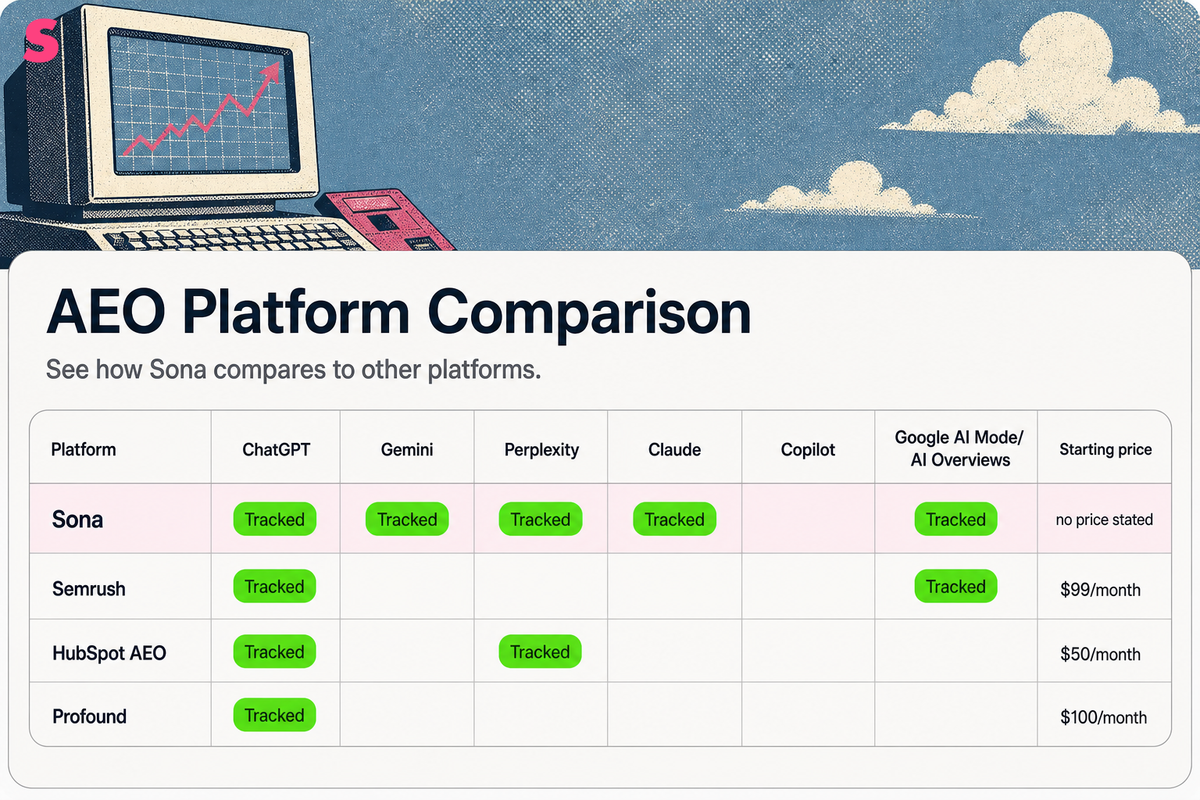
Coverage varies significantly by tool, and this is the detail most buyers skip before signing a contract. AI Visibility tools track brand mentions and citations across multiple platforms including ChatGPT, Gemini, Perplexity, Claude, and Copilot, but no two vendors track an identical list.
The table below compares platform-by-platform coverage across several named tools, based on the researched figures available for each. Where the available research does not establish a tool's coverage of a given platform, the cell says so rather than guessing.
| Tool | ChatGPT | Gemini | Perplexity | Claude | Copilot | Google AI Mode / AI Overviews | Starting price | Coverage gap |
|---|---|---|---|---|---|---|---|---|
| Sona | Tracked | Tracked | Tracked | Tracked | Not established by the available research | Tracked | Not established by the available research | Copilot coverage not established by the available research. Sona's own AI visibility data, August 2026, records 11 distinct engines in its brand archive: chatgpt, chatgpt_scrape, perplexity_scrape, gemini_google_ai_mode_scrape, gemini_scrape, mistral, qwen, anthropic, google_ai_overview, gemini, and perplexity. |
| Semrush | Tracked | Tracked | Not established by the available research | Not established by the available research | Not established by the available research | Tracked | $99/month for the AI Visibility Toolkit | Perplexity, Claude, and Copilot coverage not established by the available research. Semrush's AI Visibility Score is defined as a 0 to 100 metric representing how often a brand appears in AI-generated answers compared with others in its industry. |
| HubSpot AEO | Tracked | Not established by the available research | Tracked | Not established by the available research | Not established by the available research | Not established by the available research | $50/month ($45/month billed annually) | Gemini, Claude, Copilot, and Google AI Mode or AI Overviews coverage not established by the available research. |
| Profound | Tracked (Explorer plan) | Not established by the available research | Not established by the available research | Not established by the available research | Not established by the available research | Not established by the available research | $100/month for the Explorer plan, up to $2,000/month for Pro, with custom Enterprise pricing available | Gemini, Perplexity, Claude, Copilot, and Google AI Mode or AI Overviews coverage on the Explorer plan not established by the available research; the Explorer plan is ChatGPT only. |
Several other tools compete in this category as well. Multiple AI visibility tools are compared in the market, including Sona, Frase, Profound, Peec AI, Semrush, Athena, SE Ranking, Positive Surfer, Writesonic, and Otterly.ai, each with its own prompt library and engine list. The practical lesson is to confirm exactly which engines a vendor tracks before comparing its score against another tool's score, since a brand strong on Perplexity but absent from Copilot will score very differently depending on which platforms are included.
What does a good or poor AI visibility score look like?
A good AI visibility score puts a brand consistently ahead of its named competitors across the majority of tracked prompts, with favorable sentiment and early positioning in the answer. A poor score means the brand rarely appears, appears late in a list, or appears with neutral or negative framing, even when competitors are named clearly.
Because the underlying scale represents relative standing against industry peers, a given figure only means something in context. A moderate score in a crowded, highly competitive category can represent solid standing, while the same figure in a category with only a few competitors might indicate real weakness. AI visibility scores are always comparative, never absolute.
Three patterns tend to separate a strong score from a weak one:
- Strong scores correlate with frequent, recent, well-structured content that directly answers the buyer questions being tracked.
- Weak scores often trace back to thin or outdated pages that AI crawlers have deprioritized in favor of fresher competitor content.
- Sentiment drags a score down even when mention frequency is high, if the content cited paints the brand unfavorably or inaccurately.
Reading the score alone will not explain which of these is happening. A single brand-level number tells a team whether it has a problem, not which prompts are driving it or which sources AI engines are pulling from to generate the answer. AI Search Insights addresses that gap directly by tracking citation and source-authority data alongside sentiment at the level of individual prompts and topic clusters, turning a benchmark figure into a list of specific pages and prompts a content team can act on.
How does AI visibility relate to traditional SEO visibility (search engine optimization)?
AI visibility and traditional SEO visibility measure related but distinct things. SEO visibility tracks how a page ranks in organic search results. An AI visibility score tracks whether a brand is mentioned, cited, or recommended inside a generated answer, which may or may not link back to the page at all.
The two are connected because AI engines still rely heavily on crawled and indexed web content to generate answers, so strong SEO fundamentals, clean site structure, authoritative backlinks, well-organized pages, still influence whether a brand gets cited. But what does an AI visibility score capture that SEO visibility does not? Zero-click answers. A buyer can read a full answer inside ChatGPT or Google AI Overviews and never click through to the source page, meaning a brand can be well-cited and well-regarded in AI answers while traditional referral traffic barely moves.
That gap is exactly why attribution has become a separate problem from ranking. A brand doing well in AI answers but seeing no corresponding lift in web analytics is not necessarily failing; it may simply be winning in a channel that classic web analytics was never built to see. Closing that measurement gap requires tools built specifically to trace AI-driven research back to pipeline, rather than relying on SEO dashboards designed for a click-based world.
How can a B2B SaaS team improve its AI visibility score?
A B2B SaaS team improves its AI visibility score by publishing content that directly answers the specific prompts its buyers ask AI engines, then confirming that content is technically accessible to AI crawlers. Improving the number requires treating it as a byproduct of two separate efforts: content relevance and crawler access, not a metric to chase directly.
Concrete steps that consistently move an AI visibility score:
- Identify the actual prompts buyers use, not just the keywords they type into Google.
- Build or update pages that answer those prompts directly and completely, since AI Visibility Scores measure how frequently and prominently a brand is mentioned for relevant industry questions.
- Verify robots.txt and site structure allow AI crawlers to reach and index the content.
- Track sentiment and correct any factually wrong or outdated citations found in existing AI answers.
- Recheck performance on a recurring schedule rather than once, since answers shift as models update.
This is where the difference between an LLM visibility score and pipeline impact becomes concrete. Knowing a brand's mention count went up does not tell a demand generation team whether that visibility produced a lead. Intent Signals addresses that link by inferring the likely prompt behind an AI-referred visit and rolling committee-level signals into a single account score, so a rising AI visibility score can be tied to specific accounts actively researching the category rather than treated as an abstract benchmark.
What are the limitations of relying on an AI visibility score?
An AI visibility score has real limitations, and the biggest is that it is a proxy, not a revenue measure. A brand can post a strong AI visibility score and still see no measurable change in pipeline, because the score describes presence in an answer, not what the person reading that answer did next.
Several other limitations are worth naming plainly:
- Scores are not standardized. Vendors weight mentions, sentiment, and position differently, so AI visibility scores from two tools are not directly comparable.
- Platform coverage varies. A tool tracking a narrower set of engines will produce a different number than one tracking a broader set, even for the identical brand and identical prompt set.
- Prompt sets are curated by the vendor, not the buyer, so the score reflects the tool's assumptions about relevant questions, not necessarily the full range of what real buyers ask.
- Scores refresh on a schedule, not continuously, so a snapshot can lag behind a genuine shift in how an AI engine is answering a given question.
Because an LLM visibility score cannot answer whether visibility converted into a deal, it needs to sit alongside attribution data, not replace it. AI Attribution addresses this by tying AI search visibility directly to pipeline and revenue, connecting specific prompts and citations to the deals they influenced rather than treating visibility as the finish line.
Frequently Asked Questions
Is an AI visibility score the same across every tool?
No. Scoring scales, weighting formulas, and platform coverage differ by vendor, so a given score in one tool is not directly comparable to the same-looking score in another. Always confirm which engines and prompts a vendor uses before comparing numbers across tools.
How often should a brand check its AI visibility score?
Most B2B SaaS teams check on a recurring schedule rather than once. Prompt-level answers and citations shift as models update and competitors publish new content, so a score checked only occasionally can miss meaningful movement in either direction.
Does a higher AI visibility score mean more website traffic?
Not directly. Visibility measures appearance in AI answers, while actual referral traffic and pipeline impact require separate attribution tracking, since many AI-generated answers never send a click back to the source page at all.
Can a small brand get a meaningful AI visibility score?
Yes. Scores are typically normalized against a defined set of industry competitors and prompts, so smaller brands can still register measurable presence even without the scale of a market leader.
What roles typically own AI visibility score reporting?
Content, SEO, and demand generation teams commonly share ownership, with marketing operations or analytics teams handling the reporting cadence and making sure the number reaches revenue-facing stakeholders.
Do AI visibility scores update in real time?
Most tools refresh on a scheduled cadence rather than instantly. Re-querying multiple AI engines across many prompts takes processing time, so scores are typically a snapshot from the most recent scheduled run rather than a live figure.
Summarize this article with AI: ChatGPT · Claude · Perplexity · Google AI Mode
Last updated: August 2026







