First-party data refers to information a business gathers directly from its own audiences via its website, app, transactions, CRM, email, and other owned touchpoints. It differs from second-party, third-party, and zero-party data based on who collects it and how it is shared. It is not inherently accurate or compliant, so consent, quality, and identity matching still require work. Begin with sources you already own, then add identity resolution and measurement. Sona Marketing Measurement connects your owned data sources, AI search included, to accounts, pipeline and revenue on one identity graph, which helps when your owned data sits in separate tools.
What is first-party data versus second-party, third-party and zero-party data?
First-party data is information a company collects directly through its own website, CRM, product, transactions, and other owned touchpoints.
It connects customer activity to sales processes and revenue records. A B2B company might collect a form submission, pages viewed, webinar attendance, email engagement, and an opportunity stage in its CRM. These signals describe a direct relationship with a buyer or account.
| Data type | Who collects it first? | How your company receives it | B2B example |
|---|---|---|---|
| First-party data | Your company | Collected through owned channels | A demo request, website session, or CRM opportunity |
| Second-party data | A partner company | Shared directly under an agreement | A webinar partner shares registrant details |
| Third-party data | Another organization | Bought or licensed through a provider | A prospect list assembled from external sources |
| Zero-party data | The individual | Voluntarily stated to your company | A buyer selects preferred topics in a survey |
Zero-party data is first-party data that a person intentionally provides. A stated product interest is zero-party data. A visit to a pricing page is first-party behavioral data.
First-party data is not automatically accurate, permissioned, or useful. Duplicate contacts, stale fields, weak event definitions, and disconnected systems can make directly collected data unreliable. Data ownership describes where information came from, not its quality or governance.
What types of first-party data can a B2B company collect?
A B2B company can collect identity, behavioral, transactional, firmographic, engagement, and preference data to understand accounts and guide buyer journeys.
Each type supports a different decision. Identity data tells the team who engaged. Behavioral data shows what they did. CRM and transaction data reveal whether the account became pipeline or revenue. First-party analytics combines these records for targeting, campaigns, and follow-up.
| Data type | Examples | Primary use | Common owner |
|---|---|---|---|
| Identity data | Name, business email, phone, account | Match people to accounts and CRM records | Marketing operations |
| Behavioral data | Page views, form starts, product activity | Identify interest and buying-stage signals | Demand generation |
| Firmographic data | Company size, industry, location | Assess ICP fit and segment accounts | RevOps |
| Engagement data | Email clicks, webinar attendance, event scans | Plan nurture and sales follow-up | Lifecycle marketing |
| Revenue data | Opportunity value, closed-won date, purchase history | Measure pipeline and revenue influence | Sales operations |
| Preference data | Topics, communication choices, survey responses | Personalize content and contact strategy | Lifecycle marketing |
First-party tracking records events on owned properties, such as a documentation visit or trial signup. First-party analytics joins those events to business outcomes. A page-view count shows activity. A page view tied to an account, opportunity, and closed-won result becomes a measurement signal.
Email newsletters are a major collection channel. Sixty-three percent of advertisers named newsletters as their main first-party collection channel, per sci-tech-today.com, June 2026. Email data becomes more useful when connected to website behavior and CRM outcomes.
Why does a first-party data strategy matter in a cookieless world?
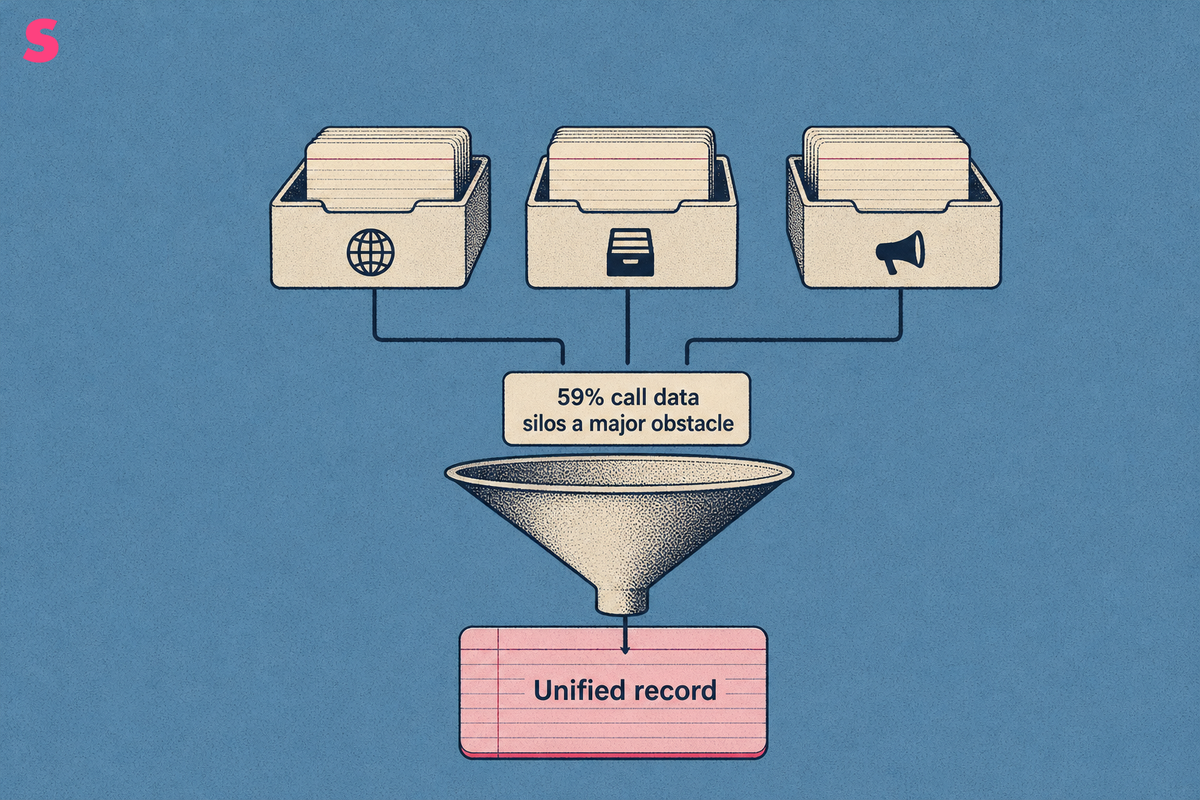
A first-party data strategy matters in a cookieless world because it creates a direct, governed record of customer and prospect interactions.
Third-party cookies and external identifiers gave marketers signals across sites outside their control. As those signals decline, owned channels matter more for audience building, measurement, and activation. Per McKinsey, once third-party cookies and identifiers are gone, marketers must rely on data from consumers who consent to share behavioral and demographic insights.
Fragmentation creates the operational problem. A website platform sees sessions, the CRM sees contacts, and ad platforms see conversions. Fifty-nine percent of marketers identify data silos as a major obstacle to effective first-party data use, per sci-tech-today.com, July 2026. A strategy defines shared identifiers, consent status, event names, and business outcomes.
Direct collection needs a clear value exchange. A useful report, event registration, product trial, or relevant newsletter can justify an information request. Gartner recommends prioritizing data around customer needs, tailoring incentives, and making data practices transparent, per Gartner.
AI search increases the need for connected first-party records. Buyers may research through AI answers before visiting a site, then arrive through branded search or a direct visit. Without identity and journey data, that demand may appear as direct traffic without a connection to earlier research.
What are examples of second-party data versus third-party data?
Second-party data is another company’s first-party data shared directly under a defined commercial or marketing agreement.
A co-hosted webinar offers a clear example. Two B2B companies agree on registration language, fields, follow-up rights, and data handling. One partner then shares registrant details with the other. The recipient did not collect the data directly, but the source company did.
- Partner lead sharing: a technology partner shares leads from a joint campaign.
- Event sponsorship: an event organizer provides attendee data under agreed terms.
- Publisher programs: a publisher shares readers who requested a report or demo.
- Channel relationships: a reseller shares account engagement from a joint sales motion.
Third-party data follows a different path. A provider assembles, enriches, or sells it between the original data source and the buyer. Third-party data can extend reach, but teams need to test freshness, permitted uses, matching rules, and field provenance before activation.
Second-party data is often confused with a purchased prospect list. The distinction is directness and agreement. A named partner sharing its own audience data is second-party. A provider selling records gathered from many sources is third-party. Neither becomes first-party data merely because it enters your CRM.
What is a first-party identity graph?
A first-party identity graph links owned-channel identifiers so anonymous activity, known contacts, and account records appear in one buyer journey.
The graph uses connection points such as a business email, form submission, authenticated product session, CRM contact, account domain, or campaign response. It does not turn every visitor into a known person. It records available evidence and preserves the difference between an anonymous session and a confirmed contact.
- Collect first-party events from the website, forms, product, CRM, and email systems.
- Standardize identifiers, event names, timestamps, and consent records.
- Match known contacts to accounts using approved business identifiers.
- Associate earlier anonymous activity when a valid identifier connects it.
- Use the resulting journey for routing, attribution, and reporting.
For example, an anonymous visitor reads an integration page on Monday. On Thursday, the same person submits a work email for a webinar. The identity graph can connect the earlier page visit to the known contact, then roll the contact into the company account. Sales can see engagement context instead of a disconnected form fill.
Sona Marketing Measurement is built with AI search as a native channel in the same identity graph as paid, content, email, and sales. Sona resolves anonymous and known traffic into account and contact profiles, then stitches touches into account and person-level journeys. AI-referred visits can be resolved to accounts and connected to later pipeline without treating modeled influence as booked revenue.
What is first-party analytics, and which metrics matter?
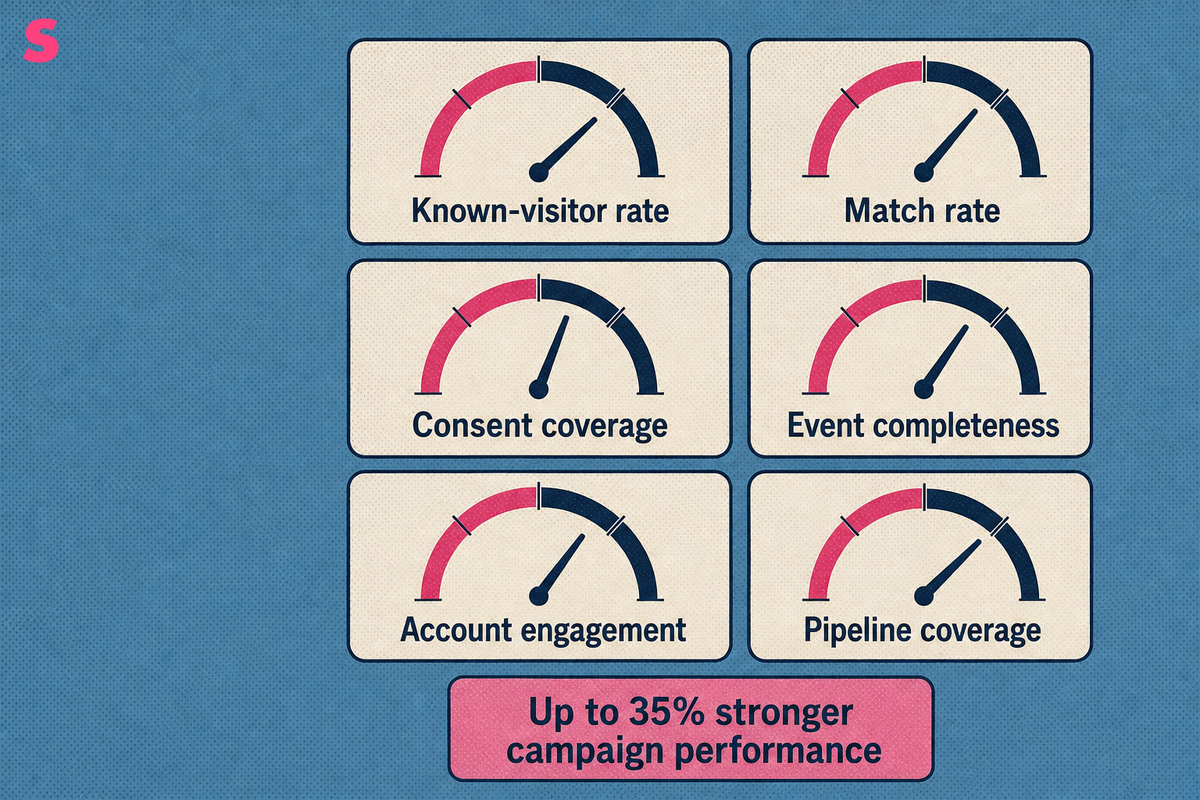
First-party analytics uses data from owned channels to measure buyer behavior, account progress, campaign outcomes, and revenue contribution.
The goal is to make decisions with records traceable to a source, customer interaction, and business outcome. A first-party analytics program should show whether data is complete enough for targeting, routing, and measurement.
- Known-visitor rate: the share of relevant visits connected to an identified contact or account.
- Match rate: the share of records that connect across systems without duplicates or conflicts.
- Consent coverage: the share of records with a recorded consent status and collection purpose.
- Event completeness: the share of priority journeys with required events and timestamps.
- Account engagement: the depth and recency of activity across a buying group.
- Pipeline coverage: the share of opportunities with connected marketing and sales touchpoints.
Campaign performance is a business metric, not proof of healthy data. Still, organizations with unified first-party data strategies report up to 35% stronger campaign performance, per sci-tech-today.com, July 2026. Teams should validate that claim within their own funnel by comparing defined audiences, conversion paths, and pipeline outcomes over a consistent period.
First-party analytics also needs exception reporting. Track duplicate rates, missing account domains, unmapped campaign values, and stale CRM fields. Clean measurement depends on exposing these failures early, not hiding them in an aggregate conversion chart.
How do you build a first-party data strategy from consent to revenue measurement?
A first-party data strategy starts with consent and business purpose, then connects collection, identity, activation, and revenue measurement in one operating model.
Start with the decisions the data must support. A demand generation leader may need to prioritize accounts. A marketing operations team may need reliable audience syncs. A revenue leader may need to understand which touch combinations moved opportunities forward. Each decision requires specific fields, events, owners, and retention rules.
- Define the use case: specify the decision, audience, and revenue outcome.
- Set governance: document purpose, consent status, access rules, and retention limits.
- Map collection points: audit forms, web events, product events, CRM fields, and offline interactions.
- Standardize data: establish naming rules for campaigns, events, accounts, and lifecycle stages.
- Resolve identity: connect contacts, accounts, and anonymous signals where valid evidence exists.
- Activate and measure: route qualified signals, build audiences, and connect campaign activity to pipeline.
Data collection should remain proportional to the stated purpose. Collecting every possible field creates cost, maintenance work, and privacy exposure. Gartner notes that first-party data cost estimation includes hidden dependencies and cost drivers across five planning areas, per Gartner. A narrow initial use case is easier to govern and prove.
AI search belongs in the measurement design. AI engines can influence a shortlist without sending a click, while directly referred visits can be measured as their own channel. Self-reported attribution, reconciled with click data, helps capture research that never produced a visible referral.
Which first-party data sources should you prioritize first, based on your maturity?
Prioritize first-party data sources by measurement maturity, starting with CRM, website, consent, and conversion records before complex enrichment or activation workflows.
Do not collect every available signal. Establish reliable records where prospects identify themselves, engage with the company, and become pipeline. AdExchanger identifies missing core contact details, including name, postal address, email, and phone, as a common activation mistake.
| Maturity stage | Priority sources | Core question answered | First operating outcome |
|---|---|---|---|
| Foundation | CRM contacts, accounts, consent records | Who is in the database? | Cleaner records and defined ownership |
| Connected | Website events, forms, email engagement | What are known buyers doing? | Account and contact engagement views |
| Revenue-ready | Opportunities, lifecycle stages, closed-won data | What became pipeline and revenue? | Campaign and journey measurement |
| Activated | Audience destinations, conversion events, intent scores | Which accounts need action? | Sales alerts and audience activation |
| Advanced | AI search referrals, self-reported attribution, offline events | Which hidden influences shaped demand? | Broader cross-channel measurement |
Newsletter signups are a practical early source because they provide a direct identifier and durable communication channel. The next step is connecting newsletter engagement to website behavior and CRM stages.
Advanced teams should not mistake data volume for maturity. A smaller set of complete, consented, well-defined records supports better decisions than a large event stream without identity rules or revenue connection.
What should you look for in a first-party data platform or provider?
A first-party data platform or provider should support governed collection, identity resolution, usable activation, and measurement against pipeline or revenue.
Evaluate the platform against the decisions your team needs to make. A platform built only for storage may not support audience activation. A reporting tool may summarize activity without resolving identities. A provider can help implement the operating model, but internal owners still need to define governance and business use cases.
- Data ingestion: support for CRM, website, product, email, ad, and warehouse data.
- Identity resolution: transparent rules for linking contacts, accounts, and anonymous events.
- Consent controls: fields and processes that preserve collection purpose and permissions.
- Data quality: duplicate handling, field standardization, and exception reporting.
- Activation: audience syncs, CRM workflows, and conversion event delivery.
- Measurement: connections between touchpoints, pipeline stages, and revenue records.
Ask vendors to demonstrate the full mechanism using your data model. Follow one contact from a website event to an account, opportunity, and conversion. Ask how the system handles a duplicate email, account-domain change, anonymous visit, and revoked consent record. Those cases reveal more than a polished dashboard.
Sona Marketing Measurement supports cookieless, first-party tracking with one lightweight script, identity resolution across accounts and contacts, and intent activation that can trigger CRM syncs or audience pushes. Its Growth plan is $599/month billed annually, or $749/month billed monthly, as of November 2026. Cross-channel attribution is available on Enterprise with custom pricing. Identity resolution and intent activation are included on Growth, while data warehouse sync is Enterprise only.
What are the frequently asked questions about what is first party data?
Is first-party data always accurate?
No. Duplicate contacts, stale CRM fields, missing consent records, and disconnected systems can make directly collected data unreliable. First-party data quality requires ongoing governance, standardized fields, identity rules, and checks for missing or conflicting records.
What is the difference between first-party and zero-party data?
Zero-party data is information a person intentionally and proactively shares, such as stated preferences, survey answers, or communication choices. First-party data also includes behavior a company observes through owned channels, such as website visits, product activity, event attendance, and purchases.
What is an example of second-party data?
Partner lead sharing is a common example. Two companies agree to share audience or customer data directly, such as webinar registrants from a joint campaign. The recipient receives another company’s first-party data under a defined agreement.
Can B2B companies use first-party data when buyers are groups, not individuals?
Yes. B2B teams connect person-level signals to account-level records, so website visits, CRM activity, product use, and event engagement roll up to the buying group. The account view helps marketing and sales see engagement across stakeholders.
Does collecting more first-party data increase privacy risk?
It can. Collection still needs a lawful basis, clear consent where applicable, retention limits, access controls, and a stated purpose for each data point. Teams should collect data needed for a defined business use rather than accumulating fields without an operating purpose.
Do you need a customer data platform to start a first-party data strategy?
Not at first. Many teams begin by cleaning their CRM, standardizing website event tracking, and recording consent. A platform becomes more useful when data sources multiply and the team needs identity resolution, audience activation, or cross-channel measurement across systems.
Summarize this article with AI: ChatGPT · Claude · Perplexity · Google AI Mode
Last updated: November 2026