


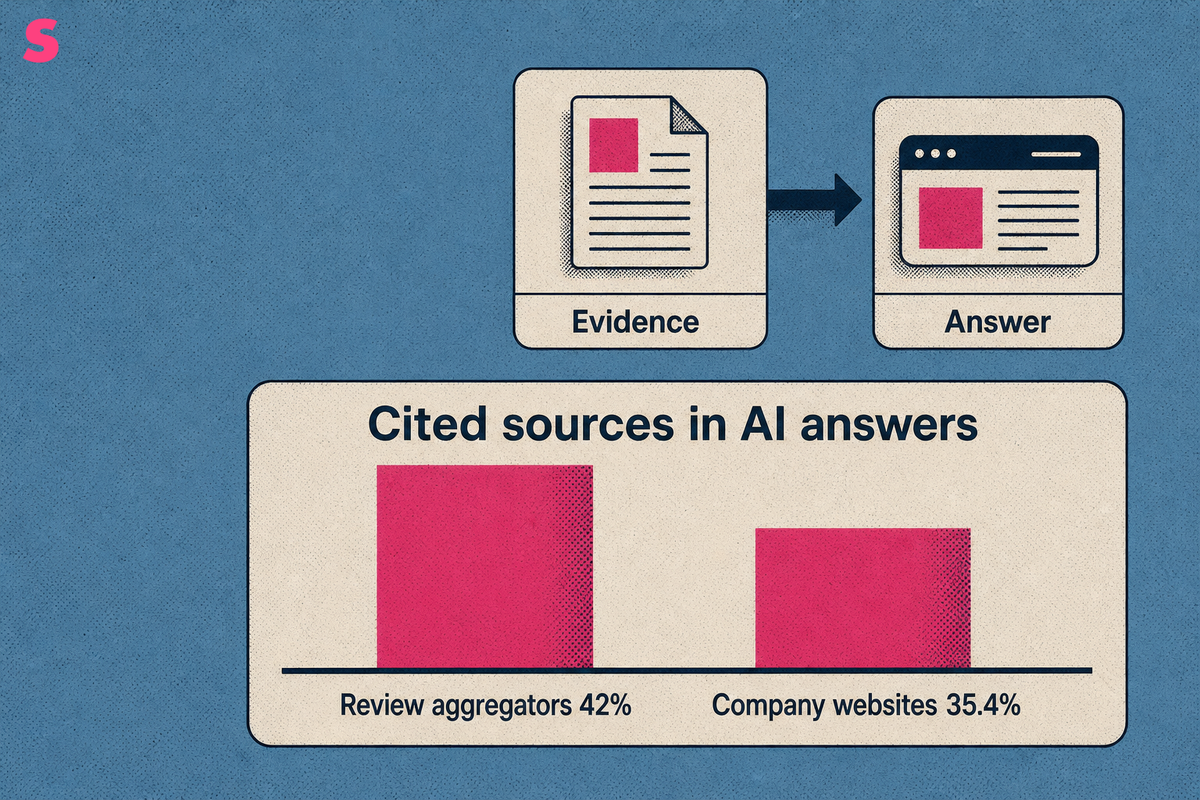
Product reviews influence AI search visibility by providing AI engines with independent, first-hand product evidence they use when determining what to cite and recommend. In a 100-query study of B2B software across five AI engines, published in August 2026, review aggregators accounted for 42% of cited sources, compared with 35.4% for company websites. The findings indicate correlation rather than a proven threshold, meaning authenticity and specificity matter as much as volume. Sona AI Visibility connects resulting prompts and citations to pipeline and revenue.
Do product reviews actually change what AI search engines recommend?
Verdict: Product reviews strengthen AI search visibility by supplying independent evidence, customer language, and product-specific proof. They do not guarantee a recommendation, because the evidence is correlational and no universal review threshold exists. B2B SaaS teams competing for comparison prompts should build authentic review coverage alongside clear, crawlable product pages.
AI visibility measures how often and how accurately a brand and its products are cited and recommended in AI-generated answers. A citation means an answer engine uses a source as evidence. A recommendation goes further by presenting a product as a fit for a buyer’s stated requirement.
This assessment draws on documented platform behaviour and published figures, not proprietary testing. Reviews do not replace owned product pages with clear positioning, implementation detail, integrations, security information, and use-case evidence. They validate the product story that owned pages make crawlable and useful.
The practical answer to how do product reviews impact AI search visibility is simple: reviews expand the evidence an answer engine can use when deciding whether a SaaS product belongs in an answer. They provide discovery data as well as customer feedback.
How do AI search engines use product reviews when recommending SaaS products?
AI platforms retrieve available context, including product reviews, when evaluating recommendation queries. Reviews contribute first-hand experience, customer language, product attributes, and independent verification. LinkedIn documentation notes that richer, more detailed reviews make it easier for AI to connect products with customer questions.
For SaaS, generic praise has little value. A buyer asking about implementation effort, SSO, integrations, security reviews, customer support, or ROI needs evidence that addresses those requirements. A review describing a Salesforce integration, a difficult onboarding step, or a faster reporting workflow gives an answer engine more semantic material than a short five-star endorsement. A general retrieval-and-matching model identifies products and attributes in review text, classifies aspect-level sentiment, connects phrases to use cases or requirements, compares those concepts with the query, and aggregates corroborating evidence across reviews and sources.
Review sources become more relevant as a buyer moves from awareness to intent. A broad question such as “what is marketing attribution?” needs conceptual sources. A commercial question such as “which attribution platform supports account-level reporting?” needs product-fit evidence, where independent customer experience is useful.
Sona’s own AI visibility data, September 2026, covers eight answer surfaces: ChatGPT, Google AI Overviews, Perplexity, Google AI Mode, Gemini, Mistral, Qwen and Claude. A review strategy should account for the evidence each answer surface retrieves rather than treating one search result as representative.
Do review-site citations give more AI visibility than a company's own website?
Review aggregators and company websites both contribute to AI visibility. In a 100-query B2B software study across five AI engines, updated October 2026, review aggregators supplied 42% of cited sources, while company websites supplied 35.4%. The evidence supports a blended source strategy rather than a choice between owned pages and review profiles.
Reviews also influence more than traditional SEO. A BrightEdge figure reported in an October 2026 listing found that only 16.7% of sources cited in Google AI Overviews also ranked in Google’s organic top 10. A review aggregator can therefore appear in an AI answer without a conventional top-ten organic position.
Review content is changing as well. AI mentions represented 35% of SEO Tools review activity in 2026, up from 12% in 2024, according to a June 2026 listing. That shift gives answer engines more customer-authored language about AI capabilities, workflows, and practical limits.
Google AI Overviews coverage varies by dataset. One 2026 analysis placed Google AI Overviews at 34.2% of global Google searches, while other analyses exceeded 30%, based on an October 2026 listing. Another October 2026 listing put Google AI Overviews on 48% of tracked queries, up from roughly 30% a year earlier. The figures are disputed, but the trend makes cited review sources worth measuring.
Which review signals matter most: volume, rating, specificity or platform authority?
Specific, authentic reviews matter more than a high star rating alone. Volume and platform authority establish breadth and credibility, but AI systems need information about use cases, limits, integrations, implementation, and outcomes before matching a product to a buyer’s prompt.
An analysis updated October 2026 associated brands with 1–13 Trustpilot reviews with a 53.5% median citation rate and a 52-percentage-point citation-rate increase. That is an association, not a threshold. It does not establish that collecting a particular number of reviews causes citations.
Additional reviews help when they add genuine detail. Quality and quantity of authentic reviews both matter for AI-based ranking and visibility systems. Profiles consisting only of perfect five-star ratings can appear suspicious because AI models are trained to detect unnatural review patterns.
Response quality has a separate local-search signal. An October 2026 local-search figure associated responses to more than 80% of reviews with a 35% improvement in local search visibility. That figure does not describe SaaS visibility, but it supports a broader operational principle: public, specific replies add context for prospective buyers.
Does review schema markup improve visibility in AI search?
Review schema markup improves machine readability and can help products qualify for rich results such as star ratings in search snippets. It does not guarantee a citation or recommendation in an AI answer. Structured data helps systems parse a page, but the underlying product evidence determines whether the page fits the query.
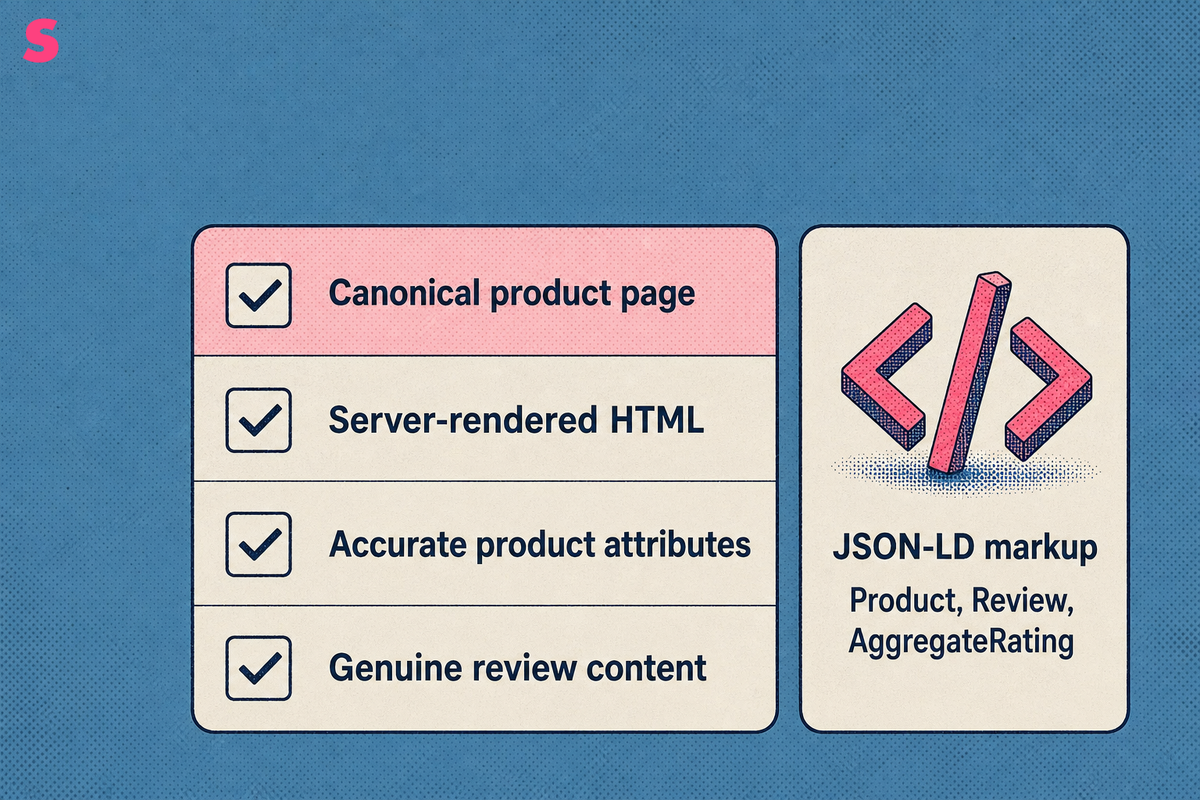
Review markup works best when an owned product page has a clear canonical tag, server-rendered HTML, accurate product attributes, and useful review content. Reviews support on-page SEO and conversion evidence, but they reinforce a product story rather than replacing it.
A technical review program should treat schema as implementation hygiene. Place Product markup on the canonical product page. Use Review and AggregateRating properties only for visible, genuine review content. Keep names, ratings, counts, and product identifiers consistent with the rendered page, prefer crawlable JSON-LD or equivalent supported markup, and validate the output after deployment. Structured reviews make facts easier to interpret, while detailed reviews give answer engines evidence to interpret. Neither replaces a crawlable page that explains what the product does.
How do negative reviews affect AI recommendations, and should you remove them?
Negative reviews should not be removed simply to protect AI recommendations. Criticism supplies limitation information that helps answer engines assess product fit, while suppression reduces authenticity and can make a review profile less credible.
A SaaS review that says a product suits large teams but requires specialist implementation can be valuable evidence. It helps an answer engine distinguish between a buyer seeking a lightweight tool and a buyer seeking enterprise controls. The goal is accurate fit, not universal praise.
Resolve recurring issues, publish specific replies, and clarify product data on owned pages. If implementation concerns recur, explain onboarding expectations. If an integration is frequently misunderstood, document the workflow. These actions preserve independent evidence while reducing ambiguity in product information.
Authenticity also protects against suspicious patterns. A profile containing only perfect five-star reviews can be flagged as unnatural, so a credible mix of feedback is more useful than a heavily filtered reputation record.
Which review platforms should a SaaS, ecommerce or local business prioritise?
Businesses should prioritise the review platforms their buyers use when evaluating the category, then collect detailed feedback after a real outcome. SaaS teams need specialist software-review evidence, ecommerce brands need product and trust signals, and local businesses need geographically relevant reviews.
- B2B SaaS: Prioritise specialist software-review platforms that shape buyer comparison prompts. Ask customers about role, use case, integrations, implementation, support, and measurable outcomes.
- National ecommerce: Prioritise Trustpilot and product-level review collection. Invite feedback after delivery or meaningful product use, with enough detail to explain fit, quality, and limitations.
- Local services: Prioritise Google reviews and location-specific feedback. Google’s Help Center states that more reviews and positive reviews can help local rankings and improve geographic visibility in AI search.
- AI visibility measurement: Sona AI Visibility connects AI citations and prompts to pipeline and revenue, helping teams assess whether review-source visibility contributes to commercial outcomes.
Do not gate reviews, purchase fake reviews, or hide incentives. Ask after a genuine customer outcome, disclose any incentive, and invite balanced detail. Review collection works as evidence only when buyers and answer engines can trust the underlying record.
What does review management for AI visibility cost?
Review management for AI visibility has four cost layers: review collection and platform fees, internal review operations, AI visibility measurement, and optional managed services. Birdeye is quote only, so it provides no public review-platform price. Internal review operations include collecting, moderating, answering, and governing feedback, but public staffing, incentive, and compliance costs vary by business.
AI visibility measurement is a separate software cost. Sona AI Visibility starts from $75/month as of October 2026, while Sona done-for-you services cost $5,500 monthly for Launch, $7,500 for Accelerate, or $9,500 for Amplify, on top of Growth or above. The table compares AI visibility measurement pricing, rather than the full cost of review-management operations.
Prices and plan details are as of October 2026.
| Tool | Starting price | Agency Plans? | # of Answer Engines Tracked | Answer Engines | # of Daily Tracked Prompts (entry plan) | Cost per Daily Tracked Prompt | Differentiation |
|---|---|---|---|---|---|---|---|
| Sona AI Visibility | From $75/month | Yes | 11 | ChatGPT, Gemini, Google AI Mode, Google AI Overviews, Perplexity, Claude, DeepSeek, Grok, Copilot, Qwen, Mistral | 5,000 credits/month, about 56 prompts tracked daily on 3 engines | $0.45 per daily tracked prompt | Connects AI citations and prompts to pipeline and revenue on one account timeline. |
| Peec AI | From $95/month | Yes | 3 | Not published | 50 prompts daily | $0.63 per daily tracked prompt | Focus: AI visibility tracking across listed answer engines. |
| Profound | Custom pricing | Yes | 9 | ChatGPT, Perplexity, Google AI Mode, Gemini, Microsoft Copilot, DeepSeek, Claude, Google AI Overviews, Exa Search | Not published | Cannot be calculated from custom pricing | Focus: enterprise AI visibility tracking across up to nine answer engines. |
| Otterly.ai | From $29/month | Yes | 4 | ChatGPT, Google AI Overviews, Perplexity, Microsoft Copilot | 15 prompts daily | $0.48 per daily tracked prompt | Focus: tracking AI search visibility across its Lite plan engines. |
| PromptWatch | From $95/month | Yes | Not published | Not published | 50 prompts daily | $0.48 per daily tracked prompt | Focus: prompt and response monitoring across supported models. |
Per-prompt figures use the comparison table’s shared daily-tracking unit. They are not a ranking of value, because teams buy different combinations of review operations, prompt coverage, reporting, and measurement depth.
How do you measure whether reviews are driving AI visibility across engines?
Measure review-driven AI visibility with a fixed daily prompt set, separate citation tracking from recommendation tracking, and compare review aggregators against first-party product pages. This creates a repeatable evidence record rather than a one-time impression of where a brand appears.
- Map prompts to buyer questions about integrations, implementation, security, support, and ROI.
- Run the same prompt list daily through Sona AI Visibility and across ChatGPT, Perplexity, Gemini, Claude, Google AI Overviews, and other answer engines.
- Record whether each answer cites a review source, an owned page, both, or neither.
- Record whether the answer merely cites the brand or actively recommends it for the stated use case.
- Compare citation changes with AI-referred traffic, conversions, pipeline, and closed-won revenue.
A team that runs the same prompt list daily can identify patterns that a weekly snapshot averages away. Answer engines change with retrieval indexes, model updates, and new competitor content. Changes that persist across repeated runs are stronger evidence than isolated fluctuations.
A brand-level visibility score is a dated snapshot, not a work item. Prompt-level evidence shows which buyer questions trigger citations and which review sources appear in those answers. Sona AI Visibility connects prompts and citations to pipeline and revenue, while AI Attribution connects AI-referred activity to accounts, pipeline, and closed-won revenue.
Sona AI Visibility also tracks AI crawler and agent activity as the front of that same path. Mention and competitor tracking is the baseline every rival offers. The harder measurement task is connecting a cited review source to traffic, conversions, and revenue, which AI-search practitioners identified as a leading challenge in an October 2026 listing.
Measurement still shows correlation. A review change cannot prove causation, but a daily log can show whether citation patterns, source mix, AI-referred visits, and commercial outcomes moved together.
What are the frequently asked questions about reviews and AI visibility?
Does a high star rating alone improve AI search visibility?
No. AI systems look for specific evidence about use cases, limitations, integrations, implementation, support, and outcomes. A perfect five-star profile can also look suspicious because AI models are trained to detect unnatural review patterns. Authentic detail is more useful than an undifferentiated rating average.
How many reviews does a SaaS company need to appear in AI answers?
No universal threshold is established. An analysis updated October 2026 associated 1–13 Trustpilot reviews with a 53.5% median citation rate, but that finding is an association rather than proof of causation. Platform authority, authenticity, review specificity, and relevance to the buyer’s prompt also affect visibility.
Does review schema markup guarantee citations in AI answers?
No. Structured data improves machine readability and can help pages qualify for rich results such as star ratings in snippets. Review schema does not guarantee inclusion in an AI answer, because answer engines still evaluate the relevance and usefulness of the underlying product evidence.
Should a company delete negative reviews to protect AI recommendations?
No. Removing criticism undermines authenticity and removes limitation information that AI systems use to judge product fit. Resolve recurring issues, reply publicly with specific context, and clarify product data on owned pages instead.
Are review sites or my own website cited more often by AI engines?
Both need attention. In a 100-query B2B study across five AI engines, updated October 2026, review aggregators supplied 42% of cited sources and company websites supplied 35.4%. Review profiles provide independent validation, while owned pages provide authoritative product detail.
Do reviews matter more when a buyer is close to purchase?
Yes. As buyers move from awareness to intent, AI relies more heavily on review sources to form recommendations. A buyer asking for a category definition needs educational context, while a buyer asking which SaaS platform integrates with a specific CRM or supports a security requirement needs product-fit evidence.
Summarize this article with AI: ChatGPT · Claude · Perplexity · Google AI Mode
Last updated: October 2026







