


Top AI visibility platforms for B2B businesses monitor brand mentions and citations in ChatGPT, Perplexity, Gemini, Google AI Overviews, and other answer engines, then identify improvements needed. Sona AI Visibility connects those prompts and citations to pipeline and revenue, while also monitoring AI crawler and agent activity. Entry-level prices listed for the six compared tools range from $29 to $250 per month, though lower plans frequently limit tracked prompts. Review prompt limits and engine coverage before evaluating scores.
What do AI visibility tools measure, and why do B2B companies need them?
AI visibility tools measure how often ChatGPT, Perplexity, Gemini, Google AI Overviews, and other answer engines mention or cite a B2B brand for a defined set of buyer prompts. They show which competitors appear, which sources support recommendations, and whether a brand appears in vendor comparisons.
The gap is material. The 2X AI Visibility Index found that only 4.3% of 70 B2B companies maintained a healthy discovery funnel for early-stage buyer questions, per linkedin.com, June 17, 2026. A Demand Gen Report summary characterized the same finding as 96% of B2B companies being invisible in AI discovery, per demandgenreport.com, April 20, 2026.
Traditional SEO and AI visibility measure different outputs. SEO focuses on rankings and clicks. AI visibility focuses on answers, citations, recommendations, and AI-referred visits. Supporting resources cover the distinction in depth and explain how to build a representative buyer-prompt set for ongoing tracking.
How were these six AI visibility tools selected, and what can a reader verify?
This comparison evaluates six AI visibility tools for B2B companies, Sona AI Visibility and five tools with public pricing or published plan details. The criteria cover engine coverage, prompt capacity, entry price and plan limits, competitor benchmarking, buyer-prompt discovery, optimization workflows, and fit for B2B marketing, agencies, or enterprises.
The review distinguishes monitoring from action. A dashboard that reports citations establishes where a brand appears, but a useful workflow identifies the prompt, source, page, or task that requires attention after a brand is absent from an answer.
- Check the entry plan’s published price, billing basis, trial terms, engine coverage, and prompt allowance.
- Check whether the platform supports competitor comparisons, buyer-prompt analysis, agency workflows, or optimization tasks.
- Check whether the output is a brand-level score only, or whether it identifies the prompts and cited sources behind that score.
- Run the same prompt list daily. Daily tracking reveals patterns that a weekly snapshot can obscure.
Prices and plan details were read from public vendor pricing listings dated September and October 2026, or earlier where noted. This review does not claim hands-on prompt testing, invent proprietary scores, or rank tools through undisclosed weighting.
A brand-level visibility score does not create a work item. A prompt-level view does. Sona AI Visibility connects prompts and citations to pipeline and revenue while showing the pages and sources associated with AI answer performance.
Which AI visibility tool for B2B companies links AI citations to pipeline and revenue?
1. Sona AI Visibility: revenue attribution and AI crawler measurement
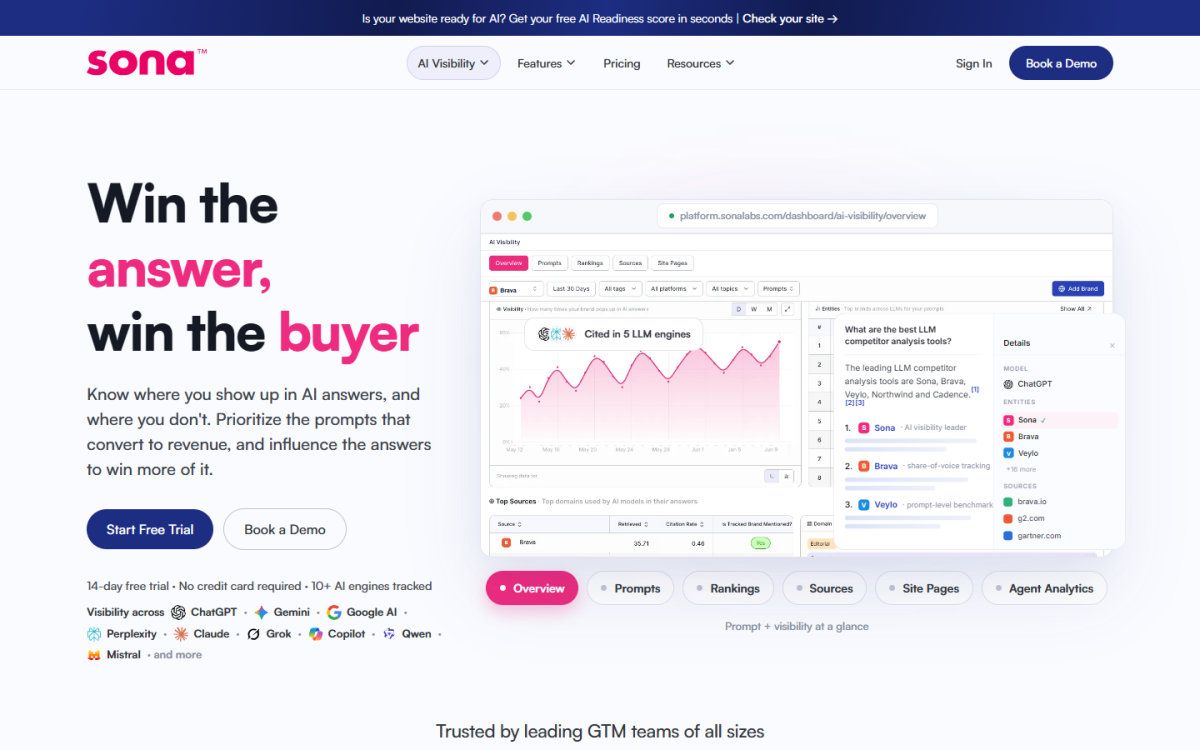
What it does: Sona AI Visibility connects prompts and AI citations to pipeline and revenue on one account timeline while tracking AI crawler activity from server logs or a lightweight edge worker. Mention and competitor tracking across 11 answer engines establish the baseline visibility record.
Sona AI Visibility uses AI Attribution to connect AI citations and AI-referred visits to accounts, pipeline, and closed-won revenue. It also supports buyer-prompt analysis, account-level identification on Growth, and done-for-you services for teams that need content, technical fixes, strategy, and reporting.
What it costs: Sona AI Visibility starts from $75/month billed annually, as of October 2026. Starter includes 5,000 credits/month, about 166 daily tracked prompts on one model or 56 across three. Growth starts from $249/month billed annually. Agency plans start from $199/month billed annually.
Who it suits: Sona AI Visibility suits B2B teams that need to connect AI answer presence with attributable commercial outcomes rather than treat citations as a separate reporting metric. It also suits agencies that need one workspace per client and white-label reports.
Which AI visibility tools suit startups and lean B2B marketing teams?
2. Otterly.ai: low-cost AI answer monitoring
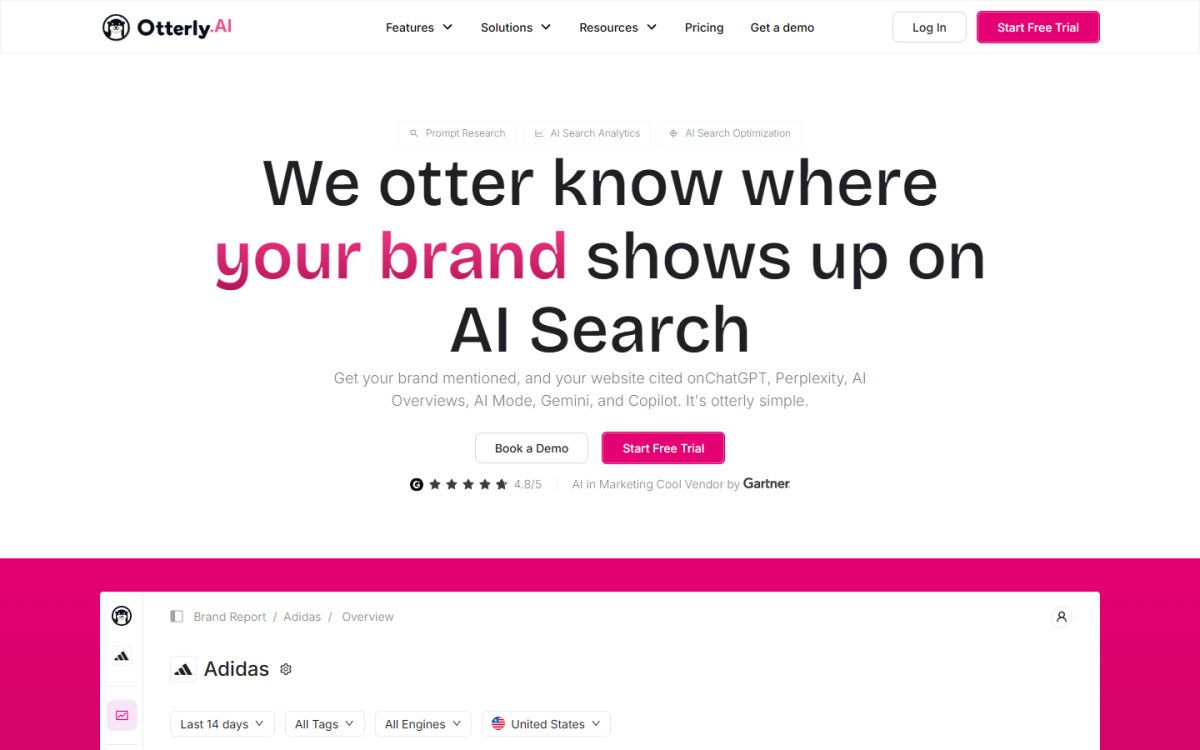
What it does: Otterly.ai tracks brand presence across AI answer engines and supports ongoing monitoring of AI-generated answers and citations. Its Lite plan covers ChatGPT, Google AI Overviews, Perplexity, and Microsoft Copilot, as of October 2026.
What it costs: Otterly.ai Lite starts from $29/month for 15 prompts, as of October 2026. Standard starts from $189/month for 100 prompts. Paid add-ons cover Claude, Google AI Mode, and Gemini.
Who it suits: Otterly.ai suits lean teams that want a low entry price and a defined prompt list before expanding an AI answer monitoring program.
3. Peec AI: self-serve prompt tracking
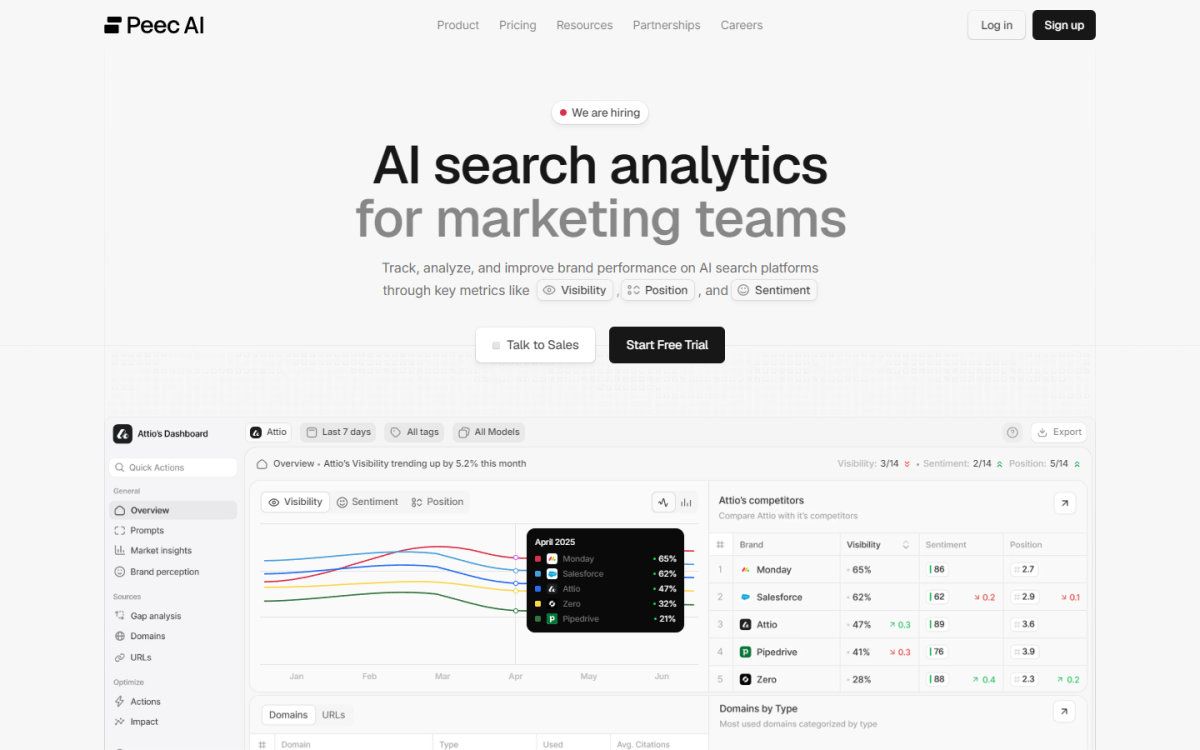
What it does: Peec AI provides self-serve tracking across AI answer engines, with daily prompt monitoring and competitor-oriented reporting. Its Starter plan lists 3 active engines, while the self-serve product lists 6 available engines, as of October 2026.
What it costs: Peec AI Starter starts from $95/month, as of October 2026. The listed Starter allowance is 50 prompts tracked daily, with higher tiers at 150 and 350 daily prompts.
Who it suits: Peec AI suits B2B teams that want a self-serve prompt tracker with room to increase daily coverage as their category, competitor set, and content program expand.
4. GetIntel: buyer-prompt and task-oriented tracking
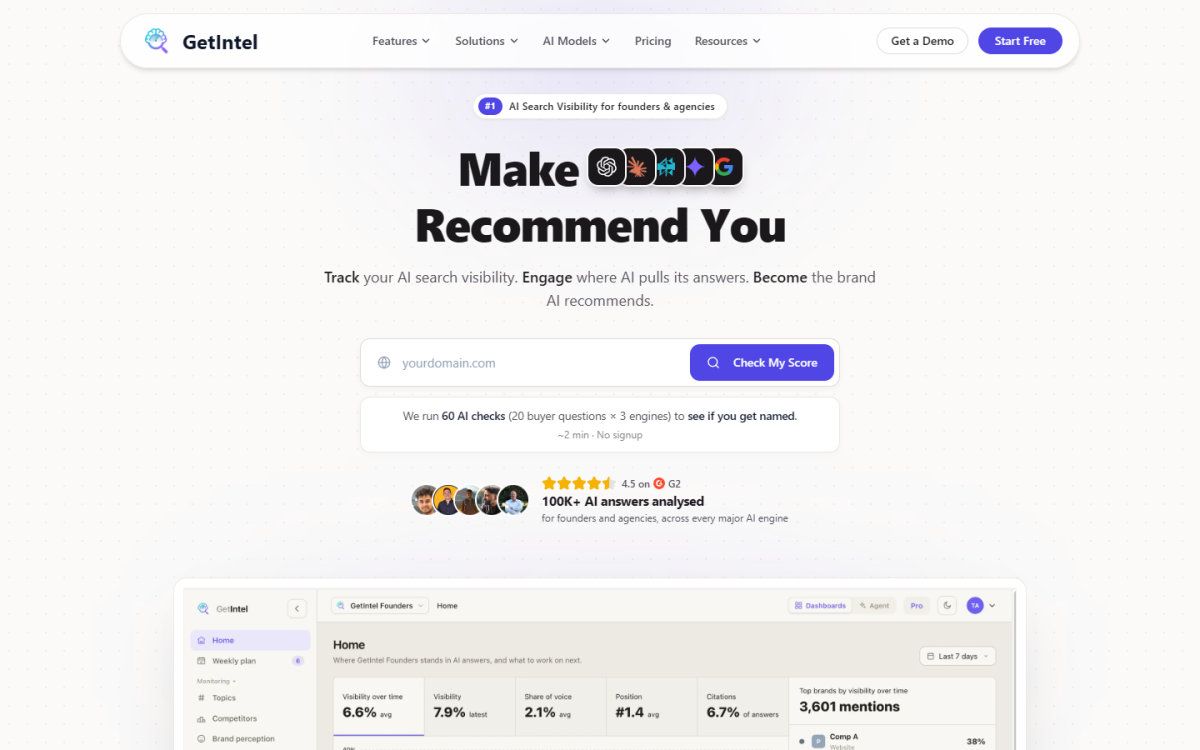
What it does: GetIntel focuses on buyer-prompt tracking and ranked tasks for teams reviewing where a brand appears in AI answers. Its plans cover ChatGPT, Perplexity, Gemini, and Google AI Overviews daily, with Claude added weekly on the Growth plan.
What it costs: GetIntel lists Monitor at $29/month, Pro at $79/month, and Growth at $149/month, as of October 2026. The published plans include 25, 60, and 120 prompts tracked daily, plus a 7-day trial requiring a card.
Who it suits: GetIntel suits small B2B marketing teams that want buyer-prompt coverage, a structured task list, and a clear progression from a modest prompt allowance to broader monitoring.
Which AI visibility tools suit larger B2B teams, enterprises and agencies?
5. Profound: agency configuration and pitch workflows
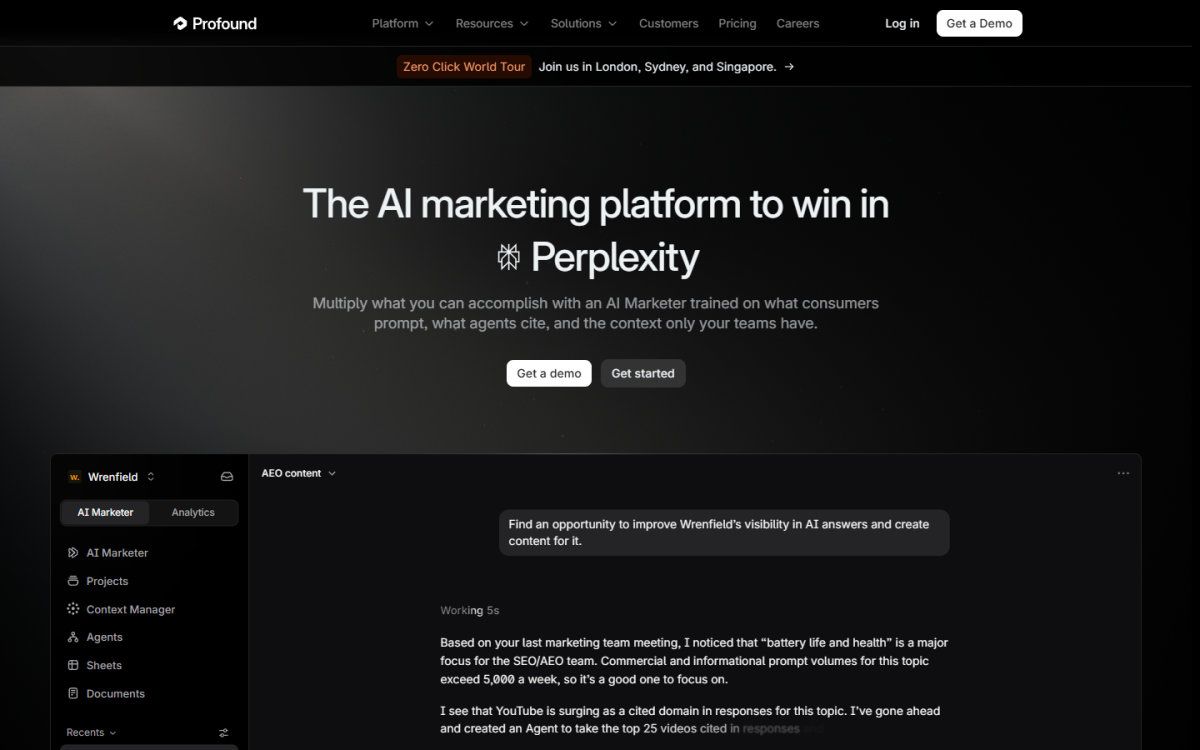
What it does: Profound supports AI visibility tracking for brands and agency workflows. Its Agency mode includes brand configurations and pitch environments for marketing agencies, as of October 2026.
What it costs: Profound has a free 7-day trial covering 50 prompts daily across 3 engines. Agency Growth starts from $99/month, billed annually, while Enterprise pricing is custom, as of October 2026.
Who it suits: Profound suits agencies that need separate brand configurations, pitch environments, and client workspace structures alongside AI answer tracking.
6. Scrunch AI: enterprise AI answer analysis
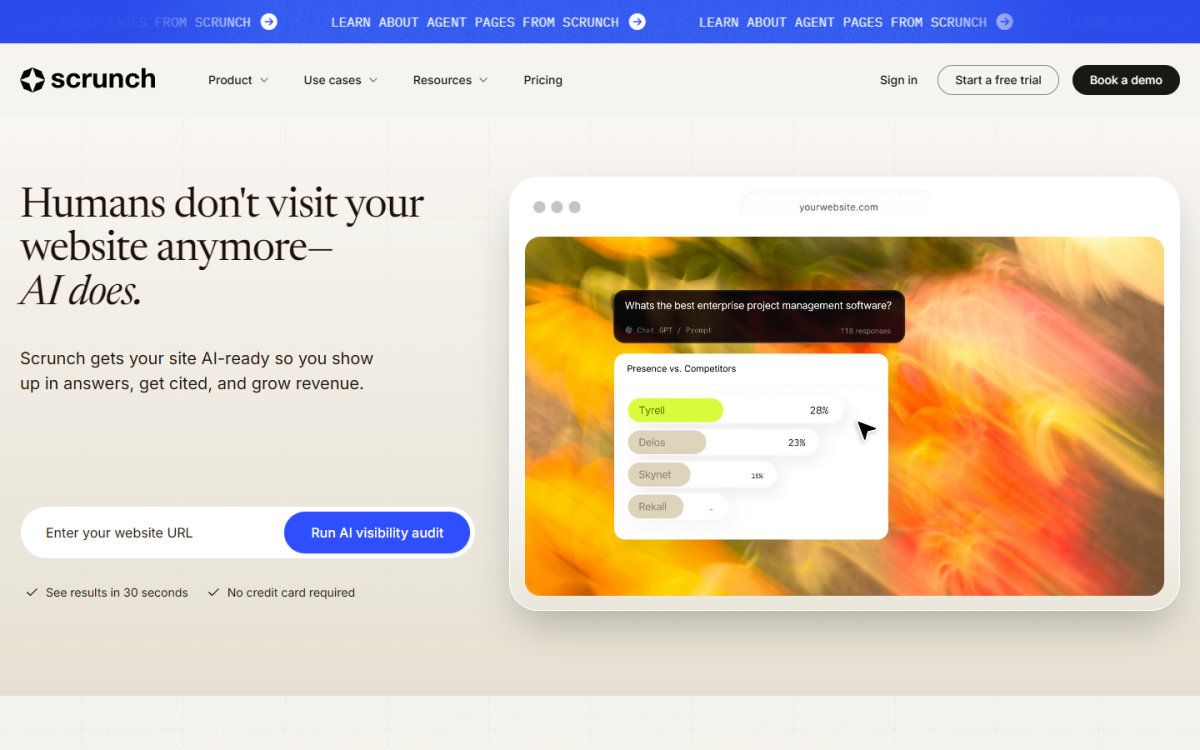
What it does: Scrunch AI provides AI visibility tracking across 4 engines on its Core plan, ChatGPT, Perplexity, Google AI Overviews, and Copilot. Its Enterprise plan lists 9 engines, as of October 2026.
What it costs: Scrunch AI Core starts from $250/month, as of October 2026. Core includes 125 prompts, while the published cadence for those prompts is not stated. Agency Core starts from $500/month.
Who it suits: Scrunch AI suits larger B2B teams and agencies that want a Core plan for AI answer monitoring and an Enterprise path with broader named engine coverage.
How do the six tools compare on price, tracked engines, prompt limits and optimization?
The table compares the six tools using published entry-plan details that buyers can verify. Price alone does not establish value because published units can be prompt slots, credit balances, response allowances, or custom enterprise allocations.
| Tool | Starting price | Agency Plans? | # of Answer Engines Tracked | Answer Engines | # of Daily Tracked Prompts (entry plan) | Cost per Daily Tracked Prompt | Differentiation |
|---|---|---|---|---|---|---|---|
| Sona AI Visibility | From $75/month, billed annually | Yes | 3 daily on Starter (11 available) | ChatGPT, Gemini, Google AI Mode, Google AI Overviews, Perplexity; Claude, DeepSeek, Grok, Copilot, Qwen, Mistral on premium models | 5,000 credits/month, about 166 daily tracked prompts on one model or 56 across three | $0.45 per daily tracked prompt | Connects AI citations and prompts to pipeline and revenue on one account timeline, and tracks AI crawler activity from server logs. |
| Peec AI | From $95/month | Yes | 3 on Starter (up to 13 on Enterprise) | Choose 3 of ChatGPT, AI Mode, AI Overviews, Microsoft Copilot, Gemini, Naver AI | 50 prompts daily | $0.63 per daily tracked prompt | Self-serve AI answer monitoring across active Starter engines. |
| Otterly.ai | From $29/month | Yes | 4 on Lite (more as paid add-ons) | ChatGPT, Google AI Overviews, Perplexity, Microsoft Copilot | 15 prompts daily | $0.48 per daily tracked prompt | Lite-plan monitoring for AI-generated answers and citations. |
| GetIntel | From $29/month | Yes | 4 (Claude added weekly on Growth) | ChatGPT, Perplexity, Gemini, Google AI Overviews | 25 prompts daily | $0.29 per daily tracked prompt | Buyer-prompt tracking with prioritized optimization tasks. |
| Profound | Custom pricing | Yes | 3 on the free trial (9 on Enterprise) | ChatGPT, Perplexity, Google AI Mode, Gemini, Microsoft Copilot, DeepSeek, Claude, Google AI Overviews, Exa Search | Custom (Enterprise); 50 daily on the 7-day trial | Not computable (custom pricing) | Agency mode with brand configurations and pitch environments. Agency plans from $99/month billed annually. |
| Scrunch AI | From $250/month | Yes | 4 on Core (9 on Enterprise) | ChatGPT, Perplexity, Google AI Overviews, Copilot | 125 prompts, frequency not stated | No refresh cadence published | Core monitoring with Enterprise coverage across 9 engines. |
Prices and plan details in this comparison are current as of October 2026.
How reliable are AI visibility scores when answers change by prompt, model and date?
AI visibility scores are directional measurement tools, not permanent truth. Answers vary by prompt wording, geography, model version, date, retrieval index, and personalization. A score captures a dated snapshot, while repeated measurements show whether movement persists.
An October 15, 2026 benchmark of 50 B2B SaaS companies found that 44.0% scored below 50 out of 100 for AI visibility. The benchmark average was 56.9 out of 100 and the median was 63.5 out of 100. Buyers should inspect the prompt set, sample size, scoring rules, and refresh date before using a benchmark for planning.
Another report found that every tested company was mentioned by Gemini and 90% were mentioned by Perplexity, per linkedin.com, April 24, 2026. Engine coverage matters, but prompt design, sampling frequency, citation extraction, and the workflow after a citation gap appears determine how teams use the data.
Sona's own AI visibility data, September 2026, covers 8 answer surfaces: ChatGPT, Google AI Overviews, Perplexity, Google AI Mode, Gemini, Mistral, Qwen, and Claude. Teams should track prompts daily, review trends quarterly, and treat one-day changes as noise until they persist across several readings.
Is the cheapest AI visibility plan enough for a B2B company?
The cheapest AI visibility plan can support an initial monitoring program, but it rarely supports mature B2B measurement. A $29/month tier with 15 daily prompts establishes a baseline, while category, competitor, and regional coverage require greater prompt capacity.
Otterly.ai Lite provides one example: $29/month for 15 prompts, as of October 2026. GetIntel Monitor also starts at $29/month with 25 daily prompts, as of October 2026. Buyers should compare prompt capacity, engines, historical data, seats, and optimization workflows before making entry price the deciding factor.
Mention tracking does not establish revenue attribution. A brand named in an AI answer may not produce a site visit, conversion, pipeline record, or vendor selection. Most entry plans measure answer presence; Sona AI Visibility connects citations and AI-referred visits to accounts, pipeline, and revenue.
Which AI visibility tool should each type of B2B buyer pick?
The best AI visibility tool for a B2B company depends on its operating model, budget, and measurement requirements. The segmentation below maps buyer types to tools based on published capabilities and plan structures as of October 2026.
- Revenue and pipeline-focused B2B teams: Sona AI Visibility, for connecting AI citations and AI-referred visits to pipeline and revenue.
- Startups on a tight budget: Otterly.ai Lite, for a $29/month entry point with 15 daily prompts.
- Teams focused on buyer-prompt tracking: GetIntel, for buyer-prompt coverage and ranked tasks across plans from $29/month.
- Agencies running several brands: Profound, for brand configurations and pitch environments in Agency mode.
- Enterprises seeking broader named engine coverage: Scrunch AI, whose Enterprise plan lists 9 engines.
- Teams wanting done-for-you help: Sona AI Visibility, with done-for-you services available on top of a Growth plan or above.
Every buyer should begin with a defined prompt list, preserve daily history, and review prompt-level citation gaps before expanding the budget. A quarterly competitive review and technical benchmark operate on a different planning cycle from daily answer tracking.
What are the frequently asked questions about AI visibility tools?
What do AI visibility tools measure for B2B companies?
AI visibility tools measure how often ChatGPT, Perplexity, Gemini, Google AI Overviews, and other answer engines mention or cite a B2B brand when a defined set of buyer queries runs. They also show competitor inclusion, cited sources, recommendation placement, and whether a brand appears in comparison-oriented answers.
How much do AI visibility tools cost?
The compared tools have listed entry prices from $29 to $250 per month, as of October 2026. Entry tiers differ sharply in daily prompt capacity, tracked engines, agency access, historical data, and optimization workflows, so the lowest monthly price is not a complete cost comparison.
Can an AI visibility tool prove revenue impact?
Mention tracking alone cannot prove revenue impact because a brand appearing in an answer does not establish a visit, conversion, pipeline record, or closed deal. Sona AI Visibility connects citations and AI-referred visits to accounts, pipeline, and revenue on one account timeline.
Which AI engines should a B2B AI visibility tool cover?
A B2B AI visibility tool should cover ChatGPT, Perplexity, Gemini, Google AI Overviews, and other answer engines relevant to the buyer’s market. Engine count matters less than representative prompt design, daily sampling, citation extraction, and a workflow for investigating missing brand citations.
Are AI visibility scores accurate enough to act on?
AI visibility scores can guide investigation, but they are directional rather than exact because answers vary by prompt, location, model, date, and personalization. Teams should read repeated daily measurements as a trend rather than act on a single score.
Do B2B companies need an agency-style AI visibility tool?
B2B companies need agency-style AI visibility tooling when they manage several brands, client workspaces, or white-label reporting. A single in-house team generally needs prompt tracking, citation analysis, and gap-fixing workflows. Agencies can use Profound’s brand configurations and pitch environments, while Sona AI Visibility connects AI citations and prompts to pipeline and revenue.
Summarize this article with AI: ChatGPT · Claude · Perplexity · Google AI Mode
Last updated: October 2026







