


AI-powered SEO agency services are monthly retainers that combine conventional technical SEO, content and digital PR with generative engine optimization (GEO), answer engine optimization (AEO) and monitoring of where a brand is cited in AI answers. Published B2B retainers mostly run $5,000 to $20,000 per month, six- or twelve-month terms are common, and several agencies quote only on request. Sona's done-for-you services start at $5,500 per month on top of an AI Visibility plan. Compare providers on platforms covered, human review and attribution method.
What do AI-powered SEO agency services actually include?

AI-powered SEO agency services are monthly retainers covering conventional search work plus the work that gets a brand quoted inside AI answers. The scope is wider than a classic SEO contract, and the deliverables differ: citations and brand mentions matter as much as rankings.
A full-scope engagement normally covers six workstreams:
- Technical SEO and crawl access: robots.txt and llms.txt rules, canonical tags, server-rendered HTML, schema coverage, and whether AI crawlers can reach the pages at all.
- Entity optimization: making the brand, its products and its people consistently described across the sources models retrieve.
- Content production: net-new pages aimed at commercial and decision-stage questions, plus refreshes of pages that have gone stale.
- Digital PR and citation building: placements on the third-party sources answer engines cite.
- AEO and GEO: answer engine optimization shapes pages so a model can lift a direct answer; generative engine optimization targets the retrieval and citation behaviour of those models.
- AI visibility monitoring: tracking a prompt list across engines, with share of voice, sentiment and the source pages behind each citation.
The split between those six separates a cheap retainer from an expensive one. Cheaper engagements lean on audits and on-page fixes. Expensive ones carry sustained content volume and off-site citation work, which is slow, manual, and the part that compounds.
What separates one AI SEO agency from another?
Seven capabilities genuinely differ between providers. Everything else on a pitch deck is shared. When comparing AI search agencies, press on these:
- Engines covered. Some providers monitor ChatGPT and Google AI Overviews only. Others add Perplexity, Gemini, Claude and Copilot. Ask for the list, by name.
- Prompt list design. Whether the list is built from commercial-intent keyword data and buying stage, or assembled by guesswork.
- Monitoring cadence. Prompts should run daily. An engine's answer shifts with the retrieval index, a model update, and whatever a competitor published last week, so a daily run surfaces the pattern a weekly snapshot would have averaged away.
- Content volume and editorial review. Pages per month, who writes them, and who subject-matter-checks them before publication.
- Digital PR throughput. Placements per quarter, and whether the citation budget sits inside the retainer or outside it.
- Reporting. Prompt-level visibility and citations, not a traffic chart with an AI label.
- Contract minimum. Month-to-month, a 90-day pilot, or a twelve-month term.
Technical readiness is the one capability a buyer can test before any sales call. Ask for a dated audit of a handful of live pages, then ask what the agency would change on each one and in what order of severity. A single audit is a snapshot; what an agency should deliver is a comparable series of them, with a named fix attached to every page that moved.
How do the leading AI SEO agencies compare?
For B2B SaaS, the strongest combinations pair technical and content execution with published pricing and a defined term. Sona is the only option below that sells the measurement software and the team together. Several agencies publish rates openly; the rest quote only.
| Agency | Focus | What's included | Pricing |
|---|---|---|---|
| Sona done-for-you services | AI visibility software plus a Sona team that ships the work | Revenue-focused page production, AI search optimization, technical fixes, internal linking, AI perception audit, custom attribution reporting | Launch $5,500/month, Accelerate $7,500, Amplify $9,500, on top of an AI Visibility plan |
| DerivateX | Full-service SEO and GEO for B2B SaaS | GEO across ChatGPT, Perplexity, Claude and Gemini; entity optimization; content; digital PR; technical SEO and migrations | Plans $5,000-$12,000/month (Rank & Get Found $5,000, Own Your Category $8,000, Market Leader $12,000); Enterprise scoped individually. $5,000 and $8,000 plans start as a 90-day pilot with no onboarding fee; $12,000 plan has a 6-month minimum. Off-site citation budget of $1,000-$3,000/month is billed separately from the retainer |
| Breaking B2B | SEO and AI search for B2B and SaaS | AEO, GEO and LLM SEO, technical SEO, content and link building, Reddit and YouTube | Growth plans $5,500-$9,700/month (Silver, Gold, Diamond), Category King $20,000+/month; Enterprise plans $8,500-$14,700/month, Category King $40,000+/month; tailored narrower-scope plans from $4,000/month. Six- or twelve-month engagements only |
| Discovered Labs | Organic search for the AI era, B2B | Citations in ChatGPT, Perplexity and Gemini; Reddit marketing; technical and content SEO; digital PR; visibility tracker | Establish €6,995/month, Compete €10,995/month (month-to-month); Outlier & Custom from €15,995/month. 3- or 6-month commitments lower the price (Establish €5,995/month, Compete €8,995/month) |
| Omniscient Digital | SEO and GEO for B2B software brands | LLM optimization and citation analysis, GEO technical roadmap, content production, brand mentions and digital PR | From $10,000/month (full-service engagements). Contract terms not published |
| TripleDart | AI-native organic growth for B2B SaaS | GEO and AEO across ChatGPT, Perplexity and Claude; technical and on-page SEO; briefs, drafts and refreshes; paid media | From $5K/month (standalone SEO/AEO). Contract terms not published |
| iPullRank | Relevance engineering for AI search | GEO, content strategy and engineering, technical SEO, attribution and brand monitoring | Not published (quote only) |
| Foundation | GEO for B2B technology companies | GEO strategy, technical SEO, LLM advertising and distribution, thought leadership and digital PR, attribution | Not published (quote only) |
How much do AI-powered SEO agency services cost?
Pricing tracks scope, and the table below sets out the reported monthly ranges tier by tier. Content volume, digital PR placements, the number of engines monitored, company size and contract length all move the number. Longer commitments lower the monthly rate at most providers.
| Scope tier | Typical buyer | What the retainer covers | Reported monthly range |
|---|---|---|---|
| Audit-led entry | Small and local businesses | Technical audit, schema and llms.txt fixes, limited page optimization | $1,000-$5,000 |
| Mid-market program | Mid-sized B2B companies | Prompt monitoring, content refreshes, some net-new pages | $2,500-$10,000 |
| Comprehensive mid-tier | Funded SaaS with a content operation | Technical plus content plus citation building | $5,000-$8,000 |
| Full-service GEO | B2B software with pipeline targets | Sustained content, digital PR, entity work, attribution reporting | From $10,000 |
| Whole market | All sizes | Entry audits through full-service GEO, digital PR and AI-crawler optimization | $2,000-$25,000+ |
AI search work carries a modest premium over conventional SEO. Seotal Research reported that AI SEO costs small businesses 20% more than conventional SEO at most agencies, with a median AI-SEO-to-SEO price ratio of 1.20x across 21 agencies publishing both prices, per einpresswire.com, October 2026. Sona's done-for-you services start at $5,500/month on top of a Sona AI Visibility plan, which puts the software and the execution on one invoice.
Which AI search environments should an agency cover?
At minimum: Google AI Overviews, Google AI Mode, ChatGPT, Perplexity, Gemini and Claude. Those are where B2B buyers run comparison and shortlist queries. Copilot matters for Microsoft-heavy enterprises. Sona AI Visibility makes 11 engines available to track, and Sona's own AI visibility archive covers eight answer surfaces: ChatGPT, Google AI Overviews, Perplexity, Google AI Mode, Gemini, Mistral, Qwen and Claude, per Sona's own AI visibility data, September 2026.
Claimed coverage and real coverage are different things, so test it before signing:
- Ask for a sample report on a live brand, with each engine named and the run date visible on the page.
- Ask which engines are regional, and in which countries each one is sampled.
- Ask how the data is collected. Some offerings scrape the prompt response the way a person sees it on screen. Others pull from the vendor's official API, which returns a structured response that can differ from the on-screen answer. The two methods capture different results.
- Run three of your own commercial prompts by hand on two engines, then check whether the agency's report shows the same result.
A provider that cannot answer the collection question is reselling a tool it has not examined. That is worth knowing before a twelve-month term.
How should an agency prove that AI citations turn into pipeline?
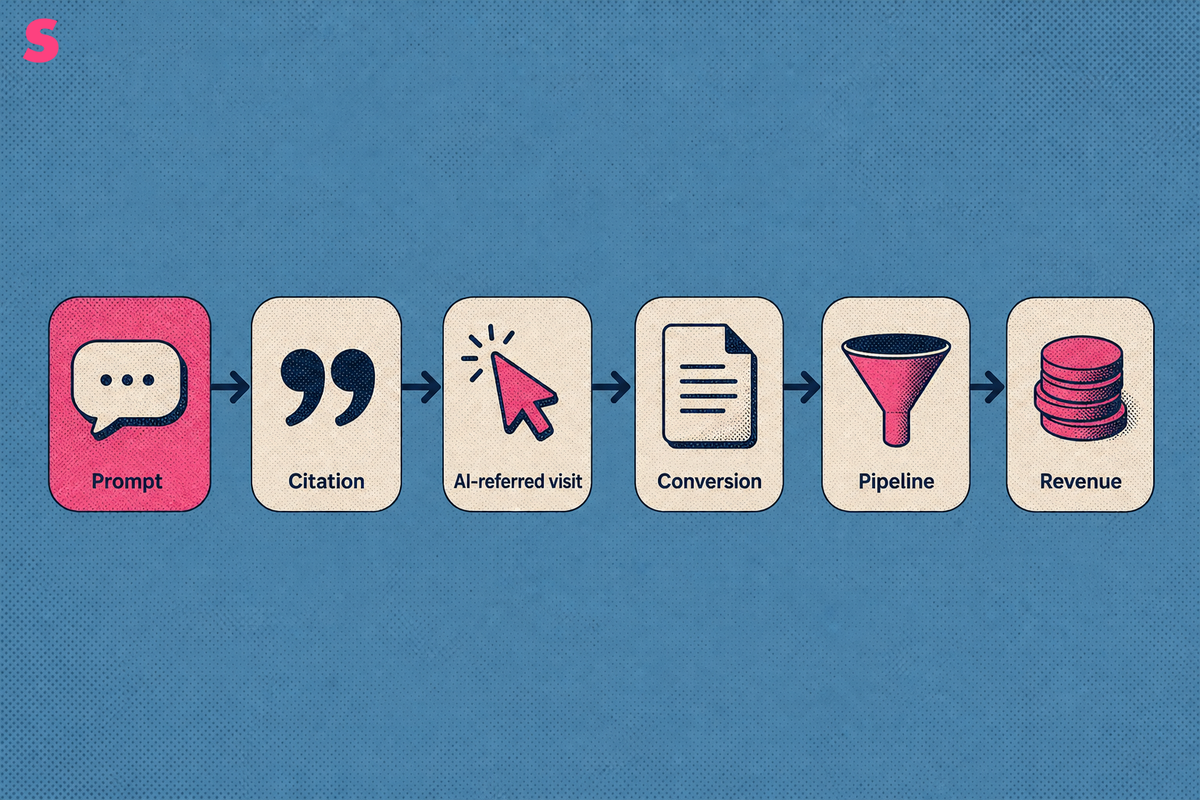
By reporting a chain, not a metric. The chain runs prompt, citation, AI-referred visit, conversion, pipeline, revenue, and a credible monthly report shows movement at every link. Rankings and traffic alone are the weakest evidence available, because AI answers resolve plenty of research without sending a click.
Three mechanisms make the proof possible. Self-reported attribution on demo and signup forms captures buyers who researched in an AI engine and arrived as direct traffic. Identity resolution ties anonymous AI-referred sessions back to real accounts. Crawler log analysis shows whether AI bots reached the page that earned the citation, which no mention tracker instruments.
The objection that AI answers are too unstable to justify a retainer has a measurement answer. Instability is a sampling problem. Run the same prompt list daily, judge movement over four-week windows rather than single days, and the noise separates from the trend. Full technical re-audits and competitive benchmarks belong on a monthly or quarterly clock, because those genuinely move slowly. Treat any agency promising guaranteed placement in an AI answer as a disqualified vendor.
What is genuinely automated in AI SEO work, and what still needs people?
Monitoring is automated. Execution is not. That division answers the claim that AI search work is conventional SEO with a new label, and it explains why retainers start around $5,000 rather than at software prices.
- Automated: prompt tracking across engines, crawler log analysis, technical audits scored against a fixed check set, keyword clustering into prompt sets, citation and sentiment counting, alerting when a competitor overtakes you on a tracked prompt.
- Still human: deciding which prompts are worth winning, original research and point of view, editorial and subject-matter review, digital PR relationships, developer implementation of schema and rendering fixes, and the quarterly call about positioning.
The compliance objection is real and specific. AI-generated content published at volume creates brand risk in regulated categories, where an unreviewed claim about pricing, efficacy or coverage becomes a legal problem rather than an SEO one. The control is editorial: a named reviewer, a source for every factual claim, and a publishing workflow nobody can bypass. Ask any prospective agency who signs off on a page, and ask to see the review step in writing. Agencies that produce pages in-house, researched and written by people, are answering a different question from agencies reselling generated drafts at volume.
Should you hire an agency, buy software, or build the capability in-house?
Buy software if you have a content team and need visibility data. Hire an agency if you have budget but no execution capacity. Build in-house if AI search is a permanent, strategic channel and you can hire two people to own it. Most mid-market B2B companies end up with a mix.
| Option | What you get | Monthly cost | Time to first output | Best when |
|---|---|---|---|---|
| Agency retainer | Strategy, content, digital PR and technical fixes shipped for you | $2,000-$25,000+ | Weeks, after onboarding | Budget exists, internal capacity does not |
| Specialist software | Prompt monitoring, citations, crawler and audit data | Varies by tool | Same day | You already have writers and a developer |
| In-house team | Full control of strategy, content and implementation | Salaries plus tooling | Months, including hiring | AI search is a permanent channel with a named owner |
| Software plus managed team | Measurement platform and an external team executing against it | From $5,500/month on top of a software plan | Weeks | You want one accountable party for data and delivery |
The objection that software is cheaper than an agency is correct and incomplete. The gap is labour, not margin: a tracking subscription tells you which prompts you are missing, and then nobody writes the page. Sona sells both sides: Sona AI Visibility from $75/month for brands, billed annually, and a team that ships pages, fixes and citations on top of an AI Visibility plan.
Who should not buy AI-powered SEO agency services?
Five situations disqualify a buyer. Skip the retainer and spend the money elsewhere if any one of them describes your company.
- No product-market fit. AI search amplifies demand for a category you already win in. It does not create a proposition.
- No content operation and no plan to build one. Agencies can write, but they cannot supply subject-matter review or product truth on your behalf.
- Sustained content and digital PR expected for under $5,000 a month. That combination is not what the lower end of this market sells. Smaller budgets can still buy audit-led or limited optimization work, which is a different and narrower purchase, so size the expectation to the scope.
- Under nine months of runway. Entity, content and citation work compounds slowly, and most published terms are 90-day pilots or six- to twelve-month commitments.
- Hard legal or compliance limits on published content. If every page requires counsel review, agency throughput is capped and the retainer will not be consumed.
One caveat applies to everyone who does buy. Monitoring which AI answers mention a brand is half the job; the other half is connecting those mentions to pipeline and revenue, which most monitoring tools and most agency reports leave unanswered. Sona AI Visibility connects AI citations and prompts to pipeline and revenue rather than stopping at mention counts, so a retainer can be judged on the business outcome it produced.
Frequently Asked Questions
How long does an AI SEO retainer take to show results?
No standard timeline can be established from the published evidence, and contract length is not a proxy for performance. What is verifiable is the commercial terms on offer: Discovered Labs sells month-to-month by default, DerivateX starts two of its plans as a 90-day pilot, and Breaking B2B sells six- or twelve-month engagements only. Those describe procurement, not time to results. Agree in advance which measured movement counts as progress, and review it on a fixed cadence.
Does AI SEO cost more than conventional SEO?
Yes, modestly. Seotal Research reported that AI SEO costs small businesses 20% more than conventional SEO at most agencies, and that among 21 agencies publishing both prices the median AI-SEO-to-SEO price ratio was 1.20x, per einpresswire.com, October 2026. The premium pays for prompt monitoring, entity work and attribution reporting.
Can an agency guarantee citations in ChatGPT or Google AI Overviews?
No. Model outputs and Google AI Overviews change without notice, with the retrieval index and with every model update, so no provider controls whether a specific answer names your brand. Treat a guaranteed-placement claim as a reason to end the conversation. What an agency can commit to is deliverables, cadence and reporting.
What contract terms do AI SEO agencies typically require?
Terms run from month-to-month to twelve-month minimums. Discovered Labs is month-to-month by default and lowers the rate for 3- or 6-month commitments. Breaking B2B sells six- or twelve-month engagements only. One-time diagnostics are sometimes credited against the first retainer month, as with DerivateX's $3,500 diagnostic.
What should a monthly report from an AI SEO agency contain?
Four things: prompt-level visibility by engine with the run dates, citation and mention counts with the source pages behind them, AI-referred traffic including self-reported attribution, and the conversions or pipeline tied to those visits. A report that stops at rankings and sessions is not measuring the channel you bought.
Can a small business buy AI-powered SEO services at a useful scope?
Yes, with calibrated expectations. At the entry end of this market the scope is technical audits, schema and limited page optimization rather than sustained content and digital PR. A tracking subscription plus a developer willing to fix crawl access and schema is often the better first purchase, with a retainer considered once there is a content operation for the agency to extend.
Summarize this article with AI: ChatGPT · Claude · Perplexity · Google AI Mode
Last updated: October 2026







