


An AI SEO agency helps brands get cited and ranked inside AI search experiences like Google AI Overviews, ChatGPT, Perplexity, and Gemini, rather than chasing clicks the way traditional SEO does. Sona AI Visibility connects those citations and prompts to pipeline and revenue and tracks the AI crawlers behind them, going further than agencies whose reporting stops at mention counts. This article compares leading AI SEO agencies on pricing, specialization, and enterprise fit, and flags the red flags that separate genuine AI search expertise from relabeled SEO retainers.
What does an AI SEO agency actually do?
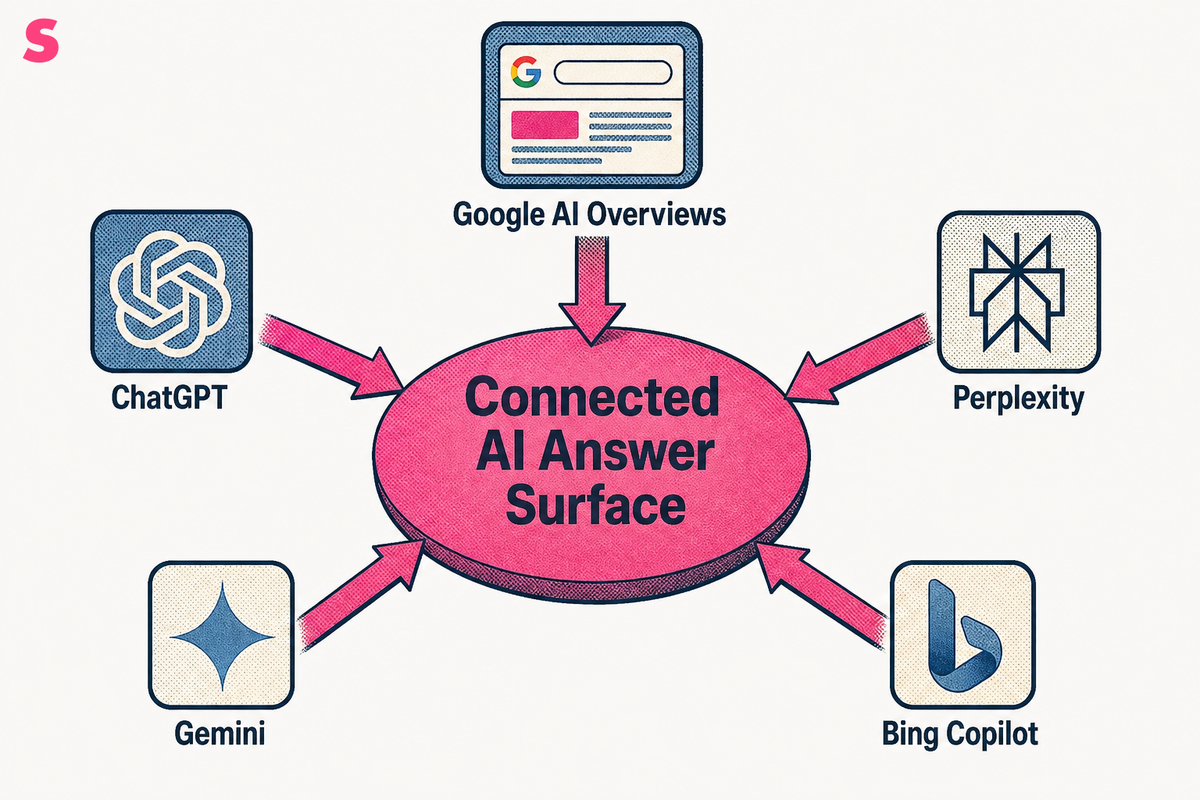
An AI SEO agency helps a brand get found and cited inside AI-generated answers rather than just ranked on a search results page. That means work aimed at Google AI Overviews, ChatGPT, Perplexity, Gemini, and Bing Copilot, the surfaces where a growing share of buyer research now happens before anyone visits a website.
AI SEO agencies optimize for visibility across all of these experiences, and Google AI Overviews, ChatGPT, Perplexity, Gemini, and Bing Copilot are treated as a single connected surface rather than five separate channels. The practical work includes structuring content so a model can extract and quote it, building the entity signals that help an LLM understand who a brand is, and auditing whether a site's technical setup lets AI crawlers reach its pages.
Despite the name, most agencies in this space describe their own work as generative engine optimization (GEO) and AI engine optimization (AEO) rather than a rebrand of conventional SEO, according to discussion on reddit.com. That distinction matters. A firm doing GEO and AEO work is thinking about how a language model synthesizes an answer from multiple sources, not just how a page climbs a ranked list of ten blue links.
Some AI SEO agencies also use AI-powered tools internally to automate parts of traditional SEO, such as keyword research, content brief generation, and scaling link outreach. That is a separate, supporting layer of the work. It speeds up production, but it is not the same discipline as optimizing for citation inside a generated answer.
How is AI SEO different from traditional SEO services?
Traditional SEO optimizes for clicks and ranking position on a search results page; AI SEO optimizes for being cited or quoted inside an AI-generated answer, where there may be no click at all. That single distinction changes almost every tactic underneath it, from how content is structured to how success gets measured.
A brand can rank first for a keyword and still never appear in the Google AI Overview that sits above the results, or in the answer ChatGPT gives to the same question. Conversely, a page with modest rankings can be the exact source an LLM chooses to quote, if its structure and clarity make it easy to extract. AI SEO agencies help brands get cited and ranked in these AI-generated results and LLM outputs, a goal distinct from the click-based targets traditional SEO services chase.
| Dimension | Traditional SEO | AI SEO (GEO/AEO) |
|---|---|---|
| Primary goal | Rank position on a search results page | Citation or mention inside an AI-generated answer |
| Success signal | Organic clicks and traffic | Share of voice across AI engines, with or without a click |
| Content structure | Keyword-optimized pages built for scanning | Extractable, quotable passages built for a model to lift directly |
| Technical focus | Site speed, backlinks, on-page keywords | Crawlability by AI bots, structured data, entity clarity |
| Measurement surface | Google Search Console, rank trackers | Prompt-level tracking across ChatGPT, Perplexity, Gemini, Google AI Overviews |
The overlap between the two disciplines is real, and no serious agency treats them as unrelated. A page that is genuinely well written, well structured, and technically sound tends to perform in both traditional rankings and AI answers. The difference is emphasis: an AI SEO agency measures whether the brand shows up in the answer itself, not just whether the underlying page ranks well enough to earn a click.
Who are the top AI SEO agencies in 2026?
There is no single, agreed-upon leaderboard. Different published rankings name different firms, which tells prospective buyers more about the state of the market than any one list does on its own. Pricing, scoring methodology, and even the count of agencies considered "top tier" vary from one published list to the next, so the table below keeps each source's figures in table form rather than treating any one number as settled fact.
| Agency | Notable claim | What it emphasizes |
|---|---|---|
| Thrive Internet Marketing Agency | Ranked highest at 97/100 in one published scoring model | Full-service digital marketing with an AI search practice |
| Intero Digital | Scored 94/100 in the same ranking | Enterprise SEO with AI search add-on services |
| Victorious SEO | Scored 91/100 in the same ranking | Traditional SEO agency extending into AI visibility work |
| Coalition Technologies | Claims #1 AI SEO (GEO) agency status, citing 800+ case studies | Volume of documented client work in GEO |
| Searchbloom, The SEO Works, Tinuiti, Digital Authority Partners, Omniscient Digital | Named among the top AI SEO companies of 2026 in a separate published list | Range of firm sizes, from boutique to large agency network |
Published lists also disagree on how many agencies even qualify for a "top" ranking, which signals a fragmented and still-consolidating market in 2026 rather than one settled top tier. An enterprise comparing agencies should treat any single "top" list as a starting point for due diligence, not a final verdict, and should verify each firm's actual GEO and AEO methodology rather than its position on a ranked list.
What should an enterprise look for in an AI SEO agency?
An enterprise should look for a leading AI SEO agency with a documented methodology for AEO and GEO, not simply a portfolio of traditional SEO case studies with "AI" added to the description. The methodology matters more than the brand name, because the underlying discipline, tracking citations across multiple LLMs, is still new enough that few firms have deep, multi-year track records in it.
Four things separate a genuinely capable partner from one riding the trend:
- Multi-engine measurement. The agency should track visibility across Google AI Overviews, ChatGPT, Perplexity, and Gemini individually, not as one blended number.
- Technical fluency. The team should be able to explain how structured data, crawlability, and content structure affect whether an AI engine can extract and cite a page.
- Attribution capability. The best AI SEO agency for an enterprise in 2026 will connect AI-driven visibility to pipeline, not just report a citation count.
- Transparent reporting. Enterprises should expect prompt-level detail, showing exactly which questions surface the brand and which do not, rather than a single aggregate score.
Enterprise buyers should also ask how an agency verifies its own claims. A firm that can show its measurement method, the engines it tracks, the sample size of prompts, and the date range of its data, is a stronger partner than one offering a single confident number with no methodology behind it.
How much does an AI SEO agency cost in 2026?
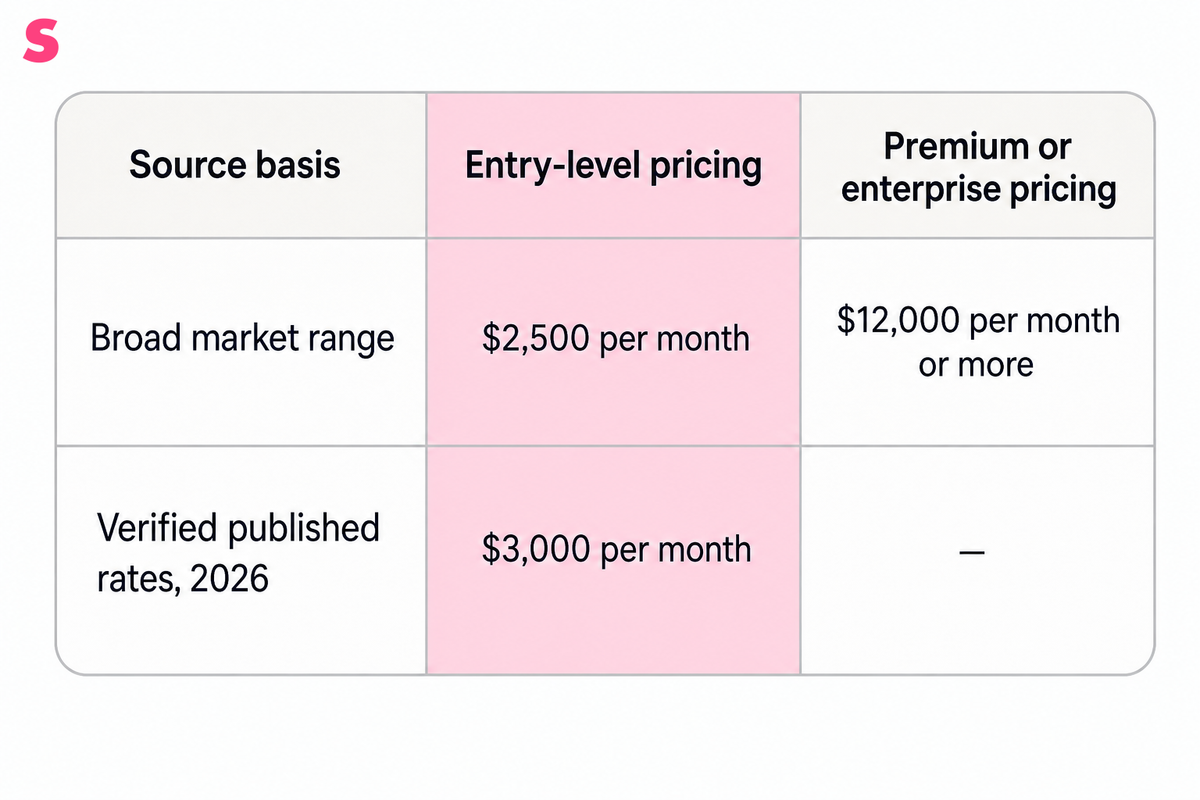
AI SEO agency pricing varies considerably depending on scope, and published rates differ enough between sources that an enterprise should treat any single figure as a data point rather than a market standard.
| Source basis | Entry-level pricing | Premium or enterprise pricing |
|---|---|---|
| Broad market range | $2,500 per month | $12,000 per month or more |
| Verified published rates, 2026 | $3,000 per month | Not specified |
Price generally scales with four variables: how many AI engines are monitored, whether the engagement includes technical implementation work or only reporting, whether ongoing content production is part of the deliverable, and whether attribution to pipeline is included. An agency quoting near the low end of the market is often providing visibility monitoring alone. An agency near the top of the range typically bundles technical AEO and GEO implementation, ongoing content production, and cross-engine reporting into one retainer.
Enterprises building a 2026 shortlist of AI SEO agencies should ask each firm to break its quote into these components rather than accepting one bundled number. A quote that separates monitoring, technical implementation, and content production from each other is easier to compare across firms and easier to defend internally when budget gets reviewed.
Sona AI Visibility offers a self-serve alternative to agency retainers for teams that want to see their own citation data before committing to a monthly contract. That distinction is a category difference, not a pricing one: agency retainers deliver strategy, implementation, and ongoing management, while self-serve measurement software gives a team its own visibility data to bring into any agency conversation without replacing agency strategy work.
What red flags signal an agency is repackaging traditional SEO as AI SEO?
The clearest red flag is an agency that cannot explain how it tracks citations across individual LLMs and instead offers only a traditional rank-tracking report with an "AI" label added to it. If a proposal talks about keyword rankings, backlinks, and domain authority without once naming a specific AI engine or a citation-tracking method, that proposal describes traditional SEO wearing a new name.
Other signals worth checking before signing with any AI SEO agency:
- No engine-level detail. A firm that cannot say whether a brand shows up in ChatGPT versus Perplexity versus Google AI Overviews specifically, and instead offers one combined score, likely has not built real cross-engine tracking.
- No technical audit component. AEO and GEO work depends on whether AI crawlers can actually reach and parse a site's pages. An agency skipping that step is not doing the technical half of the job.
- Case studies limited to traffic and rankings. A firm claiming AI SEO results but showing only organic traffic graphs, with no citation or mention data, has not demonstrated the thing it is selling.
- Vague or absent methodology. Among the top AI SEO agencies, the credible ones can describe exactly how they measure a citation and how often that measurement runs. If an agency cannot answer that question specifically, treat the claim with caution.
None of this means traditional SEO expertise is worthless. It means an enterprise should confirm that the specific AI search deliverables in a proposal are real, measurable, and distinct from the SEO retainer the agency was already selling.
What technical foundations should an AI SEO agency build first?
An AI SEO agency should start with crawlability. If AI bots such as GPTBot, ClaudeBot, or PerplexityBot cannot reach and parse a page, nothing else in the engagement matters, because the content stays invisible to the systems generating the answers a brand wants to appear inside.
A sound technical build generally follows this sequence:
- Audit crawler access. Check robots.txt, firewall rules, and any bot-blocking configuration that might be preventing AI crawlers from reaching key pages.
- Fix structured data gaps. Schema markup, including FAQ-style structured data, helps a model extract question-and-answer content directly.
- Strengthen entity signals. Consistent naming, clear authorship, and clean internal linking help an LLM understand who a brand is and what it does.
- Improve content extractability. Content should answer a specific question in a self-contained passage that a model can lift without needing surrounding context.
- Re-test on a cadence. Technical readiness is not a one-time fix; pages need to be re-audited as content changes and as AI crawlers change their own behavior.
Some AI SEO agencies use AI-powered tools to speed up this technical work, automating parts of the audit process the way they automate keyword research or content brief generation elsewhere in the engagement. That speeds up the first pass, but the underlying checks, crawlability, structured data, entity clarity, still need verification against the live site rather than assumption from a generic scan.
How should an enterprise evaluate ROI from an AI SEO engagement?
An enterprise should evaluate ROI from an AI SEO agency by tracking whether AI-driven visibility connects to pipeline, not by counting citations alone. A rising citation count is encouraging, but it answers only whether a brand is being mentioned, not whether that mention produced a lead, a signup, or a closed deal.
Sona AI Attribution addresses exactly this gap by putting AI touchpoints on the same account timeline as ads, web, and CRM data, and by treating AI search as a measurable channel with its own spend, deals, and ROAS rather than folding it into an undifferentiated "direct traffic" bucket. That distinction matters because AI-referred visitors frequently land in analytics platforms as direct traffic, which understates the channel's real contribution and makes ROI look worse than it is.
A useful ROI framework for evaluating any AI SEO agency asks four questions in sequence:
- Is the brand cited more often over time? Measured across specific engines, not a single blended score.
- Are those citations tied to real accounts? Anonymous mention counts are weaker evidence than mentions connected to identifiable visits.
- Do those accounts show up in pipeline? This requires attribution modeling, not assumption.
- Does the agency's reporting improve over the engagement? A capable partner refines its measurement as it learns which prompts and pages matter most to the brand's specific audience.
An agency that cannot answer the second and third questions is reporting visibility, not ROI, and enterprises should price and evaluate the engagement accordingly.
How does an AI SEO agency's work show up in tools like ChatGPT and Google AI Overviews?
An AI SEO agency's work shows up as a citation, a mention, or a direct quote inside an answer generated by ChatGPT, Google AI Overviews, Perplexity, or Gemini, in response to a real question a buyer typed or spoke. That is the concrete, observable outcome the whole discipline is built around.
Sona's own AI visibility archive illustrates what this measurement actually looks like in practice: it covers 8 answer surfaces, ChatGPT, Perplexity, Google AI Mode, Gemini, Mistral, Qwen, Claude and Google AI Overviews, per Sona's own AI visibility data, August 2026. Each surface answers the same prompt differently, which is why one engine's result is not a read on the others.
That structure, prompts tracked individually, across multiple engines, over a defined date range, is the same structure a capable AI SEO agency should be building for any client. A single prompt like "best AI SEO agency" can surface completely different answers in ChatGPT versus Google AI Overviews on the same day, which is why tracking has to happen per engine rather than as one combined score.
Monitoring which AI answers mention a brand is only half the job. The other half is connecting those mentions to accounts, pipeline, and revenue, so a rising citation count means something concrete to a marketing budget rather than sitting as an isolated vanity metric. Sona AI Attribution closes that loop by tying AI-referred visits to the account timeline where pipeline and revenue already get tracked, which turns a mentions report into evidence a finance team can actually use.
Frequently Asked Questions
Is an AI SEO agency the same as a GEO or AEO agency?
Yes, in practice. Most agencies calling themselves AI SEO specialists are doing generative engine optimization (GEO) and AI engine optimization (AEO) work, according to reddit.com, rather than a rebrand of conventional SEO under a new label. The naming varies by firm, but the underlying discipline, optimizing for citation inside AI-generated answers, stays consistent across GEO, AEO, and "AI SEO" branding.
How many AI SEO agencies are operating in 2026?
Published lists vary widely on how many agencies count as leaders in the space. That variation points to a fragmented, still-consolidating market in 2026 rather than a settled top tier, and it means an enterprise should treat any single ranked list as a starting point for research rather than a definitive answer.
Do AI SEO agencies replace a company's existing SEO team or agency?
Not usually. Most engagements layer AI search optimization, structured data work, and entity building on top of existing SEO foundations rather than replacing them outright. A site with strong traditional SEO already has much of the technical groundwork an AI SEO engagement needs; the additional work targets citation and extractability specifically.
Can a small in-house marketing team manage AI SEO without an agency?
Some of the work, structured data, content clarity, basic technical audits, is achievable in-house with the right checklist. Tracking citations across multiple LLMs and connecting those citations to revenue is harder to do without dedicated tooling, since it requires monitoring several engines on a schedule and reconciling that data against pipeline, which is where a specialist partner or a measurement platform typically becomes necessary.
What determines how quickly an AI SEO engagement produces results?
Two factors determine timeline more than any other: how technically ready a site already is, and how competitive its category is inside AI-generated answers. A site with clean crawlability, existing structured data, and clear entity signals starts closer to visible results than one that needs a full technical remediation first. A brand competing in a category where AI engines already cite several established sources faces a harder climb than one in a less contested space. Rather than a fixed number of weeks or months, a sound evaluation process sets milestones: crawler access confirmed, structured data in place, entity signals strengthened, and citation tracking live across the relevant engines. Progress against those milestones is a more reliable signal than any general timeline, since the specifics of a given site and category determine how fast citations actually accumulate.
Should an enterprise pick one agency for both traditional SEO and AI search visibility?
It depends on whether the incumbent agency has genuine AEO and GEO capability rather than a relabeled SEO retainer. The red flags worth checking, engine-level tracking detail, a technical audit component, citation-based case studies, and a clear measurement methodology, are the specific things to verify before deciding whether one firm can credibly handle both.
Summarize this article with AI: ChatGPT · Claude · Perplexity · Google AI Mode
Last updated: October 2026







