For a free AI visibility audit today, choose a tool that reveals its prompts, engines and raw responses, then use it to assess your brand and two or three competitors. A valuable audit details the prompt set, AI engines examined, cited sources and scoring methodology instead of offering one opaque score. View the outcome as a snapshot, since AI responses can differ across runs. Sona AI Visibility links an audit's discovered prompts and citations to pipeline and revenue.
What is a free AI visibility audit, and what do you receive when you sign up?
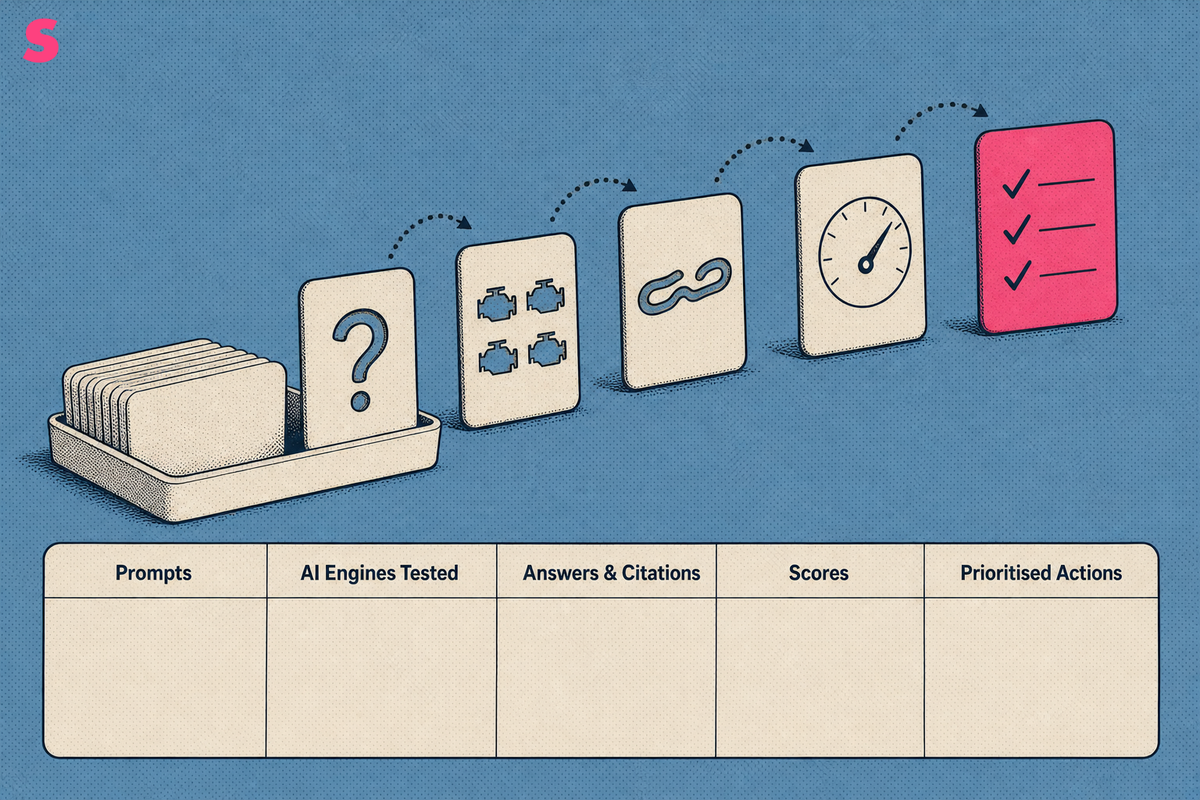
A free AI visibility audit sends buyer-style questions to AI engines and reports whether, where, and how a brand appears or earns citations in the answers. If you want to sign up for free ai visibility audit today, look for evidence rather than a vague score.
Sign up for Sona AI Visibility’s 14-day free trial with no credit card, then run the AI Search Insights page audit to identify page-level technical and content findings that affect answer-engine visibility.
A useful report includes the prompt set, tested AI engines, run count, named competitors, raw answers, cited URLs, scoring logic, and prioritised actions. Free audits commonly test ChatGPT, Gemini, Claude, Perplexity, and other answer engines, based on October 2026 listings of available audit tools.
- Prompts: buyer questions used to test your category, product, and alternatives.
- Answers and citations: the actual output, including cited pages and competitor mentions.
- Scores: a documented calculation for measures such as answer engine optimization (AEO) and generative engine optimization (GEO).
- Actions: content, technical, and authority gaps that merit investigation.
A free AI visibility audit differs from a traditional SEO audit. An SEO audit examines crawl health, rankings, and pages in conventional search results. An AI visibility audit also differs from rank tracking because one run cannot establish a permanent AI ranking. AI answers change with prompts, retrieval systems, model updates, and available citation sources.
Why should you run a free AI visibility audit now, and who should bother?
B2B SaaS marketers can use a free AI visibility audit to see whether the brand appears in vendor-shortlist questions and which competitors appear instead. Demand generation, SEO, and content teams can use that evidence to prioritise work before committing budget.
Google showed a Google AI Overview for 449 of 453 keywords, or 99.1%, in a SaaS buyer-intent study sample collected October 12–13, 2026. The study indicates that answer formats now appear beside conventional search results for many commercial queries.
At least 19 free AI visibility audit tools and checkers were available in 2026, according to October 2026 listings. The relevant question is whether an audit tests buyer prompts, shows the underlying answers, and identifies the next checks for the team.
How does a free AI visibility audit work, step by step, with a worked example?
A free AI visibility audit sends buyer prompts to several answer engines, repeats the tests, extracts mentions and citations, then summarises the evidence. Repeated runs matter because a single answer is an observation, not a stable market position.
- Choose prompts that reflect awareness, consideration, decision, and purchase questions.
- Run each prompt across the selected AI engines.
- Repeat the same prompt several times to expose answer variation.
- Record brand mentions, cited URLs, position in the answer, competitors, and sentiment.
- Calculate the score using disclosed rules, then inspect the underlying evidence.
One listed audit in October 2026 used 15 questions across 3 AI engines, with 3 runs per question, producing 135 total answers. The calculation is visible: 15 questions × 3 engines × 3 runs equals 135 answers.
Read the output with consistent definitions. Mention rate is the share of answers naming your brand. Citation rate is the share of answers citing one of your pages. Share of voice compares your mentions with named competitors. Position records where the brand appears in an answer. Sentiment records whether the context is favourable, neutral, or unfavourable.
For example, a brand mentioned in 18 of 45 answers has a 40% mention rate. If its pages are cited in 9 of those 45 answers, the citation rate is 20%. A manual version using free checklists and no paid tools takes roughly 6–10 hours, based on October 2026 listings.
Which AI engines should a B2B SaaS free audit cover, including Google AI Overviews?
A B2B SaaS free audit should cover the answer engines buyers use during research, starting with ChatGPT, Google AI Overviews, Perplexity, Gemini, Claude, Copilot, Google AI Mode, and other answer engines where relevant. Engine coverage should reflect buyer behaviour rather than a generic checklist.
Testing the wrong engines produces weak evidence. A regional SaaS product, an enterprise platform, and a local consumer brand can have different research patterns. A free tool can test across 10 AI platforms, according to an October 2026 listing, while paid entry tiers often list 3–5 engines in published plans as of October 2026.
Start with engines mentioned in sales calls, self-reported attribution, customer interviews, and referral data. Add Google AI Overviews when conventional Google search remains an important discovery route. Add Claude or Copilot when buyers work in technical, enterprise, or productivity environments that use those assistants.
Sona AI Visibility tracks 11 AI engines and connects citations to pipeline and revenue on one account timeline. That measurement shows whether AI research contributes to commercial outcomes after an audit identifies where buyers encounter the brand.
How many prompts, runs, and competitors make a free AI visibility audit useful?
A useful first AI visibility audit needs a spread of buyer prompts, several runs per prompt, and named competitors. A narrow prompt list can make a brand appear stronger or weaker than its position in commercial research.
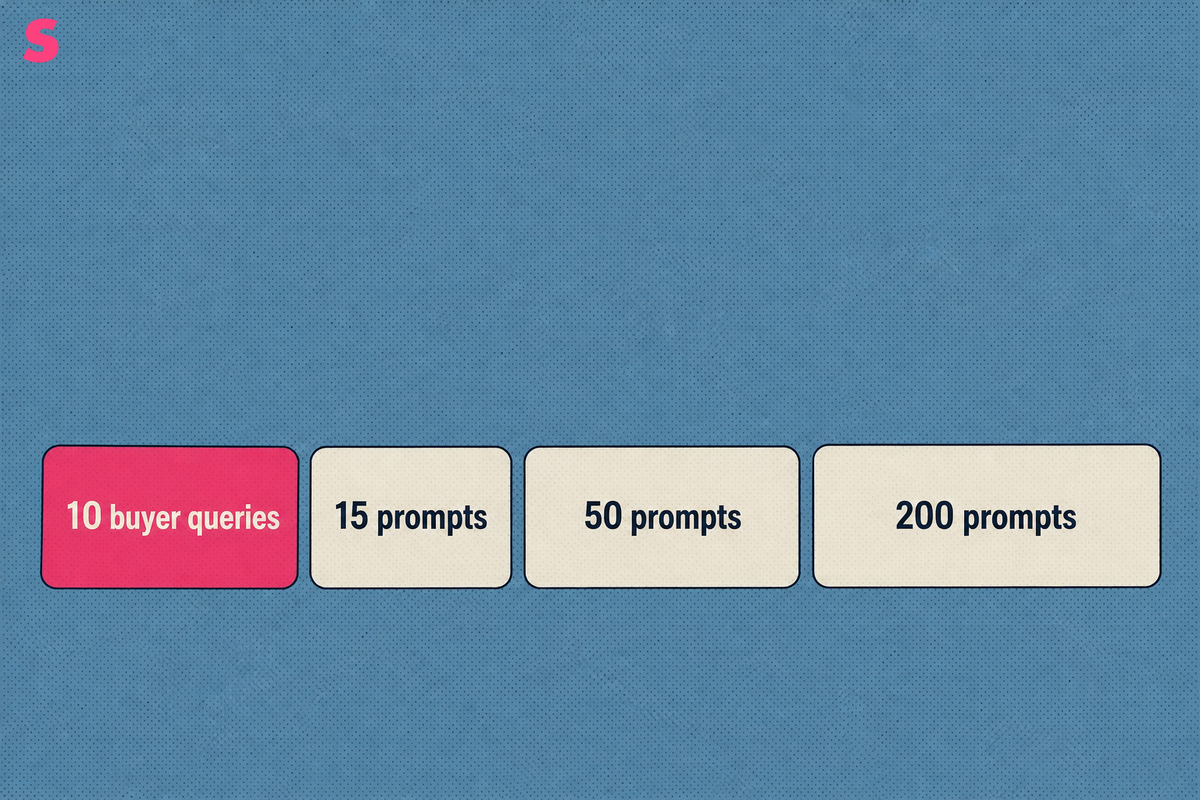
Free audits can start with 10 real buyer queries, according to October 2026 listings. Other published examples include 15 questions, 15 prompts on an entry tier, 50 prompts on another entry tier, and 200 prompts on a further plan. One listed audit scans 50 prompts daily for 7 days across 5 AI engines, based on an October 2026 listing.
A practical first audit includes prompts across awareness, consideration, decision, and purchase stages. Use category questions, comparison questions, implementation questions, and direct shortlist questions. Name competitors that buyers actually evaluate rather than brands with no role in the sales process.
Run the same prompt list daily to identify patterns that a weekly snapshot can obscure. Retrieval indexes, model updates, and newly published competitor material can change one day’s answer, while movement that holds for four days is a stronger trend.
What technical and content checks sit behind an AI visibility score?
An AI visibility score should rest on technical and content checks that determine whether answer engines can reach, parse, trust, and cite a page. The six core dimensions are crawlability, performance, security, content structure, content quality, and accessibility.
- Crawlability: whether crawlers and answer engines can reach the page, including robots.txt, canonical tags, llms.txt, and indexability.
- Performance: rendered page experience, server-rendered HTML, and JavaScript dependency.
- Security: transport and header hygiene, including trust signals from security headers.
- Content structure: schema markup, metadata, semantic HTML, and FAQPage JSON-LD.
- Content quality: whether the copy answers the subject clearly and reflects current information.
- Accessibility: alt text, ARIA attributes, contrast, and explicit image dimensions.
Answer systems discover accessible pages, index or retrieve relevant passages for a prompt, select sources through engine-specific relevance and trust signals, then generate an answer that may cite those sources. Visibility therefore varies by prompt and engine rather than forming one stable rank.
A traditional SEO audit checks many of the same technical foundations. An AI visibility audit adds the answer-engine outcome: whether the brand or page appears in a generated answer. The audits complement each other because a page must be reachable and interpretable before it becomes a credible citation candidate.
A visibility score can show that a page is not being cited, while a technical audit identifies page-level issues that may block progress. Sona AI Visibility uses AI Search Insights to score a page out of 100 across six categories, rank each finding as critical or medium with an attached fix, and re-run the audit on a watch so teams can verify whether the fix landed.
Do free AI visibility audit tools require signup, and what do they measure?
Free AI visibility audit tools measure brand mentions, citations, cited sources, competitor presence, and score-based readiness signals. Several audits run without an account in about 3 minutes or under 2 minutes, based on October 2026 listings, while others request an email address or a sales conversation.
Some free audits are rate-limited to 10 audits per hour per IP address, according to October 2026 listings. Before submitting contact details, check whether the report provides raw answers, cited URLs, the tested prompt list, and scoring logic. A lead form without those inputs offers little evidence for a marketing decision.
The comparison below covers published entry-plan details as of October 2026. Sona AI Visibility connects citations and prompts to pipeline and revenue rather than stopping at a mention count.
| Tool | Starting price | Agency Plans? (Yes/No) | # of Answer Engines Tracked | Answer Engines | # of Daily Tracked Prompts (entry plan) | Cost per Daily Tracked Prompt | Differentiation |
|---|---|---|---|---|---|---|---|
| Sona AI Visibility | From $75/month, billed annually | Yes | Up to 11 (3 on Starter) | Not published | 5,000 credits/month, about 56 daily tracked prompts across 3 engines | $0.45 per daily tracked prompt | Connects AI citations and prompts to pipeline and revenue on one account timeline, and tracks AI crawler activity from server logs or a lightweight edge worker. |
| Peec AI | From $95/month | Yes | Up to 13 (3 of 6 on Starter, plus add-ons) | Not published | 50 prompts daily | $0.63 per daily tracked prompt | Self-serve coverage lists six engines, with up to 13 engines on Enterprise. |
| Profound | Custom pricing | Yes | Up to 9 (3 on free Trial) | ChatGPT, Gemini, Google AI Overviews | 50 prompts daily for 7 days | Custom pricing; unit cost cannot be calculated | Agency Growth includes 10 pitch workspaces monthly, with client workspaces available as additions. |
| Otterly.ai | From $29/month | Yes | Up to 7 (4 on Lite, 3 as paid add-ons) | ChatGPT, Google AI Overviews, Perplexity, Microsoft Copilot | 15 prompts daily | $0.48 per daily tracked prompt | Lite includes four engines, with Claude, Google AI Mode, and Gemini available as paid add-ons. |
| PromptWatch | From $95/month | Yes | Not published | Not published | 50 prompts daily | $0.48 per daily tracked prompt | Essential includes 6,000 responses monthly, with higher response allowances on larger plans. |
What do paid AI visibility tools cost after the free audit ends?
Paid AI visibility audits and tracking tools range from one-off reports to recurring monthly subscriptions. Published one-off audits ranged from $49 to $3,500, with a reported median of $300 among provider prices reviewed in October 2026.
Monthly entry tiers in the comparison range from $29–$95 as of October 2026, excluding the custom-priced row. Ahrefs Lite starts from $129 per month, while Ahrefs Brand Radar AI starts from $199 per month as of October 2026. Check published plans against current scope before purchase.
Compare four items before paying: prompt count, engine count, competitor count, and billing structure. A monthly subscription supports repeated measurement. A one-off audit creates a dated snapshot. Neither format provides a useful decision basis when the report hides tested prompts or raw answers.
Can you trust a free audit score, and how do you turn it into action and pipeline?
A free AI visibility audit score is useful when it exposes the raw answers, cited URLs, and scoring logic behind the number. Without those elements, the audit primarily serves as a lead form. A score alone cannot prove pipeline impact.
AI answers shift with model updates, location, personalisation, retrieval indexes, and prompt wording. Treat each score as a dated snapshot. A repeated series using the same prompt set can show whether a change persists.
Turn the evidence into work across four areas: fill content gaps for missing buyer questions, resolve technical findings that limit crawlability or parsing, strengthen digital PR, and earn relevant third-party citations. Assign each action to a page, prompt cluster, or source pattern, then rerun the prompt list daily.
Sona AI Visibility connects prompts and citations to pipeline and revenue, while tracking AI crawler and agent activity at the front of that same path. Mention and competitor tracking establish the baseline. The business question is whether AI-driven research created accounts, opportunities, and closed-won revenue.
What are the frequently asked questions about a free AI visibility audit?
Is a free AI visibility audit really free, or is it a lead form?
Several tools run an audit without signup, while others request an email address or a sales conversation. Check whether the report shows raw answers, cited URLs, tested prompts, and scoring logic before providing contact details. Those inputs distinguish a usable diagnostic from a lead capture form.
How long does a free AI visibility audit take?
Some free audits finish in under 2 minutes, and others take about 3 minutes without an account, based on October 2026 listings. Some are rate-limited to 10 audits per hour per IP address. A deeper manual audit using free checklists takes roughly 6–10 hours.
Which AI engines does a free audit usually test?
Free audits commonly test ChatGPT, Gemini, Claude, Perplexity, and other answer engines. Some also cover Google AI Overviews or test up to 10 platforms. Match the engine list to where buyers research products, compare vendors, and ask implementation questions.
Is an AI visibility audit the same as an SEO audit?
No. A traditional SEO audit checks crawl health and rankings in conventional search results, while an AI visibility audit tests whether answer engines mention or cite the brand in generated answers. The two methods share technical foundations, including crawlability and page structure.
Can I run an AI visibility audit myself without a tool?
Yes. A manual audit can take roughly 6–10 hours with no paid tools, based on October 2026 listings. Write buyer prompts, run them across relevant answer engines several times, record brand mentions and cited sources, then compare the results with named competitors.
How often should I rerun a free AI visibility audit?
Rerun an AI visibility audit after major content changes or model updates, and maintain a regular testing schedule. Run the same prompt list daily because AI answers vary between runs and over time. A daily series separates persistent movement from a one-day fluctuation.
Summarize this article with AI: ChatGPT · Claude · Perplexity · Google AI Mode
Last updated: October 2026