


To check brand visibility in ChatGPT, run a fixed list of category buying prompts, log whether ChatGPT mentions, cites, or ignores your brand, and note which competitors it names instead. Repeat that same prompt set on a set cadence so you get a trend rather than a snapshot. Manual audits and visibility checkers stop at mention counts; Sona AI Visibility connects those prompts and citations to pipeline and revenue on one account timeline, alongside the AI crawler and agent activity behind them.
What does it mean when ChatGPT names your brand in an answer?
It means your company occupied one of the limited vendor slots a generated answer contains. That is the unit of visibility in AI search. There is no page two, no scroll, and no second chance below the fold.
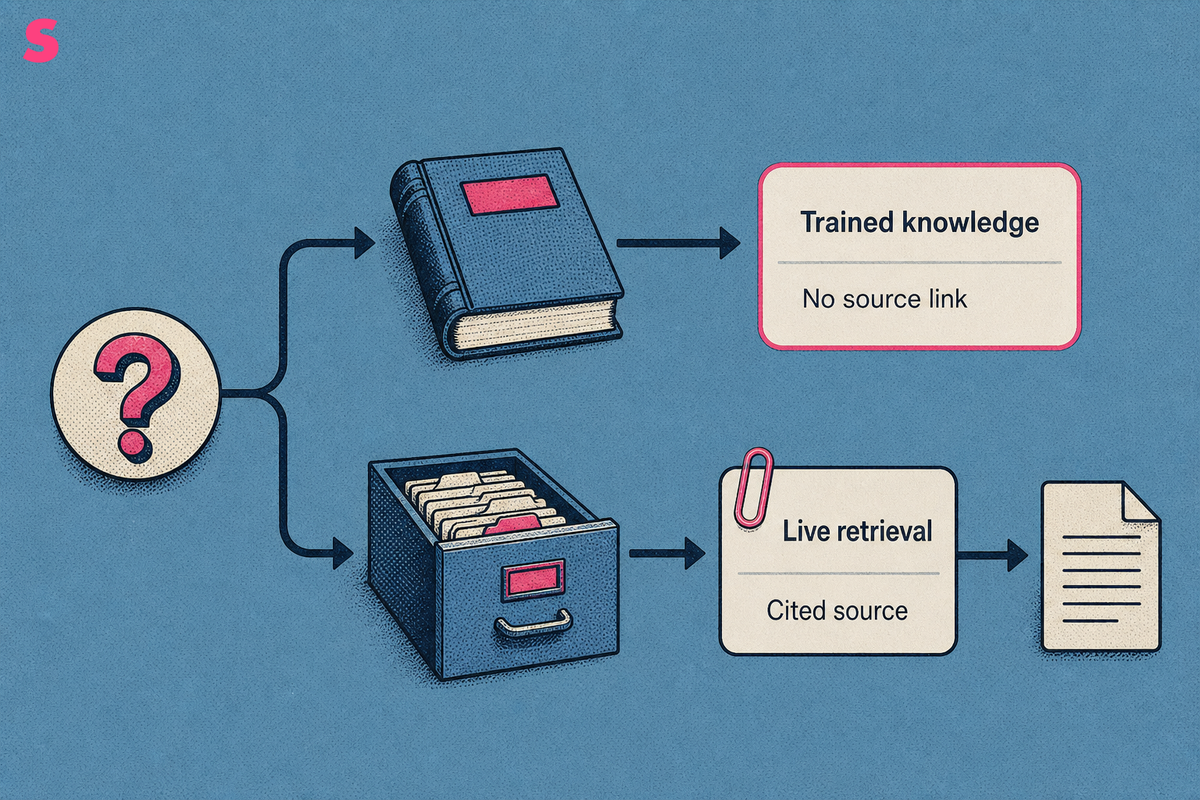
Two things get counted, and they are not the same:
- A mention is your brand name appearing in the answer text, with or without a link.
- A citation is a linked source the answer used as evidence, which may be your domain, a review site, or a forum thread that discusses you.
A Google ranking position is a place in an ordered list of ten blue links that the same query returns again tomorrow. An answer slot is a synthesis. The model rewrites the recommendation each time, so your presence is a rate across repeated runs rather than a fixed rank. Two brands can hold position three on the same query and read completely differently, because one is described as the enterprise option and the other as the cheap one.
For a B2B SaaS company the pipeline consequence is direct. A buyer who asks ChatGPT for a shortlist arrives at three vendor sites with an opinion already formed. If you are not in the shortlist, you are not in the evaluation, and nothing in your analytics will tell you the deal existed.
How does ChatGPT decide which brands it mentions and cites?
ChatGPT names brands from two places: what the model absorbed during training, and what its retrieval layer fetches at the moment the question is asked. Training gives it a general sense of who the established vendors in a category are. Retrieval gives it whatever ranks and reads well on the live web today, which is why a new entrant can appear in a search-backed answer and be absent from a purely generative one.
Brand visibility in ChatGPT is shaped by which sources the model leans on when it names a brand, and by how sentiment and context shift across different phrasings of the same question (reddit.com). Ask for the best tools in a category and you get a list. Ask which one a 40-person team should buy and the same underlying sources produce a single recommendation with a reason attached.
The sources that carry weight are rarely your own homepage. Third-party listicles, review platforms, documentation, comparison pages and community threads are what a retrieval layer finds credible for a question about who is good. Your site supplies the specifics once you are already in the set.
Variance follows from that. The same prompt run twice can hit different retrieved pages, and a paraphrase changes which sources the query matches. That is why one run tells you almost nothing.
Which prompts and query patterns decide whether ChatGPT names your brand?
The prompt shape decides the answer shape. Definitional questions return explanation with few vendors. Superlative and shortlist questions return named lists. Constrained questions, the ones carrying a budget, a company size or a required integration, return one or two recommendations and nothing else. Build your prompt set around the questions a real buyer asks, not around your own brand name.
| Prompt pattern | Worked example | Buying stage | Answer shape returned |
|---|---|---|---|
| Category definition | What is AI visibility tracking? | Awareness | Explanation, occasional single vendor cited as a source |
| Problem framing | How do I know if buyers find us in AI search? | Awareness | Method walkthrough, tools named at the end |
| Best-of shortlist | Best tools to track ChatGPT mentions for B2B SaaS | Consideration | Numbered list of five to ten named vendors |
| Alternatives | Alternatives to [incumbent vendor] | Consideration | List anchored on the named brand, framed against it |
| Use-case fit | Which AI visibility tool suits a 40-person SaaS marketing team? | Consideration | Three or four vendors, each with a stated rationale |
| Head-to-head | [Vendor A] vs [Vendor B] for prompt tracking | Decision | Two-way comparison, often ending in one recommendation |
| Constrained pick | Cheapest tool under $100/month that tracks prompts daily | Decision | One or two names, filtered by the constraint |
| Reputation check | Is [your brand] any good? | Decision | Sentiment summary drawn from reviews and forums |
Four more patterns belong in a complete set: pricing questions ("how much does AI visibility software cost"), integration questions ("which tool has an API"), migration questions ("switching from a rank tracker to AI visibility tracking"), and role questions ("what should a demand gen lead measure in AI search"). Branded vanity prompts are the ones to leave out. ChatGPT will describe you accurately when asked about you by name, and that tells you nothing about whether a buyer who has never heard of you will meet you.
How do you run a manual check of your brand visibility in ChatGPT?
A manual audit takes an afternoon and costs nothing. Write the prompt list, run it under controlled conditions, log the result in a spreadsheet, and repeat it on a fixed cadence so the second run is comparable to the first.
- Write a fixed prompt set spread across awareness, consideration and decision patterns, phrased the way a buyer would type them.
- Open a clean session: logged out or with memory and custom instructions disabled, personalization off, one prompt per conversation, no follow-up questions.
- Run each prompt repeatedly, in the same region and language, on the same model version.
- Log five fields per run: brand named yes or no, position in the list, sources cited, competitors named, and whether the description of you is factually accurate.
- Screenshot the answers where the wording matters, because you cannot re-run yesterday's response.
Comparability is the part most audits get wrong. A session that remembers you work at the company you are researching will name that company, and the audit becomes a mirror. Fix the model, the region, the phrasing and the run count, then change nothing else between audits.
Then set the cadence. Running the same prompt list daily surfaces patterns that a weekly snapshot averages away: a move that persists across consecutive runs and exceeds your observed run-to-run variation is a trend, while a single spike is noise. Save the deeper competitive read for a monthly review.
Which metrics turn a ChatGPT audit into a score you can track over time?
Five metrics do the work: brand mentions, position, citations, competitors named, and accuracy of information across ChatGPT and AI search (hackernoon.com). Everything else is a derivative of those five.
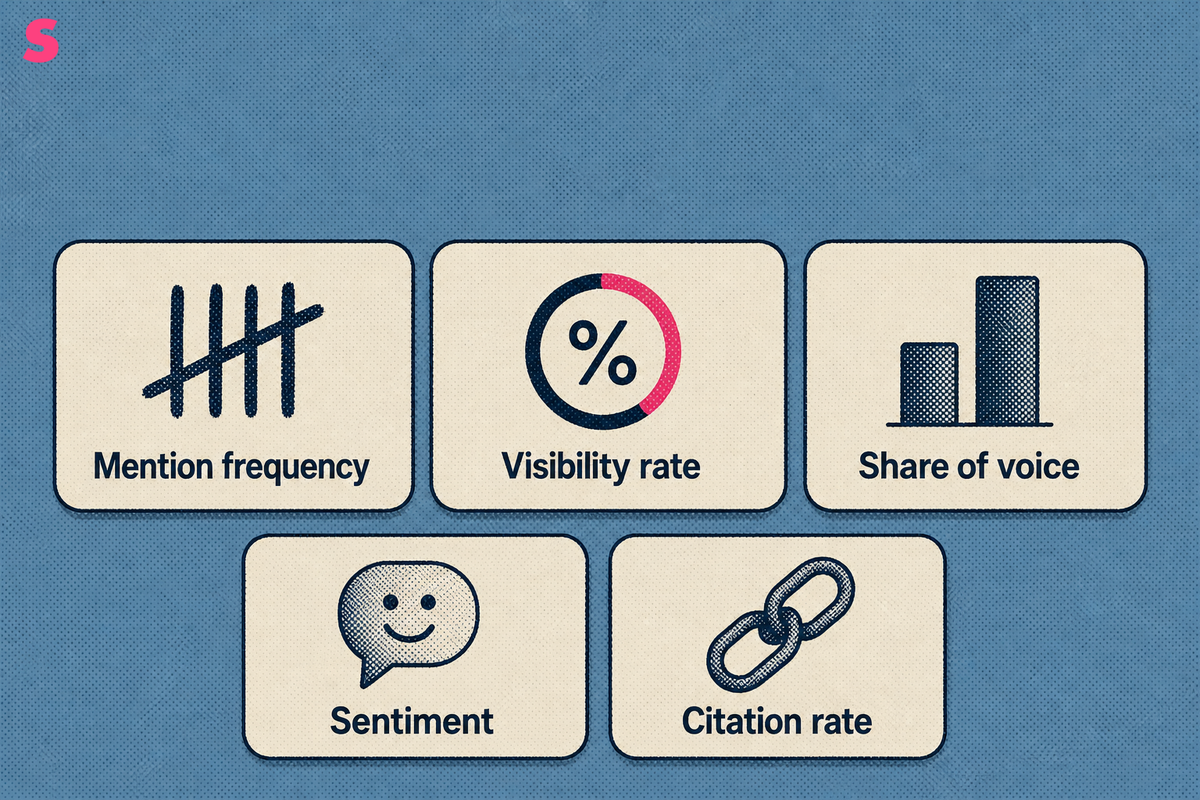
Count them as rates, not totals. Mention rate is the number of answers naming your brand divided by the total number of answers you ran. Share of voice is your mentions divided by all brand mentions counted across those same answers. Average position is the mean rank across the answers where you appear, and it moves independently of the rate: you can be named more often and slotted lower. Accuracy is a manual field, and it matters, because a mention that describes your pricing wrongly costs more than an absence.
Benchmark against the brands ChatGPT names beside you, not against a general competitor set. The vendors sharing your answer slots are the ones the model considers substitutable with you, which is a sharper competitive read than any market map.
One brand-level number is not a work item. A single mention rate tells you nothing about which prompts return your brand, which return rivals instead, or which sources the answer cited. Sona AI Visibility connects prompts and citations to pipeline and revenue on one account timeline through AI Search Insights, and infers the likely prompt behind an AI-referred visit, so the output points at named prompts and named accounts rather than one aggregate. A score is a dated snapshot; a comparable series of scores is what shows a trend.
Which tools check and monitor brand visibility in ChatGPT?
The category runs from free one-page scanners to platforms that track hundreds of prompts daily across every major answer engine. Price tracks two things: how many engines a plan covers, and how many prompt runs it buys per day.
| Tool | Starting price | Answer engines tracked | Tracked prompts (entry plan) | Cost per daily tracked prompt | Notable detail |
|---|---|---|---|---|---|
| Sona AI Visibility | Brands from $75/month, agencies from $199/month, both billed annually. 14-day free trial, no credit card. Unlimited seats and API/MCP access on every plan | 11: ChatGPT, Gemini, Google AI Mode, Google AI Overviews and Perplexity on standard, plus Claude, DeepSeek, Grok, Copilot, Qwen and Mistral on premium | 5,000 credits/month on Starter 5K, about 166 prompts tracked daily on one model or 56 across three. 1 credit = 1 AI answer | $0.45 per prompt tracked daily | Connects AI citations and prompts to pipeline and revenue on one account timeline, and tracks AI crawler activity from server logs with no JavaScript tag |
| PromptRush | From $19/month (Lite), $99 (Growth), $279 (Scale), Enterprise custom. Free one-off visibility report, no signup. 15% discount on annual billing; Claude tracking is a $39-$129/month add-on | 5 on every plan: ChatGPT, Gemini, Perplexity, Google AI Overviews and Google AI Mode | 25 prompts on Lite, 150 on Growth, 400 on Scale, scanned daily on every plan | $0.15 per prompt tracked daily | Focus: daily prompt scanning, with Claude offered as a paid add-on rather than an included engine |
| Otterly.ai | From $29/month (Lite), $189 (Standard), $489 (Premium), Enterprise from $1,000. Free trial, no commitment. 15% off annual; unlimited team members on every plan | 4 on every plan: ChatGPT, Google AI Overviews, Perplexity and Microsoft Copilot | 15 prompts on Lite, 100 on Standard, 400 on Premium, checked daily on every plan | $0.48 per prompt tracked daily | Claude, Google AI Mode and Gemini are available as paid add-ons |
| Semrush | AI Visibility Toolkit from $99/month per domain, billed annually (Base plan). Separate free AI Search Visibility Checker; 7-day trial. Sold per domain, separately from the main Semrush subscription | 4 on the Base plan: ChatGPT, Google AI, Gemini and Perplexity, of which 3 LLMs of the buyer's choice are tracked | 25 custom prompts with daily AI rankings on the Base plan | $1.32 per prompt tracked daily | AI Visibility Toolkit with a Visibility Overview feature where users enter their domain to check AI visibility |
| Profound | From $99/month (Starter), $399 (Growth), Enterprise custom, billed yearly. Free trial on Growth. Starter tracks ChatGPT only; Growth tracks 3 answer engines | 1 on Starter, ChatGPT only. 3 on Growth: ChatGPT, Perplexity and Google AI Overviews. Up to 9 on Enterprise | 50 prompts and 1,500 responses/month on Starter; 100 prompts and 9,000 responses/month on Growth | $1.98 per prompt tracked daily | Focus: tracking prompt-level answer-engine presence, with response volume rising by tier |
| AthenaHQ | From $295/month (Starter), Enterprise custom. Free Essential tier with 300 credits. 17% off annual; 1 credit = 1 AI response | 10 on Starter, including ChatGPT, Perplexity, Google AI Overviews, Google AI Mode, Gemini, Claude, Copilot, Grok and DeepSeek | 3,600 credits on Starter, where 1 credit is 1 AI response. 300 credits on the free Essential tier | $2.46 per prompt tracked daily | The free Essential tier covers 5 answer engines |
| Adobe AI Content Visibility Checker | Free, no signup and no Adobe license required. Names ChatGPT, Perplexity, Claude and more without publishing a count | Not published | One-off scan of a single page, no ongoing tracking and no prompt allowance | Not published | Chrome extension powered by Adobe LLM Optimizer that scores one page at a time for what an AI agent can read |
Multi-engine coverage matters because each surface composes its own answer. Sona's own AI visibility archive covers 8 answer surfaces: ChatGPT, Perplexity, Google AI Mode, Gemini, Mistral, Qwen, Claude and Google AI Overviews (Sona's own AI visibility data, August 2026). Check those surfaces separately rather than generalizing from one, because the answers they return to the same prompt may differ.
Most checkers stop at counting mentions and share of voice. Sona AI Visibility connects those citations to pipeline and revenue on one account timeline and tracks which AI crawlers reach your pages, so a mention becomes something you can measure rather than a number to report. Choose a manual audit if you need one answer this week; choose a monitored feed once you need a series.
What does a ChatGPT mention actually tell you about awareness, buying intent, and authority?
A mention is only as valuable as the prompt that produced it. Being named in a definitional answer is awareness. Being named in a constrained decision prompt is close to a qualified lead. Read the result against the business outcome, not against a feature list.
| Result in the answer | Prompt type that produced it | What it signals | How to read it for pipeline |
|---|---|---|---|
| Named in an explanation | Category definition | Category awareness | Low intent. Good for share of voice, weak for pipeline |
| Named in a shortlist | Best-of or alternatives | Consideration-stage presence | Track position across repeated runs, not just presence |
| Named in a head-to-head | Vendor A vs vendor B | Active evaluation | High intent. Verify the comparison facts are current |
| Named under a constraint | Budget, size or integration filter | Purchase intent, narrow fit | Highest value slot. Confirm the constraint is true of you |
| Cited but not mentioned | Any | Your domain surfaced as evidence without your brand being named | Your page supported an answer that recommended someone else |
| Mentioned but not cited | Any | Brand named with no visible supporting link to your domain | Inspect the sources the answer did cite to see what it drew on |
| Competitors named, you absent | Shortlist or alternatives | Competitive gap | The clearest work item an audit produces |
Citation without mention and mention without citation call for different fixes. Citation without mention shows your domain surfaced as evidence while the answer named other brands, which is usually a positioning problem. Mention without citation shows your brand included with no visible link to your pages behind it; whether the model drew on third-party coverage, on retrieval, or on training is a hypothesis to test by reading the sources the answer does cite.
What content and technical work changes whether ChatGPT mentions your brand?
Three layers, in order: crawlability, third-party presence, and comparison content on your own domain. Third-party presence and comparison content register only once crawlability works, because a page an AI crawler cannot fetch cannot be cited.
Start with the technical floor. Confirm that AI crawlers are permitted in robots.txt, that the pages you want cited return substantive server-rendered HTML rather than content assembled only after JavaScript executes, that key answers carry structured markup such as FAQPage JSON-LD and clear headings, and that factual pages state current prices and capabilities. Stale content is the quiet blocker: retrieval-backed engines deprioritize pages that have not been updated against fresher sources covering the same question.
Then work the sources. Answers about who is best are assembled from listicles, review platforms, documentation and community threads, so the highest-leverage work is getting accurately represented in the roundups that already rank for your shortlist prompts, and keeping your own comparison and alternatives pages current with real prices and real capability statements.
Prioritize by absence, not by volume. Take the prompts where competitors are named and you are not, look at which sources those answers cite, and fix the gap between what those sources say about you and what is true. That list is short, specific, and tied directly to decision-stage questions.
What can a ChatGPT visibility check not tell you, and how should you read the results?
A visibility check cannot tell you how many real buyers asked that prompt, whether the answer changed their shortlist, or whether the traffic it produced became pipeline. It measures the answer, not the audience. Treat it as a leading indicator that needs pairing with attribution data before anyone attaches a revenue number to it.
A single run is not a measurement. The same prompt returns different vendors depending on whether the response used live retrieval, which pages that retrieval hit, and how the model resolves a paraphrase. Run each prompt repeatedly under the same conditions, and treat any change smaller than your observed run-to-run spread as noise.
Manual audits carry their own skew. Account memory, custom instructions, prior conversation context, region and the model version selected all shape the response, and each of them can insert your own brand into an answer that would otherwise omit it. Log the conditions alongside the result so a later run can reproduce them.
Read changes as series. A drop that persists across consecutive daily runs on several prompts, and that exceeds your normal run-to-run variation, is a signal worth acting on. A drop on one prompt on one day is a coin flip. Model updates move whole categories at once, so before you attribute a decline to your own work, check whether the competitors in the same answers moved with you.
Frequently Asked Questions
Can you check brand visibility in ChatGPT for free?
Yes. A manual audit costs nothing but time. Write a fixed set of category prompts, run them in a clean session with memory and personalization off, and log whether ChatGPT names your brand, cites your site, or names a competitor instead. Sona AI Visibility runs a 14-day free trial with no credit card, and several vendors publish free one-off checkers, including a Chrome extension from Adobe that scores a single page.
Why does ChatGPT name my brand in one answer and skip it in the next?
Answers vary with phrasing, session context, and whether the response was generated with live retrieval or from the model alone. Two paraphrases of the same question can match different sources entirely. Visibility is therefore a rate across repeated runs, not a fixed position, which is why one run should never be treated as a result.
How many prompts do you need before a ChatGPT visibility score is meaningful?
Enough to cover every buying-stage pattern in your category, with each prompt run more than once. A set spanning definitional, shortlist, alternatives, head-to-head and constrained questions is workable. A small fixed list repeated daily beats a large list run once, because only repetition separates a trend from variance.
What is the difference between a ChatGPT mention and a ChatGPT citation?
A mention is your brand name appearing in the answer text. A citation is a linked source the answer used as evidence. You can get either without the other. A citation without a mention means your content informed a recommendation that went to someone else; a mention without a citation means your brand was named with no visible link to your domain as supporting evidence.
Does visibility in ChatGPT carry over to Google AI Overviews?
Not automatically. Google AI Overviews, Perplexity, Gemini and Copilot draw on different retrieval sources and rank them differently, so brands regularly appear in one engine's answers and are absent from another's. Track each surface separately, and expect the gaps between them to be large enough to change which work you prioritize.
How often should you re-check brand visibility in ChatGPT?
Run the same prompt list daily. Answers shift with the retrieval index, model updates and whatever a competitor published last week, so a daily series is the only cadence that lets you attribute a change to your own work rather than to drift. Keep the slower clocks for the slower jobs: a full technical re-audit and a competitive benchmark review belong on a monthly or quarterly schedule.
Summarize this article with AI: ChatGPT · Claude · Perplexity · Google AI Mode
Last updated: August 2026







