When choosing between peec ai and otterly, Otterly fits constrained budgets at $29 monthly for 15 prompts, whereas Peec AI supports tracking across multiple countries from $95 monthly for 50 prompts. On the shared unit of one prompt on one model per day, Otterly Lite works out to $0.48 and Peec AI Starter to $0.63 per daily tracked prompt, so engine coverage and workflow decide more than price. Both focus on measuring visibility; Sona AI Visibility links prompts and citations with pipeline and revenue. Pricing was checked in October 2026 and should be verified again.
How do the two trackers compare on price, engines and focus at a glance?
Sona AI Visibility offers plans from $75 per month for brands and $199 per month for agencies, both billed annually. Peec AI suits teams prioritising brand perception and multi-country monitoring. Otterly suits teams seeking a focused daily citation-tracking entry point. The October 2026 listings put Otterly Lite at $29 per month and Peec AI Starter at $95 per month.
The table uses a shared daily-prompt denominator for the unit-cost column. This denominator differs from each vendor’s headline prompt allowance, preventing credit balances, prompt slots and multi-engine runs from appearing equivalent.
| Tool | Starting price | Agency Plans? (Yes/No) | # of Answer Engines Tracked | Answer Engines | # of Daily Tracked Prompts (entry plan) | Cost per Daily Tracked Prompt | Differentiation |
|---|---|---|---|---|---|---|---|
| Sona AI Visibility | Brands from $75/month (Starter) and $249 (Growth), agencies from $199/month, all billed annually. 14-day free trial, no credit card. Unlimited seats and API/MCP access on every plan | Yes | 11 | ChatGPT, Gemini, Google AI Mode, Google AI Overviews and Perplexity on standard, plus Claude, DeepSeek, Grok, Copilot, Qwen and Mistral on premium | 5,000 credits/month on Starter 5K, which is about 166 prompts tracked daily on one model, or 56 across three. 1 credit = 1 AI answer | $0.45 per daily tracked prompt | Unlimited seats and API/MCP access on every plan, with 5,000 monthly credits on Starter 5K. |
| Peec AI | From $95/month (Starter), $245 (Pro), $495 (Advanced) billed monthly, 15% off annually; Enterprise custom. Free trial. Unlimited users on every plan; 50, 150 and 350 prompts by tier; extra models are a paid add-on | Yes | 3 of 6, plus add-ons | ChatGPT, Google AI Mode, Google AI Overviews, Microsoft Copilot, Gemini, Naver AI | 50 prompts on Starter, 150 on Pro, 350 on Advanced, tracked daily on every plan | $0.63 per daily tracked prompt | Brand perception and sentiment analysis, with unlimited users on every plan. |
| Otterly | From $29/month (Lite), $189 (Standard), $489 (Premium) billed monthly, or $25, $160 and $422 a month billed annually; Enterprise custom. Free trial, no commitment. 15% off annual; unlimited team members on every plan; Enterprise starts from 1,000 prompts. | Not published | 4 | ChatGPT, Google AI Overviews, Perplexity and Microsoft Copilot | 15 prompts on Lite, 100 on Standard, 400 on Premium, checked daily on every plan | $0.48 per daily tracked prompt | Citation tracking and AI crawler analytics with geographic data, plus a Looker Studio connector. |
Peec AI lists unlimited seats, while Otterly Lite lists unlimited team members, per the October 2026 listings. Seat count is unlikely to determine the purchase. Prompt scope, country requirements, reporting workflow and the definition of each visibility metric matter more.
Which tracker should you choose, and who is each one right for?
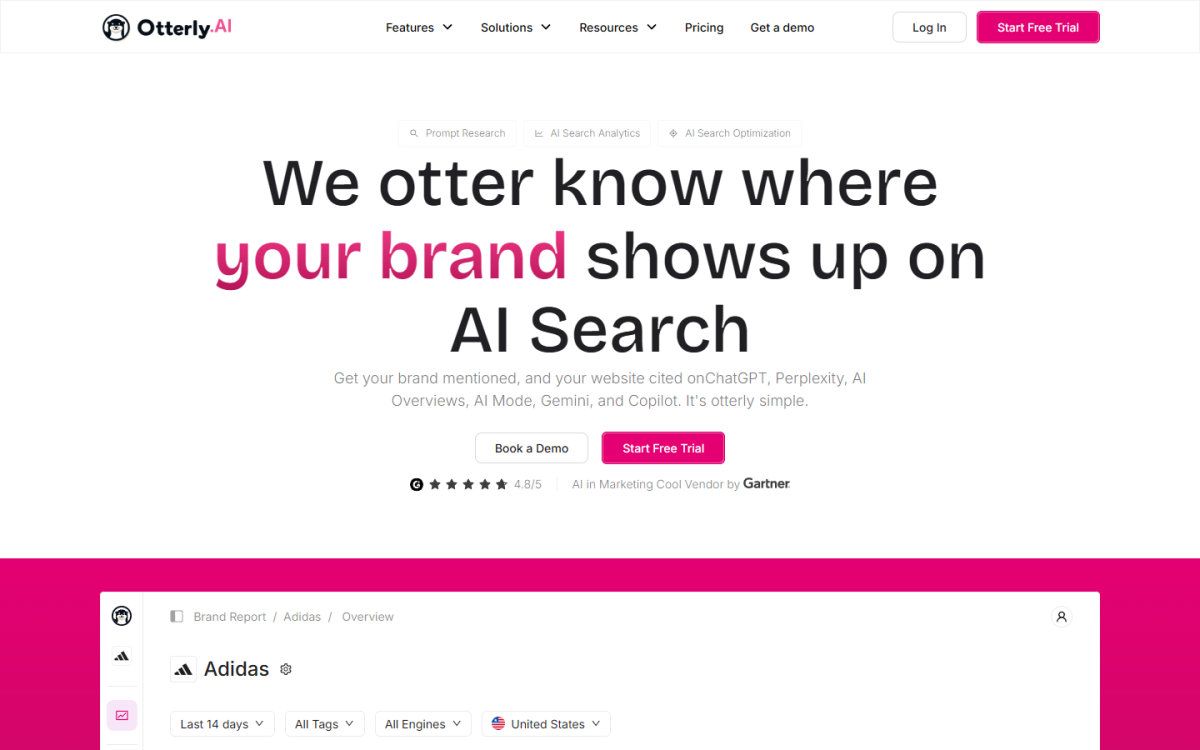
Sona AI Visibility has brand and agency plans, a 14-day free trial without a credit card, unlimited seats and API/MCP access. Between Peec AI and Otterly, start with Otterly when the choice is unclear. Its $29 Lite plan gives a single brand, content team or small agency 15 daily prompts across four named engines, unlimited team members and a low-ceremony reporting workflow, per the October 2026 listing. Choose Peec AI when multi-country coverage and brand-perception analysis justify the larger starting commitment.
Otterly is the practical call for:
- A single B2B brand monitoring its category, alternatives and branded prompts within a 15-prompt Lite allowance.
- A content team that needs citation and crawler analytics, geographic data and a Looker Studio reporting connection.
- A small agency building recurring client reporting around a low entry price and daily tracking.
Otterly pros: lower entry price, 15 daily prompts on Lite, four included answer engines, daily tracking, unlimited team members, geographic data, citation features and simpler configuration.
Otterly cons: Lite supports 15 prompts, while Claude, Google AI Mode and Gemini are paid add-ons. Published pricing does not identify a named agency plan or multi-client workspace rules.
Otterly’s advantage is its focused entry plan and simpler configuration. Its Lite allowance requires a disciplined set of commercial questions rather than a broad research library.
Peec AI is the right call for:
- A multi-country marketing team that needs visibility monitoring across markets.
- A brand team whose core question concerns perception and sentiment, not citation reporting alone.
- An organisation that wants unlimited seats and expects several stakeholders to work from the same monitoring environment.
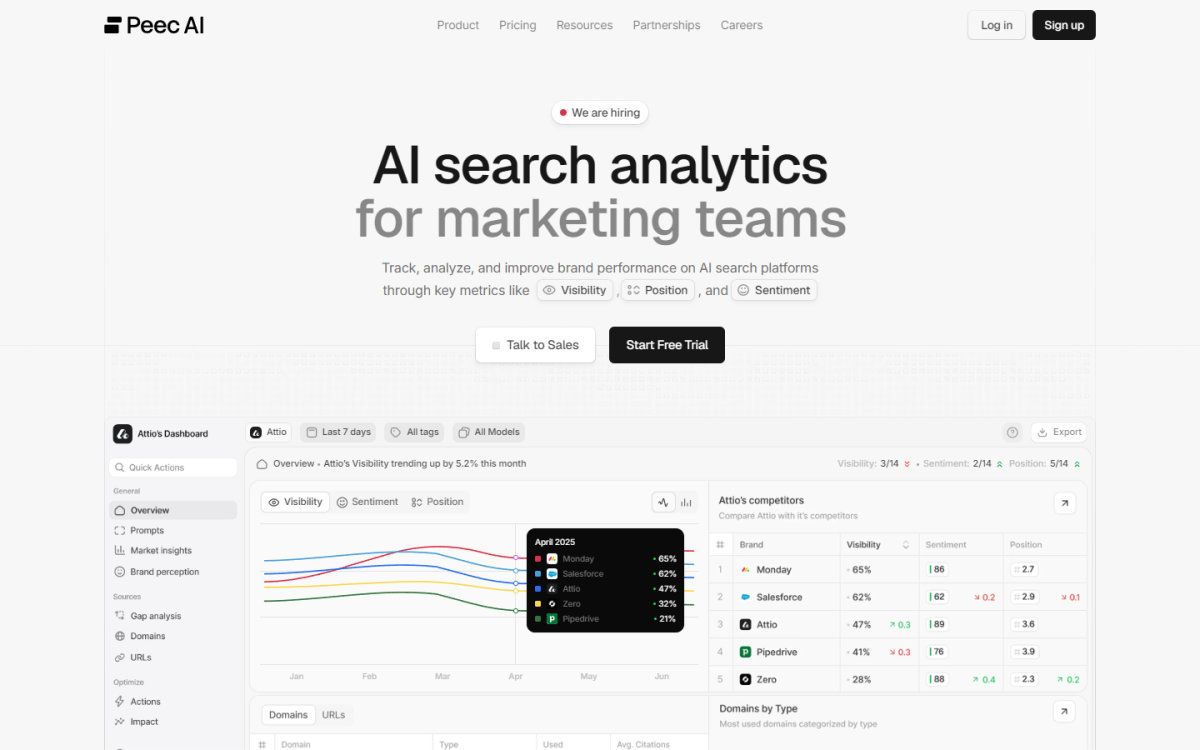
Peec AI pros: sentiment and brand-perception analysis, multi-country suitability, unlimited users, daily tracking and published agency plans for defined client portfolios.
Peec AI cons: Starter begins at $95 monthly for 50 prompts, and extra models are a paid add-on. Agency coverage uses a credit model in which each prompt, model and day consumes credits.
Peec AI emphasises sentiment and brand perception. Its Starter plan begins at $95 monthly for 50 prompts, per the October 2026 listing, so the purchase case is strongest when teams will use that broader monitoring scope.
What does each tracker cost per prompt, engine and month on a shared unit?
Sona AI Visibility prices AI answers as credits, while Peec AI and Otterly use different prompt allowances. On the shared unit of one prompt on one model per day, Peec AI Starter costs $0.63 per daily tracked prompt ($95 for 50 prompts on 3 models) and Otterly Lite $0.48 ($29 for 15 prompts on 4 engines), per the October 2026 listings. The unit is the same; the engines covered are not.
Peec AI lists Pro at $245 for 150 prompts and Advanced at $495 for 350 prompts, or $0.54 and $0.47 per daily tracked prompt on 3 models. The October 2026 listing also shows an annual-billing discount of about 15%.
Otterly lists Lite, Standard and Premium at $29, $189 and $489 monthly, with custom-priced Enterprise plans starting from 1,000 prompts, per the October 2026 listing. The supplied comparison does not include prompt allowances for Standard and Premium, so a per-prompt monthly figure would be unsupported.
Peec AI defines one credit as one prompt measured against one model for one day. One prompt on one model for a 30-day month therefore consumes 30 credits, per the October 2026 listing. Prompt counts do not establish equivalent coverage when model count and refresh frequency differ. Recheck prices and plan definitions before purchase because the supplied listings conflict.
Which AI answer engines does each tracker read, and which cost extra?
Sona's own AI visibility data, September 2026, covered eight answer surfaces: ChatGPT, Google AI Overviews, Perplexity, Google AI Mode, Gemini, Mistral, Qwen and Claude. This archive measurement counts answer surfaces included in that September 2026 data set, rather than product engine coverage.
Otterly Lite monitors four named answer engines: ChatGPT, Google AI Overviews, Perplexity and Microsoft Copilot, per the October 2026 listing. Claude, Google AI Mode and Gemini are listed as paid add-ons on Lite. The $29 plan is therefore straightforward to scope before adding model coverage.
Peec AI’s supplied pricing facts do not establish a Starter engine list for this comparison. Its credit model counts each prompt-model-day separately, so teams should confirm included models, add-on rules and country availability before signing a contract.
An engine count is a coverage specification, not proof of capture accuracy. Evaluate what a buyer sees for the same prompt, location and date.
Do not select either tracker merely because a plan names more engines. Select engines that match the buyer research surfaces relevant to the category, then test whether the dashboard reading matches the raw answer.
How do the two trackers measure visibility, sentiment and citations?
Peec AI centres brand perception and sentiment analysis. Otterly centres citation tracking, AI crawler analytics with geographic data, and Looker Studio reporting. The right choice depends on the metric a team will act upon, because mention rate, citation share, position and sentiment answer different operating questions.
- Mention rate shows how often a brand appears in the monitored answers.
- Citation share shows how often a source or page is referenced in those answers.
- Position indicates where a brand appears within an answer or shortlist.
- Sentiment classifies the tone or perception associated with the brand.
A brand-level visibility score is not a work item. Teams need the prompt that produced the score and the cited source behind it. Sona AI Visibility provides 5,000 monthly credits on Starter 5K, where one credit equals one AI answer.
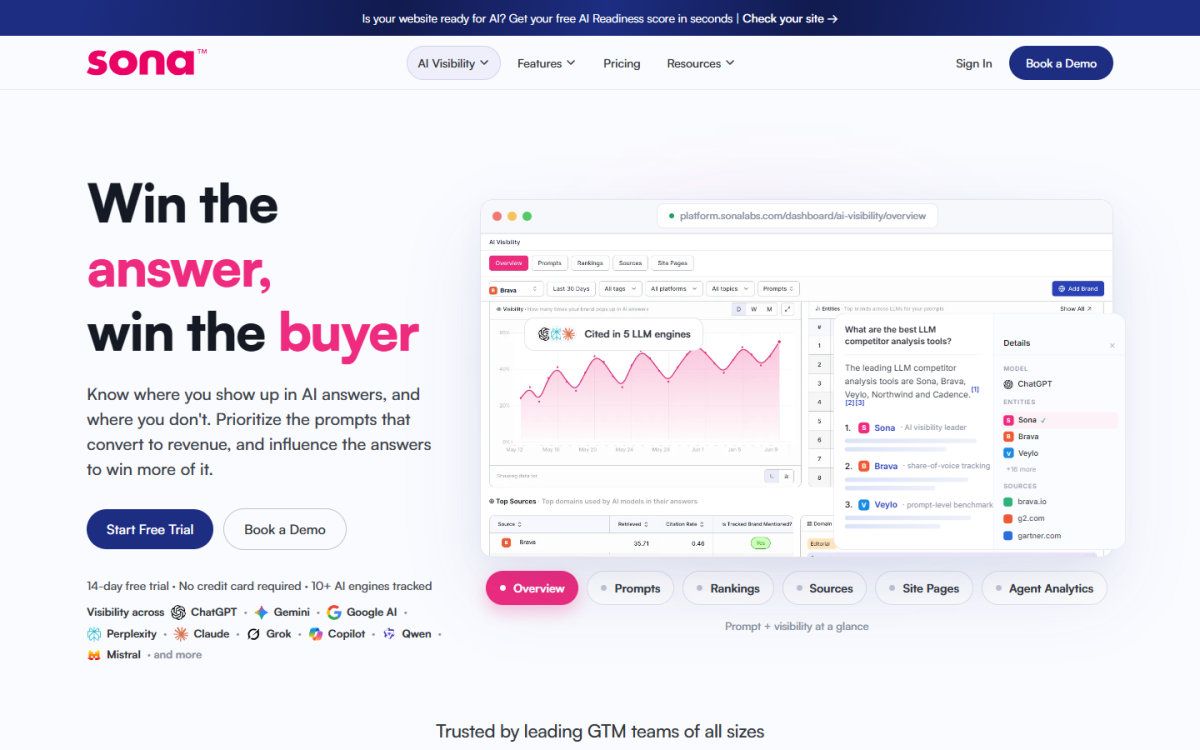
Otterly’s geographic data helps teams interpret location-specific citation patterns. Peec AI’s sentiment focus helps teams distinguish being present from being described favourably. Neither metric replaces manual review of the underlying answer.
Which tracker suits agencies and multi-country teams better?
Sona AI Visibility has agency plans from $199 per month billed annually, plus unlimited seats and API/MCP access on every plan. Between Peec AI and Otterly, Peec AI better suits multi-country teams and agencies managing a defined client portfolio, while Otterly offers a lower entry point for content intelligence and agency workflows. Peec AI’s October 2026 agency listing assigns 10,000 credits and three clients to Essential, 25,000 credits and five clients to Growth, and 65,000 credits and seven clients to Scale.
One Peec AI credit equals one prompt on one model for one day. Calculated from the October 2026 definition, 10,000 credits support about 333 prompt-and-model pairs tracked daily for 30 days. This unit helps agencies plan coverage because every additional model draws from the same credit pool.
Consider an illustrative five-client agency. Peec AI Growth lists five clients and 25,000 credits, allowing the agency to allocate coverage by client, model and prompt priority. Reserve credits for each client’s commercial comparisons and category prompts before adding broad informational monitoring.
Otterly Lite advertises unlimited team members and daily tracking at $29 monthly, per the October 2026 listing. That structure suits an agency beginning with one focused client programme, but buyers should confirm client-workspace rules and reporting requirements before treating a team-seat allowance as a multi-client plan.
How often do the trackers refresh data, and how long does setup take?
Otterly advertises daily tracking on Lite and is described as simpler to configure, with less ceremony in reporting. Peec AI’s credit definition implies daily measurement because each credit represents one prompt, one model and one day, per the October 2026 listing. The supplied facts do not establish a setup duration for either product. Ask both vendors to confirm the refresh schedule for the exact tier under consideration.
A team that runs the same prompt list daily can identify patterns that a weekly snapshot would average away. An answer can shift after a retrieval-index change, model update or competitor publication. Before testing, define a persistence threshold that separates isolated changes from changes that persist for the preselected period.
Otterly offers a Looker Studio connector, per the October 2026 listing. The supplied facts do not establish export formats, retention periods, scheduled reports or API access for either product. Ask each vendor about export options, reporting cadence, location controls and historical-data terms.
Separate daily prompt monitoring from periodic strategy review. Run the prompt list daily, then review positioning, reporting narratives and market changes monthly or quarterly.
What are the limits of each tracker that a pricing page does not show?
Sona AI Visibility provides credit-based plans, while Peec AI and Otterly price different units of visibility monitoring. Peec AI’s visible constraint is its credit model, while Otterly Lite’s is its 15-prompt allowance. Neither pricing page proves capture accuracy, localisation quality or whether dashboard recommendations will help a specific GTM team. That is why peec ai vs otterly is not a like-for-like comparison without a controlled test.
Peec AI’s pricing listing says it has no permanent free tier, per the December 2025 listing. Its costs scale with prompts multiplied by models multiplied by days because one credit covers one prompt-model-day. This structure makes model expansion an explicit budget decision.
Otterly Lite includes 15 prompts, and its additional Claude, Google AI Mode and Gemini coverage is listed as paid add-ons, per the October 2026 listing. Enterprise plans are custom-priced and start from 1,000 prompts, per the October 2026 listing. Those boundaries make Lite suitable for a concentrated set of commercial prompts rather than an unbounded prompt inventory.
Pricing listings describe allowances, but they cannot establish whether either tracker reads answers in the way a prospective buyer requires. Recheck current prices, billing terms, engine access and trial conditions before committing budget.
How do you test either tracker’s accuracy before you commit?
Sona AI Visibility has a 14-day free trial without a credit card, but Peec AI and Otterly should be tested against the same raw answers. Use the same commercial prompt set, countries, languages and start date, then compare each dashboard reading with raw answers in each engine. A controlled evaluation turns a pricing comparison into an evidence-based buying decision. First identify whether each dashboard reports ranking, mention rate or citation share.
- Build a fixed prompt list from the buyer’s category, comparison and alternatives questions. Keep the wording identical in both tools.
- Set the same countries and languages in each product. Record the engine, location, date and prompt text for every observation.
- Run every prompt-engine-country-language combination daily for 14 consecutive days. Define the persistence threshold before the first observation, then distinguish isolated changes from changes that persist for that preselected period.
- Manually inspect every eligible observation during the 14-day window. Use a worksheet containing prompt, engine, country, language, date, raw answer, citation, brand position, sentiment and dashboard result.
- Score every eligible observation: brand mentioned, source cited, position reported, sentiment classification and competitors appearing. Record a dashboard mismatch as a non-match. Record an unavailable raw answer separately and exclude it from eligible observations.
Use a simple pass rule: a tool passes an observation when its dashboard reading matches the documented raw answer under the same prompt, engine, location and date. Define the acceptance threshold before reviewing results. Calculate match rate as matching observations divided by eligible observations. Where an answer contains repeated brand references, score brand position from the first explicit brand mention. Where dashboard values are ambiguous, treat the observation as a mismatch unless the tool documentation defines the reported value.
Ask both vendors about trial and monthly terms before running the test. Peec AI’s listing says there is no permanent free tier, per the December 2025 listing. The evaluation should also document how each product handles answer changes, duplicate citations and location-specific results.
What are the frequently asked questions?
Is the cheaper tracker enough for a single brand?
Often, yes. Otterly Lite costs $29 per month and includes 15 prompts, four engines, unlimited team members and daily tracking, per the October 2026 listing. It covers a focused set of category, comparison and branded prompts. Fifteen prompts runs out when a team needs separate country, product, audience and competitor variations. Otterly Standard is listed at $189 per month, per the October 2026 listing.
Does either tracker offer a permanent free plan?
Peec AI’s pricing listing says it has no permanent free tier, per the December 2025 listing. The supplied facts do not establish Otterly’s free-access terms. Confirm trials, cancellation rules and monthly commitments directly before beginning an evaluation.
What does one credit mean on an agency plan?
One Peec AI credit covers one prompt measured against one model for one day, per the October 2026 listing. One prompt on one model for 30 days therefore uses 30 credits. Calculated on that basis, the 10,000-credit Essential agency plan supports about 333 prompt-and-model pairs tracked daily for a month.
Do annual plans cost less?
Peec AI lists an annual-billing discount of about 15%, per the October 2026 listing. Otterly lists Lite, Standard and Premium at $25, $160 and $422 a month when billed annually, compared with $29, $189 and $489 monthly. Otterly also lists 15% off annual billing, per the October 2026 listing.
Which AI engines cost extra on the $29 plan?
Otterly Lite includes ChatGPT, Google AI Overviews, Perplexity and Microsoft Copilot. Claude, Google AI Mode and Gemini are listed as paid add-ons, per the October 2026 listing.
Can a visibility tracker show whether AI citations lead to revenue?
Visibility trackers can report different measures, including mentions, citations, position and sentiment. Buyers evaluating Peec AI and Otterly should confirm which metric each dashboard reports, then compare that result against documented raw answers from the same prompt, engine, location and date.
Summarize this article with AI: ChatGPT · Claude · Perplexity · Google AI Mode
Last updated: October 2026