For law firms in 2026, generative engine optimization (GEO) means organizing legal content so AI platforms including ChatGPT, Perplexity and Google AI Overviews can find, cite and summarize the firm in generated answers. BrightEdge research in 2026 found only 17% to 38% overlap between URLs ranking in search and those cited in AI answers. Firms should establish citation baselines with jurisdiction-specific prompts before revising pages and evaluate results by signed cases; Sona AI Visibility links those prompts and citations to pipeline and revenue.
What is generative engine optimization for a law firm, and how does it differ from SEO, local SEO and AEO?
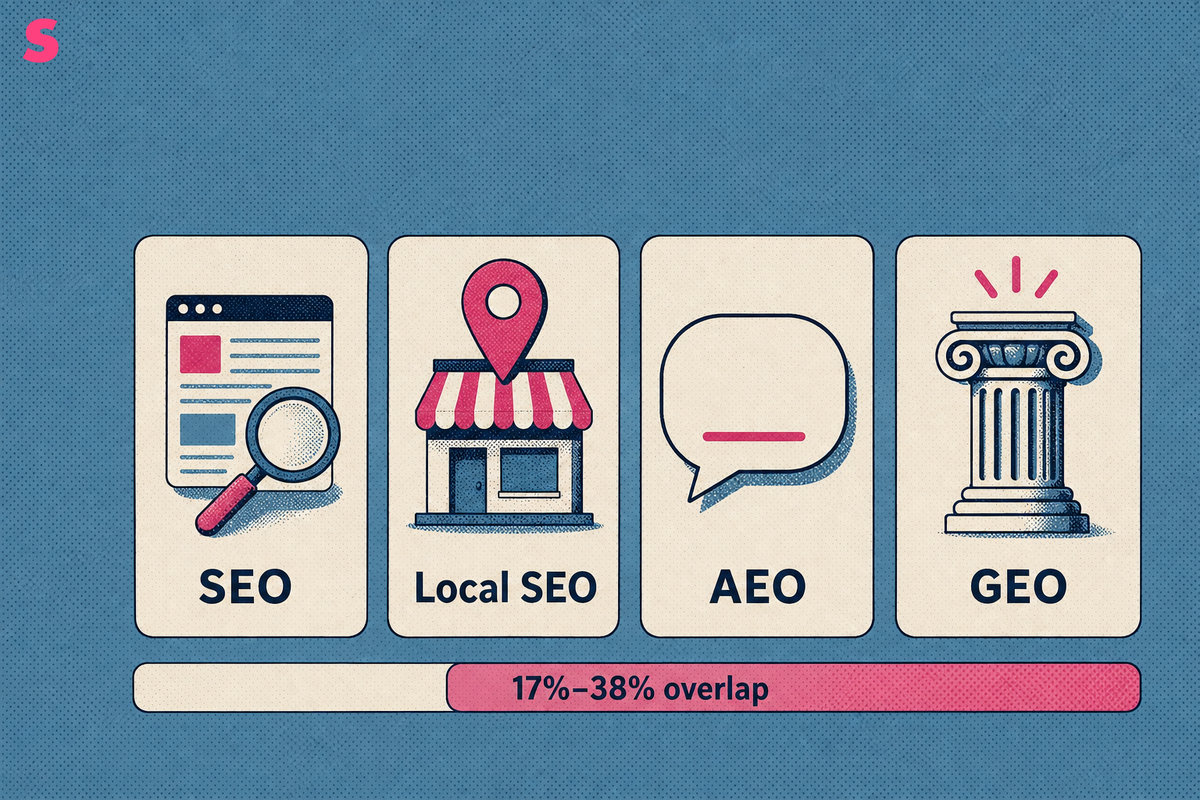
For law firms, generative engine optimization GEO law firms 2026 means structuring legal content so AI systems can discover, understand, select and cite the firm in generated answers. The goal is qualified client discovery through AI answers, not only higher placement in conventional search results.
SEO remains foundational because it improves crawlability, relevance and rankings. Local SEO establishes office relevance for a city or service area. AEO focuses on concise answers that answer engines can extract. GEO adds three measures: inclusion in generated answers, the quality of cited sources, and entity disambiguation so an AI system can distinguish a firm, attorney and office from similarly named alternatives.
Prospective clients can ask ChatGPT, Google AI Overviews, Perplexity, Claude, Gemini or Copilot for a lawyer recommendation, procedural explanation or local practice-area option. BrightEdge research published in 2026 found only 17% to 38% overlap between URLs ranking in traditional results and URLs cited in AI-generated answers. A firm must measure both surfaces.
GEO helps AI systems recognize a law firm’s expertise and reference its material in generated responses. The work requires jurisdictional specificity, named legal authorship and pages that answer a client question directly rather than relying on broad legal marketing copy.
Which legal prompts should a law firm track by practice area, city and jurisdiction?
A law firm should track jurisdiction-specific prompts combining practice area, matter type, city, state, urgency and near-me language. One law-firm GEO workflow recommended 40 prompts per practice URL in September 2026, including city, injury type and near-me variants.
Build prompts around questions prospective clients ask at stressful decision points. A personal injury claimant needs counsel after a defined event. A criminal defense prospect needs immediate representation in a specific court system. A family law client needs guidance tied to a relationship status, county and procedural issue.
| Practice area | Prompt pattern | Example prompt | Jurisdiction signal |
|---|---|---|---|
| Personal injury | Best lawyer for [injury] in [city] | Who handles truck accident claims in Phoenix? | City, state and injury type |
| Criminal defense | [Charge] defense lawyer near me | What should I look for in a DUI defense lawyer near me? | City, county and charge |
| Family law | [Matter] attorney in [county] | How does child custody work in Cook County? | County, state and family matter |
| Employment law | Lawyer for [workplace issue] in [city] | Can I speak with a wrongful termination lawyer in Austin? | City, state and claim type |
Run the same prompt list daily under fixed location and browsing conditions. Daily monitoring exposes shifts that a weekly snapshot can average away. Answers change with retrieval indexes, model updates and newly published competitor pages.
Group the 40 prompts by intent, then assign each group to a specific practice-area URL. Informational prompts can support explainers. Commercial and urgent prompts should map to service pages, attorney pages or location pages with a clear next step.
What content and entity signals make an AI engine cite a law firm?
AI engines cite law firm pages that answer a specific legal question, identify the relevant jurisdiction and present a consistent firm entity. Each page should focus on one matter type and one jurisdiction, then answer the client’s practical question before expanding into legal context.
An answer-first structure works well: state the short answer, explain the governing legal context, identify facts that change the outcome, and show when a reader should contact counsel. Avoid combining several states, cities or unrelated practice areas on one page. That structure creates ambiguity for clients and retrieval systems.
Entity consistency matters across the website, office listings, attorney profiles and third-party profiles. Keep the firm name, office address, attorney names, practice areas and service geography aligned. Use Organization, LegalService, Attorney and FAQPage schema where each schema type accurately reflects visible page content.
Freshness signals stewardship. Publish visible update dates when an attorney or editor verifies legal content, particularly on pages discussing statutes, deadlines, penalties or local court procedures. A current, narrowly framed page gives an AI system clearer evidence than an undated general overview.
How does a law firm build evidentiary trust with AI engines?
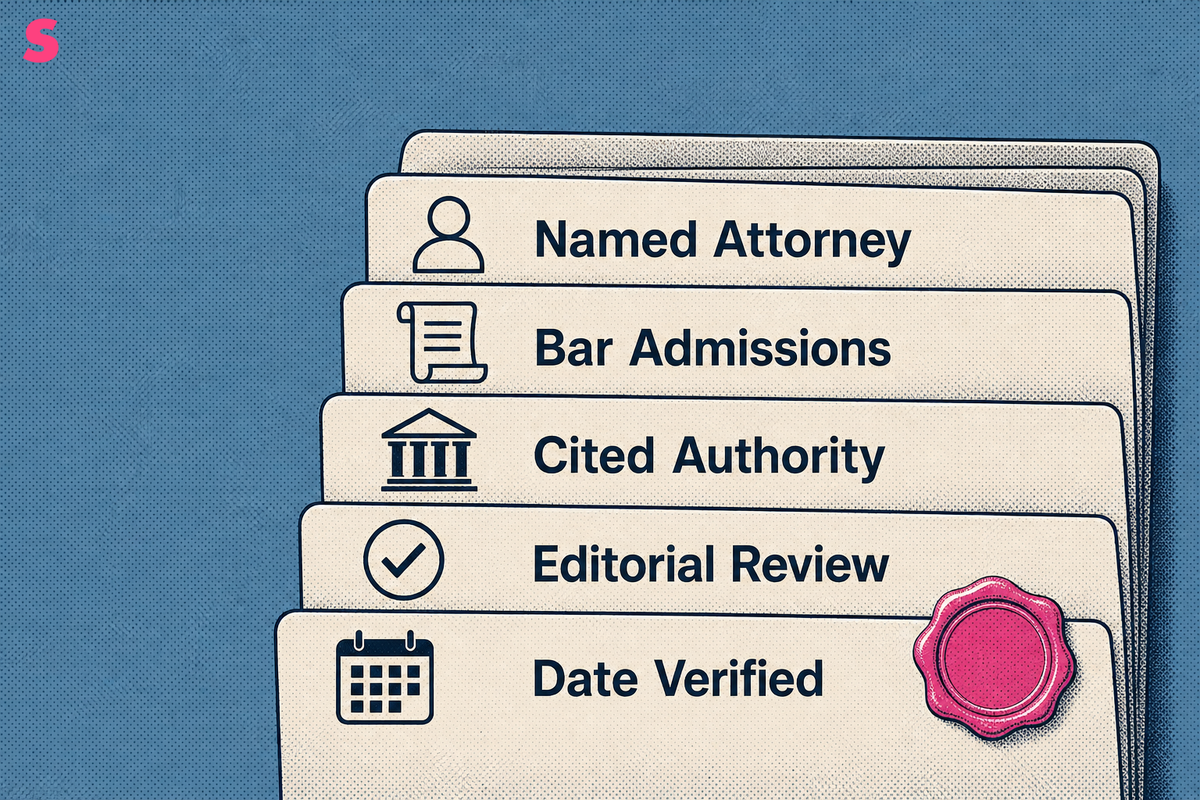
Law firms build evidentiary trust by making legal expertise attributable, jurisdiction-specific and verifiable. A page with a named licensed attorney, bar admissions and editorial oversight provides stronger evidence than anonymous legal copy because readers and AI systems can connect the analysis to accountable expertise.
Attorney pages should identify credentials, admissions, relevant case experience and the jurisdictions where the lawyer practices. Practice pages should name the state law, local court context or administrative body governing the issue. Broad national claims weaken a page when a client’s problem turns on local law.
- Attribute legal content to a named attorney or editorial reviewer.
- Cite authoritative statutes, court opinions and agency materials where relevant.
- Include original firm data or experience only when it can be supported.
- Maintain third-party reviews and firm profiles with accurate office information.
- Record who reviewed a page and when legal accuracy was confirmed.
Trust requires an evidence trail: the author is identifiable, the jurisdiction is clear, the supporting authority is credible and the page has been reviewed after material legal changes.
Can AI crawlers actually reach, render and trust a law firm website?
A law firm website must allow AI crawlers to reach practice pages, receive meaningful server-rendered HTML and encounter secure, accessible markup. If a crawler cannot fetch or parse the page, strong legal analysis cannot become source material for a generated answer.
Check robots rules and canonical tags first. Practice pages should not be blocked unintentionally, redirected through broken chains or marked canonical to an unrelated page. A crawler also needs substantive server-rendered HTML. JavaScript-dependent content can leave an AI system with an incomplete page or no usable legal answer.
HTTPS and security headers support technical trust. Accessibility improves client usability and machine interpretation. Meaningful alt text, ARIA attributes, sufficient contrast and explicit image dimensions give the page clearer structure. These checks matter most on high-value practice and location pages.
The Sona AI Crawl Checker tests whether AI bots can reach and load a URL. The Free AI Readiness Checker runs 35 checks across six categories and returns an AI readiness score out of 100, with a letter grade, in about 30 seconds. Use either result as a diagnostic starting point, then document page-level remediation work.
How do you run a GEO audit on a law firm website, step by step?
A law firm GEO audit should begin with a citation snapshot on day 1 before page changes, then test ten technical, content and entity conditions page by page. A law-firm workflow recommended that day-1 snapshot in September 2026 to create a baseline for later comparison.
| Checkpoint | How to test | What passing looks like |
|---|---|---|
| 1. AI crawler access | Review robots rules and request the practice URL. | Relevant crawlers can reach the page. |
| 2. Rendered content | Inspect the server-rendered HTML without JavaScript. | Core legal answer and headings are present. |
| 3. HTTPS and headers | Check transport security and response headers. | HTTPS works and security headers are configured. |
| 4. Schema completeness | Validate visible-page schema markup. | Organization, LegalService, Attorney and FAQPage markup match the page. |
| 5. Entity consistency | Compare firm and office details across profiles. | Name, attorneys, address and practice areas align. |
| 6. Attorney evidence | Review byline, admissions and reviewer details. | A named licensed professional is accountable for the content. |
| 7. Jurisdiction specificity | Read headings, copy and internal references. | The applicable city, county or state is explicit. |
| 8. Content freshness | Review visible update dates and legal references. | Current-law review is documented. |
| 9. Answer-first structure | Read the first section as a client would. | The page answers the matter-specific question quickly. |
| 10. Image accessibility | Inspect alt text, contrast and dimensions. | Images convey accessible, stable supporting information. |
A visibility score can show that a page is absent from AI answers, but a technical audit identifies the page-level condition blocking citation. Sona AI Visibility connects citations to pipeline and revenue, while AI Search Insights scores a page out of 100 across six categories, ranks critical or medium findings with a named fix, and re-runs the audit on a watch.
Re-run the same citation snapshot after changes. Treat the output as a log rather than a score. A dated score captures a moment, while repeated results show whether a fix changed crawlability, content structure or citation performance.
How should a law firm measure GEO performance beyond rankings?
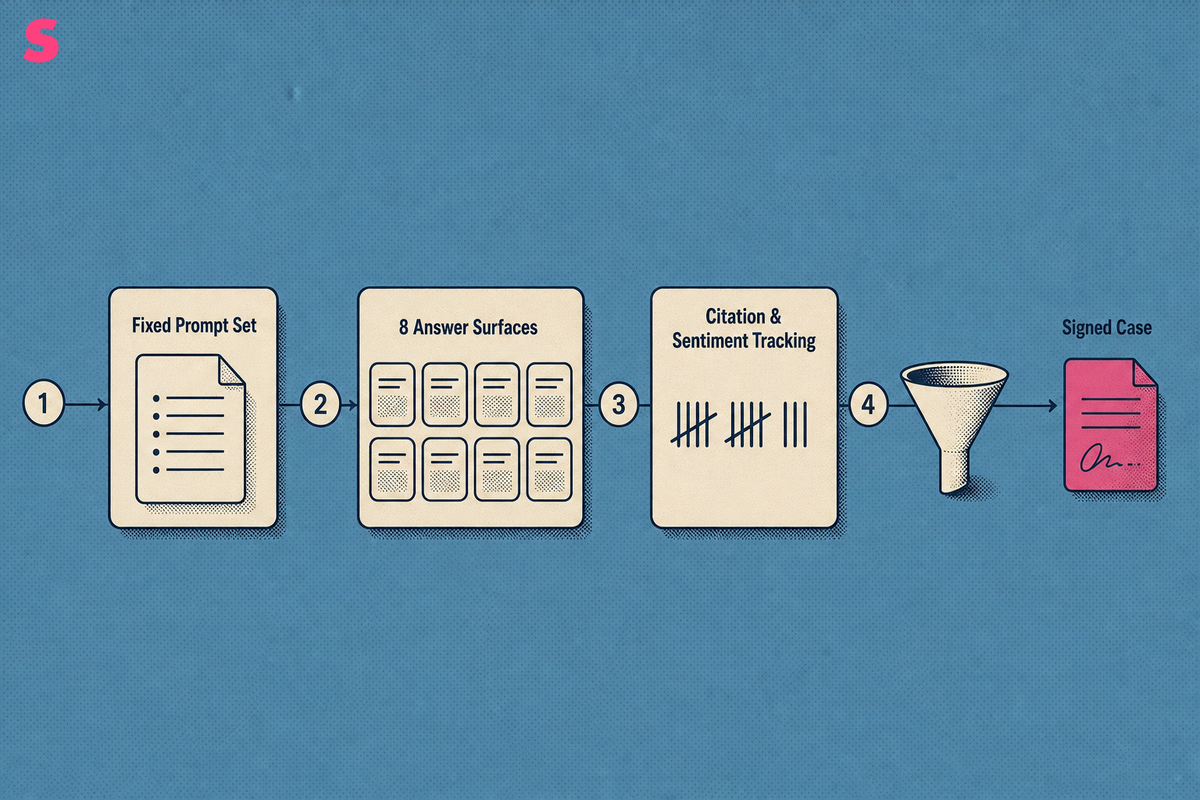
Law firms should measure GEO through share of answers, citation rate, sentiment and competitor presence across a fixed prompt set, then connect visibility to consultations and signed cases. A citation alone does not establish client acquisition.
AI answers are unstable but measurable through repeated sampling. Hold location, model and browsing state constant, run the same prompts daily and report trends rather than isolated screenshots. Sona's own AI visibility data, September 2026, covers 8 answer surfaces: ChatGPT, Google AI Overviews, Perplexity, Google AI Mode, Gemini, Mistral, Qwen and Claude.
Connect each visibility trend to referral traffic, consultation requests, qualified matters, signed cases and cost per acquisition. Sona Marketing Measurement treats AI search as a measurable channel with spend, deals and ROAS alongside other channels. Sona AI Visibility connects prompts and citations to pipeline and revenue, then tracks AI crawler and agent activity as part of the path from page discovery to client inquiry.
Mention tracking is the baseline. The business question is whether a cited practice page produced a qualified legal matter that progressed through intake and engagement.
How do GEO tools and agencies compare on prompts, engines, locations and price?
Law firms should compare GEO tools by total monitoring capacity, not headline price alone. Entry plans can begin below $30 per month, while useful coverage requires enough prompts, answer engines, locations and users to represent each practice area and jurisdiction.
| Tool | Starting price | Agency Plans? (Yes/No) | # of Answer Engines Tracked | Answer Engines | # of Daily Tracked Prompts (entry plan) | Cost per Daily Tracked Prompt | Differentiation |
|---|---|---|---|---|---|---|---|
| Sona AI Visibility | Brands from $75/month (Starter) and $249 (Growth), agencies from $199/month, all billed annually. 14-day free trial, no credit card. Unlimited seats and API/MCP access on every plan | Yes | 11 | ChatGPT, Gemini, Google AI Mode, Google AI Overviews and Perplexity on standard, plus Claude, DeepSeek, Grok, Copilot, Qwen and Mistral on premium | 5,000 credits/month on Starter 5K, which is about 166 prompts tracked daily on one model, or 56 across three. 1 credit = 1 AI answer | $0.45 per daily tracked prompt | Connects AI citations and prompts to pipeline and revenue on one account timeline, with page-level audit findings ranked by severity. |
| Peec AI | From $95/month (Starter), $245 (Pro), $495 (Advanced) billed monthly, 15% off annually; Enterprise custom. Free trial. Unlimited users on every plan; 50, 150 and 350 prompts by tier; extra models are a paid add-on | Yes | 3 of 6, plus add-ons | ChatGPT, Google AI Mode, Google AI Overviews, Microsoft Copilot, Gemini, Naver AI | 50 prompts on Starter, 150 on Pro, 350 on Advanced, tracked daily on every plan | $0.63 per daily tracked prompt | AI visibility monitoring across selected engines. |
| Profound | Quote-only, no public pricing. 7-day free trial: 50 prompts, run daily. No self-serve price is published: a 7-day trial and custom Enterprise pricing only | Not published | 3 | ChatGPT, Gemini and Google AI Overviews | 50 prompts run daily on the 7-day trial; Enterprise allowances are custom | No refresh cadence published | Prompt monitoring across three named answer engines. |
| PromptWatch | Essential $95/month, Professional $245, Business $579. 7-day free trial on Essential and Professional | Yes | 4 of 11 | Not published | 50 prompts and 6,000 responses/month on Essential | $0.48 per daily tracked prompt | Prompt and response monitoring for tracked queries. |
| Otterly.ai | From $29/month (Lite), $189 (Standard), $489 (Premium) billed monthly, or $25, $160 and $422 a month billed annually; Enterprise custom. Free trial, no commitment. 15% off annual; unlimited team members on every plan; Enterprise starts from 1,000 prompts | Not published | 4 | ChatGPT, Google AI Overviews, Perplexity and Microsoft Copilot | 15 prompts on Lite, 100 on Standard, 400 on Premium, checked daily on every plan | $0.48 per daily tracked prompt | Daily checks across four answer engines. |
Prices and plan details were read from published pricing pages in October 2026. Sona also offers done-for-you services from $5,500 per month on top of an AI Visibility plan. The service combines software measurement with a Sona team that handles content, AI search optimization, technical fixes, strategy and reporting.
A law-firm GEO agency review covering approximately 50 agencies across August 2025 to September 2026 illustrates how crowded the service market has become. Judge an agency by reporting on citations, consultation requests, qualified matters and signed cases, rather than a visibility-only pitch.
What ethics and advertising rules must a law firm check before publishing AI-assisted content?
Law firms should treat every AI-assisted page as attorney-reviewed advertising and legal information, not autonomous publishing. Before publication, confirm factual accuracy, jurisdictional relevance, current law, privacy controls and compliance with the professional-conduct and advertising rules governing the firm.
AI drafting can produce outdated legal rules, blend jurisdictions or state conclusions too broadly. An attorney admitted in the relevant jurisdiction should review claims about statutes, damages, deadlines, court procedure, results and client eligibility before publication.
- Verify every legal statement against current primary authority.
- Remove client-identifying facts and confidential intake information.
- Distinguish general legal information from individualized legal advice.
- Review testimonials, verdict references and comparative claims before publication.
- Confirm compliance with the firm’s own state bar requirements.
Unauthorized-practice risk arises when generic AI content appears to advise a person about individual facts. Attorney review, careful disclaimers and jurisdiction-specific framing keep the page focused on public legal education and appropriate client intake.
Frequently Asked Questions
Is generative engine optimization different from SEO for law firms?
Yes. SEO targets rankings and organic clicks, while GEO targets inclusion and citation in AI-generated answers. BrightEdge research published in 2026 found only 17% to 38% overlap between traditional ranking URLs and URLs cited in AI answers, so law firms must measure both result sets.
How many prompts should a law firm track for each practice area page?
One documented law-firm workflow recommended 40 prompts per practice URL in September 2026. Cover city, injury or matter type, state, county, urgency and near-me variants, then adjust the list for each jurisdiction where the firm accepts matters.
Can a law firm measure GEO if AI answers change from run to run?
Yes. Sample the same prompts repeatedly under fixed conditions for location, model and browsing state. Take a baseline citation snapshot before changing a page, run the prompt list daily, and report trends rather than relying on a single screenshot.
Does an AI citation mean a law firm will sign more cases?
No. A citation is a visibility signal, not proof of revenue. Law firms should tie citations to referral traffic, consultation requests, qualified matters, signed cases and cost per acquisition before crediting AI visibility with client acquisition.
How much does GEO monitoring cost for a small law firm?
Entry plans are listed below $30 per month, while broader coverage across more prompts, engines and locations can reach hundreds of dollars per month. Compare monitoring capacity, including daily prompts and answer engines, rather than selecting a platform on headline price alone.
Is it safe to use AI to write law firm website content?
AI can support drafting only with attorney review, jurisdiction-specific checks, current-law verification and privacy controls. Law firms should confirm that every page meets their state’s applicable professional-conduct and advertising rules before publication.
Summarize this article with AI: ChatGPT · Claude · Perplexity · Google AI Mode
Last updated: October 2026