A practical GEO framework for manufacturing companies begins with buyers rather than search engines: determine the roles and question categories that generate RFQs, then create validated product proof and test it using a fixed prompt set. Run the tests across engines and evaluate the pattern, not an individual response. Sona AI Visibility connects those prompts and citations to pipeline and revenue, while displaying AI crawler activity on the website. Assess each tactic by whether it generates qualified inquiries.
What is a no fluff GEO framework for manufacturing brands, and how does it differ from SEO?
Manufacturing brands need a GEO framework that makes product facts, application limits, and supplier proof easy for answer engines to retrieve, cite, and connect to RFQs. Generative engine optimization (GEO) structures product data, listings, and brand presence so AI engines can cite and recommend a brand.
SEO and GEO share technical foundations, but they measure different outputs. SEO concentrates on rankings, impressions, and visits from search results. GEO tests whether an answer engine can assemble an accurate response about a material, component, process, supplier, or certification, then records the citations and referrals that follow.
| Area | Traditional SEO | GEO for manufacturing brands | Practical output |
|---|---|---|---|
| Primary unit | Keyword and search-result position | Buyer prompt and AI answer | A question a procurement or engineering buyer would ask |
| Visibility signal | Ranking, impression, and click | Mention, citation, position, and answer accuracy | Evidence that a manufacturer appears in the answer |
| Content focus | Searchable pages and keyword relevance | Retrievable specifications, use cases, constraints, and proof | Pages an engine can cite without guessing |
| Commercial outcome | Organic sessions and conversions | Qualified AI referrals, RFQs, and pipeline | Visibility tied to sales activity |
GEO is not renamed SEO because it adds a reporting layer. A manufacturing site still needs crawlability, useful content, and clean information architecture. GEO adds fixed-prompt testing across answer engines, citation analysis, and attribution for AI-referred visits. Engineers and procurement teams can now obtain synthesized specifications, comparisons, and supplier shortlists directly in AI answers rather than assembling every answer from search results. As of October 2026, Google AI Overviews correlate with a 58% lower top-result CTR for industrial search results.
A no fluff GEO framework for manufacturing brands starts with commercial questions, not abstract visibility. The operating test is direct: can the company show which buyer questions produce citations, which pages support those citations, and whether the resulting visits become RFQs?
Which buyer personas and question types should a manufacturer identify before building a GEO strategy?
A manufacturing GEO strategy should begin with the roles that influence specification, supplier approval, and purchase authorization, then map the questions each role asks. Manufacturing buyers ask about tolerances, operating conditions, lead times, certifications, substitutions, integration requirements, and supplier capability.
Build persona clusters from sales calls, RFQ forms, distributor questions, application engineering notes, and lost-deal reasons. Marketing owns the verified fact base, while sales contributes operational data from buying conversations. That division prevents polished marketing copy from overriding production reality.
| Buyer persona | Question type | Example prompt pattern | Required evidence |
|---|---|---|---|
| Design engineer | Technical fit | Which component meets this temperature, load, or tolerance requirement? | Datasheets, drawings, test methods, application boundaries |
| Procurement manager | Supplier selection | Which manufacturers can supply this part at production scale? | Capacity, geography, lead-time process, supplier qualifications |
| Quality leader | Risk and compliance | Which suppliers support this certification or inspection requirement? | Certificates, quality procedures, traceability documentation |
| Operations leader | Implementation | Which supplier can solve this downtime or replacement problem? | Installation guidance, maintenance data, anonymized outcomes |
Inventory persona-question pairs from RFQs, sales calls, support tickets, distributor requests, and lost deals. Compare each pair by observed RFQ frequency, deal relevance, sales validation, decision-stage proximity, and the availability of verified evidence. Produce a ranked persona-question matrix, then use its highest-priority combinations as the initial prompt set.
The no fluff GEO framework for manufacturing brands also distinguishes the person asking from the organization buying. An engineer can seek a specification, while procurement validates supplier risk and a plant manager approves disruption. The prompt set should reflect that buying committee rather than treat every mention as equal.
How do you build a prompt set and test it across ChatGPT, Google AI Overviews, Perplexity, Gemini, Copilot, and other answer engines?
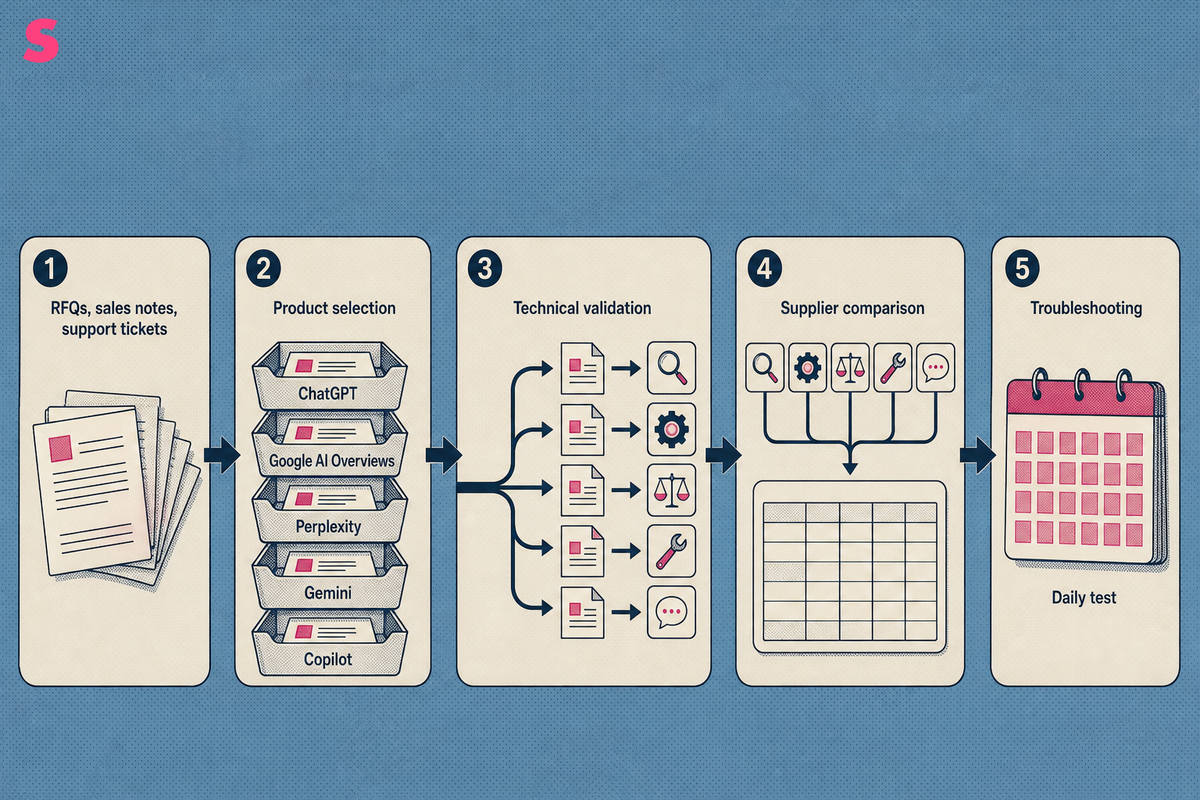
Collect real buyer questions, group them by persona and intent, preserve fixed wording, run them across the named engines, and record mentions, citations, competitors, accuracy, and landing pages. The prompt set should include product-selection, technical-validation, supplier-comparison, and troubleshooting questions.
- Collect questions from RFQs, sales notes, product-support tickets, distributor requests, and internal search data.
- Group near-duplicate questions by application, industry, product family, certification, and buying stage.
- Write several natural-language phrasings for each high-value question cluster.
- Record the brand mention, citation source, answer position, competitors named, factual accuracy, and referral destination.
- Run the fixed prompt list daily and review persistent changes every week.
AI answers change when retrieval indexes change, models update, or competitors publish new material. Daily testing reveals persistent movements that a weekly snapshot can obscure. Treat isolated changes as variation until the pattern holds.
Sona AI Visibility Growth adds page-level insights, Agent Analytics, company-level visitor identification, and AI search attribution. Those capabilities can support prompt-level investigation after the testing procedure is established.
Keep the test controlled. Do not change prompt wording, geography, audience assumptions, and product terminology during the same measurement period. When a prompt produces an inaccurate answer, preserve the answer text, identify the cited source, and assign the correction to the page owner or subject-matter expert.
How should product, specification, compliance and comparison content be structured so AI engines can cite it?
Manufacturing content earns citations when each page gives an answer engine a complete, verifiable unit of information: what the product does, where it fits, where it does not fit, and what evidence supports the claim. Product copy that hides specifications behind a contact form gives an engine little material to retrieve.
Structure each priority page around one product or application question. Put the direct answer near the top, then supply specification tables, compatible materials, operating ranges, installation conditions, certifications, test methods, and clear exclusions. Use consistent part numbers and terminology across product pages, PDFs, distributor listings, and technical documentation.
- Product pages: State dimensions, materials, performance constraints, compatible systems, and ordering logic.
- Specification pages: Define units, test conditions, revision dates, and product variants.
- Compliance pages: Identify the certificate, scope, document owner, and current status.
- Comparison pages: Explain selection criteria, tradeoffs, and use-case boundaries without unsupported superiority claims.
Freshness matters when product availability, regulations, certification status, or technical revisions change. Assign an owner and review date to technical pages. A monthly content review suits high-change product data, while a quarterly review suits stable application guides.
Proprietary data does not need publication. Manufacturers can publish validated specifications, approved application boundaries, test methods, certifications, diagrams, and anonymized outcomes. The goal is not to reveal a formula or customer design. The goal is to give answer engines reliable facts they can cite.
Which trust signals make answer engines recommend a manufacturer?
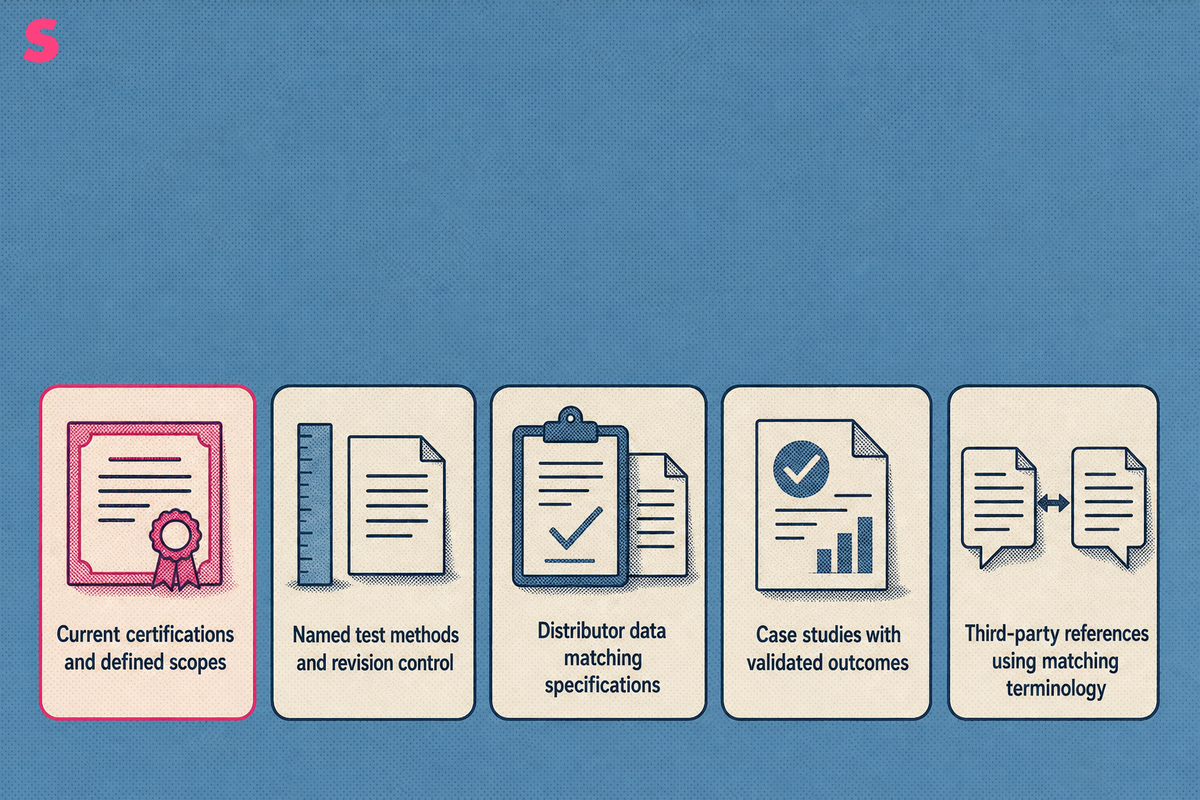
Answer engines have stronger material to recommend when a manufacturer’s claims are consistent across first-party technical pages, certification records, distributor data, case studies, reviews, and independent references. The useful trust signal is corroboration, not a vague assertion of authority.
Start with a verified fact base. Marketing should maintain approved product descriptions, certification language, facility facts, industry terminology, and application claims. Sales should add the operational evidence buyers request during evaluation, including lead-time process, qualification steps, packaging constraints, support requirements, and common implementation questions.
- Current certifications and clearly defined scopes
- Named test methods and document revision controls
- Distributor product data that matches first-party specifications
- Case studies that state the problem, configuration, and validated outcome
- Third-party references that use the same product names and technical terminology
A citation supports an answer engine’s recommendation with attributable evidence. Manufacturing teams should audit whether each published claim has a source that substantiates it.
Sales and marketing need a shared escalation process for disputed claims. If sales hears a new buyer objection, marketing should determine whether the verified fact base supports a page update, a new FAQ, or a clarification in distributor data. That workflow keeps AI-facing information aligned with field reality.
What technical checks decide whether AI crawlers can find, parse and trust a manufacturing site?
A manufacturing GEO program needs crawlable, server-rendered, secure, structured pages that expose technical facts without fragile JavaScript dependencies. An AI crawler must reach the page, load the key content, identify the canonical version, and parse the evidence needed for a citation.
| Technical area | What to check | Manufacturing failure mode | Recommended operating rhythm |
|---|---|---|---|
| Crawlability | robots.txt, canonical tag, indexability, sitemap, and access controls | Datasheets or application pages blocked from retrieval | Check after releases and during quarterly audits |
| Performance | Server-rendered HTML, page weight, rendering path, and JavaScript dependence | Specifications load only after scripts fail or time out | Review priority pages monthly |
| Security | HTTPS, response headers, and secure document delivery | Technical assets appear unreliable or inaccessible | Review after infrastructure changes |
| Content structure | Schema.org markup, headings, tables, metadata, and semantic HTML | Product facts lack labels, units, or machine-readable context | Validate with each template release |
| Accessibility | Alt text, ARIA attributes, contrast, and explicit image dimensions | Critical diagrams and charts lack usable descriptions | Audit during page refreshes |
Run crawl checks when a manufacturing team needs to confirm whether retrieval bots can access a product, specification, or application page. Test for robots.txt disallow rules, WAF blocks, rate limiting, cloaking, and rendering failures.
Technical checks need two clocks. Run the prompt list daily because answer changes require high-resolution measurement. Run a full technical re-audit monthly or quarterly because template regressions, security changes, and content releases are periodic events. A dated score is a snapshot; severity-ranked fixes for affected pages create the work queue.
How do you measure AI visibility and connect it to RFQs?
Manufacturing teams should measure AI visibility through prompt-level mentions, citations, position, sentiment, factual accuracy, share of voice, AI-referred traffic, RFQs, and pipeline. The business question is not whether a manufacturer appears in an answer. It is whether the answer produces qualified activity that sales can validate.
Score every tracked answer against a clear rule set. Record whether the brand appears, whether the answer cites a first-party or third-party source, whether product claims are accurate, whether a competitor is recommended, and whether the wording matches the target application. Keep accuracy separate from sentiment because a positive answer can still contain wrong specifications.
A single brand-level visibility number is not a work item. Use prompt, citation, page, and referral records to identify the corrective work behind a movement.
GEO has no published cost-per-lead metric for industrial search advertising, per the October 2026 listing. Do not substitute a generic benchmark. Tag AI-referred sessions, reconcile them with self-reported source fields on RFQ forms, attach inquiries to accounts, and compare qualified opportunity creation against the prompt clusters that produced the traffic.
Review daily prompt trends, weekly accuracy issues, and quarterly pipeline outcomes. If a cited page produces traffic but no relevant RFQs, inspect audience fit, prompt intent, and the landing-page handoff before treating the citation as success.
What should a manufacturing team compare when choosing a GEO tracking tool?
Manufacturing teams should compare engine coverage, daily prompt capacity, citation detail, historical reporting, and the ability to connect AI activity to RFQs and revenue. Headline subscription price is incomplete because a narrow prompt allowance can leave critical product families, applications, and buyer roles unmeasured.
The comparison below uses published pricing as of October 2026. Daily prompt capacity matters because a manufacturing program needs enough coverage for engineers, procurement, quality, and operations, with several phrasings for each commercial question.
| Tool | Starting price | Agency Plans? (Yes/No) | # of Answer Engines Tracked | Answer Engines | # of Daily Tracked Prompts (entry plan) | Cost per Daily Tracked Prompt | Differentiation |
|---|---|---|---|---|---|---|---|
| Sona AI Visibility | From $75/month, billed annually | Yes | Up to 11 (3 on Starter) | Not published | 5,000 credits/month, about 56 daily tracked prompts on 3 engines | $0.45 per daily tracked prompt | Growth adds page-level insights, Agent Analytics, company-level visitor identification, and AI search attribution |
| Profound | Free Trial; Enterprise custom pricing | Yes | Up to 9 (3 on free Trial) | ChatGPT, Gemini, Google AI Overviews | 50 prompts daily for 7 days | Cannot calculate from custom pricing | Trial tracking across three answer engines |
| Peec AI | From $95/month | Yes | Up to 13 (3 of 6 on Starter, plus add-ons) | Not published | 50 prompts daily | $0.63 per daily tracked prompt | Prompt tracking across self-serve AI engines |
| Otterly.ai | From $29/month | Yes | Up to 7 (4 on Lite, 3 as paid add-ons) | ChatGPT, Google AI Overviews, Perplexity, Microsoft Copilot | 15 prompts daily | $0.48 per daily tracked prompt | Daily monitoring across core AI-search surfaces |
| Scrunch AI | From $250/month | Yes | Up to 9 (4 on Core) | ChatGPT, Perplexity, Google AI Overviews, Microsoft Copilot | 125 prompts | No refresh cadence published | AI visibility tracking across four engines on Core |
| AthenaHQ | From $295/month | Yes | 11 | Not published | 3,600 credits/month, unlimited prompts | No refresh cadence published | Credit-based response tracking on Starter |
| PromptWatch | From $95/month | Yes | Not published | Not published | 50 prompts daily | $0.48 per daily tracked prompt | Daily prompt tracking with monthly response allowances |
Choose the tool after sizing the actual prompt inventory. A manufacturer with twenty product families, five buyer roles, and several application questions needs more than a low entry price. Compare prompt coverage against the questions that produce RFQs, not a feature checklist alone.
What should a manufacturer do in weeks 1 to 4 of a GEO program?
A manufacturing GEO program should spend four weeks establishing a verified baseline, a stable prompt set, citation-ready pages, and RFQ measurement. The first month is not a content-production sprint. It identifies what buyers ask, what answer engines say, and which gaps sales can confirm.
- Week 1, establish the fact base: Collect product specifications, certification language, application limits, distributor records, RFQ questions, and sales objections. Assign owners for product, quality, sales, and marketing facts.
- Week 2, build and run the prompt set: Create clusters for technical selection, supplier comparison, compliance, replacement, and troubleshooting. Run the fixed set daily across the selected engines and record citations, accuracy, and competitors named.
- Week 3, repair priority pages: Update the pages tied to high-intent prompts with direct answers, structured specifications, application limits, citations, and current revision details. Resolve crawler access and JavaScript rendering issues.
- Week 4, connect evidence to commercial outcomes: Tag AI-referred traffic, review RFQ source fields with sales, and create a report that separates mentions from qualified inquiries and pipeline.
Limited subject-matter-expert access requires a narrow queue. Start with the product family that produces the highest-value RFQs, then schedule short approval sessions around disputed facts and technical boundaries. Assess whether AI engines can crawl and parse priority pages through structured checks of technical access, content, and page structure.
Sona AI Visibility Growth can support the measurement phase with page-level insights, Agent Analytics, company-level visitor identification, and AI search attribution. Manufacturing teams should use that record to prioritize pages where buyer demand, citation gaps, and commercial value overlap.
What are the frequently asked questions about GEO for manufacturers?
Is GEO for manufacturers just renamed SEO?
No. Crawlability, clean structure, and useful content are shared foundations, but GEO adds prompt testing, citation tracking, and multi-engine measurement that conventional SEO reporting does not cover. Manufacturing GEO also evaluates whether technical answers are accurate enough to support supplier research.
Can AI answers be measured when they change from run to run?
Yes. Fix the prompt set, run each prompt repeatedly across several answer engines, and read the results as a trend rather than treating one answer as definitive. Daily tracking separates persistent movement from a one-day answer variation.
Can a manufacturer improve AI visibility without publishing trade secrets?
Yes. Validated specifications, application boundaries, test methods, certifications, FAQs, diagrams, and anonymized outcomes give answer engines material to cite without exposing proprietary formulas, customer designs, or confidential process data.
Which AI engines should a manufacturing brand track first?
Sona AI Visibility tracks 11 answer engines. Start with the engines the buying committee uses for supplier research, including ChatGPT, Google AI Overviews, Perplexity, Gemini, Copilot, and other answer engines relevant to the market. Add more engines after the initial prompt baseline is stable.
Does visibility in AI answers actually produce RFQs?
It can, but the manufacturer has to prove the connection. GEO has no published cost-per-lead benchmark for industrial search, per the October 2026 listing. Tie citations and AI-referred visits to inquiries, qualified opportunities, and pipeline in first-party data.
How many prompts does a manufacturer need to track?
Track enough prompts to cover every buyer role and question type with several phrasings. Build the inventory from product families, applications, compliance questions, supplier comparisons, and troubleshooting needs, then select a tool whose daily prompt allowance supports that coverage.
Summarize this article with AI: ChatGPT · Claude · Perplexity · Google AI Mode
Last updated: October 2026