


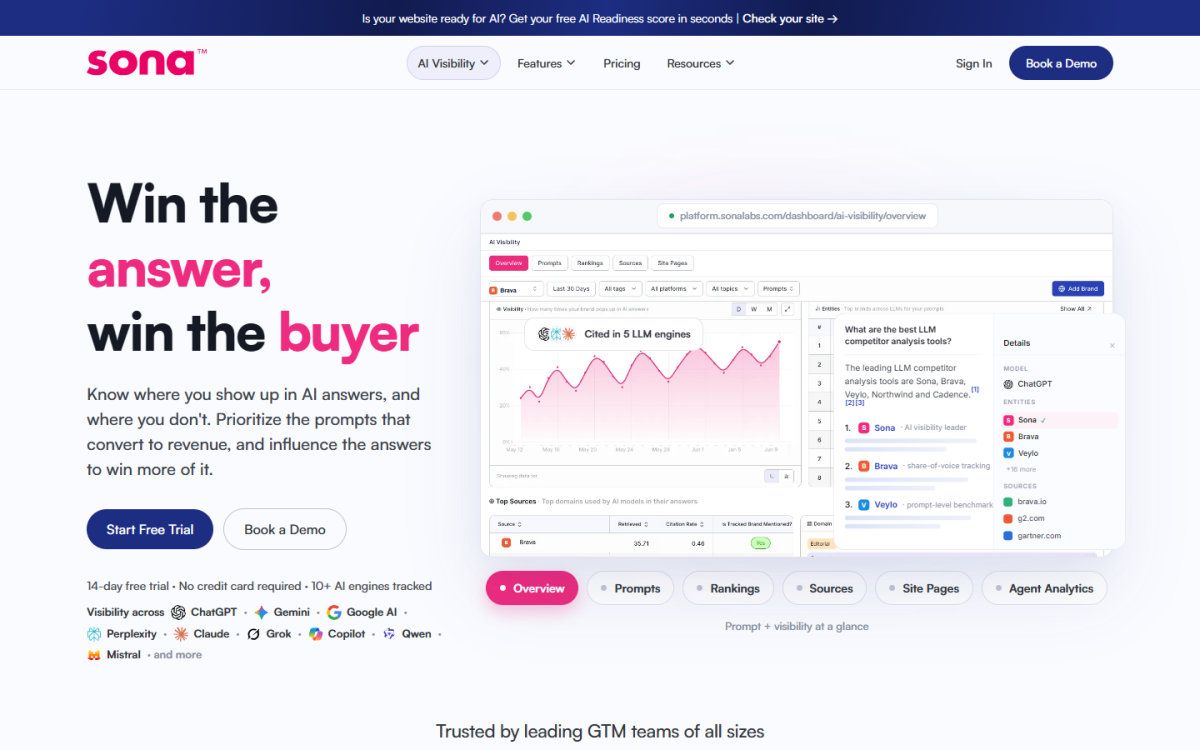
For financial services, generative engine optimization best practices involve publishing accurate, legally reviewed product facts in crawlable HTML and schema, allowing AI engines to cite them correctly. In a July 2026 ACM benchmark, AI answers appeared above organic results for 51.5% of queries, making it necessary to track citation share and answer accuracy alongside rankings. Sona AI Visibility links tracked prompts and citations to pipeline and revenue, going beyond what mention counts alone can achieve.
What are GEO best practices for financial services, and how do they differ from SEO?
GEO, or generative engine optimization, helps financial institutions become accurately represented, discoverable and trustworthy in AI systems. For financial services, GEO best practices ensure AI-generated answers can understand, cite and recommend products such as mortgages, refinancing and HELOCs with correct terms, qualifications and disclosures.
SEO remains foundational. Generative engine optimization overlaps with SEO because AI tools use similar ranking signals, per the UC Davis Institute for Engineering and Technology. The output differs: search engines rank pages, while answer engines synthesize responses, select citations and may resolve a question without a click. Financial services teams need to measure citation share and answer accuracy alongside organic rankings.
The GEO field is becoming more formalized. An arXiv survey reviewed 45 GEO studies published between November 2023 and July 2026, per arXiv, November 2023. For finance, the practical requirement is clear: preserve SEO fundamentals, then add structured product facts, entity consistency, citation monitoring and governance for AI-generated answers.
| Practice dimension | General GEO | Financial services GEO | Measurement priority |
|---|---|---|---|
| Content approach | Direct, useful answers to buyer questions | Direct answers with product terms, exclusions and effective dates | Answer accuracy and citation presence |
| Authority signals | Clear entities, credible sources and cited content | Consistent institution, product and licence naming with primary documentation | Source accuracy and entity consistency |
| Compliance focus | Truthful, current and accessible information | Legally reviewed rates, fees, eligibility rules and disclosures | Version control and correction workflow |
| How it is measured | Mentions, citations and referral traffic | Mentions, citations, qualified applications and funded accounts | Leading and lagging revenue metrics |
Which content, entity and citation practices get a financial brand cited by AI engines?
Financial brands earn AI citations by publishing direct answers to specific questions, maintaining consistent entity data and supporting product claims with primary evidence. Question-form content matters because AI systems frequently activate on conversational queries. In a study of 55,393 trending queries tracked over 40 days, Google AI Overviews activated for 13.7% of queries overall and 64.7% of question-form queries, per arXiv, 2026-07-15.
Build pages around buyer questions, including “Should I refinance my mortgage?”, “What is a HELOC?”, “How do fixed and variable rates differ?” and “What fees apply to this account?” Put the direct answer near the top, then explain terms, constraints, examples and disclosures. Conversational prompts are more detailed than traditional keywords, but conventional demand research still identifies commercial topics worth answering.
Optimize the same question-led pages for featured snippets. Follow each question heading with a self-contained answer paragraph, list or table that can be extracted by search engines and AI systems. Put financial qualifications, effective dates and disclosures immediately beside the answer rather than separating essential conditions into another page.
Entity clarity matters equally. Use the same institution name, product name, licence name and rate terminology across owned pages, business profiles and third-party references. AI systems need stable evidence that a product, institution and claim identify the same entity.
Every financial claim needs support on the page. Approximately 11% of 98,020 atomic claims in a 2026 analysis were classified as insufficiently supported, per arXiv, 2026-07-15. A rate, fee, eligibility statement or promotional offer should direct readers to the relevant primary product document rather than rely on a broad marketing assertion.
How should rates, fees and disclosures be published so AI systems read them correctly?
Financial companies should publish rates, fees, eligibility rules and disclosures as structured, versioned and legally reviewed content. Do not reduce regulated information to vague copy. Make the authoritative version easier for people and AI systems to parse.
Each product page should show an explicit effective date, applicable exclusions, relevant disclosures and a path to the controlling product documentation. A legal reviewer should approve the page before publication. When a rate or condition changes, update the product page, supporting documentation and any FAQ that repeats the claim during the same release cycle.
Schema markup and FAQ markup help distinguish product facts from generic marketing language. “Implement schema markup (using JSON-LD or microdata) on your pages for things like FAQs, product details, rates, addresses, reviews, etc.” PwC, financial-services guidance, 2025-10-23.
A workable governance model has five controls:
- Legal review before publication.
- Factuality checks against primary product documents.
- Version control for rates, terms and disclosures.
- Privacy and accessibility review for customer-facing pages.
- A rapid correction process when an AI answer repeats outdated information.
What does an AI-readiness audit check on a financial services website?
An AI-readiness audit checks whether answer engines can access, parse and trust a financial services website. The technical baseline includes clean HTML, structured data and no key content hidden behind JavaScript, per a Reddit technical discussion. The audit should assess individual pages, not only a domain-level score.
A complete audit covers six dimensions:
- Crawlability: whether AI crawlers and answer engines can reach the page, including robots.txt and access decisions.
- Performance: rendered page experience and dependence on JavaScript.
- Security: transport and header hygiene that supports trust signals.
- Content structure: headings, schema markup and page organization.
- Content quality: whether copy earns a citation, including recency.
- Accessibility: alt text, ARIA attributes, contrast and explicit image dimensions.
Financial services teams should document audit findings by page, assign an owner, set a remediation priority and recheck material product pages after technical, content or disclosure changes.
Sona AI Visibility also reads AI crawler activity from server logs or a lightweight edge worker rather than a JavaScript tag. This gives financial services teams evidence of which AI crawlers reached specific pages, including pages requiring technical or content remediation.
Which AI engines and prompts should a finance marketer monitor?
Finance marketers should monitor ChatGPT, Google AI Overviews, Google AI Mode, Gemini, Perplexity, Claude and other answer engines with prompt sets covering product, comparison, local, educational, high-intent and sensitive financial questions. A mortgage lender should not measure only its brand name. It should test refinancing, payment, rate, eligibility and HELOC prompts.
Generative results are unstable, so monitoring must be statistical rather than anecdotal. A benchmark of 11,500 real-user queries found AI answers above organic results for 51.5% of representative queries, per an ACM Digital Library benchmark, 2026-07-19.
Run the same prompt list daily to identify patterns that a weekly snapshot would average away. Answers can change with retrieval indexes, model updates and new competitor content. A change that holds for four days is a trend. A one-day spike is not.
- Product prompts, such as mortgage refinancing rates or HELOC requirements.
- Comparison prompts, such as fixed versus adjustable-rate mortgage options.
- Educational prompts, such as how refinancing affects monthly payments.
- Local prompts, such as mortgage lenders in a named market.
- High-intent prompts, such as how to apply for a HELOC.
- Sensitive prompts that require careful disclosure language.
How do you measure AI visibility and ROI for a financial services firm?
Financial services firms should measure AI visibility as a chain from mentions and citations to referrals, qualified applications and funded accounts. Visibility alone does not prove revenue impact. Mention rate and citation share are leading indicators, while applications, funded accounts and revenue are lagging indicators.
Interest is material. An industry compilation found that 92% of marketers planned to optimize, or already optimized, for traditional and AI search, while 40.6% were actively updating SEO strategy for AI engines, per Nadia Mohamed, 2026-09-23. Finance teams need reporting that separates brand exposure from commercial outcomes.
| KPI | What it shows | How to track it | Leading or lagging |
|---|---|---|---|
| Mention rate | How often the institution appears in tracked AI answers | Run a representative prompt set daily across answer engines | Leading |
| Citation share | How often owned pages are selected as sources | Record cited domains and cited landing pages by prompt | Leading |
| Source accuracy | Whether AI answers use current and authoritative product evidence | Review answer claims against current primary documentation | Leading |
| AI referral traffic | Visits attributed to AI answer engines | Track referrals and resolve traffic against landing pages | Leading |
| Qualified applications | Commercial intent generated after AI-assisted research | Connect form starts, applications and CRM outcomes to source paths | Lagging |
| Funded accounts | Real financial outcome from AI-influenced journeys | Join application, approval and funding records to attribution data | Lagging |
A single brand-level visibility score is a dated snapshot, not an operational task. A prompt-level view identifies the questions and cited sources behind that score. Sona AI Visibility connects citations and AI-referred visits to pipeline and revenue, while Sona Marketing Measurement provides the measurement foundation for AI search alongside other channels.
AI Attribution connects AI citations to accounts, pipeline and closed-won revenue on one account timeline. For financial services, the equivalent operational model connects AI-referred visits and assisted conversions to qualified leads, applications and funded accounts while preserving the governance controls required for customer data.
Calculate ROI with a pre-GEO baseline or comparison cohort. Attribute direct applications conservatively, report assisted applications separately, convert funded accounts into an approved revenue or contribution-margin value, and include software, agency, content and compliance costs. The calculation is: ROI = (attributable return − GEO cost) ÷ GEO cost. Report directly attributable and assisted return separately so uncertain assisted conversions do not inflate the primary ROI figure.
Which 4 tools track GEO for financial services, and what do they cost?
Sona AI Visibility, Profound, Peec AI and PromptWatch provide four distinct starting-price positions for GEO tracking. Sona AI Visibility starts from $75/month billed annually, Peec AI and PromptWatch start from $95/month, and Profound uses custom Enterprise pricing, as of October 2026.

The right GEO platform depends on engines covered, tracked prompts, refresh frequency, user access, API access, citation depth and whether reporting connects results to pipeline. Compare those variables before comparing prices. Vendors bill by prompts, seats, licences or credits, so headline subscription cost is not a common denominator.
Lowest paid AI-visibility plans ranged from $24.99 to $295 per month in a 2026 comparison, per Cheers, 2026-06-14. Four of 20 vendors reviewed for enterprise-brand coverage published no public brand pricing, per Cheers, 2026-06-14. The following descriptions use published information available as of October 2026.
-
Sona AI Visibility
What it does: Sona AI Visibility connects prompts and citations to pipeline and revenue on one account timeline, and tracks AI crawler activity from server logs or a lightweight edge worker.
What it costs: From $75/month billed annually for Starter, with about 56 prompts tracked daily across three engines, as of October 2026.
Who it suits: Financial services teams that need prompt and citation reporting connected to measurable commercial outcomes.
-
Profound
What it does: Profound offers custom Enterprise prompt plans across up to nine engines, as of October 2026.
What it costs: Custom pricing for brand Enterprise plans, as of October 2026.
Who it suits: Enterprise teams that need a custom prompt plan and agency workspace options.
-
Peec AI
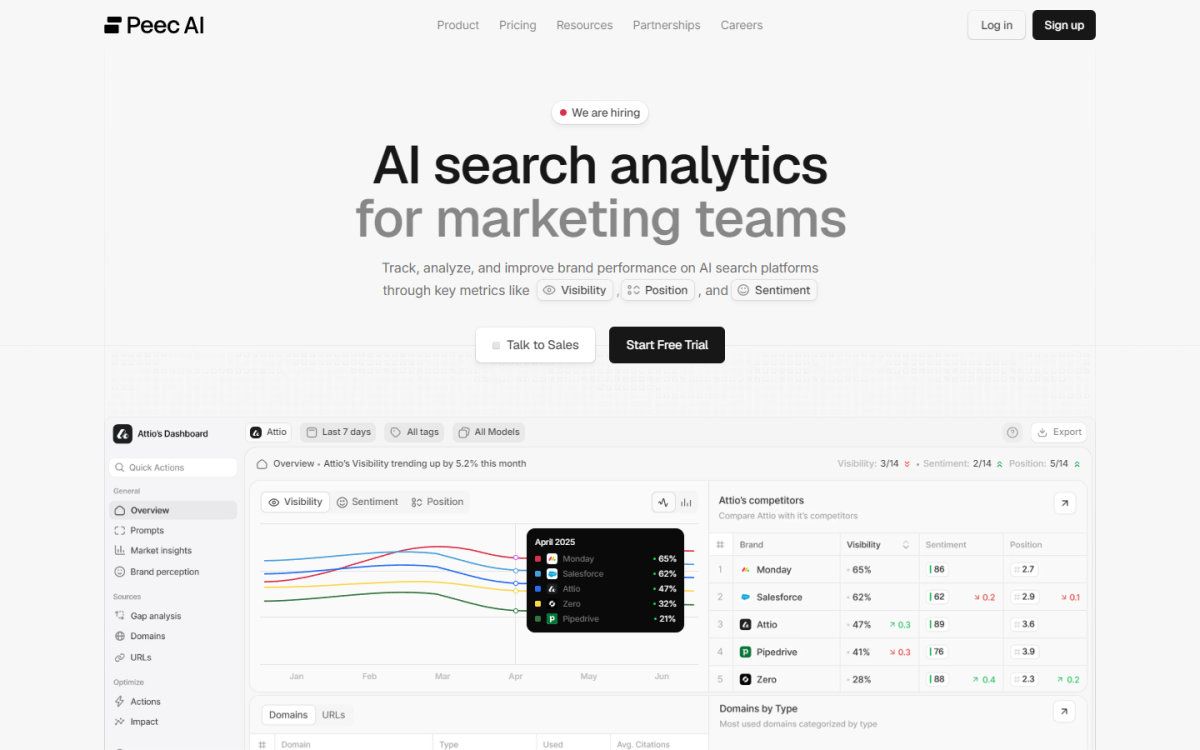
Peec AI homepage, October 2026 What it does: Peec AI provides daily prompt tracking, citation analysis and competitor visibility tracking across self-serve and Enterprise plans, as of October 2026.
What it costs: Starter begins at $95 per month and includes 50 prompts tracked daily, as of October 2026.
Who it suits: Teams focused on routine prompt monitoring and competitive AI-search reporting.
-
PromptWatch
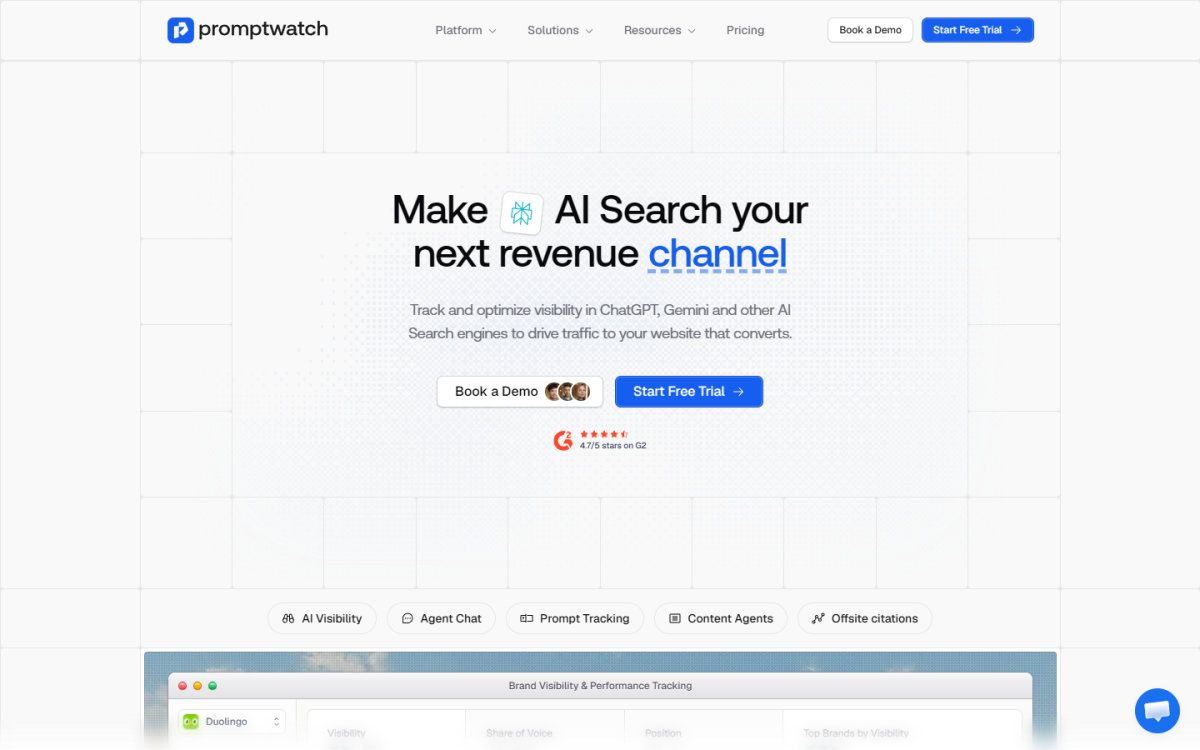
PromptWatch homepage, October 2026 What it does: PromptWatch provides prompt monitoring with monthly response allowances, as of October 2026.
What it costs: Essential starts at $95 per month and includes 50 prompts, as of October 2026.
Who it suits: Teams that need prompt monitoring and monthly response allowances.
| Tool | Starting price | Agency Plans? (Yes/No) | # of Answer Engines Tracked | Answer Engines | # of Daily Tracked Prompts (entry plan) | Cost per Daily Tracked Prompt | Differentiation |
|---|---|---|---|---|---|---|---|
| Sona AI Visibility | From $75/month billed annually | Yes | Up to 11 (3 on Starter) | Not published | 5,000 credits/month, about 56 daily tracked prompts across three engines | $0.45 per daily tracked prompt | Connects AI citations and prompts to pipeline and revenue on one account timeline, and tracks AI crawler activity from server logs. |
| Profound | Custom pricing | Yes | Up to 9 (3 on free Trial) | ChatGPT, Perplexity, Google AI Mode, Gemini, Microsoft Copilot, DeepSeek, Claude, Google AI Overviews, Exa Search | Custom prompt plan, daily | Cannot calculate from custom pricing | Custom Enterprise prompt plans across up to nine answer engines. |
| Peec AI | From $95/month | Yes | Up to 13 (3 of 6 on Starter, plus add-ons) | Not published | 50 prompts daily | $0.63 per daily tracked prompt | Citation and mention tracking across self-serve plans. |
| PromptWatch | From $95/month | Yes | Not published | Not published | 50 prompts daily | $0.48 per daily tracked prompt | Prompt monitoring with monthly response allowances. |
How do the leading AI SEO agencies compare?
AI SEO agencies differ most in service scope, contract model and reporting depth. Financial services buyers should ask how an agency handles legally reviewed product content, citation monitoring and correction workflows before selecting a retainer. Agency prices below were read from each agency’s own website in October 2026.
| Agency | Focus | What's included | Pricing |
|---|---|---|---|
| Sona done-for-you services | AI search optimization, technical fixes, content, strategy and reporting | A Sona team working on top of an AI Visibility Growth plan or above | Launch from $5,500/month, Accelerate $7,500/month, Amplify $9,500/month |
| DerivateX | Full-service SEO and GEO for B2B SaaS | GEO, LLM SEO, entity optimization, content, digital PR and technical SEO | Plans $5,000–$12,000/month |
| Breaking B2B | SEO and AI search for B2B and SaaS | AEO, GEO, technical SEO, content, link building, Reddit and YouTube | From $4,000/month; Growth plans $5,500–$9,700/month |
| Discovered Labs | Organic search for the AI era | AEO, GEO, Reddit marketing, technical SEO, digital PR and AI visibility tracking | Establish €6,995/month, Compete €10,995/month |
| Omniscient Digital | SEO and GEO for B2B software brands | LLM optimization, citation analysis, technical assessment, content and digital PR | From $10,000/month |
| iPullRank | AI search and GEO through relevance engineering | Relevance engineering, GEO, content strategy, technical SEO and measurement | Not published (quote only) |
| Foundation | GEO agency for B2B companies | GEO strategy, technical SEO, LLM advertising, content distribution and analytics | Not published (quote only) |
| Siege Media | Full-service GEO for brands | Research reports, digital PR, bottom-of-funnel content and content refreshes | Not published (quote only) |
| TripleDart | AI-native organic growth for B2B SaaS | AI visibility, technical SEO, content production, programmatic optimization and paid media | From $5K/month |
Breaking B2B lists fintech and financial services among its sectors. Siege Media lists fintech among its target sectors. Those statements identify sector coverage, not a recommendation or evidence of financial-services compliance capability.
Who should pick which GEO tool or service?
A team that needs revenue attribution for AI referrals should choose software that connects cited prompts, landing pages, accounts and downstream outcomes. A marketing team already using an SEO suite should assess whether its AI reporting provides sufficient prompt depth, citation detail and reporting cadence for financial products.
A team that needs only prompt and citation tracking should compare daily prompt capacity, engine coverage and answer capture. A team that wants done-for-you execution should compare service scope, legal-review workflow, content production and reporting. A team that needs agency strategy and content production should compare engagement terms, technical scope and the agency’s ability to work with product documentation.
Normalize every quote by engines, tracked prompts, refresh frequency, users, API access and citation depth. Do not compare a credit package with a daily prompt allowance without understanding the denominator. Some enterprise vendors publish no brand pricing, per Cheers, 2026-06-14.
Financial services teams should use separate supporting guidance for compliance review, implementation roadmaps and financial-services case studies. Those subjects require deeper operational detail than a GEO tool comparison provides.
What are the frequently asked questions about GEO for financial services?
What is generative engine optimization for financial services?
Generative engine optimization for financial services makes sure AI-powered search engines and large language models represent a financial institution accurately and can discover, trust and cite it for product-related queries. A lender, for example, should be cited accurately for mortgage refinancing and HELOC questions, including eligibility, rates, fees and disclosures.
Is GEO just rebranded SEO for banks and lenders?
No. SEO remains foundational and the signals overlap, per the UC Davis Institute for Engineering and Technology. AI systems also synthesize answers, select citations and may answer a financial question without a click. Banks and lenders need separate measurement for citation share, answer accuracy and entity visibility.
Are AI answers too inconsistent to optimize for?
AI output can vary across repeated runs and small query edits. The appropriate response is statistical monitoring across many prompts and dates, not abandoning measurement. A daily prompt log separates a sustained trend from an unstable single result.
How can finance content be made machine-readable without compliance risk?
Publish structured, versioned and legally reviewed pages with explicit effective dates, exclusions, disclosures and links to primary documents. Do not remove important qualifications to make copy shorter. Clear structure makes the authoritative version easier for readers and AI systems to interpret.
How do you compare AI visibility tool prices when vendors bill differently?
Normalize pricing by engines, tracked prompts, refresh frequency, users, API access and citation depth. Lowest paid plans ranged from $24.99 to $295 per month across vendors reviewed in 2026, per Cheers, 2026-06-14. Four of 20 enterprise-focused vendors published no public brand pricing, per Cheers, 2026-06-14.
Does AI visibility prove revenue impact for a financial firm?
Not by itself. Mentions and citations are leading indicators. A serious financial-services GEO program ties AI referrals, assisted conversions, qualified leads, applications and funded accounts to tracked prompts and landing pages.
Summarize this article with AI: ChatGPT · Claude · Perplexity · Google AI Mode
Last updated: October 2026







