


ChatGPT brand mentions occur when ChatGPT names your company or product in a response; measure them by using a fixed set of prompts on a schedule and recording every result. Manual reviews offer an initial view, but wording, date and location alter responses, making a consistent log more valuable than one answer. Paid trackers started at $20 per month in September 2026, while Sona AI Visibility links prompts and citations to pipeline and revenue, not just mention totals.
What counts as a ChatGPT brand mention, and how is it different from a citation or a link?
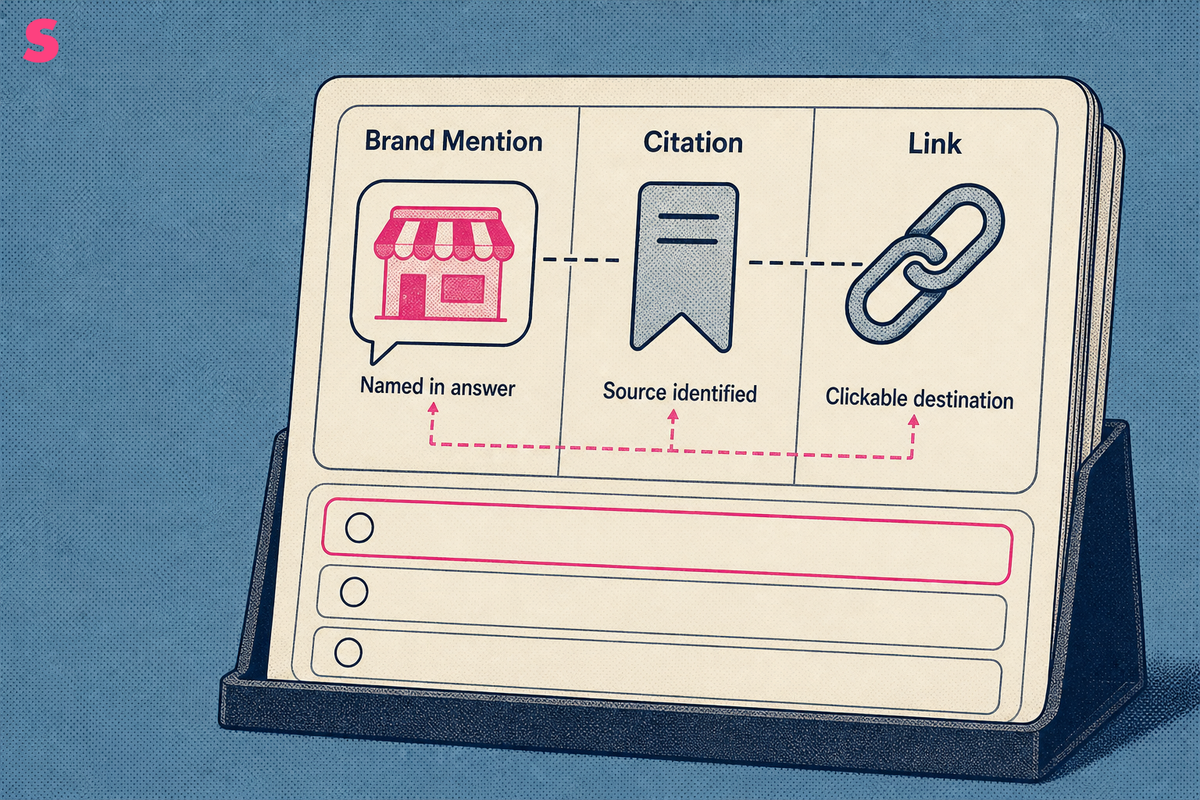
A ChatGPT brand mention occurs when your brand name appears in a generated answer to a relevant prompt. It may name a company, product, service, or executive. The mention places the brand within the recommendation or explanation a buyer receives.
A mention differs from a citation or link. A citation is a source ChatGPT identifies in support of an answer. A link is a clickable destination when ChatGPT displays one. ChatGPT can mention a brand without citing its website, cite a source that never names the brand, or display both.
ChatGPT brand mentions also differ from social listening and SEO rankings. Social listening tracks posts, reviews, news, forums, and websites. SEO rank tracking measures where a page appears on a search results page. AI answer monitoring captures the generated response, recommendation context, cited sources, answer position, and competing brands named beside yours.
For example, a buyer who asks for the best account-based marketing platform might receive a list of vendors. A brand named first occupies a different position from a brand added in a final catch-all sentence. The citation list and competitor set provide context for that appearance.
How can you manually check whether ChatGPT mentions your brand?
Manually check ChatGPT mentions by running a fixed prompt set in fresh sessions and logging each answer in a spreadsheet. This creates an initial baseline and shows how buyers frame questions and which brands ChatGPT returns.
- Choose prompts that represent commercial questions buyers ask.
- Open a fresh ChatGPT session for each prompt.
- Run the prompt without changing its wording.
- Record the date, exact prompt, brand mention, answer position, cited sources, and competitor names.
- Save the full response, not only a yes-or-no result.
- Repeat the same prompt list daily to create a comparable log.
For example, a B2B software company could test “What are the best platforms for multi-touch attribution?” and record whether its brand appears, where it appears, and which sources accompany the answer. The worksheet records what changed and when.
Manual checking becomes unreliable when prompt wording, date, location, account context, and response variation multiply. Daily runs of the same prompt list reveal patterns that a weekly snapshot can obscure. Persistent changes deserve investigation, while isolated spikes may reflect answer variation.
How do you build a prompt set that measures ChatGPT brand mentions reliably?
A reliable ChatGPT mention prompt set is a fixed library of buyer questions grouped by intent and funnel stage. Use stable wording, preserve complete responses, and rerun prompts so one answer does not determine the conclusion.
- Category discovery: “What are the leading marketing attribution platforms for B2B SaaS?”
- Comparison: “Which attribution platform is best for companies using Salesforce?”
- Problem-led: “How can a marketing team connect anonymous website visits to pipeline?”
- Brand-specific: “What does [brand name] do, and who is it for?”
Use the same wording for each run. Preserve the complete answer, sources, links, named competitors, and each brand’s location in the response. A score is a dated snapshot. The response log provides the evidence needed to distinguish an isolated answer from a recurring pattern.
Log ChatGPT Search answers separately from conversational answers. Search mode can retrieve and display sources differently, while conversational answers can reflect the ongoing exchange. Combining these outputs hides the difference between distinct answer experiences.
Sona AI Visibility uses AI Search Insights to connect buyer prompts with brand visibility, cited sources, and page-level performance. Sona’s own AI visibility data covers 8 answer surfaces, ChatGPT, Google AI Overviews, Perplexity, Google AI Mode, Gemini, Mistral, Qwen, and Claude, per Sona’s own AI visibility data, September 2026.
Why do ChatGPT answers change between runs, and how do you measure through the noise?
ChatGPT answers change between runs because the system is not deterministic. Prompt wording, location, model version, personalization, search mode, and run date can change which brands appear and how the answer is structured.
Variation does not make measurement useless. It requires a controlled method. Run standardized prompts repeatedly, save each full answer, and report a range or mention rate rather than treating one response as a final verdict.
For example, if a brand appears in three of five runs for the same prompt, report a 60% mention rate for that prompt and date range rather than claiming the brand either does or does not appear. Keep model changes and search-mode changes in separate fields so those shifts are not mistaken for a content result.
Daily prompt tracking provides the resolution needed to identify changes in retrieval indexes, model updates, and competitor content. Review trends quarterly, while maintaining daily prompt observations to separate persistent movement from random variation.
Which metrics show how visible your brand is in ChatGPT answers, and how are they calculated?
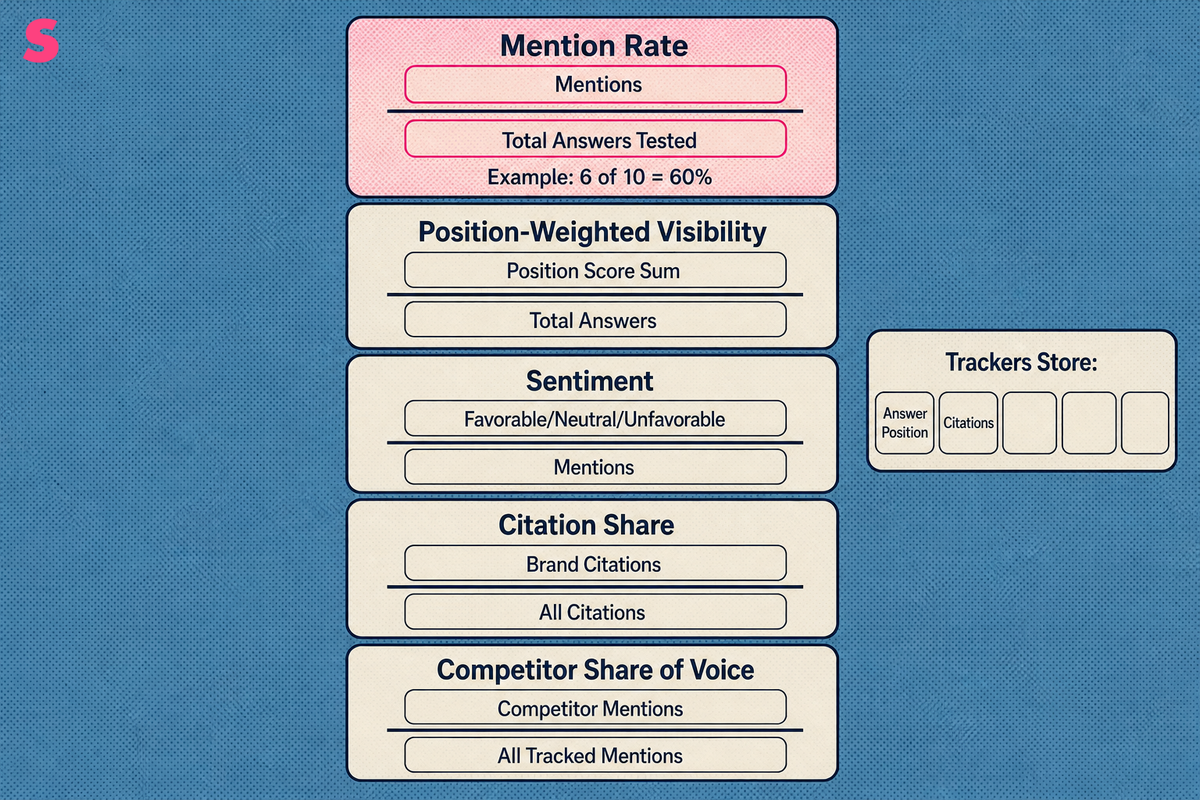
The most useful ChatGPT visibility metrics measure whether a brand appears, where it appears, how it is described, and which competitors take the remaining share. Mention rate alone is insufficient because two brands can appear equally often while holding very different positions.
- Mention rate: answers mentioning the brand ÷ total answers tested.
- Position-weighted visibility: the sum of each appearance’s position score ÷ total answers tested.
- Sentiment: favorable, neutral, or unfavorable descriptions ÷ total brand mentions.
- Citation share: citations associated with the brand or its pages ÷ all citations captured.
- Competitor share of voice: a competitor’s mentions ÷ mentions for all tracked brands.
Illustrative example, not market data: if a brand appears in 6 of 10 responses, its mention rate is 60%. If it appears first in 2 answers, second in 3, and fourth in 1, the team can apply a defined position score to compare that exposure against competitors over time.
Trackers commonly store mention rate, answer position, sentiment, citations, competitors, and full responses. A single brand-level visibility score can serve as a headline, but it does not identify the required work. Sona AI Visibility shows prompt-level visibility and cited sources, helping teams identify the questions and pages requiring attention.
How much do ChatGPT brand mention tracking tools cost?
ChatGPT mention tracking prices range from entry plans under $100 per month to custom enterprise pricing. The comparison below uses public plan details available as of October 2026. Prompt allowances, engine coverage, and refresh cadence differ enough that monthly price alone is not a fair buying metric.
| Tool | Starting price | Agency Plans? | # of Answer Engines Tracked | Answer Engines | # of Daily Tracked Prompts (entry plan) | Cost per Daily Tracked Prompt | Differentiation |
|---|---|---|---|---|---|---|---|
| Sona AI Visibility | From $75/month, billed annually | Yes | 11 | ChatGPT, Gemini, Google AI Mode, Google AI Overviews, Perplexity, Claude, DeepSeek, Grok, Copilot, Qwen, Mistral | 5,000 credits/month, about 56 prompts tracked daily across 3 engines | $0.45 per daily tracked prompt | Connects AI citations and prompts to pipeline and revenue on one account timeline, and tracks AI crawler activity from server logs. |
| Peec AI | From $95/month | Yes | 3 | ChatGPT, Google AI Mode, Google AI Overviews | 50 prompts daily | $0.63 per daily tracked prompt | Daily prompt tracking across AI answer engines. |
| Otterly.ai | From $29/month | Yes | 4 | ChatGPT, Google AI Overviews, Perplexity, Microsoft Copilot | 15 prompts daily | $0.48 per daily tracked prompt | AI search monitoring across four entry-plan engines. |
| Scrunch AI | From $250/month | Yes | 4 | ChatGPT, Perplexity, Google AI Overviews, Microsoft Copilot | 125 prompts, refresh cadence not published | No refresh cadence published | Brand visibility monitoring across AI answer engines. |
| Profound | Custom pricing | Yes | 3 | ChatGPT, Gemini, Google AI Overviews | 50 prompts daily during the 7-day trial | Not published | Daily prompt tracking through a trial and custom enterprise plans. |
| PromptWatch | From $95/month | Yes | Not published | All supported models | 50 prompts daily | $0.48 per daily tracked prompt | Prompt and response monitoring across supported models. |
| Goodie | From $295/month | Yes | 5 | Not published | 110 prompts daily | $0.67 per daily tracked prompt | AI visibility monitoring with five models on the Core plan. |
The table reflects listed prices and plan details as of October 2026. Sona AI Visibility Starter begins from $75 per month billed annually, per Sona pricing, October 2026. Public prices can change, and custom plans require a direct quote.
How should you compare ChatGPT mention trackers beyond the monthly price?
Compare ChatGPT mention trackers by the unit each plan sells, not the headline monthly fee. Vendors define a prompt, check, engine, brand, model, refresh, and tracked response differently, so similarly priced plans can provide very different monitoring coverage.
- Prompt limit and whether it applies per day, week, month, engine, or response.
- Included answer engines, including ChatGPT, Gemini, Perplexity, Google AI Overviews, and other answer engines.
- Refresh frequency and whether daily tracking is included.
- Competitor tracking, sentiment classification, and citation capture.
- Full-response storage for later review and auditability.
- Countries, locations, brands, projects, seats, and historical retention.
Most trackers stop at mention counts, positions, and share of voice. Sona AI Visibility connects citations to pipeline and revenue, giving marketing leaders a way to assess the commercial value of AI answer visibility alongside visibility measurement.
A tracker should preserve enough context to explain movement. A mention-rate change without answer text, cited sources, prompt version, and named competitors cannot tell a team what changed or what requires investigation.
How do you connect ChatGPT mentions to website traffic, leads and revenue?
A ChatGPT mention does not prove commercial impact alone. To connect ChatGPT visibility to revenue, track referral visits, tagged campaigns, branded-search changes, assisted conversions, demo requests, and pipeline records in the same reporting process.
Start with ChatGPT referral traffic in web analytics. Segment visits that arrive from ChatGPT, preserve landing-page and campaign data, and follow those sessions into form submissions, product activity, CRM contacts, opportunities, and closed-won deals. Track branded-search changes because AI research can influence later direct or search visits.
For example, a buyer reads a ChatGPT answer that names a software vendor, clicks through to a pricing page, submits a demo request, and becomes part of an opportunity in the CRM. The original visit provides direct referral evidence. The opportunity and deal record show whether AI-influenced research produced pipeline or revenue.
Sona AI Visibility connects prompts and citations to pipeline and closed-won revenue on one account timeline. It can identify companies behind anonymous AI-referred visits at the account level, infer the likely prompt behind a visit, and track which AI crawlers reach pages through server logs rather than a JavaScript tag.
Sona Marketing Measurement provides the wider measurement foundation for Identity Resolution and Cross-Channel Attribution. AI search can then be evaluated as a measurable channel beside paid, organic, and other acquisition sources rather than being grouped into unattributed traffic.
How do you increase how often ChatGPT mentions your brand?
Increase ChatGPT brand visibility by keeping positioning consistent across owned pages, earning credible third-party validation, maintaining structured data, and publishing expert material that answers buyer questions directly. Re-measure changes with the same prompt set to separate improvement from answer variation.
Start with positioning. Product pages, comparison pages, help content, executive profiles, and customer-facing descriptions should use consistent language about the category, buyer problem, and differentiation. Inconsistent terminology makes it harder to assess whether a response reflects the same brand proposition.
Third-party references and validation matter because ChatGPT can surface information beyond a company’s own pages. Structured data helps machines parse entities and page relationships. Expert content gives a brand clear material for problem-led and comparison prompts. Traditional SEO still matters, but rankings alone no longer determine which brands ChatGPT recommends.
Use the Free AI Readiness Checker to assess whether AI systems can technically read a site through 35 checks across 6 categories, per Sona product information, October 2026. Re-run the same ChatGPT prompt library daily after substantive changes, and schedule deeper positioning reviews and competitive benchmarks quarterly.
What are the frequently asked questions about ChatGPT brand mentions?
Can you track ChatGPT brand mentions for free?
Yes. Run a fixed set of prompts by hand and log the answers in a spreadsheet. Manual tracking works for exploration, but becomes inconsistent as prompts, dates, locations, models, and competitor sets multiply.
How often should you check ChatGPT for brand mentions?
Run the same prompt list daily because daily observations reveal patterns that a weekly snapshot can obscure. For a manual log, rerun each prompt several times per check and keep wording, location, account settings, and search mode consistent.
Does a ChatGPT mention count as a citation?
No. A mention is the brand name appearing in the generated answer. A citation is a source the answer identifies. A brand can be mentioned without a citation, and a cited source can appear without naming the brand.
How do you track traffic that comes from ChatGPT?
Segment ChatGPT as a referral source in web analytics, tag links you control, and follow those visits through to leads and deals. Some AI-influenced visits arrive unattributed, so branded search and assisted conversions should remain part of the analysis.
Why does ChatGPT mention my brand in one answer and not the next?
ChatGPT responses are not deterministic. Prompt wording, model version, search mode, location, personalization, and run date can change the output. Rerun each prompt several times and report a mention rate rather than treating one answer as conclusive.
Is ChatGPT brand mention tracking the same as social listening?
No. Social listening monitors posts, news, forums, reviews, and websites. ChatGPT tracking captures the generated answer, the brand’s position in that answer, cited sources, and competitors named beside the brand.
Summarize this article with AI: ChatGPT · Claude · Perplexity · Google AI Mode
Last updated: October 2026







