How to rank higher in LLMs: get your pages cited in AI-generated responses by ensuring they are crawlable, organized into self-contained passages, consistent in describing your company, and supported by third-party sources. Tactics work differently across ChatGPT, Claude, Gemini, Perplexity, and other answer engines, so align each tactic with its engine and track citation frequency separately from citation prominence. Sona AI Visibility connects prompts and citations to pipeline and revenue, beginning with AI crawler activity on your site.
What does it mean to rank higher in LLMs, and how is it different from Google SEO?
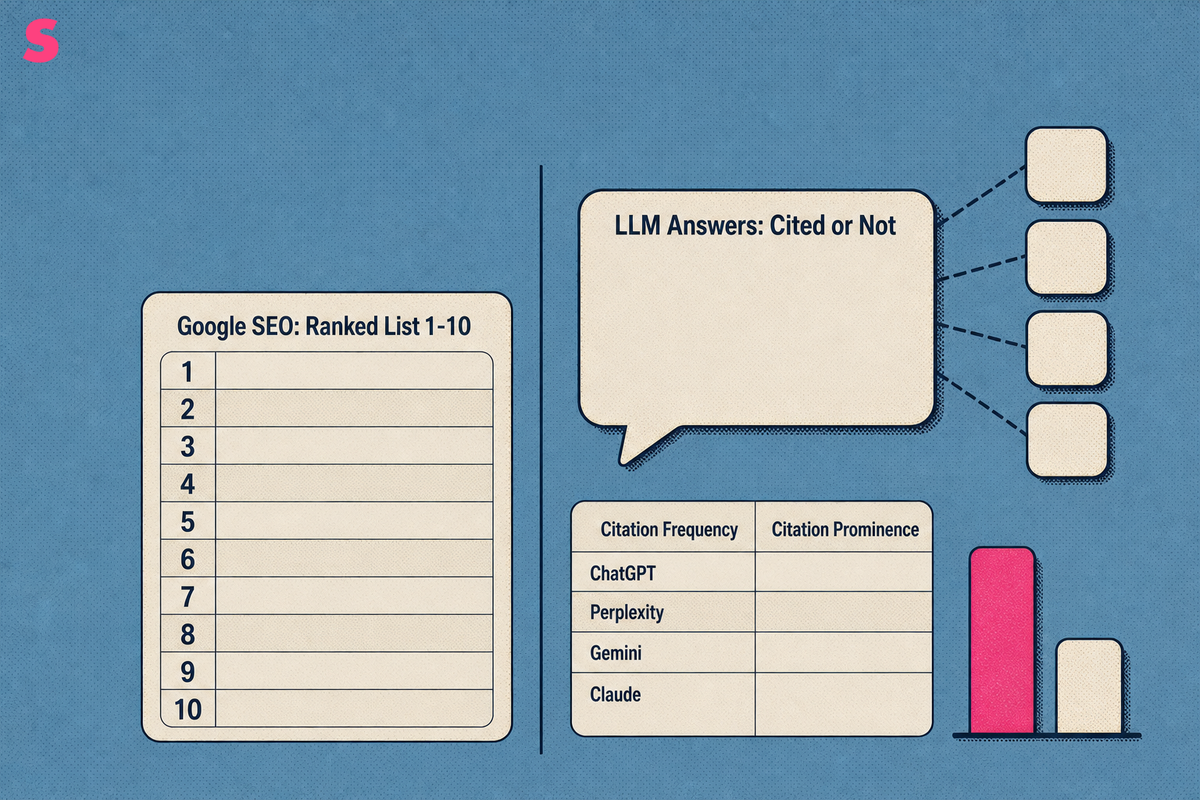
To rank higher in LLMs means getting your website cited, summarized, or recommended inside an AI-generated answer. The goal is not a stable position from 1–10 in a list of links. It is appearing when a buyer asks a relevant question in ChatGPT, Perplexity, Gemini, Claude, or another answer engine.
LLMs are probabilistic continuation systems, not traditional ranking engines, so conventional ranking-factor thinking does not map cleanly to AI search optimization. The same prompt can produce different answers as the engine, model, location, freshness of connected sources, and retrieved material change.
Some work remains familiar SEO: crawlable pages, relevant content, clear information architecture, authoritative evidence, and useful internal links. The newer work happens at passage level. An answer engine must locate a specific statement, understand the entity behind it, corroborate the claim, and judge the passage useful enough to cite.
Citations are the practical ranking signal for AI answers, per B2B Marketing Community. Track two outcomes: citation frequency, meaning how often your brand appears, and citation prominence, meaning whether the engine presents your page or brand as a primary source.
What do you need in place before you start optimizing for LLMs?
Before optimizing for AI-generated answers, secure access to your robots.txt file, CMS, web-server or CDN logs, and analytics. Build a baseline from the ten most-visited pages, which Commonmind recommends reviewing in its April 20, 2026 guidance.
Create a fixed list of buyer-style prompts. Include questions about comparisons, implementation guidance, alternatives, pricing context, category definitions, and recommendations. Record the exact wording, engine, model, location, date, answer text, cited pages, and whether your brand was the lead source.
- Access to robots.txt and the CMS for public-page changes.
- A list of the ten most-visited pages.
- A prompt set based on real buyer research questions.
- A way to inspect crawler requests, such as server or CDN logs.
- A baseline sheet for citation frequency, citation prominence, and AI-referred visits.
The Sona AI Crawl Checker can test whether 45 AI crawlers can reach and load a page, including GPTBot, ClaudeBot, and PerplexityBot, per Sona product documentation, October 2026. Use the result as a technical starting point, not proof that an engine will cite the page.
How do you make your pages crawlable and eligible for citation in AI answers?
Make public pages accessible, renderable, fast, and technically consistent before rewriting copy. An AI crawler cannot cite a page it cannot reach, parse, or retrieve reliably.
- Check robots.txt. Review rules for GPTBot, ClaudeBot, and PerplexityBot. A B2B SaaS playbook from May 9, 2026 recommends checking those three crawlers.
- Verify HTTP status codes. Important public pages should return a successful response rather than a redirect chain, error response, or soft 404.
- Test rendering. Confirm that core claims, headings, tables, FAQs, and product information are available in server-rendered HTML rather than dependent on client-side JavaScript.
- Review Bing Webmaster Tools. Use it to inspect crawl and indexing signals that affect Bing-connected retrieval systems.
- Measure response time. One technical recommendation from May 9, 2026 sets a time-to-first-byte target below 200 milliseconds.
Treat crawler access as a commercial decision. Allow crawlers to access public marketing, documentation, and educational pages you want cited. Keep gated assets, customer data, proprietary research, and low-value utility pages restricted where appropriate.
Sona AI Visibility tracks which AI crawlers reach pages and how often, using server logs or a lightweight edge worker rather than a JavaScript tag, per Sona product documentation, October 2026. The data separates a content problem from an access problem.
How should you structure content so an LLM can extract and cite a single passage?
Structure each page so an answer engine can extract a self-contained answer without reconstructing your argument across several sections. Lead with the direct answer, then provide definitions, evidence, examples, and limitations in distinct passages.
- Answer the page question immediately. A current AI-search guide recommends placing the direct answer within the first 100 words, April 15, 2026.
- Keep passages compact. The same April 15, 2026 guidance recommends no more than 3–4 sentences per paragraph. A separate workflow recommends keeping paragraphs under 80 words, September 30, 2026.
- Use buyer language. Write specific answers to the complete questions buyers ask, not only short keyword variants.
- Build a real FAQ section. FAQs create clear question-and-answer passages that answer engines can isolate, per B2B Marketing Community.
- Support claims with dated evidence. Use relevant, recent statistics and multiple proof points rather than unsupported assertions.
A strong passage names the subject, makes one claim, explains its significance, and identifies supporting evidence. Replace claims that a platform is powerful or comprehensive with details an answer engine can quote or cite without interpretation.
How do schema markup, consistent messaging and internal links affect AI visibility?
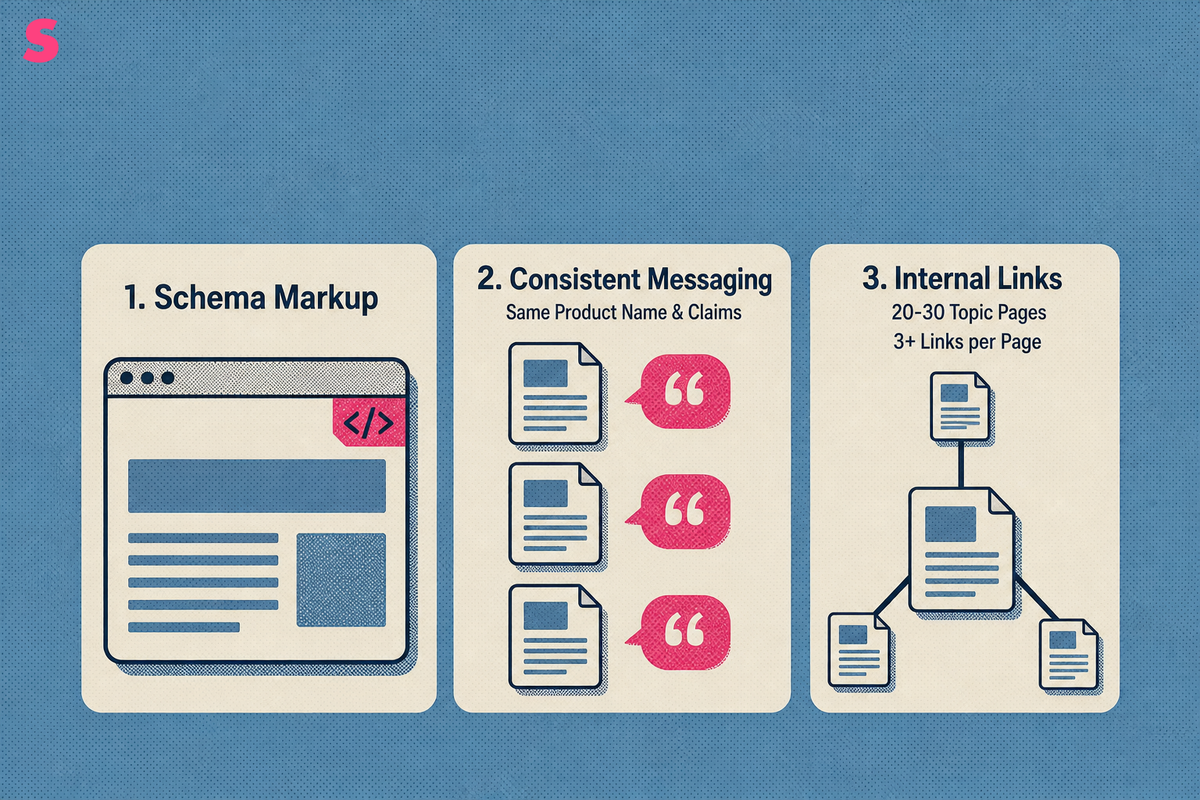
Schema markup, consistent entity descriptions, and internal linking help answer engines interpret a site as a connected source of expertise. They do not replace useful passages, but they make those passages clearer and easier to corroborate.
Validate Article schema on the ten most-visited pages first. A B2B SaaS playbook from May 9, 2026 recommends that scope, while current AI-search guidance identifies schema markup on homepage and blog pages as a foundational LLM-ranking step.
Use the same product name, category definition, customer description, and core claims across every page. Messaging consistency across webpages and content is required for LLM visibility, per Epicenter. Conflicting descriptions force an engine to choose between competing versions of your entity.
Build topical clusters around connected buyer questions. One current LLM-SEO guide recommends 20–30 pages covering related subtopics as a starting point for topical coverage, April 15, 2026. Each major page should link to at least three related pages, according to the same guidance and date.
Sona AI Visibility connects page-level AI coverage to the prompts those pages should answer, per Sona product documentation, October 2026. Teams can use that information to prioritize internal links for pages connected to commercially relevant prompt gaps.
Which third-party sources shape how AI answers describe your product?
Third-party sources shape AI answers because citations and independent mentions corroborate what your website says. Review sites, forums, videos, blogs, podcasts, and industry publications can influence how an answer engine describes a product or category.
Prioritize sources where customers and practitioners explain real use cases. G2, Capterra, Reddit, YouTube, specialist blogs, podcasts, and industry publications serve different research intents. Mentions in blogs, forums, and podcasts can generate quality citations that improve LLM visibility, per LinkedIn.
Do not manufacture evidence. Ask customers for detailed feedback after a meaningful outcome, provide accurate product information to publishers, and contribute subject-matter expertise where it is useful. A review-based optimization study reported top-1 promotion rates of 78%–88% across four tested LLMs, April 2026, but the research does not make fabricated reviews valid.
Third-party descriptions should match the messaging on your site. If customer reviews describe one use case while your pages describe another, an answer engine receives inconsistent entity signals. Consistency matters more than volume alone.
Which tactics help you rank higher in ChatGPT, Claude, Gemini and Perplexity?
The strongest cross-engine tactics improve citation eligibility and evidence quality: crawl access, extractable passages, clear entities, connected topical coverage, and credible third-party corroboration. ChatGPT, Claude, Gemini, Perplexity, and other answer engines vary by prompt, model, location, retrieval behavior, and connected sources, so verify every tactic against a fixed prompt set.
| Tactic | ChatGPT | Claude | Gemini | Perplexity |
|---|---|---|---|---|
| Crawl access | Focus on citation frequency, verify public pages are accessible. | Focus on citation frequency, verify public pages are accessible. | Focus on citation frequency, verify public pages are accessible. | Focus on citation frequency, verify public pages are accessible. |
| Passage structure | Focus on citation prominence, verify direct answers appear early. | Focus on citation prominence, verify passages stand alone. | Focus on citation prominence, verify claims are easy to extract. | Focus on citation prominence, verify concise answers match prompts. |
| Article schema | Focus on citation frequency, verify structured page metadata. | Focus on citation frequency, verify structured page metadata. | Focus on citation frequency, verify Article schema validates. | Focus on citation frequency, verify page entities remain clear. |
| Entity consistency | Focus on citation prominence, verify product descriptions match. | Focus on citation prominence, verify terminology remains stable. | Focus on citation prominence, verify entities align across pages. | Focus on citation prominence, verify source descriptions agree. |
| Topical clusters | Focus on citation frequency, verify connected subtopics cover intent. | Focus on citation frequency, verify related pages answer adjacent questions. | Focus on citation frequency, verify internal links connect relevant pages. | Focus on citation frequency, verify subject depth across the domain. |
| Review-site presence | Focus on citation prominence, verify reviews describe real use cases. | Focus on citation prominence, verify independent evidence is specific. | Focus on citation prominence, verify review language corroborates claims. | Focus on citation prominence, verify third-party descriptions are accurate. |
| Community mentions | Focus on citation frequency, verify authentic practitioner discussion. | Focus on citation frequency, verify relevant forum context. | Focus on citation frequency, verify credible publication mentions. | Focus on citation frequency, verify useful community references. |
| Dated supporting statistics | Focus on citation prominence, verify claims include current evidence. | Focus on citation prominence, verify evidence supports the passage. | Focus on citation prominence, verify sources and dates are explicit. | Focus on citation prominence, verify statistics answer the prompt. |
Use the table as a testing plan, not an engine-specific algorithm. Run the same prompts daily, preserve the answers, and identify changes that persist across several days. Daily prompt tracking reveals patterns that a weekly snapshot can obscure.
How do you measure whether your pages are ranking higher in LLM answers?
Measure LLM visibility with a repeatable prompt log, not a single score. Success means your brand appears in more relevant prompts, appears more often as a lead source, receives AI-referred visits, and is described accurately.
For every check, record the prompt, engine, model, location, date, cited sources, citation frequency, and citation prominence. Run the same buyer-style prompt list daily. A change that holds for four days is a trend, while a one-day spike can reflect a retrieval update, model change, or newly published competitor material.
Sona AI Visibility connects prompts and citations to pipeline and revenue on one account timeline, and tracks AI crawler and agent activity, per Sona product documentation, October 2026. That lets a B2B team evaluate whether AI visibility contributes to signups, pipeline, and closed-won revenue rather than treating mentions as the final outcome.
Measurement establishes correlation, not causation. Compare the date of a page change with the prompt log, inspect answer wording, and watch AI-referred traffic. The useful output is a comparable time series, because a dated snapshot cannot show whether a result persisted.
What should you do if your pages still are not cited after the changes?
Recover from missing citations in a fixed order: crawler access, rendering, answer visibility, entity consistency, and third-party corroboration. Do not rewrite every page before identifying the failing part of the citation path.
- Check whether a crawler is blocked. Review robots.txt, firewall rules, status codes, and logs for the target page.
- Check whether the page renders. Confirm that server-rendered HTML contains the answer, evidence, headings, and FAQ content.
- Check whether the answer is buried. Move the direct answer into the opening section and reduce long, mixed-topic paragraphs.
- Check brand consistency. Compare product descriptions, category language, and key claims across core pages.
- Check external corroboration. If no credible third-party source supports a claim, build evidence through real customer feedback and earned coverage.
A visibility score shows the outcome, but a technical audit identifies page-level blockers. Sona AI Visibility’s AI Search Insights scores a page out of 100 across crawlability, performance, security, content structure, content quality, and accessibility; it ranks each finding as critical or medium with the fix attached, then re-runs on a watch so teams can see whether the fix landed, per Sona product documentation, October 2026.
Use a monthly or quarterly technical re-audit for deeper review while retaining daily prompt tracking for answer volatility. Fix the earliest failure in the chain, then test whether the same prompts produce a different citation outcome.
What are the frequently asked questions?
Is ranking higher in LLMs the same as SEO?
Partly. Crawlability, relevance, authority, and useful content still apply. The goal changes from a position in a list of ten links to a citation inside a generated answer. The new work is passage-level structure, third-party corroboration, and answer-level measurement.
Do LLMs have a ranking algorithm I can optimize for?
LLMs do not have one stable ranking algorithm. Results shift by engine, model, prompt, location, freshness, and connected sources. Optimize for signals that support citation across engines, then expect answer-level variance.
Should I allow GPTBot, ClaudeBot and PerplexityBot to crawl my site?
If you want visibility, check that robots.txt does not block GPTBot, ClaudeBot, and PerplexityBot from public pages. A B2B SaaS playbook recommends checking those three crawlers, May 9, 2026. Gated, proprietary, and low-value content can remain restricted because crawler access is a per-section decision.
Does schema markup help LLMs cite my pages?
Schema markup is a foundational step for LLM visibility. Validate Article schema on the ten most-visited pages first, following a B2B SaaS playbook from May 9, 2026. Treat schema as support for clear passages and consistent entities, not as a substitute for them.
How do I get mentioned on review sites and forums without it looking manufactured?
Earn mentions from real customers describing specific use cases on sites such as G2, Capterra, and Reddit. Make it easy for customers to leave detailed feedback after a meaningful outcome. Never fabricate reviews, pay for undisclosed endorsements, or script supposedly independent community comments.
How do I know a change actually improved my visibility in AI answers?
Run the same fixed buyer-style prompts before and after a change, then record the engine, model, date, citation frequency, citation prominence, and AI-referred traffic. Daily checks provide the needed resolution. The result shows correlation rather than proof of cause, but persistent changes in answer wording provide useful evidence.
Summarize this article with AI: ChatGPT · Claude · Perplexity · Google AI Mode
Last updated: October 2026