


For enterprise GEO API integration, send prompts to a visibility API by engine and location, save every response and its metadata, then load the data into a warehouse or BI tool. Retain the timestamp, locale, model and repeat runs, since one AI response is not a dependable measurement. Sona AI Visibility links prompts and citations to pipeline and revenue, beginning with AI crawler and agent activity. Assess vendors by cost per monitored prompt, engine and location.
What does it mean to integrate AI visibility data via an enterprise GEO API?
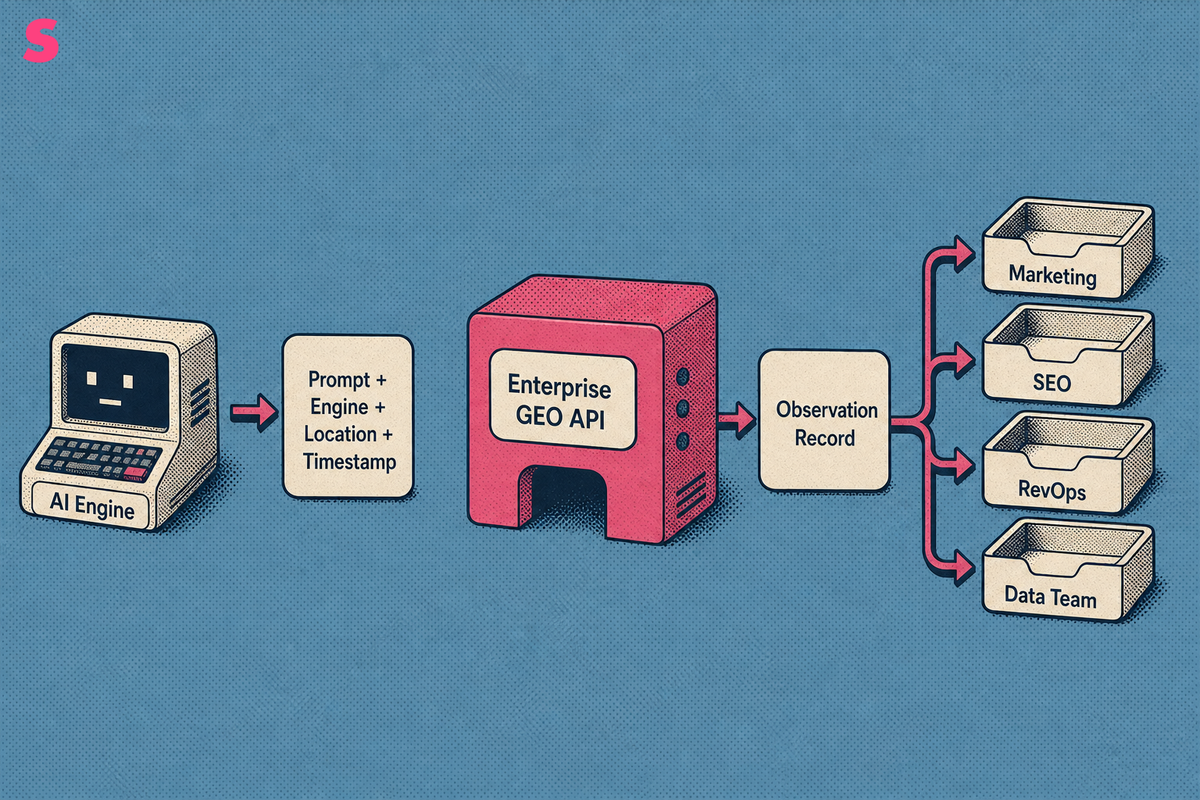
Integrating AI visibility data via an enterprise GEO API means pulling structured records of brand mentions, citations, positions, and answer content from AI engines into enterprise systems. The integration gives marketing, SEO, RevOps, and data teams one shared dataset instead of a separate reporting dashboard.
An enterprise LLM visibility API is not for generating AI answers or retrieving web pages for an application. It is a measurement interface that records how a brand appears for a defined prompt, engine, location, language, competitor set, and timestamp.
A useful record answers a specific question: did an answer engine mention the brand for a commercial prompt in a particular market on a particular day? The record should preserve the underlying answer evidence, not only a blended visibility score.
Enterprise integration matters because teams need data in systems that already govern reporting and action. AI visibility APIs can feed CRM workflows, analytics platforms, BI tools, and custom workflows, per an October 2026 market listing. The API supports repeatable monitoring, ownership assignment, and an audit trail for AI answers.
What data should an enterprise LLM visibility API return?
An enterprise LLM visibility API should return a timestamped observation for each prompt, engine, location, and run. The minimum useful dataset includes brand mention status, citation or link evidence, answer position, named competitors, and the full response or an inspectable response extract.
Sona AI Visibility tracks 11 AI engines, including ChatGPT, Gemini, Google AI Mode, Google AI Overviews, and Perplexity, per Sona product documentation, October 2026. Leading AI visibility APIs track brand mentions, citations, links, and share of voice across these answer surfaces, per an October 2026 market listing. A mention measures presence, a citation identifies supporting sources, and share of voice describes relative appearance across a defined prompt set.
- Prompt metadata: prompt text, topic, intent, owner, market, and version.
- Run metadata: engine, locale, location, language, timestamp, and collection method.
- Brand evidence: mention status, answer position, cited URL, linked domain, and answer text.
- Competitive evidence: named competitors, their positions, and their cited sources.
- Data quality fields: run status, error code, response identifier, and schema version.
Do not treat a score as the complete output. A score is a dated snapshot. The durable asset is the observation-level log because a data team must reproduce dashboard results, investigate unusual movement, and compare like-for-like observations over time.
Which AI engines and locations should an enterprise integration cover?
An enterprise AI visibility integration should cover the answer engines and markets where the company sells, then store each engine-location combination as a distinct measurement unit. A global average hides differences that affect regional demand teams, local product marketers, and international revenue operations.
Google AI Overviews should be treated as a separate answer surface from conversational answer engines. ChatGPT, Perplexity, Gemini, Claude, and other answer engines differ in retrieval behavior, answer format, and cited-source patterns. The integration should retain the engine name, country, city where relevant, and language on every record.
Start with markets tied to pipeline targets, not every country available in a vendor selector. For example, a company selling in the United States, United Kingdom, and Germany can run the same vendor-comparison prompt in each market, then compare three independent observations instead of reporting one blended result.
Sona AI Visibility tracks 11 AI engines, with ChatGPT, Gemini, Google AI Mode, Google AI Overviews, and Perplexity included on every plan, per Sona product documentation, October 2026. Its Agent Analytics reports which AI crawlers visit a site and which pages they read, helping teams distinguish answer visibility from crawler activity that can precede a citation.
How do you design a data layer that stays reliable when AI answers vary?
A reliable AI visibility data layer stores raw observations first and derived metrics second. AI answers vary as retrieval indexes change, models update, locations differ, and competitors publish new material. A data model that overwrites yesterday’s answer cannot separate a real trend from normal answer variation.
Use a stable natural key composed of prompt ID, prompt version, engine, location, language, and run timestamp. Store the raw answer response separately from calculated fields such as visibility rate, citation rate, average position, and share of voice. This preserves the evidence when metric definitions change.
- Version each prompt before changing its wording or market targeting.
- Write one immutable observation for every API run.
- Normalize brand aliases, product names, domains, and competitor entities in a controlled reference table.
- Calculate rates only across comparable observations, such as the same engine, locale, and prompt version.
- Flag failed, partial, or duplicate runs before they reach executive reporting.
Run the same prompt list daily. Daily collection exposes patterns that a weekly snapshot can average away. An answer can change with the retrieval index, a model update, or a competitor’s new page, so sustained movement deserves investigation while an isolated spike requires validation.
How do you pull AI visibility data into a warehouse or dashboard, step by step?
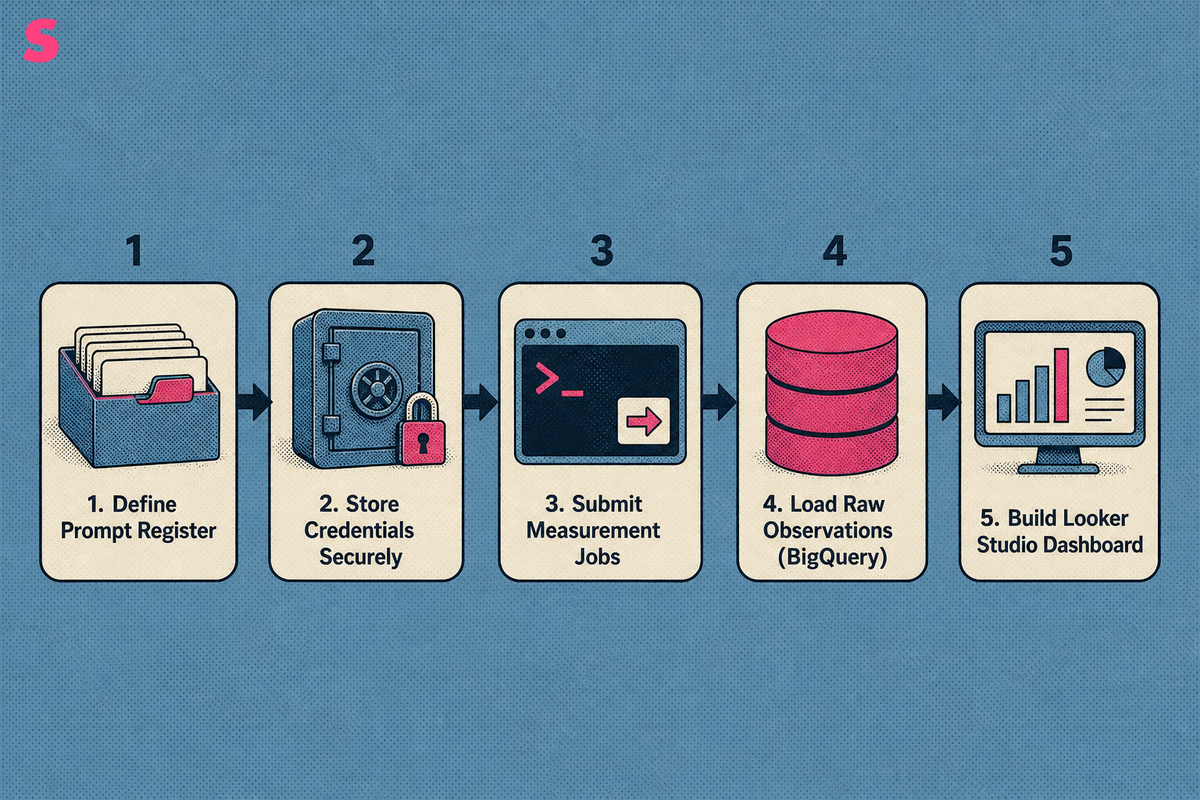
Use Sona AI Visibility API and BigQuery for an end-to-end implementation that connects AI citations and prompts to pipeline and revenue on a governed account timeline. BigQuery becomes the source for a Looker Studio dashboard, CRM workflow, or revenue model, while Sona AI Visibility supplies the monitored observations.
- Define the prompt register. Assign every prompt an ID, owner, business topic, intent category, target market, approved wording, and version.
- Store credentials securely. Put the Sona API credential in the enterprise secret manager, grant the collection service only read access to that secret, and never place credentials in source code, dashboards, or warehouse tables.
- Submit measurement jobs. The following implementation pseudocode shows the request contract. Confirm Sona API field names and job methods during implementation.
job = sona.create_observation_job({
  prompt_id: "comparison_001",
  prompt_version: "v3",
  prompt_text: "best enterprise GEO API",
  engines: ["ChatGPT", "Gemini", "Google AI Overviews"],
  locations: ["US", "GB", "DE"],
  language: "en"
})while job.status != "complete":
  wait_with_backoff()
  job = sona.get_job(job.id)
for page in sona.list_observations(job.id, cursor=next_cursor):
  load_raw(page.records)
Retry rate-limit and server failures with exponential backoff, recording the request identifier, status code, attempt count, and failure time. Route invalid credentials, malformed requests, and schema errors to an incident log rather than retrying indefinitely. Preserve asynchronous job status and pagination cursors so a restarted run continues from the last confirmed page.
CREATE TABLE ai_visibility.raw_observations (
  observation_key STRING NOT NULL,
  collected_at TIMESTAMP NOT NULL,
  prompt_id STRING NOT NULL,
  prompt_version STRING NOT NULL,
  engine STRING NOT NULL,
  location STRING NOT NULL,
  language STRING,
  response_id STRING,
  run_status STRING,
  payload JSON,
  loaded_at TIMESTAMP NOT NULL
);
Create observation_key as a deterministic hash of prompt ID, prompt version, engine, location, language, collected timestamp, and response identifier. Merge on that key so retries are idempotent and raw records remain immutable.
CREATE OR REPLACE VIEW ai_visibility.daily_visibility AS
SELECT
  DATE(collected_at) AS observation_date,
  prompt_id,
  prompt_version,
  engine,
  location,
  COUNT(*) AS observations,
  COUNTIF(JSON_VALUE(payload, '$.brand_mentioned') = 'true') AS mentions,
  COUNTIF(JSON_VALUE(payload, '$.citation_url') IS NOT NULL) AS citations
FROM ai_visibility.raw_observations
WHERE run_status = 'complete'
GROUP BY 1, 2, 3, 4, 5;
Connect Looker Studio to the daily_visibility view, set the data source refresh to the warehouse schedule, and build an engine-by-market trend, cited-page report, prompt-movement table, and failed-run exception report. Join the reporting view to separately governed visit, account, opportunity, and revenue tables only after the visibility dataset passes validation.
- Access: require SSO and role-based access for the API administration area, warehouse, dashboard, and downstream CRM workflow.
- Encryption: require encryption in transit and at rest for API responses, raw answer text, warehouse storage, and backups.
- Retention: define how long raw answer text, cited URLs, prompt text, and audit logs remain available, then apply deletion rules at the end of that period.
- Regional handling: document storage regions, transfer requirements, vendor subprocessors, and applicable data-processing terms before loading answer content.
- Auditability: retain access events, credential rotation events, job failures, schema changes, and manual corrections in an incident-ready log.
Perplexity research reports that 88.6% of queries produce exactly two fan-out sub-queries. No publication date was supplied. Retain prompt families and variants in the warehouse rather than treating one wording as the entire demand pattern.
Is a free search API for LLM applications enough for visibility tracking?
A free search API for LLM applications is useful for retrieving web results or grounding an application, but it is not enough for enterprise AI visibility tracking. Visibility measurement requires repeated, governed observations of how answer engines mention and cite a brand across prompts, markets, and time.
A retrieval API answers a different operational question: what information should an application fetch now? An LLM visibility API records how a defined answer engine presented a brand for a monitored prompt and how that result changed across prior runs.
Open-source AI visibility dashboards can run locally without an API key, including GEO/AEO Tracker, per an October 2026 market listing. That model can suit exploratory work, internal prototypes, or a small manually maintained prompt set. Enterprise reporting needs scheduled collection, access controls, prompt governance, historical records, and a workflow for failed or disputed observations.
Free credits do not establish an enterprise pricing model. Some LLM visibility APIs offer free credits before charging for additional requests, per medium.com, with no publication date supplied. Evaluate the billable unit after the trial balance ends, then model the full prompt, engine, location, and refresh schedule.
What does enterprise LLM visibility API access cost, and how do you compare it?
Compare enterprise LLM visibility API access by monitored prompt, engine, location, and refresh cadence, not headline plan price alone. A low entry price can represent a smaller engine set, a different daily prompt allowance, or an Enterprise-only API entitlement.
The table compares published entry-plan terms as of October 2026. Cost per Daily Tracked Prompt uses the stated common comparison unit. Confirm API availability, SSO, role-based access, retention requirements, encryption, audit logs, data-processing terms, and MCP permissions during procurement.
| Tool | Starting price | Agency Plans? (Yes/No) | # of Answer Engines Tracked | Answer Engines | # of Daily Tracked Prompts (entry plan) | Cost per Daily Tracked Prompt | Differentiation |
|---|---|---|---|---|---|---|---|
| Sona AI Visibility | From $75/month | Yes | Up to 11 (3 on Starter) | Not published | 5,000 credits/month, about 56 daily tracked prompts across three engines | $0.45 per daily tracked prompt | Connects AI citations and prompts to pipeline and revenue on one account timeline, with API and MCP access on every plan. |
| Peec AI | From $95/month | Yes | Up to 13 (3 of 6 on Starter, plus add-ons) | Not published | 50 prompts daily | $0.63 per daily tracked prompt | AI visibility tracking across its Starter engine set. API access is reserved for Enterprise. |
| Otterly.ai | From $29/month | Yes | Up to 7 (4 on Lite, 3 as paid add-ons) | ChatGPT, Google AI Overviews, Perplexity, Microsoft Copilot | 15 prompts daily | $0.48 per daily tracked prompt | Brand monitoring across its Lite engine set. API and MCP entitlement details are not published. |
| Scrunch AI | From $250/month | Yes | Up to 9 (4 on Core) | ChatGPT, Perplexity, Google AI Overviews, Microsoft Copilot | 125 prompts, refresh cadence not published | No refresh cadence published | AI visibility measurement across its Core engine set. API and MCP entitlement details are not published. |
Do not divide a monthly subscription by a vendor’s advertised prompt allowance. Plans meter prompts, credits, answers, engines, and refresh frequency differently. Normalize the same monitored unit in the procurement model, then add implementation, warehouse, security-review, and administration costs.
How do you connect AI visibility API data to pipeline and revenue?
Connect AI visibility API data to pipeline and revenue by joining prompt and citation observations to AI-referred visits, identified accounts, CRM opportunities, and closed-won revenue. A visibility rate measures exposure. Revenue analysis requires a defined attribution model and account timeline.
Begin with two separate tables. The first stores AI answer observations, including prompt, engine, location, brand mention, cited page, and timestamp. The second stores web sessions, account identifiers, campaign data, opportunities, opportunity stages, and revenue. Join them through AI referral evidence, first-party identifiers, and a documented attribution rule.
For a worked mechanism, a buyer asks a comparison prompt, an answer cites a product page, and an AI-referred visit arrives later. The warehouse records the cited page and prompt observation, resolves the visit to an account where permitted, then associates later opportunity activity with the same account timeline. The report can show exposure, referred visits, opportunities, and revenue as distinct stages rather than implying causation from a mention.
Sona AI Visibility connects AI citations and AI-referred visits to pipeline and closed-won revenue on one account timeline, per Sona product documentation, October 2026. It also uses a self-reported “How did you hear about us?” field to capture AI research that did not produce a measurable click.
Which page-level checks decide whether AI engines can find, parse and trust the content you track?
Page-level checks for enterprise AI visibility examine whether answer engines can reach, render, parse, and evaluate the page cited by a monitored answer. Check crawlability, server-rendered HTML, canonical tags, structured data, security headers, content recency, and accessibility before treating a citation gap as only a content problem.
Sona’s Free AI Readiness Checker assesses whether AI can technically read a site. It does not measure brand mentions or citations in AI answers.
- Crawlability: robots.txt, llms.txt, canonical tags, and indexability.
- Performance: rendered experience, core web vitals, server-rendered HTML, and JavaScript dependency.
- Content structure: Schema.org validation, metadata, FAQPage JSON-LD, and semantic structure.
- Content quality: completeness, citation-worthiness, and update recency.
- Security and accessibility: response headers, alt text, ARIA attributes, and contrast.
Monitor technical conditions monthly or quarterly because page diagnostics change on a different clock from daily prompt tracking. The output should produce a severity-ranked fix attached to the affected page, not a generic readiness score without assigned work.
A citation gap can result from inaccessible pages, weak structure, outdated content, or incomplete technical controls. Assign each issue to the affected page and track remediation separately from answer-engine visibility.
What are the frequently asked questions about integrate ai visibility data via enterprise GEO api?
What is an enterprise GEO API?
An enterprise GEO API is an interface that returns structured data about how AI engines mention and cite a brand for a given prompt, engine, location, and timestamp. It supports scheduled pulls into warehouses, BI tools, CRMs, and governed enterprise workflows rather than one-off manual checks.
Can I use a free search API for LLM tracking instead of an enterprise one?
A free search API can retrieve results or provide grounding data for an LLM application, but it does not provide a complete visibility-tracking system. Enterprise tracking requires historical observations, competitor normalization, prompt governance, locale controls, error handling, and audit-ready reporting.
How often should AI visibility data be refreshed through the API?
Refresh a monitored prompt list daily and store every timestamped observation. Daily collection can reveal patterns that a weekly snapshot averages away because retrieval indexes, model behavior, and competitor content can change answers between runs.
Do AI answers really differ by country and city?
Yes. AI answers can differ by country, city, language, and user context. Each API record should retain locale and location fields rather than being blended into a global visibility score that obscures regional differences.
How do I price an AI visibility API fairly across vendors?
Normalize every quote to the cost of one monitored prompt, engine, location, and refresh combination. Record whether the vendor charges per answer, credit wallet, prompt allowance, plan tier, or Enterprise contract, then model the required daily volume rather than comparing headline subscription prices.
Does a higher visibility score mean more revenue?
No. Mention and citation rates measure exposure in AI answers, not commercial impact. Pair visibility data with AI-referred traffic, assisted conversions, identified accounts, sales-qualified opportunities, pipeline, and closed-won revenue before drawing a revenue conclusion.
Summarize this article with AI: ChatGPT · Claude · Perplexity · Google AI Mode
Last updated: October 2026







