


Improve brand visibility in AI search engines by making your brand the explicitly named answer to buyers’ questions, fixing crawler access, publishing answer-first pages, and earning consistent third-party mentions. Follow that sequence because every step relies on the previous one. Sona AI Visibility connects resulting prompts and citations to pipeline and revenue, while tracking the preceding AI crawler activity.
What does brand visibility in AI search engines mean, and what do you need before step one?
Brand visibility in AI search engines means an AI answer names, cites, or recommends your company or product for a buyer’s question. A linked page alone is insufficient. In October 2026, 61.7% of AI citations were ghost citations, meaning a source page was linked but the brand was not named in the answer.
Measure visibility across ChatGPT, Perplexity, Gemini, Claude, and other answer engines separately. Each system retrieves, summarizes, and presents sources differently, so a strong result in one engine does not establish broad visibility.
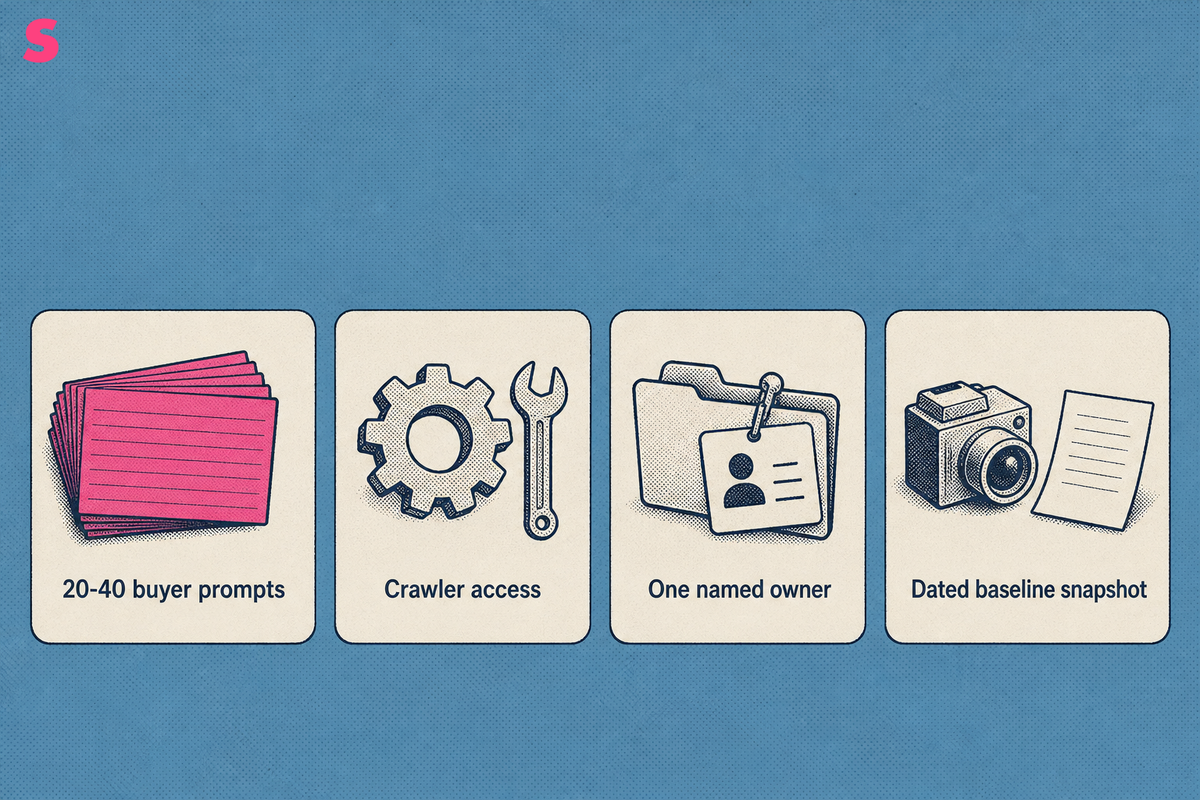
Set the operating conditions before making changes:
- A fixed panel of 20–40 buyer prompts, grouped by commercial intent and buying stage.
- Access to robots.txt plus CDN, WAF, or server settings.
- One named owner for technical fixes, content, and testing.
- A dated baseline snapshot of every target engine’s answers.
In what order should you work when you want visibility across several AI search engines?
Follow a 90-day sequence: establish technical access and entity facts first, publish answer-first content next, then earn third-party validation and test each engine. Pages that cannot be crawled cannot be cited. Content that conflicts with product facts confuses retrieval. Outside mentions become useful only after AI systems can connect them to one clear entity.
| Phase | Days | Action | The question it answers | Sign it is done |
|---|---|---|---|---|
| Technical access and entity facts | 1–30 | Remove crawler barriers, confirm indexability, and standardize company and product descriptions. | Can answer engines reach the site and identify the company correctly? | Key pages are accessible, facts match across owned properties, and the prompt baseline is dated. |
| Answer-first content | 31–60 | Create or revise pages for the highest-intent prompt clusters. | Does each priority question have a direct, citable answer? | Priority pages answer buyer questions with definitions, evidence, and comparison structure. |
| Validation and testing | 61–90 | Strengthen review profiles, third-party mentions, and per-engine testing. | Do independent sources reinforce the same brand entity? | Prompt snapshots show named mentions, citations, or recommendations in target engines. |
AI search is unstable at the individual-answer level, but the operating method is stable. Run the same prompt list daily to distinguish sustained movement from a one-day spike. A change that holds for four days is a trend. A one-day spike is noise.
Traditional SEO remains the base layer, but it does not settle the question. In October 2026, only 17%–38% of Google AI Overviews citations reportedly came from pages in the traditional top 10. Yet a September 2026 analysis reported that AI cited 90.0% of traditional top-10 results, compared with 49.3% of results outside the top 10. Both findings can be true: rankings support retrieval, while extractable answers, entity clarity, and source selection determine citations.
How do you make your site crawlable and retrievable for AI search engines?
Make key pages accessible to AI crawlers before changing content. Traditional technical SEO remains the retrieval base layer: answer engines need pages that can be fetched, rendered, canonicalized, and indexed before selection as evidence.
- Check robots.txt for blocked retrieval crawlers and review CDN or WAF bot-protection rules.
- Confirm that priority pages return server-rendered HTML rather than depending on JavaScript for core copy.
- Validate XML sitemaps, canonical tags, indexability, and status codes for product, category, pricing, and documentation pages.
- Review server logs for crawler requests to the pages that should support priority prompts.
Technical success appears in server logs: AI crawler requests reach key pages and return usable responses. Sona AI Visibility tracks AI crawler activity from server logs or a lightweight edge worker, which helps teams see which pages crawlers reach without relying on a JavaScript tag.
A common failure is a bot-protection rule that silently blocks AI crawlers at the CDN. Identify the blocked user agent or verified bot request, adjust the relevant WAF or rate-limit rule, and check logs again after deployment. Keep the work focused on retrieval access rather than a broader content audit.
How do you make your brand and product facts consistent so AI engines identify you correctly?
Give AI systems one stable description of the company, audience, category, and product. Entity clarity comes from using the same factual language across the website, documentation, profile pages, review sites, and social profiles, then supporting those facts with Organization and Product schema.
Create a canonical fact sheet for internal use. Define the company, target audience, product names, primary use cases, feature descriptions, pricing language, and category terms. Use the fact sheet when editing product pages, knowledge-base articles, comparison pages, executive bios, and external listings.
Clear descriptive text matters. Higoodie.com states that inserting text into product information pages increases the chance that an LLM recommends the brand. A product page should explain the product’s purpose, buyer, workflow, and evidence in direct language rather than relying on screenshots or slogans.
The most common failure is conflicting pricing, category, or feature claims between the site and third-party listings. Fix the owned source first, then submit corrections to profiles and review pages. Sona AI Visibility can connect prompt-level visibility to the pages and sources involved, helping teams identify where inconsistent product facts affect answer coverage.
How should you structure pages so AI engines can quote and recommend them?
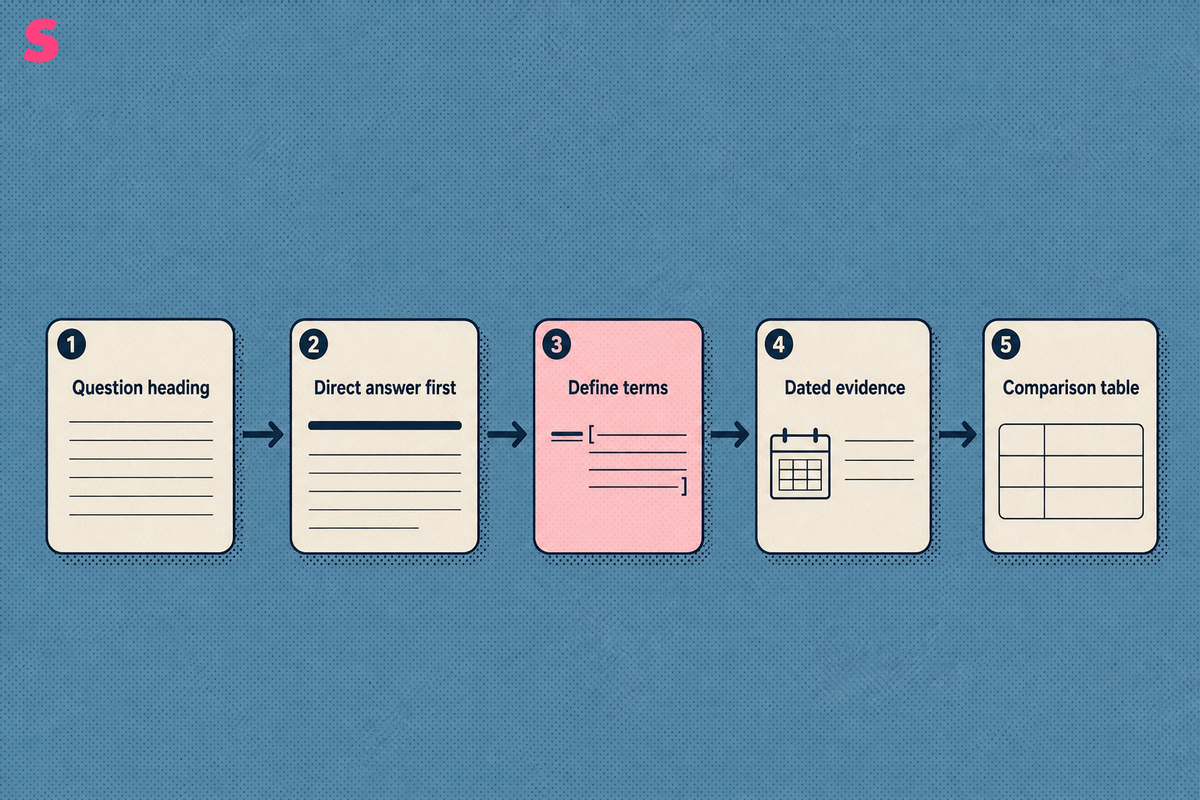
Structure each priority page around the buyer question, then answer it in the opening sentences. AI retrieval benefits from plain definitions, explicit claims, dated evidence, comparison tables, descriptive internal links, and visible revision dates.
- Use a question-style heading that matches a real buyer prompt.
- Give the direct answer immediately, then add the reasoning and evidence.
- Define specialized terms before using them repeatedly.
- Attach dates and named sources to statistics and factual claims.
- Use tables when readers need to compare options, requirements, or workflows.
Research from Princeton University GEO researchers on improving visibility in generative-engine responses supports sourced statistics and quotations. For a B2B site, the practical implication is straightforward: make each factual unit easy to extract, verify, and attribute.
Writing for AI can improve human readability through clearer definitions, verifiable claims, and structured comparisons. Keyword stuffing does the opposite. Refresh high-priority pages monthly, re-check factual claims, and run a fuller technical review quarterly. Sona AI Visibility includes AI Search Insights, which surfaces buyer prompts and shows how owned pages perform in AI answers.
How do reviews, comparison pages and third-party mentions earn recommendations in AI answers?
Reviews, fair comparison pages, credible coverage, community participation, and social profiles give answer engines independent evidence about a brand. Third-party validation supports recommendations because the same company and product claims appear beyond the company’s own site.
In an analysis updated in October 2026, branded web mentions reportedly had a 0.664 correlation with appearances in Google AI Overviews, compared with 0.218 for backlinks. Correlation does not prove causation, but the finding supports prioritizing credible mentions alongside link acquisition.
- Maintain complete review profiles and respond to reviews with accurate product facts.
- Publish original data, implementation guidance, and detailed documentation that publishers can cite.
- Build relationships with credible editors, analysts, customers, and community contributors.
- Create comparison pages that describe alternatives fairly and clarify the buyer fit.
Independent coverage cannot be dictated. Companies can improve the odds through original research, useful documentation, and credible publisher relationships. Third-party validation belongs after entity clarity because outside references need one consistent company, product, and category definition to reinforce.
Which tactics fit Google AI Overviews, ChatGPT, Perplexity and agent-style systems?
Use the same factual foundation across AI search scenarios, then test how each system responds to page structure, source type, and prompt framing. Google AI Overviews, conversational assistants, product recommendation interfaces, and agent systems can expose different retrieval behavior, so treat each tactic as a testable hypothesis.
| Scenario | What the engine tends to pull from | The tactic to prioritize | Concrete page or asset to change |
|---|---|---|---|
| Google AI Overviews | Search-indexed pages and cited web sources. | Strengthen crawlability, direct answers, and cited factual claims. | A category guide with a definition, comparison table, and dated sources. |
| Conversational assistants | Retrieval sources selected for the user’s conversational prompt. | Build prompt-specific pages that answer comparison and implementation questions. | A product comparison page with buyer criteria and explicit product facts. |
| Shopping or product recommendations | Product facts, reviews, and structured information. | Align product descriptions, pricing language, and review profiles. | A product information page with descriptive copy and Product schema. |
| Agent systems | Pages fetched on a user’s behalf. | Prioritize accessible HTML, clean canonicals, and bot access. | A documentation or pricing page tested against CDN and WAF rules. |
Google AI Overviews merit attention because organic click-through on queries with Google AI Overviews reportedly rose from 1.3% to 2.4% between December 2025 and February 2026, according to figures published in October 2026. Test the same prompt panel across systems rather than assuming that a page cited by Google AI Overviews will also appear in ChatGPT or Perplexity.
Sona AI Visibility connects citations to pipeline and revenue on one account timeline, while tracking AI crawler and agent activity that determines whether key pages can enter retrieval.
How do you test whether each change moved your visibility in AI answers?
Test AI visibility with the same fixed prompt panel in each answer engine every day, and preserve dated snapshots. Record whether the brand was named, cited, recommended, or linked only as a ghost citation. Then map the result to the page or third-party source that appears to support the answer.
Daily testing captures shifts caused by retrieval-index changes, model updates, and competitor publishing. Review the resulting pattern quarterly while retaining the daily record.
Do not dismiss AI search because referrals appear small in conventional analytics. In an August 2026 survey, 19% of respondents attributed more than 5% of site revenue to AI search, up from 8%. The same August 2026 survey found that 92% tracked AI visibility and citations, up from 78%.
Sona AI Visibility treats mention tracking as the baseline, then connects prompts and citations to pipeline and revenue while tracking the crawler activity behind AI-referred visits. A dated snapshot is useful, but a comparable series of snapshots shows whether a change held long enough to merit further work.
What does it look like when this works, and what do you do when visibility does not move?
Successful AI visibility means the brand is named, not merely linked, for target prompts in at least some answer engines, and each result can be traced to a specific page or source. The objective is repeatable coverage on commercial questions, not a single favorable answer.
- Cited but not named: Add explicit company and product statements beside the answerable claim, then test whether the brand becomes visible in the response.
- Visible in one engine only: Compare prompt wording, cited sources, and page structures by engine, then adjust the asset that best matches the missing scenario.
- Pages blocked or stale: Recheck robots.txt, CDN controls, canonicals, rendering, and factual revision dates.
- Facts differ across the web: Correct owned pages first, then update listings, profiles, review responses, and partner materials.
Monitoring which AI answers mention a brand is only half the job. The other half is connecting those mentions to accounts, pipeline, and revenue. Sona AI Visibility closes that loop by connecting AI citations and AI-referred activity to an account timeline alongside pipeline and closed-won revenue.
Repeat the 90-day cycle after major product changes, category shifts, or sustained prompt movement. Keep the prompt panel stable long enough to identify direction, while adding buyer questions from sales calls, support tickets, and market language.
What are the frequently asked questions about AI search visibility?
How long does it take to improve brand visibility in AI search engines?
Plan for a 90-day first cycle. Technical fixes can appear in crawler logs first, while changes in generated answers often appear later. No fixed timeline applies because answer engines change retrieval and response behavior. Dated snapshots show whether visibility is moving in the intended direction.
Do I still need traditional SEO to appear in AI search?
Yes. Traditional SEO supplies crawlability, indexability, and ranking signals that support retrieval. AI answers also depend on explicit brand mentions and extractable content. In October 2026, only 17%–38% of Google AI Overviews citations reportedly came from traditional top-10 pages, while a September 2026 analysis reported that AI cited 90.0% of top-10 results versus 49.3% outside the top 10.
Can a brand control what AI engines say about it?
No. A brand can control its own pages, documentation, structured facts, and product descriptions. It can influence third-party coverage through original research, credible publisher relationships, complete review profiles, and accurate review responses. AI engines still choose which sources and claims appear in each answer.
Is AI search too unstable to optimize?
Individual answers change, but a fixed prompt panel with dated snapshots for each engine still reveals directional movement. Compare repeated results rather than isolated answers. Daily testing distinguishes movement that holds for several days from a short-lived response change.
Are AI referrals big enough to justify a program?
Referral volume can be modest while AI visibility shapes consideration before a click. In the August 2026 survey, 19% of respondents attributed more than 5% of site revenue to AI search, up from 8%, and 69% reported an AI-search-optimization budget, up from 38% in 2025.
Will writing for AI engines make content worse for human readers?
No, provided the work focuses on clearer definitions, direct answers, verifiable claims, dated evidence, and structured comparisons. Those elements improve human comprehension. Avoid keyword stuffing because it weakens readability without making the underlying information more reliable.
Summarize this article with AI: ChatGPT · Claude · Perplexity · Google AI Mode
Last updated: October 2026







