


AI visibility scores for enterprise marketing teams show how frequently and prominently a brand features in AI responses across engines including ChatGPT, Gemini, Perplexity, and other answer engines. A combined score can mask differences by prompt, model and region, so request each vendor’s prompt set, sample size and engine mix. Sona AI Visibility links prompts and citations with pipeline and revenue, while monitoring AI crawler and agent activity, connecting the score to business results.
What is an AI visibility score, and how does it differ from SEO rankings?
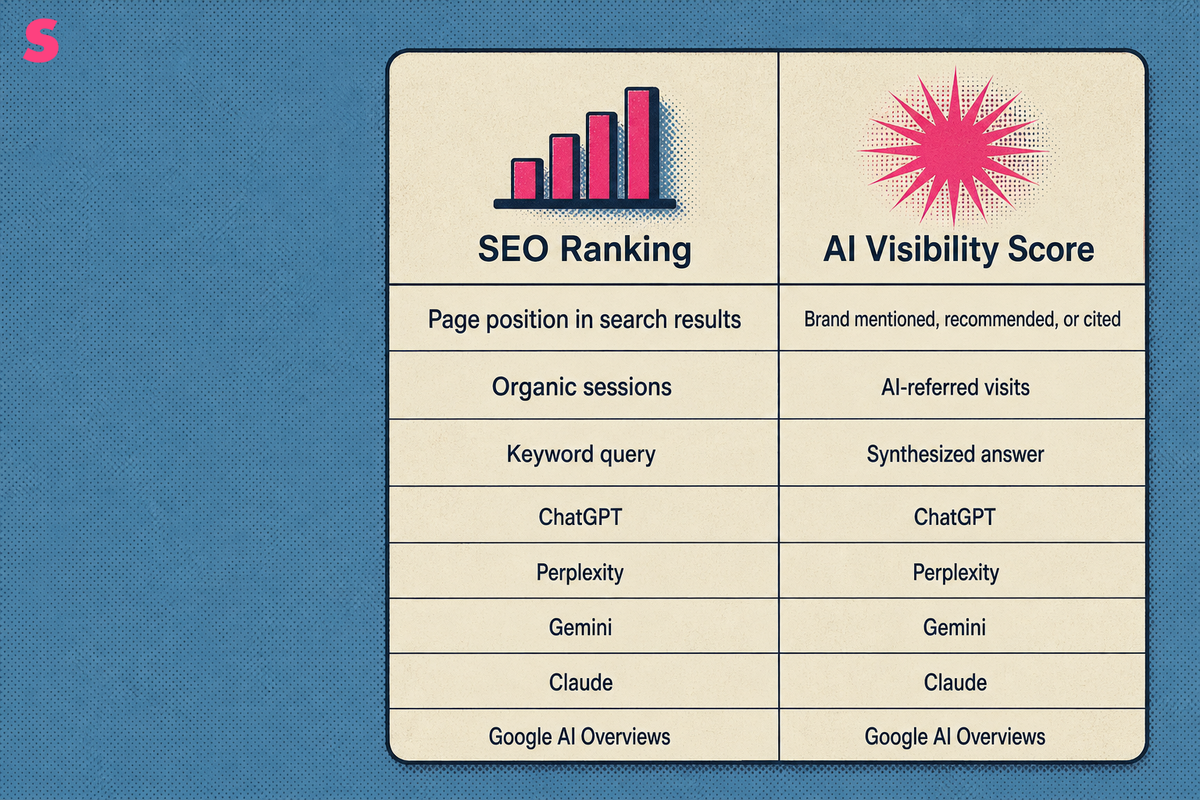
Enterprise marketing teams use an AI visibility score to measure how often and how prominently a brand appears in AI-generated answers for relevant prompts. An SEO ranking records a page’s position in a search result. An AI visibility score records whether an answer engine mentions, recommends, or cites the brand.
A buyer can ask ChatGPT, Perplexity, Gemini, Claude, or another answer engine for a vendor recommendation, comparison, or implementation plan without generating a conventional search click. Sona AI Visibility connects citations and AI-referred visits to pipeline and revenue on one account timeline. Traditional SEO reporting can show organic position and sessions while missing the answer that shaped the buyer’s shortlist.
AI visibility scores for enterprise marketing teams are channel-health measures, not replacements for keyword rankings. SEO asks whether a page ranks for a query. AI visibility asks whether a brand appears in a synthesized answer, which sources support that answer, and whether the resulting visit or self-reported research contributes to pipeline.
- SEO ranking: the position of a page in a conventional search result.
- AI visibility score: the frequency and prominence of brand appearances across relevant prompts and answer engines.
- AI citation: evidence, often a webpage or source, used in an AI-generated answer.
- AI referral traffic: visits that arrive after a user follows a link from an answer engine.
Google AI Overviews adds another reporting surface. A page can hold a strong conventional organic position but receive little citation activity in Google AI Overviews. A different page can become a cited source despite weaker traditional rankings. Enterprise teams need both views because they measure different buyer journeys.
How is an AI visibility score calculated, and why can't vendor scores be compared directly?
An AI visibility score is calculated from a defined prompt set, a defined set of answer engines, and rules for counting brand mentions, recommendations, positions, or citations. Two platforms can label their output as a score from 0 to 100 while measuring different prompt populations and weighting each answer differently.
A defensible enterprise score begins with a prompt inventory. Separate branded prompts, category prompts, competitor-comparison prompts, implementation questions, and high-intent buying questions. Record whether the brand appeared, where it appeared, whether it was recommended, and whether the answer cited the company’s content or another source.
Vendor scores cannot be compared directly unless the underlying prompt list, engine sample, response collection method, weighting formula, region, language, and citation rules are disclosed. A platform that tests a small branded prompt list will produce a different score from one that tests category prompts across several buyer stages. The label is the same, but the denominator differs.
A brand-level score does not identify the work required. Enterprise teams need to know which prompts created the score and which sources shaped each answer. Sona AI Visibility uses AI Search Insights to show the prompts buyers ask and the sources answer engines cite, while connecting citations to pipeline and revenue on one account timeline.
Ask every platform provider to document four items before using its score in a board report:
- The exact prompts included in the calculation.
- The answer engines, regions, and languages sampled.
- The rule used to count mentions, recommendations, positions, and citations.
- The refresh schedule and whether historical responses remain available for review.
Which metrics should enterprise marketing teams track beyond the headline score?
Enterprise marketing teams should track mention rate, recommendation rate, prompt coverage, share of voice, model-specific visibility, citations, sentiment, and AI referral traffic alongside the score. A headline score summarizes performance. Supporting metrics identify whether the issue is coverage, authority, competitive pressure, or conversion.
Brand Mention Rate measures how often the brand appears. Recommendation Rate measures how often an answer engine actively suggests the brand. Prompt Coverage shows the portion of the tracked prompt set where the brand appears. Share of Voice compares the brand’s presence with competitors across the same prompt set.
Model-specific visibility matters because answer engines do not return identical answers. A brand can appear consistently in one engine and rarely in another. Breakouts by model, country, language, business unit, product line, and buying stage prevent an enterprise average from concealing a regional or portfolio-level failure.
- Mentions: whether the brand appears in the answer.
- Recommendations: whether the answer presents the brand as a suggested option.
- Citations: whether the enterprise website supplies evidence for the answer.
- Share of Voice: the brand’s visibility relative to tracked competitors.
- Referral traffic: AI-referred visits that can be evaluated alongside conversion and pipeline data.
Martech.org notes that a single AI visibility score can hide whether the brand appears in an answer, whether its website supplies the evidence, and how results differ by prompt, model, and region. Enterprise dashboards should preserve those dimensions rather than flattening them into one executive number.
How do you set up AI visibility measurement for the first time?
Enterprise AI visibility measurement starts with governance, a representative prompt library, a baseline score, and a reporting owner. The first deployment should answer a narrow operating question: where does the brand appear today for high-value buyer questions, and which pages or sources influence those answers?
- Define the business units, markets, languages, products, and competitors in scope.
- Build a prompt library from sales calls, search demand, product messaging, support themes, and competitive research.
- Tag every prompt by intent, buying stage, product line, geography, and accountable team.
- Capture a dated baseline across the answer engines that matter to the buying audience.
- Connect AI referral and conversion data to existing marketing measurement and CRM reporting.
Allocate the initial library across every in-scope buyer stage and prompt archetype: problem definition, approach comparison, vendor comparison, implementation, security, pricing, migration, and local-language questions. The approved research does not establish a universal initial prompt count. Expand the governed sample when a product, region, language, or buyer stage enters scope, rather than allowing one high-volume segment to determine the score.
| Measurement stage | Enterprise owner | Primary output | Decision supported |
|---|---|---|---|
| Scope definition | Marketing operations | Markets, products, competitors, and reporting rules | Which business units are included |
| Prompt design | SEO and content leadership | Tagged prompt library | Which buyer questions matter |
| Baseline audit | Demand generation | Dated score, citations, and source record | Where visibility is weakest |
| Revenue connection | RevOps | AI-referred visits, accounts, and pipeline view | Which visibility work merits investment |
Sona AI Visibility can support the baseline with prompt tracking, source visibility, and attribution for AI-referred visits.
Keep the initial prompt library governed. An enterprise with several business units can create a misleading average when one large, low-intent prompt group outweighs a smaller set of high-value commercial questions. Use tags and reporting cuts that reflect the organization’s revenue model.
How does prompt selection bias change an AI visibility score?
Prompt selection bias changes an AI visibility score by changing the questions used to calculate it. A score built from branded prompts will often look stronger than a score built from unbranded category, comparison, migration, integration, and pricing prompts that buyers use before they know the brand.
Enterprise teams should treat the prompt list as a research sample, not a keyword dump. Product marketing teams may emphasize category language, while sales teams hear implementation objections and procurement teams encounter comparison questions. Each source exposes a different part of the buyer journey.
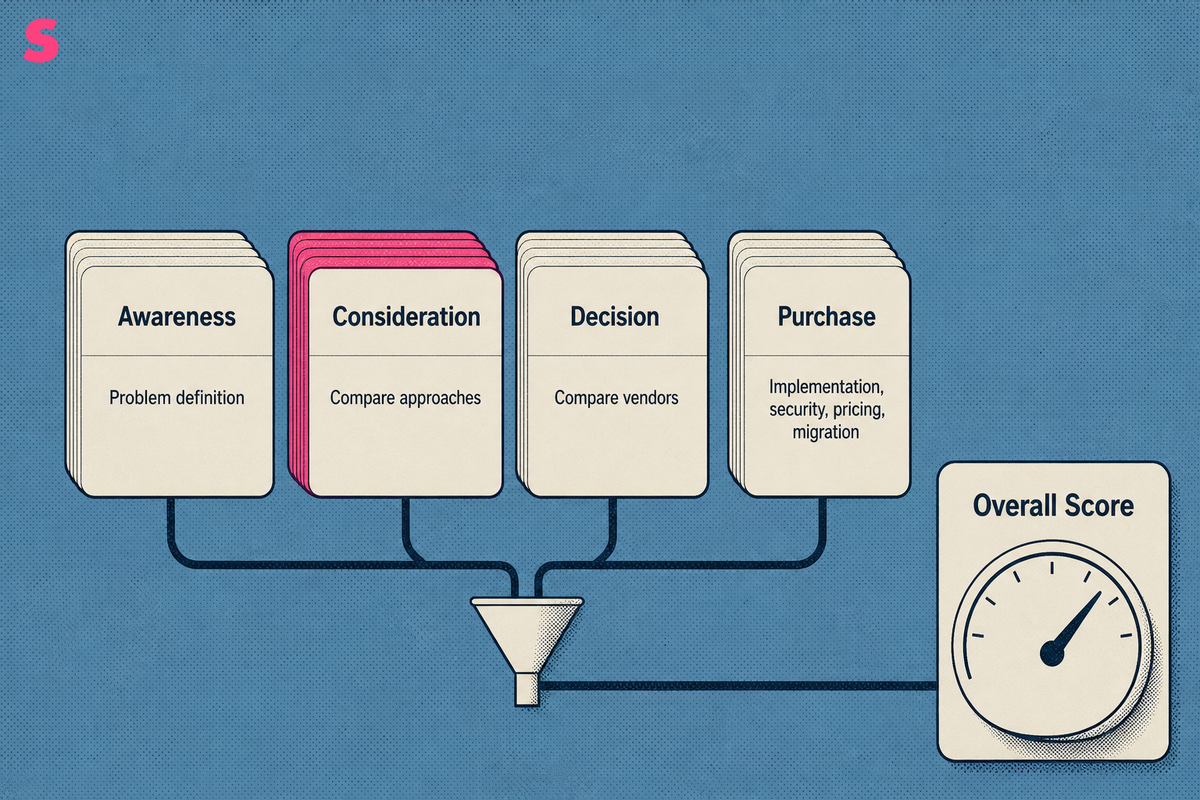
Use a balanced prompt portfolio. Include awareness prompts that define a problem, consideration prompts that compare approaches, decision prompts that compare vendors, and purchase prompts that ask about implementation, security, pricing, or migration. Report each segment separately before calculating an overall score.
Sona AI Visibility supports this operating model by grouping prompts into topics and recording buying stage, intent, visibility, position, mentions, and share of voice at the prompt level. That structure helps an enterprise distinguish broad awareness from commercial demand instead of treating every appearance as equal.
Prompt selection should also account for regional language and product naming. A global enterprise can appear strongly in its headquarters market while failing to surface for local terminology elsewhere. The remedy is a governed prompt taxonomy with named owners, documented inclusion rules, and scheduled review.
How often should an enterprise re-measure AI visibility: weekly, monthly or quarterly?
Enterprise teams should run the same prompt list daily, review operational movement weekly, review score trends monthly, and conduct a positioning and competitive benchmark review quarterly. Daily tracking provides the resolution needed to separate a sustained answer change from a one-day fluctuation.
An answer engine’s response can change when its retrieval index changes, a model updates, or a competitor publishes new material. Daily tracking reveals patterns that a weekly snapshot can average away.
| Cadence | What enterprise teams review | Primary decision | Why the cadence fits |
|---|---|---|---|
| Daily | Tracked prompt responses, mentions, citations, and changes | Whether a movement is persistent | Preserves answer-level resolution |
| Weekly | Emerging content, source, and competitor patterns | Which team receives a work item | Supports operational prioritization |
| Monthly | Segmented score trend, referrals, and conversion signals | Where budget and content effort move | Creates a stable management view |
| Quarterly | Technical re-audit, positioning review, and competitive benchmark | Whether the strategy remains valid | Fits broader planning cycles |
The output is a log, not only a score. A score is a dated snapshot. A comparable series of prompt-level observations reveals the trend that an executive score summarizes. Monthly reporting should include the score, the change since the prior period, the prompts responsible for movement, and the accountable action.
What counts as a good AI visibility score for an enterprise?
A good AI visibility score for an enterprise improves across the organization’s high-value prompt set while producing qualified referral, account, or pipeline evidence. No universal threshold exists because the score changes with category maturity, prompt selection, engines, regions, and the competitors included.
A home-services benchmark places an appearance rate of 34.9% or higher at the top-quarter line, per cheers.tech, October 2026. That figure should not become an enterprise SaaS target. Prompt mix, buyer behavior, engine coverage, and competitive density differ too much for one industry benchmark to serve as a general standard.
Set internal targets in layers. Start with coverage for commercial prompts, then recommendation rate for comparison prompts, then citation share for the enterprise website, and finally AI-referred conversion and pipeline. A strong score with no presence in high-intent prompts is weaker than a lower overall score that improves visibility where buyers choose vendors.
Sona AI Visibility connects citations and AI-referred visits to pipeline and closed-won revenue on one account timeline. Enterprise leaders can assess whether higher visibility aligns with commercial outcomes rather than treating mention volume as the final measure of progress.
Report progress against a dated baseline and a defined prompt universe. A target is credible when leadership can see which market, product, prompt segment, and answer engine produced the movement.
Which AI visibility platforms should enterprise marketing teams compare, and what do they cost?
Enterprise marketing teams should compare platforms on answer-engine coverage, prompt capacity, refresh cadence, seat model, agency support, SSO, export capability, query-level analysis, competitive benchmarks, and the ability to connect visibility with business outcomes. Pepper.inc identifies engine coverage, seat models, SSO, data export capabilities, and pricing as core enterprise buying criteria.
The comparison below reflects published plan details as of October 2026. Sona pricing and product figures are from sona.com, October 2026. A platform’s starting price is not a proxy for enterprise readiness because enterprise access, data retention, integrations, and governance requirements often sit above entry plans.
| Tool | Starting price | Agency Plans? (Yes/No) | # of Answer Engines Tracked | Answer Engines | # of Daily Tracked Prompts (entry plan) | Cost per Daily Tracked Prompt | Differentiation |
|---|---|---|---|---|---|---|---|
| Sona AI Visibility | From $75/month, billed annually | Yes | Up to 11 (3 on Starter) | Not published | 5,000 credits/month, about 166 daily tracked prompts on one model or 56 across three | $0.45 per daily tracked prompt | Connects AI citations and prompts to pipeline and revenue on one account timeline |
| Peec AI | From $95/month | Yes | Up to 13 (3 of 6 on Starter, plus add-ons) | Not published | 50 prompts daily | $0.63 per daily tracked prompt | Citation and mention tracking across AI engines |
| Otterly.ai | From $29/month | Yes | Up to 7 (4 on Lite, 3 as paid add-ons) | ChatGPT, Google AI Overviews, Perplexity, Microsoft Copilot | 15 prompts daily | $0.48 per daily tracked prompt | AI search visibility monitoring and GEO audit |
| Scrunch AI | From $250/month | Yes | Up to 9 (4 on Core) | ChatGPT, Perplexity, Google AI Overviews, Microsoft Copilot | 125 prompts | No refresh cadence published | Brand visibility across answer engines |
| AthenaHQ | From $295/month, billed annually | Yes | 11 | Not published | 3,600 credits/month, unlimited prompts | No refresh cadence published | Enterprise AI visibility monitoring |
| PromptWatch | From $95/month | Yes | Not published | Not published | 50 prompts daily | $0.48 per daily tracked prompt | Prompt and response monitoring |
| Goodie | From $295/month | Yes | Up to 14 (5 on Core) | Not published | 110 prompts daily | $0.67 per daily tracked prompt | AI search visibility and brand monitoring |
Smaller AI visibility subscriptions can start at approximately $20–$50 per month, while CRM-integrated and advanced offerings commonly range from $800–$3,000 per month, per business.com, June 2026. Enterprise tiers are frequently custom-priced, so procurement should evaluate data access and operational fit before comparing headline prices.
How should an enterprise team improve its score and report it to leadership?
Enterprise teams should improve AI visibility scores by prioritizing prompts, sources, and pages tied to high-value buyer questions, then reporting visibility and business movement together. Leadership reporting should connect the score to market coverage, competitive position, referral quality, and pipeline evidence.
Start with prompts where the enterprise is absent or poorly represented despite relevant expertise. Review the sources cited in those answers, determine whether the company has a page that directly answers the question, and assign a content, technical, product marketing, or communications owner.
For distribution, identify the third-party sources already cited for priority prompt segments. Determine where expert commentary, original research, partner or customer evidence, and relevant earned coverage should appear. Assign an owner for each source opportunity, then measure whether those sources enter subsequent answer sets for the same governed prompts.
- Prioritize commercial and decision-stage prompts before broad awareness prompts.
- Improve pages that should support a cited answer but are missing from the source set.
- Track whether owned pages become cited after updates.
- Separate brand visibility gains from competitive share-of-voice losses.
- Connect AI-referred visits and self-reported AI discovery to account and pipeline reporting.
Sona AI Visibility shows page-level performance and prompts where a page should appear but does not, helping teams turn a brand score into attached work items. The resulting report can identify the page, the missing prompt, the cited alternatives, and the business owner responsible for the next change.
Leadership reporting should remain concise. Use one executive score, a segmented trend, the most material source and prompt changes, the work completed, and pipeline context. The objective is not to claim that a score caused revenue. It is to show which AI visibility investments are producing measurable buyer access and which require revision.
What are the frequently asked questions about AI visibility scores?
What is an AI visibility score?
An AI visibility score measures how frequently and prominently a brand is mentioned across AI answer engines for relevant industry prompts. The definition varies by platform. One score can emphasize brand mentions, while another also weights recommendation placement, citations, share of voice, or prompt coverage.
Why can one AI visibility score hide important problems?
A single number can conceal whether a brand appeared in the answer, whether its own website supplied the evidence, and how results differ by prompt, model, region, or buyer stage. Martech.org identifies those granular gaps as a central limitation of treating AI visibility as one aggregate metric.
Can AI visibility scores from different platforms be compared?
AI visibility scores from different platforms cannot be compared safely without methodology disclosures. Vendors use different prompt sets, answer-engine samples, weighting rules, response collection methods, regions, and citation definitions. Enterprise buyers should request those disclosures before placing two scores in the same leadership report.
What should enterprise buyers compare when choosing an AI visibility platform?
Enterprise buyers should compare engine coverage, seat models, SSO, data export capabilities, and pricing, per pepper.inc. They should also review query-level analysis, recommendation tracking, citations, competitive benchmarks, refresh cadence, historical data retention, and the ability to connect AI visibility with marketing measurement.
How much do AI visibility platforms cost?
Smaller subscriptions can begin at approximately $20–$50 per month, while CRM-integrated and advanced offerings commonly range from $800–$3,000 per month, per business.com, June 2026. Enterprise tiers often use custom pricing because requirements for governance, integrations, data retention, and account coverage differ.
Are there affordable AI visibility platforms for startups?
Yes. Entry plans started at about $29 per month as of October 2026, with limits on tracked prompts and answer engines. Startups should compare prompt capacity, engine coverage, and refresh cadence before committing.
Summarize this article with AI: ChatGPT · Claude · Perplexity · Google AI Mode
Last updated: October 2026







