AI engine optimization means choosing a fixed set of buyer prompts, running them across ChatGPT, Google AI Overviews, Perplexity, Gemini and Copilot, recording where you are mentioned and cited, then rewriting the source pages those answers pull from. Treat it as a measurement loop rather than a one-time rewrite, and re-run the same prompts on a monthly cadence so changes are attributable. Most trackers stop at mention counts; Sona AI Visibility ties those citations, and the prompts behind them, to pipeline and revenue.
What is AI engine optimization, and how does it differ from SEO, AEO and GEO?
AI engine optimization is the practice of getting your brand named, cited and recommended inside the answers that ChatGPT, Google AI Overviews, Perplexity, Gemini, Claude and Copilot generate. It is measured on a fixed prompt set, not on keyword rankings. The unit of success is a citation in a generated answer, not a blue link.
The labels differ more than the methods. Answer engine optimization (AEO), generative engine optimization (GEO) and AI engine optimization all describe the same work: making a page retrievable, extractable and credible enough that a model selects it as a source. SEO is the parent discipline, and most of its technical foundation still applies.
| Practice | Primary unit of success | Where it is measured | What moves it |
|---|---|---|---|
| Traditional SEO | Ranking position and clicks | Search engine results pages | Links, relevance, technical health |
| AEO | Being the extracted answer | Featured snippets and generated answers | Question-shaped structure, concise answers |
| GEO | Citation inside generated text | ChatGPT, Perplexity, Gemini, Claude | Evidence, entity clarity, source authority |
| AI engine optimization | Mentions, citations and recommendations | A frozen prompt set across engines | All of the above, plus crawler access |
The rest of this guide is a seven-step measurement loop: build a prompt set, baseline it, confirm crawler access, fix existing pages, publish retrieval-worthy assets, connect citations to revenue, then read the result. Run the loop monthly. Change one variable per cycle.
What needs to be in place before step one of AI engine optimization?
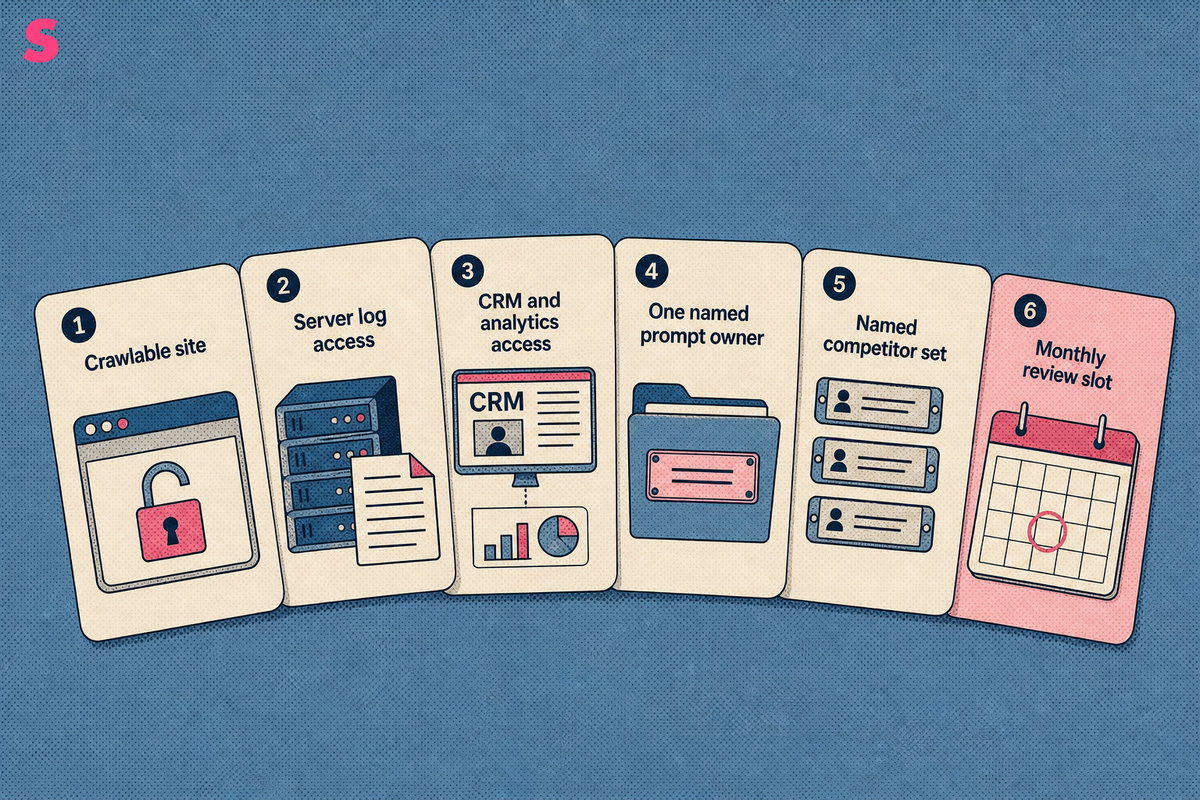
Six prerequisites, each a matter of hours rather than weeks:
- A crawlable site, with robots directives you can read and edit.
- Access to server logs, or permission to deploy a lightweight edge worker.
- CRM and analytics access, so AI-referred sessions can be traced to accounts.
- One named owner for the prompt list. Not a committee.
- A named competitor set, written down before you start measuring.
- A monthly review slot in the calendar, with the owner in it.
The competitor set matters more than teams expect. Share of voice is meaningless without a denominator, and a denominator you redefine every month produces a chart nobody trusts. Name a fixed set of rivals and leave the list alone for a quarter.
A baseline you cannot repeat is worse than no baseline, because it creates false confidence. If you ran the set by hand in one sitting and cannot reproduce the exact wording, engine and date, you have an anecdote. Record the method alongside the result: prompt text, engine, date, and whether the session was logged in.
Step 1: How do you build the prompt set that AI engine optimization is measured against?
Start with a prompt set small enough to run consistently across every engine, drawn from what buyers actually ask, then freeze the wording. The raw material is sales call recordings, objection handling notes, support tickets, win-loss interviews and the questions prospects send before a demo. Keyword volume is a secondary input, because conversational and comparison queries are over-represented in real AI usage.
Split the set across three buying stages so the readings mean something:
- Problem-aware: "why is our direct traffic growing but attribution flat".
- Solution-aware: "how do B2B teams measure visibility in AI search".
- Vendor-comparison: "best AI visibility tools for B2B SaaS".
Vendor-comparison prompts are the smallest group and the most valuable. A high score on an informational, awareness-stage prompt is worth less than a modest score on a commercial, decision-stage one, because only the second sits next to a buying decision.
Tag every prompt with the competitors you expect to appear in its answer. That turns each run into a scoreboard rather than a mention count. Then freeze the wording. A prompt you reword between runs is a new prompt, and the comparison that made the measurement worth taking is gone.
Step 2: How do you baseline mentions and citations across ChatGPT, Google AI Overviews, Perplexity, Gemini and Copilot?
Run the frozen prompt set across every engine your buyers use, on the same day, and log six fields per answer: date, engine, prompt, cited URLs, competitors named, and whether a recommendation was made. Record sentiment and source position too. Those fields are what make run two comparable to run one.
Once tooling is in place, run the list daily. An engine's answer to the same prompt shifts with the retrieval index, a model update, and whatever a competitor published last week. Daily readings expose a pattern a weekly snapshot would have averaged away: a movement that holds across repeated runs is a trend, a single-day spike is not.
Engine coverage decides how much of the market you can see. Sona's own AI visibility archive covers 8 answer surfaces: ChatGPT, Google AI Overviews, Perplexity, Google AI Mode, Gemini, Mistral, Qwen and Claude (Sona's own AI visibility data, September 2026).
| Tool | Starting price | Agency Plans? (Yes/No) | # of Answer Engines Tracked | Answer Engines | # of Daily Tracked Prompts (entry plan) | Cost per Daily Tracked Prompt | Differentiation |
|---|---|---|---|---|---|---|---|
| Sona AI Visibility | Brands from $75/month, agencies from $199/month, both billed annually. 14-day free trial, no credit card. Unlimited seats and API/MCP access on every plan | Yes | 11 | ChatGPT, Gemini, Google AI Mode, Google AI Overviews and Perplexity on standard, plus Claude, DeepSeek, Grok, Copilot, Qwen and Mistral on premium | 5,000 credits/month on Starter 5K, which is about 166 prompts tracked daily on one model, or 56 across three. 1 credit = 1 AI answer | $0.45 per daily tracked prompt | Connects citations and prompts to pipeline and revenue on one account timeline, and tracks AI crawler activity from server logs or an edge worker |
| Otterly.ai | From $29/month (Lite), $189 (Standard), $489 (Premium) billed monthly, or $25, $160 and $422 a month billed annually; Enterprise custom. Free trial, no commitment. 15% off annual; unlimited team members on every plan; Enterprise starts from 1,000 prompts | Not published | 4 | ChatGPT, Google AI Overviews, Perplexity and Microsoft Copilot | 15 prompts on Lite, 100 on Standard, 400 on Premium, checked daily | $0.48 per daily tracked prompt | Focus: daily prompt checks on every tier, unlimited team members |
| Profound | Quote-only, no public pricing. 7-day free trial: 50 prompts, run daily. No self-serve price is published: a 7-day trial and custom Enterprise pricing only | Not published | 3 | ChatGPT, Gemini and Google AI Overviews | 50 prompts run daily on the 7-day trial; Enterprise allowances are custom | No refresh cadence published | Focus: enterprise answer-engine monitoring, custom-quoted |
| Scrunch AI | From $250/month (Starter) or $300 monthly, $417 (Growth) or $500 monthly, Enterprise custom. 7-day trial of Starter, no credit card. 17% discount on annual billing | Not published | 6 | ChatGPT, Claude, Gemini, Perplexity, Google AI Mode and AI Overviews, and Meta | 350 custom prompts plus 1,000 industry prompts on Starter; 700 plus 2,500 on Growth | No refresh cadence published | Focus: custom prompts alongside a large industry prompt library |
| Peec AI | From $80/month (Starter), $205 (Pro), $420 (Advanced), Enterprise custom, billed annually. Unlimited users on every plan; 50, 150 and 350 prompts by tier | Not published | 6 | ChatGPT, Google AI Mode, Google AI Overviews, Microsoft Copilot, Perplexity and Gemini | 50 prompts on Starter, 150 on Pro, 350 on Advanced | No refresh cadence published | Focus: prompt-tier visibility tracking with unlimited users |
| AthenaHQ | From $295/month (Starter) billed monthly, 17% off annually; Enterprise custom. Free Essential tier with 300 credits. 1 credit = 1 AI response | Not published | Not published | Not published | 3,600 credits on Starter, where 1 credit is 1 AI response. 300 credits on the free Essential tier | $2.46 per daily tracked prompt | Focus: credit-metered AI response monitoring with a free entry tier |
| PromptWatch | Essential $95/month, Professional $245, Business $579. Agency plans from $199/month (Kick-off) | Yes | 4 | ChatGPT, Claude, Gemini and Perplexity | 50 prompts and 6,000 responses/month on Essential, with 500 agent credits | $0.48 per daily tracked prompt | Focus: response-volume monitoring with published agency tiers |
Step 3: How do you confirm AI crawlers can actually reach and parse your pages?
Check robots directives and server logs before concluding that low visibility is a content problem. AI engines discover a page, retrieve it, then select it as a source for an answer. A page blocked at retrieval drops out at step one, and no amount of rewriting recovers it.
Three technical causes account for most invisible pages: robots directives that disallow a named AI crawler; content that exists only after client-side rendering, so a retrieval bot receives an empty shell; and assets behind a form, a paywall or infinite-scroll pagination that a bot cannot traverse.
Read crawler activity from server logs or a lightweight edge worker rather than a JavaScript tag. Ad blockers suppress tags, and bots never execute them, so a tag-based view of crawler traffic is systematically incomplete. Sona AI Visibility tracks that crawler activity from server logs or an edge worker, with no JavaScript tag required.
Distinguish the two crawler types when you set directives. Retrieval and agent bots affect whether a given engine can fetch your page directly for an answer today, so blocking one can prevent or reduce that direct retrieval. Blocking a training crawler limits what that crawler can take from your site, but it does not decide what a model knows about your brand, because the model can encounter you through third-party coverage, and an engine may also reach your material through a search index or a partner rather than its own named crawler. Structured data, consistent entity naming and internal links are retrieval aids here, not ranking tricks: they tell a parser what the page covers and where the related evidence lives.
Step 4: Which page changes make a source more likely to be cited in an AI answer?
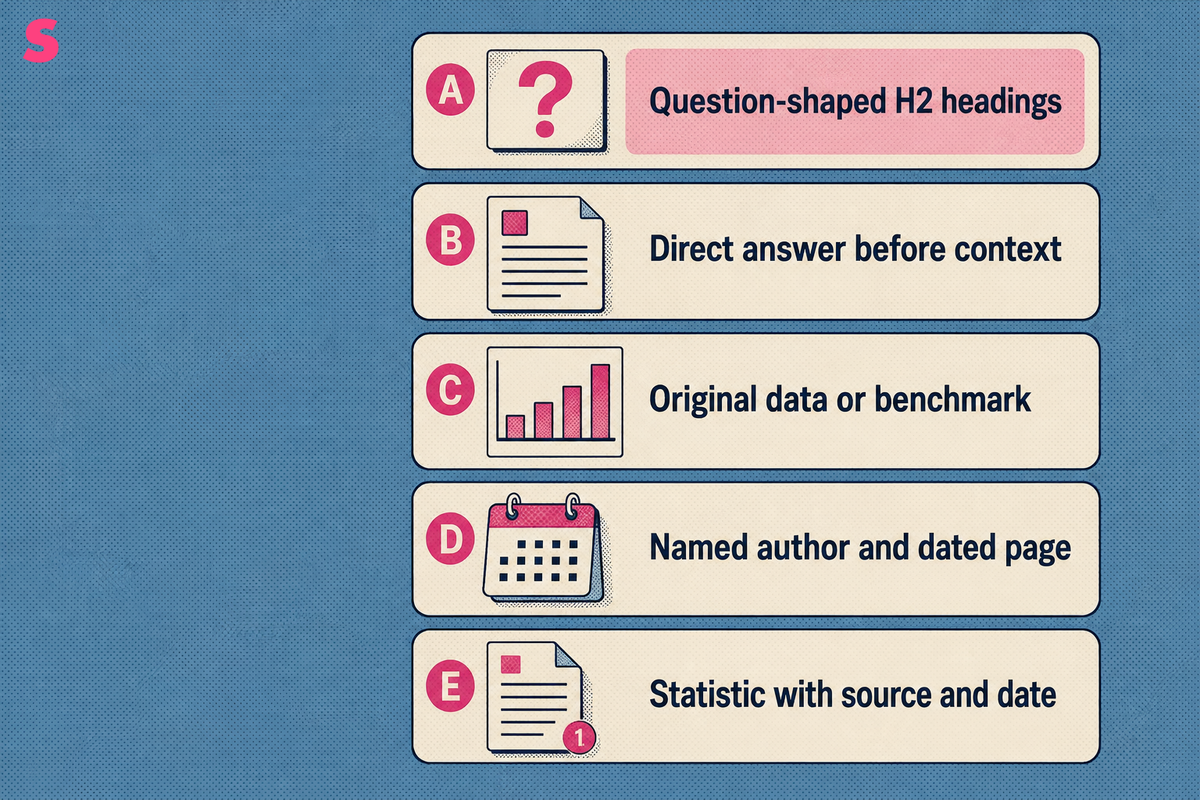
Put an extractable answer in the opening lines of every section, under a question-shaped heading, and make each section readable with everything around it deleted. That is the unit a retrieval system pulls: a heading plus the prose beneath it. A section that leans on the paragraph above it cannot be lifted into an answer.
The changes that move citation likelihood, in order of effort to payoff:
- Question-shaped h2 headings that match how buyers phrase the question.
- A direct answer before any context or caveats.
- Original data, a benchmark, or a figure an engine cannot synthesise from elsewhere.
- A named author and a dated page.
- Every statistic carrying its source and date in the prose itself.
Do not simplify the writing for an AI audience. Technical B2B material belongs at a professional reading level, and stripping out the vocabulary removes the precise terms a retrieval system matches. Write "canonical tag" and "server-rendered HTML", not paraphrases of them.
Prioritise by gap, not by traffic. The pages worth fixing first are the ones that should appear in a tracked prompt and do not. Sona AI Visibility names those gap prompts page by page, which turns a brand-level score into a work item.
Step 5: How do you publish new content for AI retrieval without producing filler?
Apply one publishing test: if the page carries no fact an engine could not already synthesise from existing sources, it is unlikely to earn a citation. Generated summaries of common knowledge compete against the model's own training data and lose.
Four asset types are high-value candidates to test against the frozen prompt set in B2B:
- Original benchmarks. Your own data, with the sample size and date range stated.
- Pricing transparency. Real numbers give a comparison answer something to extract.
- Methodology pages. How you measured something, written so it can be checked.
- Comparison pages with real criteria. Named columns, published figures, no hedging.
Default to refreshing before publishing. Refresh a page when its facts, prices or methodology have gone stale, because corrective work on a page that already carries authority tends to pay back faster than a new URL competing from zero. Re-audit the pages you care about on a regular cadence, and run the full technical re-audit quarterly.
The output of that cadence is a log, not a grade. A score is a dated snapshot. The comparable series of those scores, with the severity-ranked fix attached to each page that moved, is what a team can act on.
Step 6: How do you connect AI citations to pipeline and revenue?
Treat AI search as a channel with spend, deals and ROAS, measured like any other. Three layers are needed: AI referral traffic, the accounts behind that traffic, and the deals those accounts produce. Mention counts stop at layer zero.
The hard part is identity. Buyers research in ChatGPT or Perplexity, then arrive later as direct traffic, so the citation that started the deal never appears in the attribution report. Resolving the anonymous account behind an AI-referred visit, without cookies, closes that loop. Inferring the likely prompt behind the visit tells you which question was being answered when the buyer found you.
Sona AI Visibility connects prompts and citations to pipeline and revenue on one account timeline, resolves the anonymous accounts and contacts behind AI-referred visits with no cookies, and tracks which AI crawlers reach your pages, so a mention becomes something you can measure rather than a number to report. For teams without an owner for the work, Sona also offers done-for-you services on top of an AI Visibility plan.
Most AI visibility tools tell you whether you were mentioned. Few tell you what that mention was worth, which is the number a budget conversation actually needs.
Step 7: How do you tell AI engine optimization worked, and what do you do when results stall?
Success on the same frozen prompt set looks like four things: more first-position citations, more answers that name you as a recommendation rather than a passing mention, rising share of voice against your tagged competitor set, and AI-referred sessions resolving to accounts on your target list. All four read against the baseline logged during the first full run across engines.
The common failure is changing the prompt set and the pages in the same cycle. Nothing is then attributable, because two variables moved together. Recovery is mechanical:
- Refreeze the prompt set at its current wording.
- Re-baseline across every engine on one day, logging all six fields.
- Hold the prompt wording still across repeated cycles while page changes ship.
The second failure is reacting to week-to-week engine output. Daily tracking exists to build a series, not to generate weekly panic. Read the daily series, decide monthly, review positioning quarterly.
On the objection that AI engines are too unpredictable to optimize: nobody can guarantee a citation. What you can improve is retrieval eligibility, factual clarity, entity naming, source authority and measurement consistency across a defined prompt set. Those compound, and the engines reward each of them.
Frequently Asked Questions
How long does AI engine optimization take to show results?
Expect several monthly cycles on a frozen prompt set before a change is stable enough to trust. Single-week movement in AI answers is usually engine variance, not your work. Track daily to build the series; judge monthly.
Is AI engine optimization the same as AEO and GEO?
The practices overlap almost entirely. Answer engine optimization (AEO), generative engine optimization (GEO) and AI engine optimization all describe earning mentions and citations inside generated answers. The differences are vocabulary rather than method, so pick one term for internal use and move on.
How many prompts should a B2B SaaS team track?
Track a set you can run across every engine on the same day without cutting corners, split across problem-aware, solution-aware and vendor-comparison stages. Expand only once the first set produces repeatable month-over-month readings. A large set you cannot run consistently is worth less than a small one you can.
Do you need a paid tool to start AI engine optimization?
No. A manual first baseline in a spreadsheet works for a small prompt set. Tooling becomes necessary once you are running the same prompts across several engines daily, because the volume of answers to log and score by hand multiplies with every engine you add.
Does ranking well in Google guarantee citations in AI answers?
No. Ranking helps retrieval eligibility, but selection also depends on how extractable the answer is, how clearly entities are named, and whether the page carries evidence an engine cannot synthesise elsewhere. Strong organic position with zero AI citations is a common and fixable pattern.
Should you block AI crawlers from your site?
Blocking a retrieval crawler can prevent or reduce that engine's direct fetching of your pages for an answer. Blocking a training crawler limits what it can take from your site, but it does not determine whether a model knows your brand, since the model can learn about you from third-party sources. Check your robots directives and server logs before assuming low visibility is a content problem.
Summarize this article with AI: ChatGPT · Claude · Perplexity · Google AI Mode
Last updated: October 2026