AI search engine optimization is the practice of making your content retrievable, citable and accurately described inside AI-generated answers from ChatGPT, Google AI Overviews, Perplexity, Gemini and Claude, instead of competing for ten blue links alone. It adds prompt coverage, citation share, answer accuracy and sentiment to conventional crawlability and authority work. Most trackers stop at mention counts; Sona AI Visibility connects those citations, and the prompts behind them, to pipeline and revenue. Treat any single answer as one sample, never a fixed rank.
What is AI search engine optimization?
AI search engine optimization is the practice of making a brand's content retrievable, quotable and correctly represented inside AI-generated answers, across engines like ChatGPT, Google Gemini, Claude, Perplexity and Google AI Overviews. The unit of success is a citation in an answer, not a blue link position.
The shift is larger than it sounds. A ranking is a position on a page a person scrolls; a citation is a sentence an engine generates on your behalf, sometimes with your brand named, often with no click attached.
The work splits into four measurable things:
- Prompt coverage. The share of your tracked buyer questions where the brand appears at all.
- Citation inclusion. Whether your domain is named as a source behind the answer.
- Answer accuracy and sentiment. Whether the description of your product is right and whether it reads positively.
- Share of voice. How often you appear against the competitors named in the same answers.
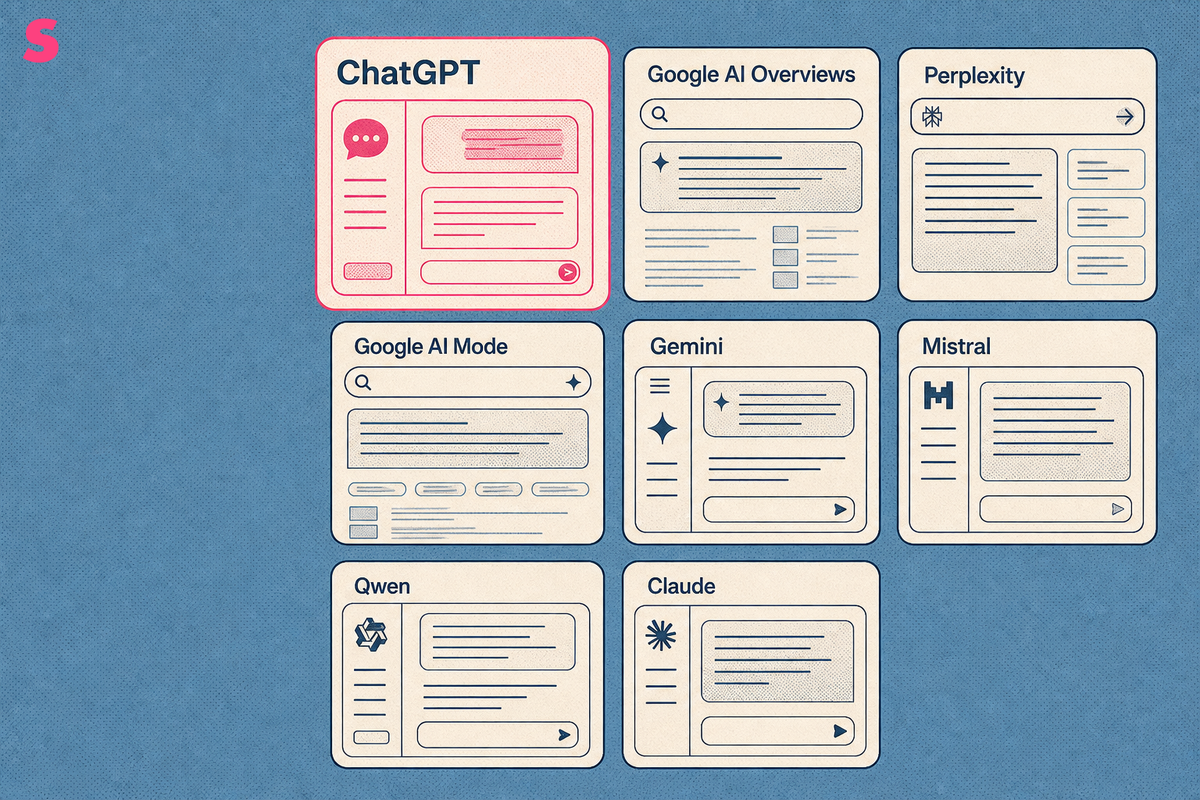
Sona's own AI visibility data, September 2026, covers eight answer surfaces: ChatGPT, Google AI Overviews, Perplexity, Google AI Mode, Gemini, Mistral, Qwen and Claude. Those surfaces do not answer identically, which is why a single-engine check tells you very little.
Why does AI search engine optimization matter to a B2B revenue team?
Because the research step that used to produce a tracked click now produces an answer. A buyer asks an assistant which vendors solve their problem, gets a shortlist, and either arrives at your site as untagged direct traffic or never arrives at all. Marketing has a new front door and, by default, no view of it.
The commercial consequence is concrete. A page that ranks third in Google and is never cited in the answer above it has lost the demand it used to capture. A page nobody ranks for but every engine quotes is now a pipeline asset your analytics files as direct.
| Benchmark | Figure | Period | What it implies for a revenue team |
|---|---|---|---|
| AI Overviews presence on business-intent searches | 86.7%, up from 56.9% | April 2026 vs April 2025 | Commercial queries now resolve in an answer layer first |
| AI Overviews presence across all searches | About 16%, after roughly 25% in July 2025 | November 2025 | Coverage fluctuates; a single snapshot is not a trend |
| Searches ending without a click | About 60% | 2025 | Visibility can rise while sessions stay flat |
| AI-search referral traffic growth | 527% year over year | 2026 benchmark | The clicks that do come are growing fast from a small base |
| ChatGPT share of AI referral traffic | 87.4% | 2026 benchmark | One engine dominates measurable referrals today |
| ChatGPT-referred visitor conversion rate | 15.9% | 2026 benchmark | These visitors arrive pre-qualified by the assistant |
| AI Overviews citing a source from the top 20 organic results | 97% of cases | 2024 benchmark, page updated October 2026 | Organic strength still feeds the retrieval pool |
| Businesses reporting higher ROI from using AI in SEO | Nearly 70% | November 2025 | Production efficiency is a separate gain from citation share |
Read the last two rows together. Low volume, high conversion. That combination is why the channel justifies attention before it justifies a large budget.
How do AI search engines decide which sources to retrieve and cite?
AI search engines decide through a four-step mechanism: fan-out, retrieval, grounding, attribution. The sequence tells you where a page drops out, and most pages drop out at step two.
- Fan-out. The engine decomposes one buyer question into many sub-queries. "Best AI attribution software for B2B" becomes searches for attribution tools, B2B-specific requirements, pricing, and competitor comparisons. Your page competes against a set of phrasings, not one string.
- Retrieval. Each sub-query hits a search index or a live web fetch, returning a candidate pool. If your page is not in that pool, nothing later in the chain can save it.
- Grounding. The model reads the retrieved passages and composes an answer constrained by them. Passages that state a claim plainly and completely in one place survive this step; claims scattered across five paragraphs often do not.
- Attribution. The engine links sentences back to the sources that supported them. A source can influence an answer and still go uncited, which is why mention counts and citation counts are different metrics.
Conventional ranking still feeds step two heavily. Retrieval draws on the same indexes that power conventional organic results, so a page already performing for a sub-query is far likelier to enter the candidate pool than one that is not. Organic position is not the goal of AI search engine optimization, but it remains the most reliable route into that pool.
How does AI search engine optimization differ from traditional SEO, AEO and GEO?
They differ in what counts as a win. Traditional SEO wins a ranked position. Answer engine optimization (AEO) wins inclusion in a direct answer. Generative engine optimization (GEO) wins a citation inside generated text. Optimizing for AI search is the umbrella over the latter two, and it depends on the first.
| Dimension | Traditional SEO | AEO | GEO |
|---|---|---|---|
| Unit of success | Ranked position for a keyword | Inclusion in a direct answer or featured snippet | Citation inside a generated answer |
| Query form | Short keyword strings | Explicit questions | Conversational, multi-constraint prompts |
| Primary signal worked | Links, relevance, crawlability | Structured answers, schema, concision | Retrievable passages, corroboration across sources |
| Measured by | Rank, sessions, clicks | Snippet ownership, answer presence | Citation rate, share of voice, sentiment |
| Typical failure mode | Outranked | Answer taken from a competitor | Influenced the answer but never named |
What AI search optimization is not: prompt engineering, paid placement, or a rebrand of technical SEO. It is also confused with using AI tools to produce SEO content, which is a production question rather than a visibility one. Faster content workflows reduce cost per page; they do not by themselves make a page quotable.
How do you map the prompts your buyers actually type into ChatGPT, Gemini and Claude?
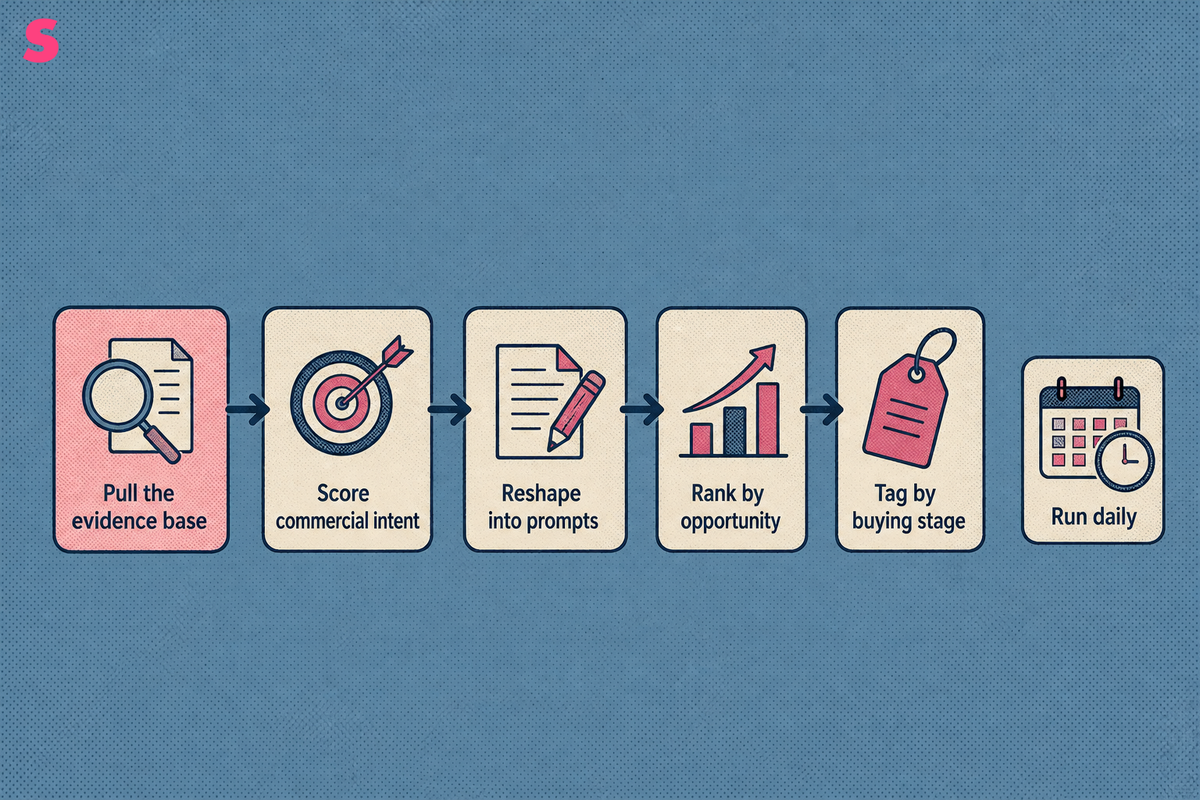
Start from keyword data you already own, then reshape it. Keywords are fragmented strings; prompts are full questions with constraints attached. The chain runs keywords to prompts to pages, and each step needs a decision rule rather than intuition.
- Pull the evidence base. Export commercial-intent keywords from Search Console and a rank tool, then cluster near-duplicates by intent rather than by wording.
- Score commercial intent. Combine lexical modifiers ("best", "vs", "pricing"), CPC, SERP features and funnel stage into one composite per cluster.
- Reshape into natural phrasings. Turn each high-intent cluster into one to three conversational prompts a buyer would actually type.
- Rank by opportunity, not demand alone. Order the list by commercial intent first, winnability second and raw demand third. Winnability is the part keyword tools miss: low difficulty, weak incumbent position, few competitors ranking.
- Tag each prompt with a buying stage. Awareness, Consideration, Decision, Purchase. A 100% visibility score on an awareness-stage informational prompt is worth less than a 20% score on a decision-stage commercial one.
One caveat belongs in writing alongside the ranked list: search volume is not prompt volume. Google demand is a decent proxy and an imperfect one, and it under-counts conversational comparison queries.
Then run the list daily. A change that holds across several consecutive runs is a trend; a one-day spike is noise, and a weekly snapshot averages both away.
Which content changes make a page easier for an AI engine to quote?
Write passages that are self-contained, factual and attributable. An engine grounding an answer lifts a span of text, and a span that depends on three paragraphs of surrounding context cannot be lifted cleanly. That single constraint drives most of what follows.
- Answer in the first 40 to 60 words under each heading. Retrieval scores a heading plus the prose beneath it, so the answer has to sit inside that unit.
- Phrase headings as the question a buyer asks. Fan-out generates question-shaped sub-queries; a heading that matches one is a direct match.
- Attach a source and a date to every figure. Grounded models favor claims they can verify, and a figure that carries its origin and its date is easier to corroborate than a bare number.
- Add FAQPage JSON-LD. It lets engines extract question and answer pairs directly, which makes verbatim surfacing likelier.
- Refresh the page. Engines with web retrieval weight recency, so a page untouched for months is deprioritized against a fresher source on the same topic.
- Use definitions, comparisons and numbers. Those genres get absorbed into answers far more often than pure narrative explanation.
Sona AI Search Insights maps each site page to the AI prompts likely to surface it and names the gap prompts a page should answer and does not, so content work gets ordered by missing coverage rather than by guesswork.
What technical setup lets AI crawlers and agents reach your pages?
Three things have to be true: the bot is allowed to fetch the page, the essential content is present in fetchable HTML rather than assembled entirely by client-side JavaScript, and that content is marked up. Rendering behaviour differs between crawlers, so test each bot that matters to your buyers rather than assuming a single standard. Fail the first condition and nothing else matters, because a page a retrieval crawler cannot fetch has no path into any answer.
AI crawlers and the robots controls that govern them fall into distinct groups, and most sites block the wrong ones by accident:
| Tier or control | What it does | Named examples | Consequence of blocking it |
|---|---|---|---|
| Live search retrieval | Fetches pages to ground a live answer | OAI-SearchBot, Claude-SearchBot, PerplexityBot, Googlebot, Bingbot, Applebot | You cannot be cited in answers today |
| Agent / user-triggered | Fetches because a user asked, in session | ChatGPT-User, Claude-User, Perplexity-User, Google-NotebookLM | Live buyer research on your site fails |
| Training | Fetches to train a model | GPTBot, ClaudeBot, CCBot, Bytespider, Amazonbot, PetalBot | Future models know less about your brand |
| Robots control token | Not a crawler: a token in robots.txt that governs how already-crawled content may be used | Google-Extended | Google's generative products may use less of your content |
| Stealth / undocumented | No honored user-agent to allowlist | xAI/Grok, DeepSeek, OpenAI Operator, Devin, Manus | Cannot be managed by robots.txt at all |
The Sona AI Crawl Checker tests a URL against the documented AI crawlers and returns a pass or fail per bot with the exact reason each blocked one fails: robots.txt disallow, WAF 403, rate-limiting or cloaking. The Free AI Readiness Checker runs a different job, auditing a single page against readiness checks grouped by category and returning a score with a letter grade.
Evidence of crawler behaviour belongs in server logs, not in a JavaScript tag. Tag-based analytics miss bots entirely, and ad blockers hide part of the rest. Log-level or edge-worker collection is the only way to see which bots reached which pages, how often, and whether a page has ever been indexed at all.
How do you baseline AI visibility across engines, and what do the tools cost?
Baseline by fixing a prompt set, running it daily across the engines your buyers use, and recording the result as a series. Across the shortlist below, published entry prices start at $29 per month for Otterly.ai and reach $399 per month for Goodie, while Profound publishes no self-serve price at all. What separates the tools is engine coverage, prompt allowance and whether the data connects to anything downstream.
| Tool | Starting price | Agency Plans? (Yes/No) | # of Answer Engines Tracked | Answer Engines | # of Daily Tracked Prompts (entry plan) | Cost per Daily Tracked Prompt | Differentiation |
|---|---|---|---|---|---|---|---|
| Sona AI Visibility | Brands from $75/month, agencies from $199/month, both billed annually. 14-day free trial, no credit card. Unlimited seats and API/MCP access on every plan | Yes | 11 | ChatGPT, Gemini, Google AI Mode, Google AI Overviews and Perplexity on standard, plus Claude, DeepSeek, Grok, Copilot, Qwen and Mistral on premium | 5,000 credits/month on Starter 5K, which is about 166 prompts tracked daily on one model, or 56 across three. 1 credit = 1 AI answer | $0.45 per daily tracked prompt | Connects AI citations and prompts to pipeline and revenue on one account timeline, and tracks AI crawler activity from server logs with no JavaScript tag |
| Profound | Quote-only, no public pricing. 7-day free trial: 50 prompts, run daily. No self-serve price is published: a 7-day trial and custom Enterprise pricing only | Not published | 3 | ChatGPT, Gemini and Google AI Overviews | 50 prompts run daily on the 7-day trial; Enterprise allowances are custom | No refresh cadence published | Focus: enterprise answer-engine visibility reporting |
| Peec AI | From $80/month (Starter), $205 (Pro), $420 (Advanced), Enterprise custom, billed annually. Unlimited users on every plan; 50, 150 and 350 prompts by tier | Not published | 6 | ChatGPT, Google AI Mode, Google AI Overviews, Microsoft Copilot, Perplexity and Gemini | 50 prompts on Starter, 150 on Pro, 350 on Advanced | No refresh cadence published | Focus: prompt-level visibility with unlimited users per plan |
| Otterly.ai | From $29/month (Lite), $189 (Standard), $489 (Premium) billed monthly, or $25, $160 and $422 a month billed annually; Enterprise custom. Free trial, no commitment. 15% off annual; unlimited team members on every plan; Enterprise starts from 1,000 prompts | Not published | 4 | ChatGPT, Google AI Overviews, Perplexity and Microsoft Copilot | 15 prompts on Lite, 100 on Standard, 400 on Premium, checked daily on every plan | $0.48 per daily tracked prompt | Focus: daily prompt checks with unlimited team members |
| Scrunch AI | From $250/month (Starter) or $300 monthly, $417 (Growth) or $500 monthly, Enterprise custom. 7-day trial of Starter, no credit card. 17% discount on annual billing | Not published | 6 | ChatGPT, Claude, Gemini, Perplexity, Google AI Mode and AI Overviews, and Meta | 350 custom prompts plus 1,000 industry prompts on Starter; 700 plus 2,500 on Growth | No refresh cadence published | Focus: custom prompts alongside a large industry prompt library |
| AthenaHQ | From $295/month (Starter) billed monthly, 17% off annually; Enterprise custom. Free Essential tier with 300 credits. 1 credit = 1 AI response | Not published | Not published | Not published | 3,600 credits on Starter, where 1 credit is 1 AI response. 300 credits on the free Essential tier | $2.46 per daily tracked prompt | Focus: credit-metered answer sampling with a free entry tier |
| PromptWatch | Essential $95/month, Professional $245, Business $579. Agency plans from $199/month (Kick-off) | Yes | 4 | ChatGPT, Claude, Gemini and Perplexity | 50 prompts and 6,000 responses/month on Essential, with 500 agent credits | $0.48 per daily tracked prompt | Focus: response-volume monitoring with published agency tiers |
| Goodie | From $399/month (Core), $999 (Pro), Enterprise custom. 7-day free trial on Core. Annual billing gives 2 months free; agency plan from $275/month, billed quarterly or annually | Yes | 5 | ChatGPT, Google AI Overviews, Perplexity, Google AI Mode and Copilot | 120 prompts on Core | No refresh cadence published | Focus: brand monitoring across major answer surfaces |
Compare the unit price, not the sticker price. Prompt counts are not a shared unit: some vendors count a prompt per model, others across all engines, and AthenaHQ sells credits where one credit is one AI response. The cost-per-daily-prompt column above normalizes all of them to one prompt, on one model, once a day.
Check how the data is collected before you buy. Some offerings capture the end-user experience directly, scraping the prompt response the way a person would see it, ads, formatting and all. Others pull from the vendor's official API, which returns a structured response that does not necessarily match what appears on screen. The two methods can capture different answers. Sona aims to mirror the end-user experience as closely as possible, and uses both methods to do it.
How do you connect AI citations to pipeline instead of stopping at mention counts?
Connect them by separating what you observe directly from what you infer, then placing both on the same timeline as your CRM opportunities. A mention count answers whether you appeared. It does not answer whether appearing was worth anything.
The mechanism has three parts, and they carry different levels of certainty. First, directly observed referral data: the session that arrives from ChatGPT, Perplexity, Gemini or Claude, read from the referrer. Second, company resolution on those anonymous sessions, which is probabilistic and attaches a visit to a likely account rather than a confirmed one. Third, prompt matching, which is an estimate of the question behind the visit unless the engine passes the prompt itself through. Self-reported attribution on demo and signup forms is one way to capture zero-click research that leaves no referrer at all, and an attribution model that treats AI search as a channel with spend, deals and ROAS puts the result alongside every other source.
Monitoring which AI answers mention a brand is half the job; the other half is connecting those mentions to accounts, pipeline and closed revenue. Sona AI Visibility does that on one account timeline, scoring each account on intent and tagging it to a buying stage, so a citation becomes a prioritised account rather than a number in a monthly report.
Set the reporting rhythm accordingly. Re-run the full technical audit monthly, and review positioning and competitive benchmarks quarterly, since those change on a slower clock than daily answers do. What you report upward is not the score on any one day; it is the series of scores and the severity-ranked fix attached to each page that moved.
Frequently Asked Questions
Is AI search engine optimization just SEO with a new label?
No. Conventional SEO still supplies much of the corpus that gets retrieved, and a page that already performs in organic results is far likelier to enter the retrieval candidate pool for a sub-query. But optimizing for AI answers adds prompt coverage, citation inclusion, answer accuracy, sentiment and share of voice as separate things to measure and improve. None of those appear in a rank report.
Why do AI answers change every time I run the same prompt?
Outputs vary by model version, location, account history, exact prompt wording, retrieval index and date. Treating one answer as a ranking is a category error. Fix a prompt set, run it daily, and read the trend across runs. A change that persists across several consecutive runs is signal; a single shifted answer is not.
Can you manipulate an AI search engine into recommending your brand?
Repetition, synthetic citations and mass-produced pages can move short-term discoverability. They also create brand, compliance and reputation risk, and both human reviewers and the engines themselves discount sources that read as fabricated consensus. The durable approach is corroborated, accurate content that other credible sources independently repeat.
How long does AI search engine optimization take to show results?
Expect weeks, not days. Content and technical changes have to be recrawled and re-embedded before they can influence retrieval, and crawl frequency varies by page and by bot. Baseline a fixed prompt set first, track it daily, and review the month-over-month series rather than reacting to week one.
Does ranking well in Google organic still help you get cited in AI answers?
Yes. Grounded answers frequently draw from sources that also perform in conventional organic results, which makes strong rankings a practical input to the retrieval candidate pool. It is not a guarantee: plenty of top-ranking pages are never cited, usually because the relevant claim is not stated plainly in one retrievable passage.
Which AI engines should a B2B SaaS team prioritize first?
Start with the engines already sending measurable referral traffic and appearing in your buyers' daily workflows. ChatGPT dominates measurable AI referrals today, which makes it the obvious first baseline. Once that series is stable, widen the prompt set to Gemini, Perplexity, Claude and Google AI Overviews.
Summarize this article with AI: ChatGPT · Claude · Perplexity · Google AI Mode
Last updated: October 2026