AI search optimization expert suggestions come down to three habits: publish specific, evidence-backed content that answers commercial prompts, keep it crawlable, and measure citations repeatedly rather than trusting one answer. Experiments such as the Princeton-led GEO study point to quotations, statistics and cited sources as the tactics worth testing. Sona AI Visibility ties prompts and citations to pipeline and revenue, and shows AI crawler activity at the front of that path. Treat any single AI answer as a sample, not a ranking.
What do experts mean by AI search optimization?
AI search optimization is the practice of making your pages the sources that ChatGPT, Google AI Overviews, Perplexity and similar engines retrieve and cite when they answer a buyer's question. It also goes by answer engine optimization (AEO) and generative engine optimization (GEO). The goal is inclusion in the answer, not a blue-link position.
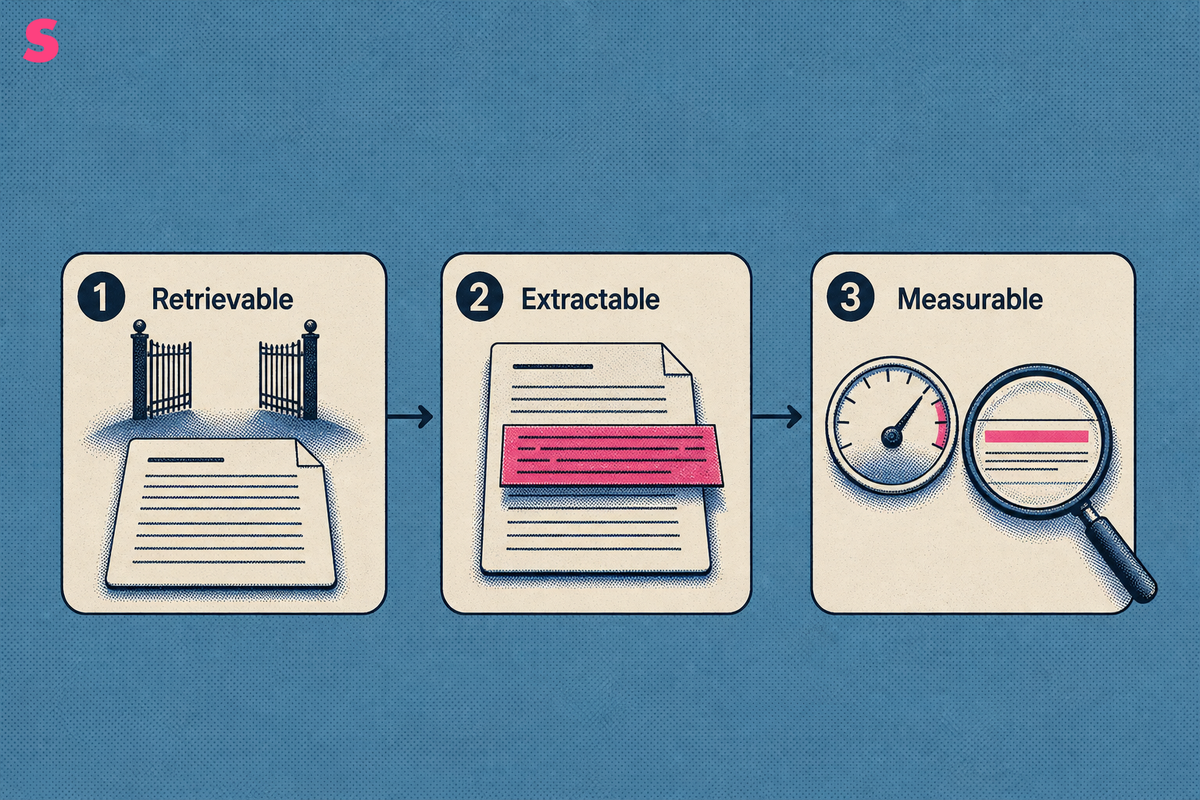
Most AI search optimization expert suggestions reduce to three jobs. Make the page retrievable, so crawlers can fetch and parse it. Make the claims extractable, so an engine can lift a sourced statement intact. Make the result measurable, so a team knows whether a change worked.
AEO leans toward the direct answer; GEO leans toward responses synthesized from several sources. Practitioners use the two terms interchangeably, and the tactics below serve both.
Why does AI search optimization matter for a B2B SaaS team with a pipeline target?
Buyers now research vendors inside AI engines and arrive at a website with a shortlist already formed. A SaaS company absent from those answers is cut from consideration before any click, and standard analytics rarely records the loss.
Three consequences land on whoever owns the number:
- Shortlist risk. An engine asked for the best tools in a category names a few vendors. A brand left out never enters the evaluation.
- Attribution blind spots. An AI-influenced visit often lands as direct or unattributed traffic, so the channel looks smaller than it is.
- Budget exposure. Content aimed at AI answers cannot be defended in a quarterly review without prompt-level evidence of where the brand appears.
The practical response is to treat AI search as a channel with its own baseline, its own prompt list and its own link to pipeline.
How is AI search optimization different from traditional SEO, and what is it confused with?
Traditional SEO optimizes a page to rank in a list of links. AI search optimization optimizes a page to be quoted inside a generated answer. Rankings remain a foundation, since engines retrieve indexed pages, but a ranking position does not guarantee a citation.
- Unit of success. SEO measures position and click. AI search optimization measures inclusion rate and citation across repeated runs of the same prompt.
- Unit of content. SEO scores page-level relevance. Engines extract passage-level claims, so each paragraph has to stand alone.
- Measurement. SEO uses rank trackers and search console data. AI search needs a prompt list run on a schedule, crawler logs and AI-referred visits.
Three misreadings come up often. AI search optimization does not replace SEO; it builds on it. It is not a single file: an llms.txt file is one input, and it cannot substitute for pages worth citing. And it is not a promotional exercise, because engines weigh sources, not slogans.
Which content tactics do experts suggest for getting cited in AI answers?
Experts suggest writing pages that carry quotations, statistics and named sources, in fluent prose, and that answer the exact commercial prompt in the opening lines. The best published evidence comes from a Princeton-led GEO study. Its scores are experimental, not percentages of traffic or rankings.
| Tactic | What to do on the page | Evidence reviewed | Caveat |
|---|---|---|---|
| Unoptimized baseline | Reference point for every other row | Scored 19.3 in the Princeton-led GEO study, as reported June 2025 | Experimental scoring framework |
| Add quotations | Include verified statements from named, real people | Raised the overall score to 27.2 against the 19.3 baseline | Never invent or paraphrase a quote into existence |
| Add statistics | State the figure, its source and its date in the same sentence | Scored 25.4 | Experimental score, not a traffic gain |
| Cite sources | Name the origin of each claim in the prose | Scored 25.0 | Applies to claims you can source |
| Optimize fluency | Write clean, direct sentences an engine can lift intact | Scored 24.7 | Smallest of the four lifts |
| Answer the prompt first | Put the direct answer in the opening 40 to 60 words of each section | Method, no published figure in the research reviewed | Test against your own prompt list |
| Avoid listicle dependence | Do not rely on self-promotional "best of" pages as the sole strategy | Roughly 1 in 10 AI-search citations reportedly came from self-promotional listicles, December 2025 to February 2026 | Vendor-published estimate, not independently audited |
Across the rows, specific, attributable claims outperform general assertions. A SaaS team can apply that page by page: replace each vague claim with a figure, name where it came from and date it.
Which technical practices help AI engines find and cite your pages?
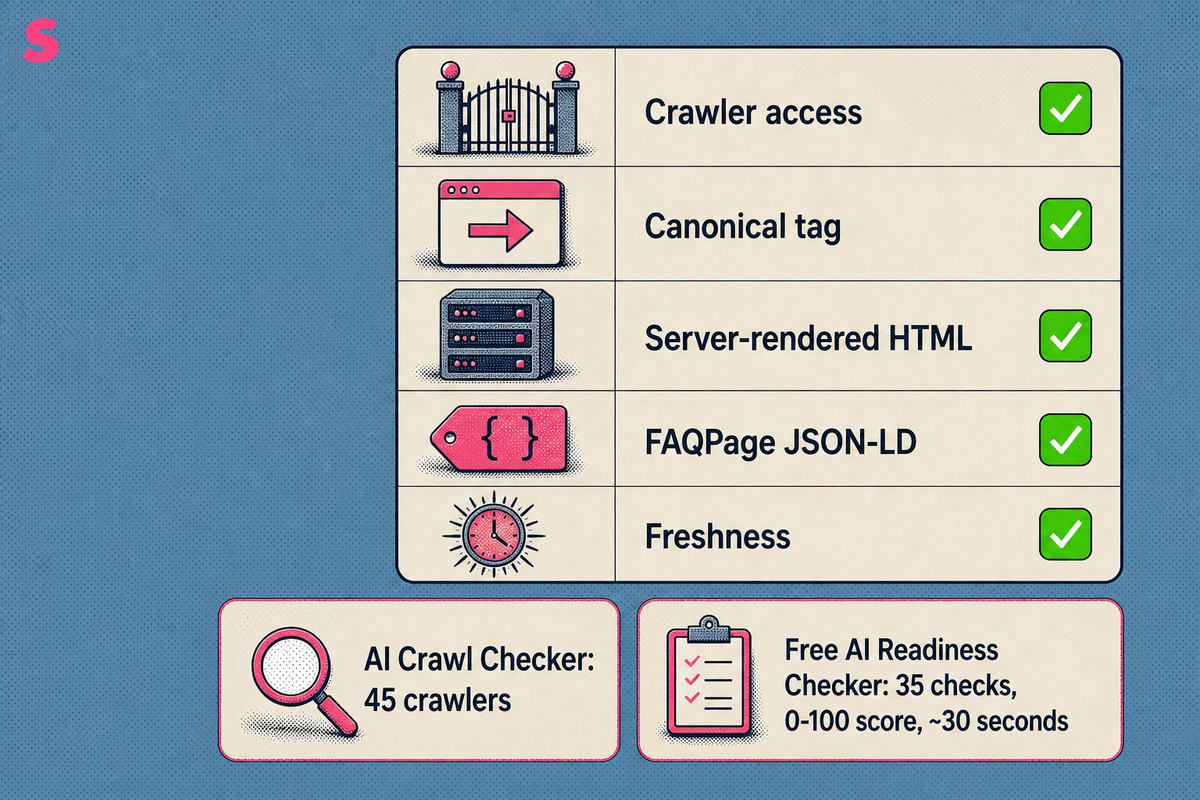
An engine cannot cite a page its crawler cannot reach or parse. The technical basics are crawler access in robots.txt, a correct canonical tag, server-rendered HTML, structured data such as FAQPage JSON-LD, and visible freshness. Fix these before any content tactic.
- Crawler access. Retrieval and agent bots decide whether a brand can be cited today; training bots decide whether a model knows the brand later. A robots.txt that blocks one group and not the other is a decision, and many sites make it by accident.
- Rendering. Content that depends on client-side JavaScript can be invisible to a bot that does not execute it. Server-rendered HTML removes that dependency.
- Structure and freshness. FAQPage JSON-LD lets engines extract question-and-answer content directly. A page untouched for months loses ground to fresher sources.
The Sona AI Crawl Checker tests whether 45 AI crawlers can reach and load a page, and returns the reason each blocked bot fails. The Free AI Readiness Checker runs 35 checks across six categories and returns a 0 to 100 score in about 30 seconds.
Sona AI Visibility runs the same 35 checks per page on an ongoing watch and ranks findings as critical or medium. It also reads AI crawler activity from server logs or a lightweight edge worker, with no JavaScript tag for ad blockers to hide. A full technical re-audit is a monthly or quarterly task, not a daily one.
How do you build a prompt set and measure AI visibility without overstating results?
Build a small prompt list grouped by buying intent, run the identical list daily on fixed engines, and report inclusion rates across repeated runs, never a single answer. A daily run shows a pattern that a weekly snapshot would have averaged away.
- Group prompts into three intents: category prompts, comparison prompts and problem prompts.
- Write each prompt as a full question the way a buyer would type it, plus two or three phrasing variants.
- Fix the engines, models and locations, and record them with the results.
- Run the whole list daily. An engine's answer shifts with the retrieval index, a model update and whatever a competitor published last week, so a change that holds four days running is a trend and a one-day spike is not.
- Log inclusion, citation and position per prompt, per engine, per day.
- Change one variable per page, then compare windows of equal length.
Sona's AI Search Insights tracks visibility and share of voice per engine daily, and shows which sources get cited when a brand or a competitor appears. Whatever tool you use, state the prompt count and date range beside every figure you report. Review positioning and competitive benchmarks quarterly; the prompt runs stay daily.
Are AI answers too volatile to optimize, and what risks should buyers weigh?
No. Answers vary from run to run, but that variance is the reason to measure repeatedly, not a reason to skip optimization. Inclusion rate across many runs is stable enough to act on; a single screenshot is not.
Engines also differ from one another. Sona's own AI visibility data, September 2026, covers eight answer surfaces: ChatGPT, Google AI Overviews, Perplexity, Google AI Mode, Gemini, Mistral, Qwen and Claude. Each retrieves and cites differently, so a result on one surface does not carry to another.
Buyers of measurement tools should weigh four risks:
- Collection method. Some offerings capture the end-user experience directly, scraping the prompt response the way a person would see it, ads, formatting, and all. Others pull data from the vendor's official API, which returns a structured response that does not necessarily match what an end user sees on screen. The two methods can capture different answers. Sona aims to mirror the end-user experience as closely as possible, and uses both methods to do it.
- Unit mismatch. Vendors count prompts differently; some count per model, others across all engines.
- Unaudited statistics. A figure from a vendor's own study is an estimate until independently validated.
- Price drift. Plans and allowances change, so confirm figures on the pricing page.
What do AI search optimization tools track, and what do they cost?
AI search optimization tools track whether and where a brand appears in AI answers, with citations and share of voice per engine, across a prompt list run on a schedule. Published entry prices in the table run from $29 to $295 per month; one vendor publishes no price. Prices were read from each vendor's own pricing page between August and October 2026.
| Tool | Starting price | Agency Plans? (Yes/No) | # of Answer Engines Tracked | Answer Engines | # of Daily Tracked Prompts (entry plan) | Cost per Daily Tracked Prompt | Differentiation |
|---|---|---|---|---|---|---|---|
| Sona AI Visibility | Brands from $75/month, agencies from $199/month, both billed annually. 14-day free trial, no credit card. Unlimited seats and API/MCP access on every plan | Yes | 11 | ChatGPT, Gemini, Google AI Mode, Google AI Overviews and Perplexity on standard, plus Claude, DeepSeek, Grok, Copilot, Qwen and Mistral on premium | 5,000 credits/month on Starter 5K, about 166 daily tracked prompts on one model or 56 across three. 1 credit = 1 AI answer | $0.45 per daily tracked prompt | Connects AI citations and prompts to pipeline and revenue on one account timeline; resolves the anonymous accounts behind AI-referred visits, 100% cookieless |
| Profound | Quote-only, no public pricing. 7-day free trial | Not published | 3 | ChatGPT, Gemini and Google AI Overviews | 50 prompts run daily on the 7-day trial; Enterprise allowances are custom | No refresh cadence published | Custom Enterprise pricing with a 7-day trial that runs 50 prompts daily |
| Peec AI | From $80/month (Starter), $205 (Pro), $420 (Advanced), billed annually; Enterprise custom | Not published | 6 | ChatGPT, Google AI Mode, Google AI Overviews, Microsoft Copilot, Perplexity and Gemini | 50 prompts on Starter, 150 on Pro, 350 on Advanced | No refresh cadence published | Unlimited users on every plan; prompt allowance set by tier |
| Otterly.ai | From $29/month (Lite), $189 (Standard), $489 (Premium) billed monthly; $25, $160 and $422 billed annually | Not published | 4 | ChatGPT, Google AI Overviews, Perplexity and Microsoft Copilot | 15 prompts on Lite, 100 on Standard, 400 on Premium, checked daily on every plan | $0.48 per daily tracked prompt | Free trial with no commitment; unlimited team members on every plan |
| Scrunch AI | From $250/month (Starter) or $300 monthly, $417 (Growth) or $500 monthly; Enterprise custom | Not published | 6 | ChatGPT, Claude, Gemini, Perplexity, Google AI Mode and Google AI Overviews, and Meta | 350 custom prompts plus 1,000 industry prompts on Starter | No refresh cadence published | Splits custom prompts from industry prompts; 7-day Starter trial, no credit card |
| AthenaHQ | From $295/month (Starter) billed monthly; Enterprise custom | Not published | Not published | Not published | 3,600 credits on Starter, where 1 credit is 1 AI response | $2.46 per daily tracked prompt | Free Essential tier with 300 credits; 17% off annual billing |
| PromptWatch | Essential $95/month, Professional $245, Business $579. Agency plans from $199/month (Kick-off) | Yes | 4 | ChatGPT, Claude, Gemini and Perplexity | 50 prompts and 6,000 responses/month on Essential, with 500 agent credits | $0.48 per daily tracked prompt | Publishes a named agency plan alongside single-brand tiers |
The cost column uses one denominator: one prompt, on one model, once a day. Sona's Starter 5K plan buys 5,000 credits a month, which is about 166 prompts tracked daily on one model, so $75 divided by 166 gives $0.45. Where a vendor publishes no refresh cadence, the column says so rather than estimating.
Most AI visibility tools tell you whether you were mentioned. Few can tell you what that mention was worth, so ask any vendor whether its data reaches pipeline.
How do you connect AI search visibility to pipeline and revenue?
Connect AI search visibility to pipeline by tagging AI-referred visits by engine, resolving the accounts behind them and reading their journeys against opportunities and closed revenue. Referral traffic alone undercounts, so pair it with prompt-level citation data and self-reported attribution.
- Segment visits referred by AI engines and keep each engine separate.
- Add a "how did you hear about us" field to demo and signup forms, and categorize the answers by engine.
- Match anonymous sessions to accounts, then place each touch on one timeline beside ads, web and CRM activity.
- Compare cited prompts against the deals those accounts opened and closed.
The self-reported field matters because many AI answers never produce a click. A buyer can read a citation, then return later as direct traffic, and only the form answer records the origin.
Monitoring which AI answers mention a brand is only half the job. The other half is connecting those mentions to accounts, pipeline and revenue. Sona AI Visibility closes that loop by connecting citations to pipeline and revenue on one account timeline, and by tracking which AI crawlers reach your pages.
Frequently Asked Questions
What is the single most useful AI search optimization suggestion experts give?
Publish pages with specific, sourced claims that answer the exact commercial prompts buyers ask. Then measure whether engines cite those pages over repeated runs. A claim with a figure, a named source and a date gives an engine something to extract and a team something to test.
Do traditional search rankings still matter for AI search optimization?
Yes, as a foundation, since engines retrieve and cite indexed pages. A ranking position does not guarantee an AI citation, though, so measure both separately. A page can rank well and still be absent from answers.
How many prompts should a B2B SaaS team track?
Start with a small set grouped by buying intent: category, comparison and problem prompts. Expand only once repeated daily runs give stable inclusion rates. A short list measured well beats a long list measured loosely.
Can you measure AI search optimization results from referral traffic alone?
No. Referral traffic undercounts influence because many AI answers never produce a click. Pair it with prompt-level citation tracking and crawler activity, and add self-reported attribution on forms.
Are AI search optimization tactics the same for ChatGPT, Google AI Overviews and Perplexity?
The core practices overlap, but engines differ in sources and retrieval. Test each engine separately instead of assuming one result carries over to another.
How long does AI search optimization take to show results?
No reliable fixed timeline exists. Set a baseline, change one variable at a time, and compare inclusion and citation rates across repeated measurement windows of equal length.
Summarize this article with AI: ChatGPT · Claude · Perplexity · Google AI Mode
Last updated: October 2026