AI visibility is how often, how prominently and how accurately a brand appears in answers from engines such as ChatGPT, Google AI Overviews, Perplexity and Gemini. It is measured with a fixed set of prompts, sampled repeatedly, and compared against competitors. Mention counts alone prove little, so Sona AI Visibility connects prompts and citations to pipeline and revenue, and tracks the AI crawler and agent activity that comes first on that path. Treat any single score as a range, not a rank.
What is AI visibility, and how is it different from search rankings?
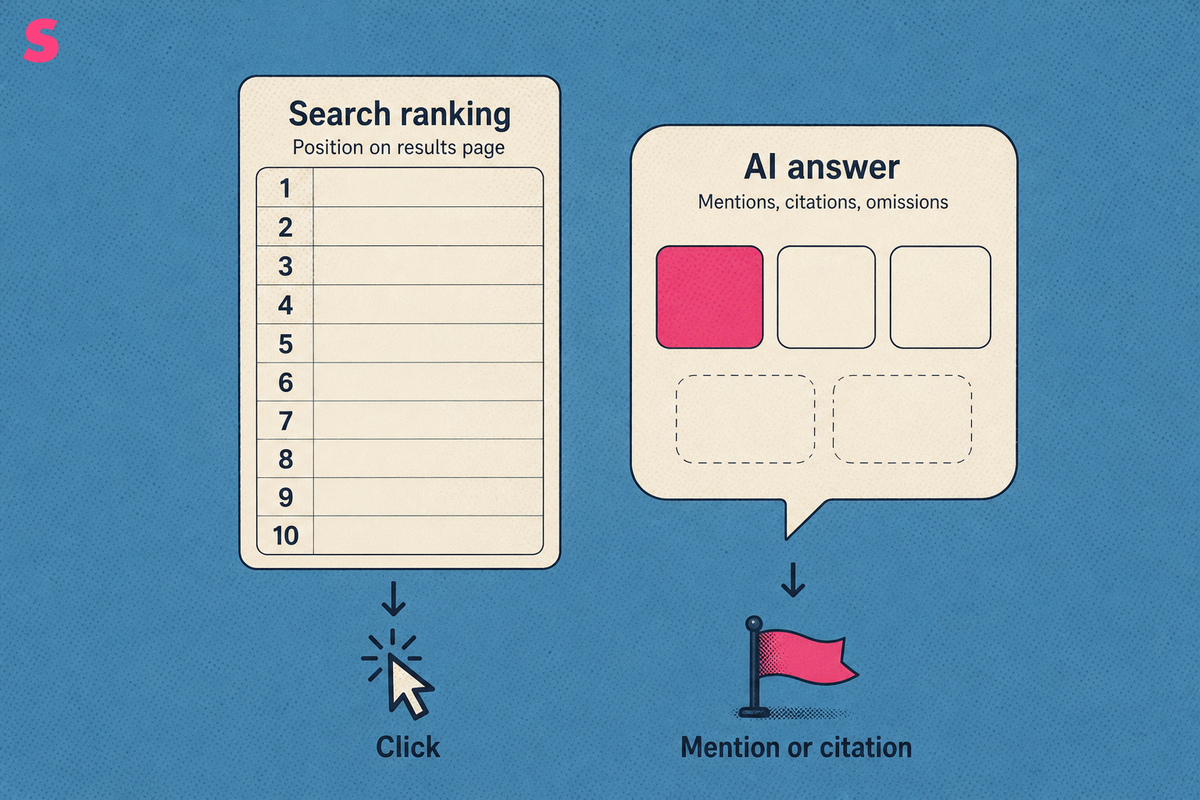
AI visibility is how often, how prominently and how accurately a brand appears inside AI-generated answers, measured against competitors across a fixed set of prompts. The engines in scope include ChatGPT, Google AI Overviews, Perplexity and Gemini.
A search ranking is a position on a results page, such as third for one keyword on one day. An AI answer has no page of ten links. The engine composes a response, names some brands, cites some URLs and omits the rest. Change the wording, the country or the date and the composition changes. Visibility is therefore a rate across repeated samples, not a position.
- Unit of measure: a ranking scores a URL; answer visibility scores a brand's presence in a response.
- Stability: a ranking holds for days; an answer shifts with wording, model, location and date.
- Success event: a ranking earns a click; an answer earns a mention, a citation or a recommendation, often with no click.
Buyers shortlist vendors inside these engines before they visit a site. A team that tracks only Google positions cannot see that shortlist forming, and the shortlist decides who earns the visit.
What is AI visibility not, and what is it commonly confused with?
Presence in AI answers is not a ranking, not traffic and not the optimization work itself. It is the measured outcome. Five neighbouring concepts get mistaken for it, and each answers a different question.
- SEO rankings: positions on a results page. They overlap with AI answers, since engines retrieve ranked pages, but a page that ranks well can still go uncited.
- AI referral traffic: visits that arrive from an engine. A brand can be recommended in a zero-click answer and record no visit.
- Answer engine optimization (AEO) and generative engine optimization (GEO): the practices that change the outcome. Visibility is the number they try to move.
- Crawl access: an AI crawler fetching a page is a precondition, not a citation.
- Brand awareness surveys: they measure what people recall, while visibility tracking measures what an engine says.
Mention counts say whether a brand appeared. They do not say whether appearing produced a visit, a pipeline dollar or a closed deal.
Which signals make up AI visibility: mentions, citations, share of voice, position and sentiment?
Five signals make up the measurement: mentions, citations, share of voice, position and sentiment. Each is calculated per prompt and per engine, then aggregated.
- Mention: the brand name appears in the answer. Mention rate is answers naming the brand divided by answers sampled.
- Citation: the answer links or attributes a URL from the brand's domain. It is stronger than a mention, because the engine retrieved a page.
- Share of voice: the brand's mentions as a fraction of all brand mentions across the same prompts.
- Position: where the brand sits in a list-style answer. First named carries more weight than fifth.
- Sentiment: whether the description is positive, neutral or negative.
Suppose a team runs 50 prompts on 3 engines once a day, which is 150 answers. The brand is named 30 times and competitors 90 times. Mention rate is 20%; share of voice is 30 of 120 mentions, or 25%.
Weight prompts by intent. A high rate on an informational, awareness-stage prompt is worth less than a lower rate on a commercial, decision-stage one.
How does AI visibility tracking work across ChatGPT, Google AI Overviews, Perplexity and Gemini?
Tracking runs the same prompts against each engine on a schedule, records what each answer says, and compares results over time. The procedure is identical on ChatGPT, Google AI Overviews, Perplexity and Gemini, even though each formats answers differently.
- Build a fixed prompt set from buyer questions, grouped by topic and intent.
- Run every prompt on every engine daily, from the same location.
- Store the answer text, brands named, cited URLs and order.
- Score the sentiment of each mention.
- Normalize against named competitors.
Collection method matters. Some tools capture the end-user experience directly, scraping the response the way a person sees it, ads and formatting included. Others pull from a vendor's official API, which returns a structured response that does not necessarily match the screen. The two methods can capture different answers. Sona aims to mirror the end-user experience as closely as possible and uses both. Sona's own AI visibility data, September 2026, covers 8 answer surfaces: ChatGPT, Google AI Overviews, Perplexity, Google AI Mode, Gemini, Mistral, Qwen and Claude.
A single brand-level score is not a work item; a prompt-level view is. Sona's AI Search Insights shows which prompts surface the brand and which cited sources drive each answer, with share of voice per engine tracked daily, so a team knows which page or source to change.
What makes an AI visibility metric reliable when answers change between prompts and dates?
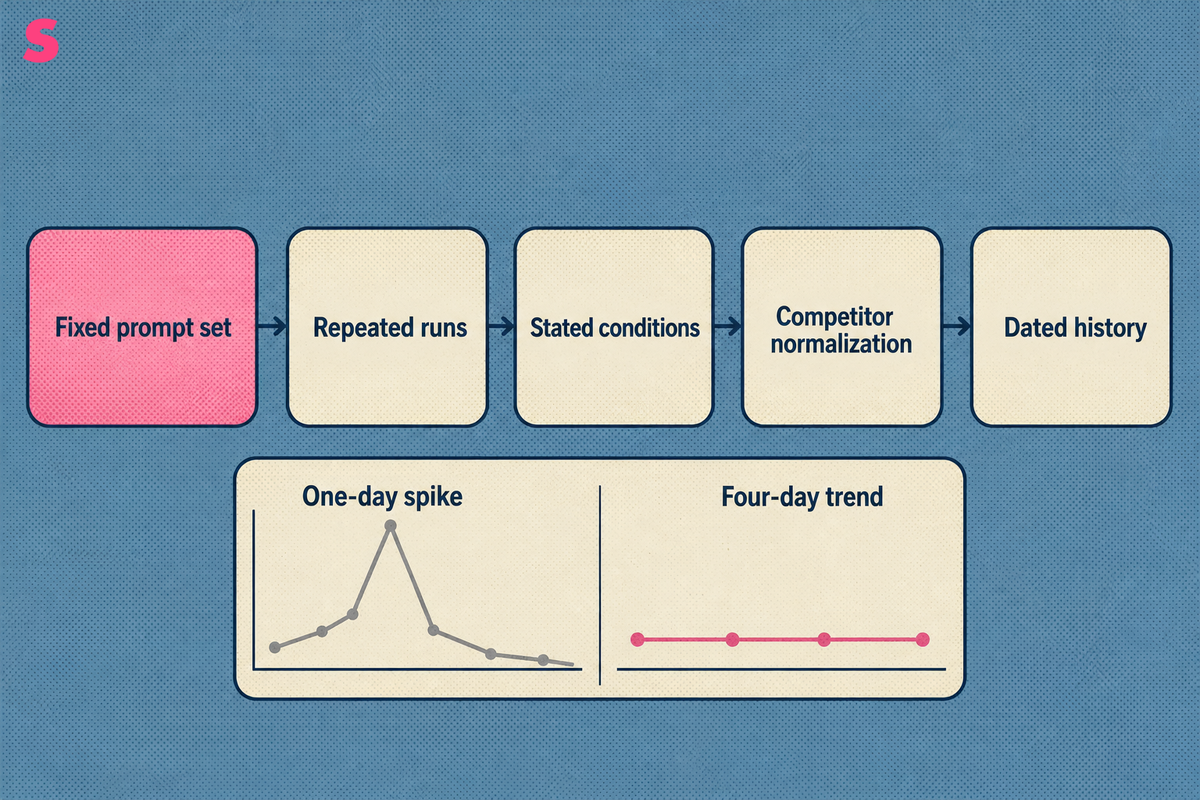
A reliable metric comes from repeated sampling of a fixed prompt set, with engine, location and date recorded, and it is read as a range or a trend. One run of one prompt shows what one answer said on one day.
- Fixed prompt set: change the prompts and the trend breaks.
- Repeated runs: several samples per prompt show the spread.
- Stated conditions: engine, model, location and collection method.
- Competitor normalization: a shift across the whole answer is not a brand gain.
- Dated history: every reading is kept with its date.
Run the prompt list daily. An engine's answer shifts with its retrieval index, a model update and whatever a competitor published last week. A change that holds four days running is a trend; a one-day spike is not. A weekly snapshot would average that pattern away.
A score is a dated snapshot; the comparable series of scores is what shows a trend. Review the narrative and competitive benchmark quarterly, and re-audit pages monthly.
What decides whether an AI engine mentions a brand, cites its page or recommends a competitor?
Four things decide it: whether the engine can reach the page, whether the page answers the prompt specifically, whether independent sources corroborate the brand, and how firmly competitors hold the same prompt. Fail one and a competitor fills the slot.
- Access: retrieval and agent crawlers fetch pages for live answers; training crawlers fetch for model training. A robots.txt rule, WAF block or rate limit can shut either out, often by accident.
- Page fit: pages that state the answer plainly, with specific figures, schema markup and a recent update date, are easier to extract.
- Corroboration: third-party coverage, reviews and listings that repeat the brand's claims.
- Competitor presence: an established competitor on a comparison prompt is hard to displace.
Sona reads AI crawler activity from server logs or a lightweight edge worker, with no JavaScript tag, so ad blockers do not hide which bots reach which pages. The free Sona AI Crawl Checker tests 45 AI crawlers and returns the reason each blocked bot fails. If a crawler never reaches a page, there is no citation, no visit and no revenue.
How do you improve AI visibility without turning optimization into gaming?
Improve a brand's presence in AI answers by making its pages better sources, then re-measuring on the same prompts. Gaming manipulates the engine instead: hidden text, prompt injection on pages, fabricated reviews, mass-produced thin pages. Engines resample constantly, so those gains are short-lived and they corrupt the metric.
- List gap prompts: prompts where competitors appear and the brand does not.
- Confirm crawler access for retrieval and agent bots.
- Rewrite the page that should own each prompt: direct answer first, specific figures, FAQPage schema for real questions, a visible update date.
- Earn credible third-party coverage that corroborates those claims.
- Re-run the same prompt list daily and compare against the baseline.
Sona's Free AI Readiness Checker runs 35 checks across six categories and returns a 0 to 100 score with a letter grade in about 30 seconds. It tests whether engines can crawl and parse a page, not whether the brand appears in answers. Sona re-audits key pages on an ongoing basis and ranks fixes by severity, which turns a one-off snapshot into a worklist.
How do you connect AI visibility to qualified traffic, pipeline and revenue?
Tag AI-referred sessions by engine, resolve each visit to an account, place those touches on one timeline with ad, web and CRM data, and report pipeline by engine and prompt. A brand can be named often and produce no qualified visit.
- Segment sessions referred by each AI engine in analytics.
- Resolve anonymous visits to accounts and contacts.
- Stitch those touches onto one account timeline beside ads, web and CRM activity.
- Add a "how did you hear about us" field to demo and signup forms, to catch buyers who researched in an engine and arrived as direct traffic.
- Report pipeline, closed deals and revenue by engine and prompt.
Most trackers stop at mention counts; Sona AI Visibility connects citations and prompts to pipeline and revenue on one account timeline. Sona resolves the anonymous accounts behind AI-referred visits, 100% cookieless, infers the prompt behind each visit and scores the account from 0 to 100 on intent. It then acts through Slack alerts, CRM sync and live ad audiences.
What do AI visibility tools cost, and what should you compare before choosing one?
Entry plans run from $24.99 to $295 per month, per cheers.tech, based on vendor pricing pages reviewed on September 23, 2026. Advanced subscriptions with CRM integrations and enterprise features run $800 to $3,000 per month, per business.com, updated October 13, 2026. The list price matters less than the unit behind it.
- Engines tracked: the count and the names, for the plan being priced.
- Prompt unit: slots, credits or responses, converted to daily answers.
- Refresh cadence: daily, or unstated.
- Agency plans: a named multi-client offer.
- Revenue link: whether visits resolve to accounts and pipeline.
| Tool | Starting price | Agency Plans? (Yes/No) | # of Answer Engines Tracked | Answer Engines | # of Daily Tracked Prompts (entry plan) | Cost per Daily Tracked Prompt | Differentiation |
|---|---|---|---|---|---|---|---|
| Sona AI Visibility | Brands from $75/month, agencies from $199/month, both billed annually. 14-day free trial, no credit card. Unlimited seats and API/MCP access on every plan | Yes | 11 | ChatGPT, Gemini, Google AI Mode, Google AI Overviews and Perplexity on standard, plus Claude, DeepSeek, Grok, Copilot, Qwen and Mistral on premium | 5,000 credits/month on Starter 5K, about 166 daily tracked prompts on one model or 56 across three. 1 credit = 1 AI answer | $0.45 per daily tracked prompt | Connects AI citations and prompts to pipeline and revenue on one account timeline, and tracks AI crawler activity with no JavaScript tag |
| Peec AI | From $95/month (Starter), $245 (Pro), $495 (Advanced) billed monthly, 15% off annually; Enterprise custom | Yes | 3 | Pro and Advanced: ChatGPT, Google AI Mode, Google AI Overviews, Microsoft Copilot, Gemini and Naver AI | 50 prompts on Starter, 150 on Pro, 350 on Advanced, tracked daily on every plan | $0.63 per daily tracked prompt | Unlimited users on every plan; extra models are a paid add-on |
| Profound | Quote-only, no public pricing. 7-day free trial | Not published | 3 | ChatGPT, Gemini and Google AI Overviews | 50 prompts run daily on the trial; Enterprise allowances are custom | No refresh cadence published | Custom Enterprise pricing after a 7-day trial |
| Otterly.ai | From $29/month (Lite), $189 (Standard), $489 (Premium) billed monthly, or $25, $160 and $422 billed annually; Enterprise custom | Not published | 4 | ChatGPT, Google AI Overviews, Perplexity and Microsoft Copilot | 15 prompts on Lite, 100 on Standard, 400 on Premium, checked daily on every plan | $0.48 per daily tracked prompt | Unlimited team members on every plan; free trial, no commitment |
| Scrunch AI | From $250/month (Starter) or $300 monthly, $417 (Growth) or $500 monthly; Enterprise custom | Not published | 6 | ChatGPT, Claude, Gemini, Perplexity, Google AI Mode, Google AI Overviews and Meta | 350 custom prompts plus 1,000 industry prompts on Starter; 700 plus 2,500 on Growth | No refresh cadence published | Splits custom prompts from industry prompts; 7-day Starter trial, no credit card |
| AthenaHQ | From $295/month (Starter) billed monthly, 17% off annually; Enterprise custom | Not published | Not published | Not published | 3,600 credits on Starter, where 1 credit is 1 AI response | $2.46 per daily tracked prompt | Free Essential tier with 300 credits |
| PromptWatch | Essential $95/month, Professional $245, Business $579 | Yes | 4 | ChatGPT, Claude, Gemini and Perplexity | 50 prompts and 6,000 responses/month on Essential, with 500 agent credits | $0.48 per daily tracked prompt | Agency plans from $199/month (Kick-off) |
Prices in the table were read from each vendor's own pricing page in October 2026. Cost per daily tracked prompt is the entry price divided by the AI answers the plan buys per day, on one shared denominator: one prompt, one engine, once a day. Dividing by each vendor's own prompt count would mislead, because some count per engine and others across all engines. The column is a unit price, not a ranking.
Frequently Asked Questions
What is AI visibility in simple terms?
It is how often, how prominently and how accurately a brand shows up in AI-generated answers. Teams measure it against competitors across a fixed set of prompts, so the result is a comparable rate rather than a one-off observation.
Is AI search visibility the same as SEO?
No. SEO measures ranked positions on a results page. AI search visibility measures presence inside a generated answer, which varies by prompt, engine and date. The two overlap, since engines retrieve ranked pages, but teams track them differently.
How do you track visibility in AI answers?
Define a fixed prompt set and run it daily on each engine. Record mentions, cited URLs, position and sentiment. Normalize against competitors so trends stay comparable over time.
Can one visibility score be trusted?
Only as a range. Outputs vary by wording, model, location and date, so a single number implies false precision. Repeated sampling and trend lines are more defensible than any one reading.
How do you improve visibility in AI answers?
Make pages clear, specific and easy for crawlers to read. Earn credible third-party coverage. Close the gaps where competitors appear and you do not, then re-measure on the same prompt set.
Do AI mentions lead to revenue?
Not automatically. A brand can be mentioned often without producing qualified visits. Tie mentions to AI-referred traffic, account activity, pipeline and closed deals to see what they are worth.
Summarize this article with AI: ChatGPT · Claude · Perplexity · Google AI Mode
Last updated: October 2026