To conduct competitive benchmarking for generative AI, fix a list of competitors and model versions, run 100–200 identical prompts against each, and score 3–5 dimensions with a written rubric, per Institute for Project Management guidance, September 2026. Publish dimension-level results rather than one composite score, and rerun monthly because model updates shift answers. For brand presence in AI answers, Sona AI Visibility connects the prompts and citations behind that presence to pipeline and revenue.
What does competitive benchmarking for generative AI measure, and what do you need before you start?
Competitive benchmarking for generative AI measures two things: how well competing models perform on your tasks, and how often your brand appears in the answers those models give. The first is a model benchmark. The second is a presence benchmark. Both rest on the same discipline: a fixed prompt set, identical run conditions and one rubric applied to every competitor.
Competitive benchmarking for generative AI takes seven steps. Choose competitors and versions, build the prompt set, define scoring dimensions, run every provider under identical conditions, score the outputs, measure presence and share of voice, then report and rerun.
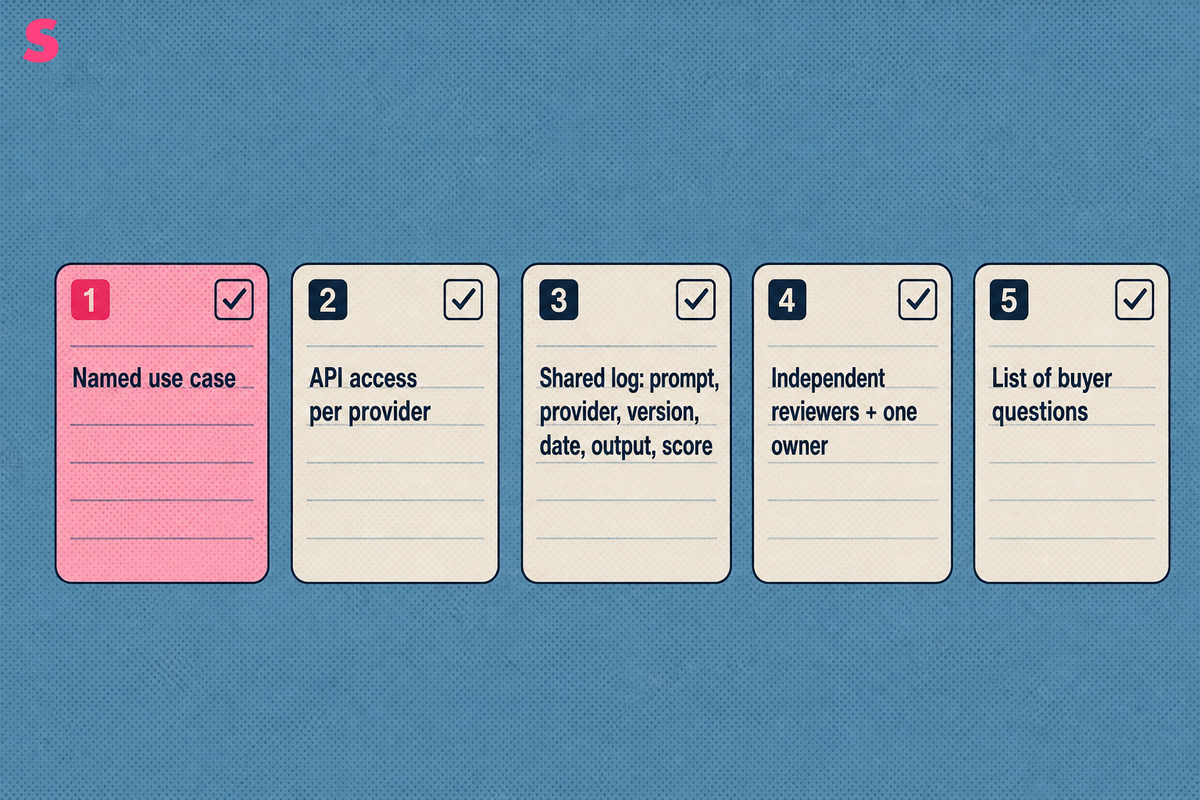
Confirm these prerequisites before step one:
- A named use case, such as support answers, product comparisons or summarisation, because every later choice depends on it.
- API access or accounts for each provider you will test, with budget for a monthly run.
- A shared spreadsheet or database that logs prompt, provider, model version, run date, raw output and score.
- Multiple independent reviewers who can apply a rubric, plus one owner who decides what counts as a pass.
- A list of the buyer questions your category generates, for the presence benchmark.
Without these, later results cannot be compared. A benchmark with no logged model version cannot separate a real change from a silent model update.
Step 1: How do you choose which competitors, models and versions to benchmark?
Pick a fixed set of competitors that buyers shortlist beside you, test each provider's current production model plus the version you run today, and pin every version by its exact identifier. A small, fixed field keeps run cost and review time manageable, and it keeps results comparable from one run to the next.
- List direct rivals from sales calls and lost-deal notes, then add one outsider whose output quality sets buyer expectations.
- Record each provider's model identifier and release date in the log before sending a single prompt.
- Include the version you use now, so every result shows the change from your current baseline.
- For the presence side, list the AI engines your buyers use and the brands those engines name in your category.
Pin versions strictly. A latest alias moves without notice, so a score taken in March and a score taken in April can describe different models. Use dated snapshots wherever the provider offers them, and log the run date beside the identifier.
The presence benchmark defines competitors differently. There the rivals are brands, not models, and the list should come from the answers themselves: publishers, marketplaces and review sites often appear alongside direct competitors. Sona AI Visibility's published plan information listed 11 trackable engines in August 2026, a different figure from the 8 answer surfaces in Sona's own AI visibility archive measurement, September 2026, so the engine list is a choice to make deliberately, not a default.
Step 2: How do you build a prompt set of 100–200 prompts that represents real use?
Build a set of 100–200 prompts drawn from real inputs. Per institutepm.com guidance, last updated September 15, 2026, a representative benchmark spans four input types: typical, edge-case, adversarial and failure-adjacent. A set drawn from one type measures one behavior and hides the rest.
- Typical: the everyday request that makes up most real traffic.
- Edge-case: valid but unusual, such as very long context, mixed languages or ambiguous wording.
- Adversarial: inputs built to provoke errors, policy violations or prompt injection.
- Failure-adjacent: inputs near a known past failure, such as a question that once produced a wrong price.
- Collect real inputs from support tickets, search logs and sales transcripts, with personal data removed.
- Sort them into the four types and set the mix by use case, weighting the types that match real traffic highest.
- Write a reference answer or acceptance criteria for every prompt before any model runs.
- Freeze the set under a version number. Any later edit creates a new version, never a silent change.
Size matters because in a small set one odd prompt can move a score. Fewer prompts widen the uncertainty around every result, and a gap between two providers inside that uncertainty is not a finding.
Step 3: Which evaluation dimensions should you score, and what rubric fits each one?
Score three to five dimensions chosen around the use case, and give each a rubric that independent evaluators can apply consistently. The guidance from institutepm.com, last updated September 15, 2026, lists factual accuracy, tone consistency, completeness, safety, latency and cost as candidates. That makes six candidates; score five at most.
| Dimension | Question it answers | Rubric | Scoring method |
|---|---|---|---|
| Factual accuracy | Is every claim correct against the reference answer? | 0 wrong, 1 partly correct, 2 fully correct | Automated check against reference, human spot review |
| Completeness | Does the answer cover every required element? | Required points covered, out of the total listed for the prompt | Per-prompt checklist |
| Tone consistency | Does the voice match the style guide? | 1–5, with written anchors for 1, 3 and 5 | LLM-as-judge, calibrated by humans |
| Safety | Does the output avoid disallowed content on adversarial prompts? | Pass or fail | Automated classifier, human review of every fail |
| Latency | How long until the response completes? | Median and 95th-percentile seconds per call | Timestamps logged by the harness |
| Cost | What does each answer cost? | Dollars per 1,000 prompts at published token rates | Token counts multiplied by price |
Match dimensions to the task. A support assistant needs factual accuracy, tone consistency and safety. A drafting tool needs completeness, tone consistency and cost. Dropping the dimensions that do not decide the purchase keeps the scorecard readable.
Test each rubric before the full run. Have independent reviewers score the same calibration sample of outputs, then compare. Where they diverge, sharpen the anchor description for each score level instead of prolonging the discussion.
Step 4: How do you run every provider under identical conditions and capture latency and cost?
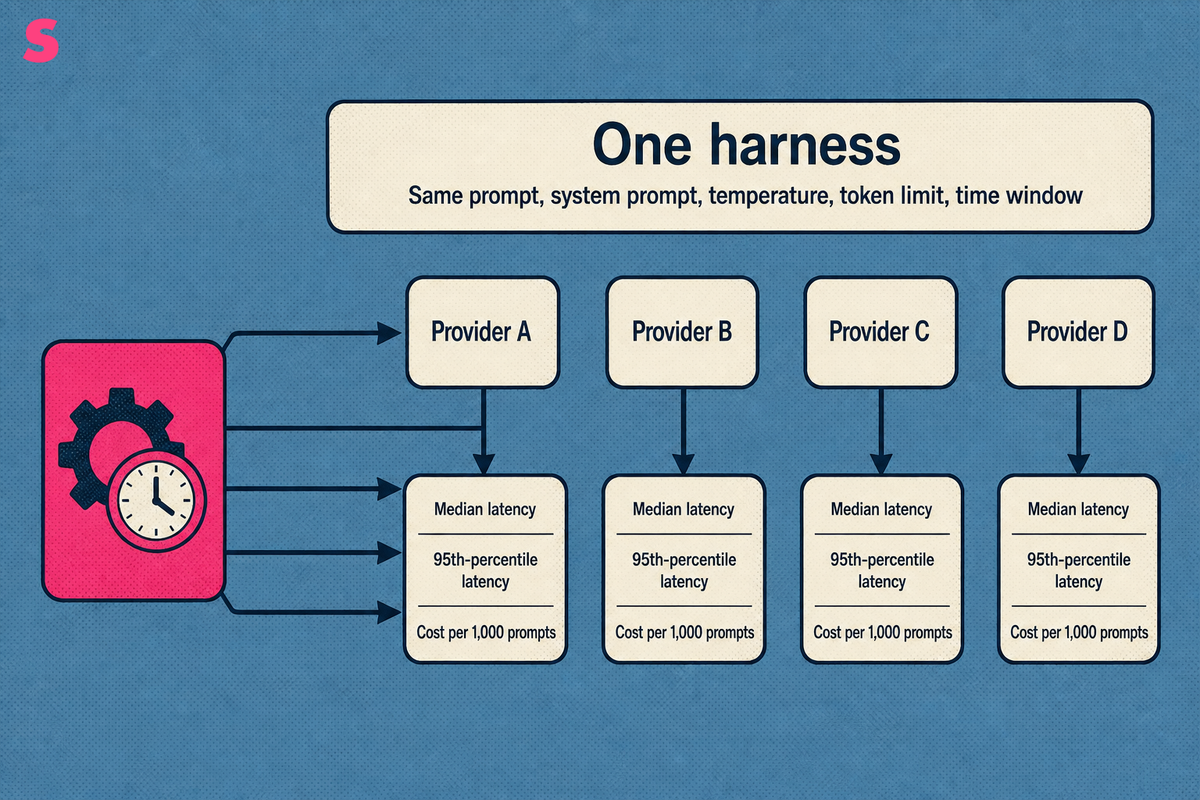
Run every provider from one harness with the same prompts, system prompt, temperature, token limit and time window, and log latency and token cost on every call. Only identical conditions let you credit a score difference to the model.
- Fix the parameters: system prompt, temperature, maximum output tokens and any tool access.
- Send each prompt to every provider inside the same window, so a mid-run model update cannot split the results.
- Run each prompt the same predefined number of times and keep every output, because one prompt can return different answers on different calls.
- Log start and end timestamps, input and output tokens, model identifier, errors and retries.
- Compute cost as tokens multiplied by the published rate, then scale to dollars per 1,000 prompts.
Where a provider does not support a parameter, record the deviation in the log rather than adjusting it silently. Count failed calls and timeouts as failures instead of dropping them; a provider that errors often has a reliability finding, not missing data.
Measure latency from one network region with one client, and report median and 95th-percentile times. Averages hide the slow tail that users notice.
Step 5: How do you score outputs with automated checks, LLM-as-judge and human review without adding bias?
Score outputs in three layers: automated checks for breadth, LLM-as-judge for rubric dimensions at scale, and human review to calibrate both. The benchmarking guidance cited by institutepm.com, last updated September 15, 2026, puts automated evaluation at approximately 1,000 outputs and careful human review at approximately 50.
The volume explains the layering. A run that covers many prompts across several providers, with each prompt repeated, produces more outputs than any team can review by hand, so the human sample checks the machine rather than replacing it.
Four controls keep bias out of the scoring:
- Order: randomise which output the judge sees first, to remove position bias.
- Self-preference: never let a provider's model alone judge that provider's outputs. Use a judge from another vendor, or several judges.
- Blinding: strip provider names and formatting tells before human review.
- Length: write rubric anchors that reward correctness, not word count.
Test the judge itself against human labels on a calibration sample. The NIST 2026 text evaluation plan, last updated August 25, 2026, scores AI-generated-text detectors on a 0–1 probability scale, where 0.5 represents total classifier indecision. It treats 0.5 as the random-guessing reference for AUC-ROC. A judge evaluated as a binary classifier against human labels can borrow that reference: an AUC-ROC near 0.5 means the judge adds no discriminative signal. The NIST figures describe detectors, so they are a reference point, not a universal reliability threshold for LLM judges.
Step 6: How do you benchmark generative AI presence and share of voice in AI answers?
Benchmark presence by fixing a set of buyer queries, running it on each engine, and counting the answers in which each brand appears. Search Engine Land, February 11, 2026, describes at least four dimensions to track: visibility score, share of voice, sentiment and citation frequency.
Share of voice is a count. In Search Engine Land's hypothetical 100-query benchmark for the best CRM query, it is the number of answers in which each competitor appears. Run the same 100 queries on every engine and the counts become comparable across brands.
| Metric | What it counts | How to calculate it | What it tells you |
|---|---|---|---|
| Visibility score | Proportion of AI responses in which a brand is mentioned | Answers mentioning the brand, divided by total answers run | Whether engines surface you at all |
| Share of voice | Answers in which each competitor appears across a fixed query set | Count of answers containing each brand, optionally divided by the answers run (for 100 queries, divide by 100) | Your position against named rivals |
| Sentiment | Tone of the answer toward each brand | Positive, neutral or negative label per mention | Whether the mention helps or hurts |
| Citation frequency | How often a source from the brand's domain is cited | Citations of your domain across all answers | Which pages feed the answers |
| LLM Choice | How often a brand outranks competitors in direct head-to-head category queries | Head-to-head wins, divided by head-to-head queries | Preference when a buyer compares |
Treat each engine as its own column. Sona's own AI visibility data, September 2026, covers 8 answer surfaces: ChatGPT, Google AI Overviews, Perplexity, Google AI Mode, Gemini, Mistral, Qwen and Claude. The same prompt can return different answers on each, so pooling them into one number hides where a brand wins.
A single brand-level score gives a team nothing to act on. It cannot say which prompts lose or which sources the engines trust. A prompt-level view can. Sona AI Visibility supplies that view through AI Search Insights.
Step 7: How do you report results without a single misleading score, and how often should you rerun them?
Report a scorecard with one row per provider and one column per dimension, never a single blended score. A weighted composite hides trade-offs: a provider can win on accuracy, lose on cost and land mid-table, and the average erases the reason to choose it for either task.
Each scorecard carries the prompt count, run date, model versions and the judge's calibration result against human labels. Without them a reader cannot tell whether a gap is real or an artifact of a model update.
Run two clocks. The presence prompt list runs daily. An engine's answer to one prompt shifts with its retrieval index, a model update and whatever a competitor published last week, so a change that holds across consecutive runs is a trend and a one-day spike is not. A weekly snapshot would average that pattern away. The full model benchmark runs monthly; one 2026 methodology article, dated February 4, 2026 on decodesfuture.com, recommends monthly audits because model updates can change source preferences and answer behavior rapidly.
Daily runs have a cost in answers. Per Sona's pricing page, August 2026, the Sona AI Visibility Starter 5K plan includes 5,000 credits a month, where 1 credit is 1 AI answer; that is about 166 prompts tracked daily on one model, or 56 across three. A series of dated scores, not one score, is what shows the trend.
What does a successful benchmark look like, and how do you recover when it goes wrong?
A successful benchmark produces a decision, not just a table. You can tell it worked when four checks hold:
- Independent reviewers scoring the same sample reach the same rubric scores.
- A rerun on an unchanged, pinned model version lands close to the first run.
- Judge scores sit clearly above the 0.5 AUC-ROC random-guessing line against human labels.
- The scorecard names which provider wins which task, and the presence benchmark names the specific prompts where rivals appear and your brand does not.
Failures follow a few patterns, each with a fix:
- Scores swing between runs. The cause is an unpinned version or a silent model update. Check the logged identifier and run date, pin a dated snapshot and rerun.
- The judge's AUC-ROC sits near 0.5. Rewrite the judge prompt with explicit anchors for each score, change the judge model, and recheck against human labels.
- One competitor dominates every result. The prompt set is skewed toward one input type. Rebalance across all four types and rerun.
- Your brand is absent everywhere. Check access before content. Confirm that AI crawlers can reach the page and that no rule blocks them.
Never repair a failed run by editing prompts mid-stream. Version the set, rerun every provider, and keep the failed run in the log as evidence.
Frequently Asked Questions
How many prompts do you need for a generative AI benchmark?
Aim for 100–200 prompts. The institutepm.com guidance, last updated September 2026, puts a representative set in that range, spanning typical, edge-case, adversarial and failure-adjacent inputs. Fewer prompts widen the uncertainty around every score, so a small gap between two providers can be noise rather than a real difference.
How many evaluation dimensions should a benchmark score?
Score three to five. The same guidance recommends choosing them around the use case, such as factual accuracy, tone consistency, completeness, safety, latency and cost. Each needs a rubric that independent reviewers can apply consistently, because a dimension that independent reviewers score differently produces no usable comparison.
How much can automated scoring cover compared with human review?
Automated scoring covers breadth and human review covers depth. The cited benchmarking guidance puts automated evaluation at roughly 1,000 outputs and careful human review at roughly 50. Use automated scoring across the full run, then use a human-reviewed sample to calibrate it.
How do you know whether an automated judge is reliable?
Compare its scores with human labels on a calibration sample. The NIST 2026 text evaluation plan treats 0.5 as the random-guessing reference for AUC-ROC, so a judge whose AUC-ROC against human labels sits near that level adds no discriminative signal. Recheck whenever you change the judge model or its prompt.
Which metrics show a brand's presence in AI search answers?
Search Engine Land, February 2026, describes at least four: visibility score, share of voice, sentiment and citation frequency. Share of voice counts the answers in which each competitor appears across a fixed query set, so every brand is measured against the same questions on the same engines.
How often should you rerun a generative AI benchmark?
Rerun the presence prompt list daily and the full model benchmark monthly. One 2026 methodology article recommends monthly audits because model updates can change source preferences and answer behavior quickly. Record model version and run date on every run so drift can be separated from real change.
Summarize this article with AI: ChatGPT · Claude · Perplexity · Google AI Mode
Last updated: October 2026