An AI-powered answer engine is software that retrieves sources, writes a synthesized answer to a question and cites where it came from, instead of returning a list of links. B2B buyers now use these engines to shortlist vendors. Whether your brand is cited is only half the picture; Sona AI Visibility ties the prompts and citations behind those answers to pipeline and revenue. Treat results as repeated-run samples, because outputs vary by run, location and model.
What is an AI-powered answer engine, and how is it different from a search engine or chatbot?
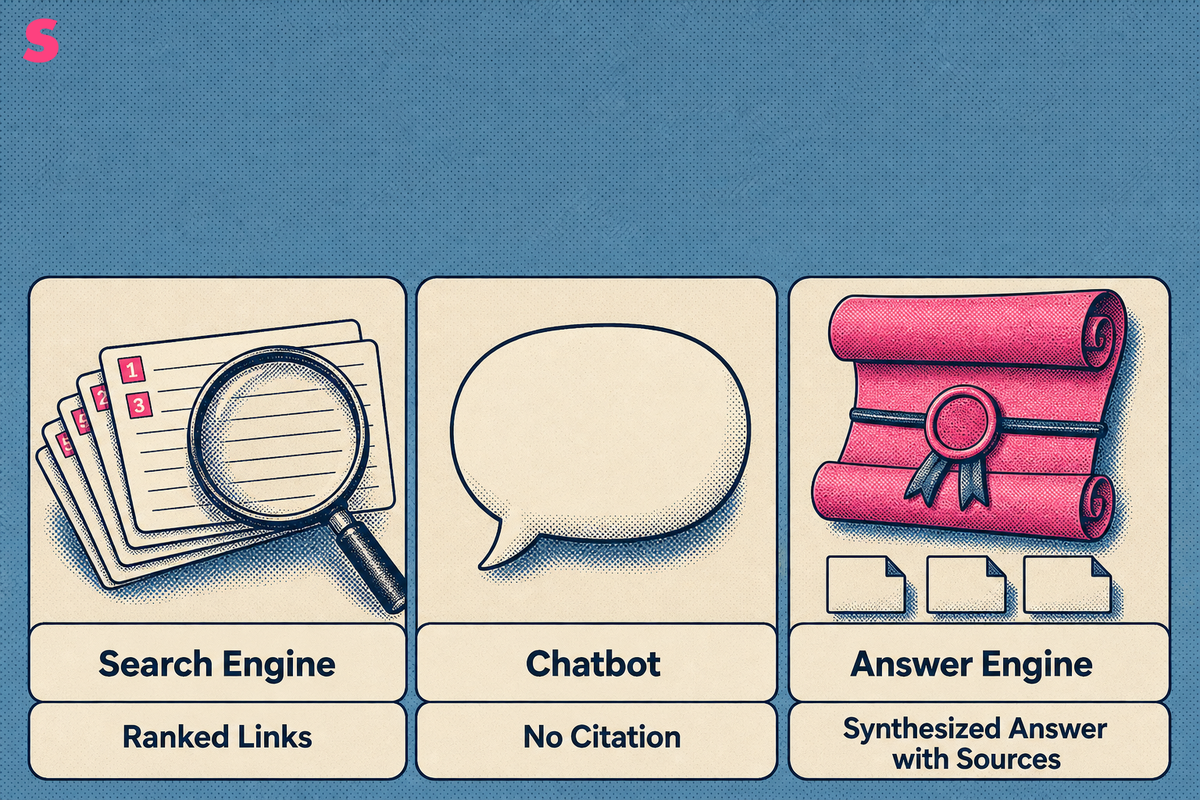
An AI-powered answer engine takes a question in natural language, retrieves information from indexed or live sources, and returns one synthesized answer with cited sources instead of a ranked list of links. The buyer reads the answer. The sources sit beneath it.
Three systems get confused, so the boundaries matter:
- Search engine: matches a query to an index and returns ranked links. The reader does the synthesis.
- Chatbot: generates a reply from model training data and may retrieve nothing. No citation is guaranteed.
- Answer engine: retrieves passages, synthesizes them with a large language model (LLM), and attaches citations.
Take a buyer who asks, "Which attribution software suits a B2B SaaS team on HubSpot?" A search engine returns ten links. An answer engine returns a three-vendor shortlist with reasons and sources, and the buyer can stop reading there.
One product can play both roles. ChatGPT acts as a chatbot when it answers from memory and as an answer engine when it searches the web and cites pages. Google AI Overviews is a feature inside Google Search, not a separate product. Answer engine optimization (AEO) is the discipline of earning mentions in these answers, not the engine itself.
Why does an AI-powered answer engine matter to a marketing team with a pipeline target?
An answer engine matters because buyers form vendor shortlists inside the answer before they visit any website. A brand absent from the answer is absent from the shortlist. That is a pipeline problem, not a branding one.
The scale is disputed. A secondary marketing-statistics source, digitalapplied.com, reported on April 8, 2026 that AI-native answer engines drive 11–18% of discovery traffic across B2B SaaS. Validate that figure against your own referral data before budgeting around it.
The harder issue is attribution. A buyer researches in ChatGPT, then arrives later as direct traffic, and analytics credits no one. Marketing gains a new front door and loses the record of who walked through it.
Sona AI Visibility connects those citations to pipeline and revenue on one account timeline, and tracks AI crawler activity from server logs or a lightweight edge worker with no JavaScript tag, so a mention becomes something you can measure rather than a number to report.
How does an AI-powered answer engine retrieve, synthesize and cite sources?
An answer engine runs four stages: it expands the question, retrieves candidate passages, synthesizes a response with an LLM, and attaches citations to the sources it used. A brand can drop out at any of them.
- Query fanout. The engine rewrites one prompt into several sub-queries, such as pricing, integrations and alternatives.
- Retrieval. It pulls passages from a search index or the live web. A crawler blocked by robots.txt or a web application firewall (WAF) never reaches the page.
- Synthesis. The LLM merges the passages into one response and decides which brands to name.
- Citation. The engine links the sources that supported the answer. Some surfaces display them prominently and others bury them.
Here is the mechanism on a real prompt. A buyer asks for the best AEO tools for a SaaS team. The engine fans that into queries on price, engines covered and agency support, retrieves one passage per vendor page, and names the vendors whose passages answered each sub-query cleanly. A vendor whose pricing sits behind a demo form supplies no passage for the price sub-query.
Which AI answer engines matter most for B2B SaaS visibility?
Start with ChatGPT, Perplexity, Google AI Overviews and Google AI Mode, then add Gemini, Copilot and Claude as your referral data justifies. Those four cover the main chat-first and search-embedded surfaces, so they form a sensible baseline.
| Engine | Operator | Where the buyer meets it | Why it matters for B2B SaaS |
|---|---|---|---|
| ChatGPT | OpenAI | Chat interface that can search the web and cite pages | Open-ended vendor research and shortlists |
| Perplexity | Perplexity | Answer interface with sources beside the response | Category research with visible citations |
| Google AI Overviews | Summary at the top of a Google results page | Reaches buyers already searching your category | |
| Google AI Mode | Conversational mode inside Google Search | Longer, multi-constraint comparison questions | |
| Gemini | Google's AI assistant | A second view of Google-side answers | |
| Copilot | Microsoft | Microsoft's AI assistant | Buyers working inside Microsoft tools |
| Claude | Anthropic | Anthropic's AI assistant | Worth tracking once the first six show a baseline |
Engine coverage differs by tool. Sona's own AI visibility data, September 2026, covers 8 answer surfaces in its measurement archive: ChatGPT, Google AI Overviews, Perplexity, Google AI Mode, Gemini, Mistral, Qwen and Claude. Sona AI Visibility lets a customer track 11 engines. Choose the set by where your buyers ask, not by the longest list.
What makes an answer engine cite one SaaS company instead of another?
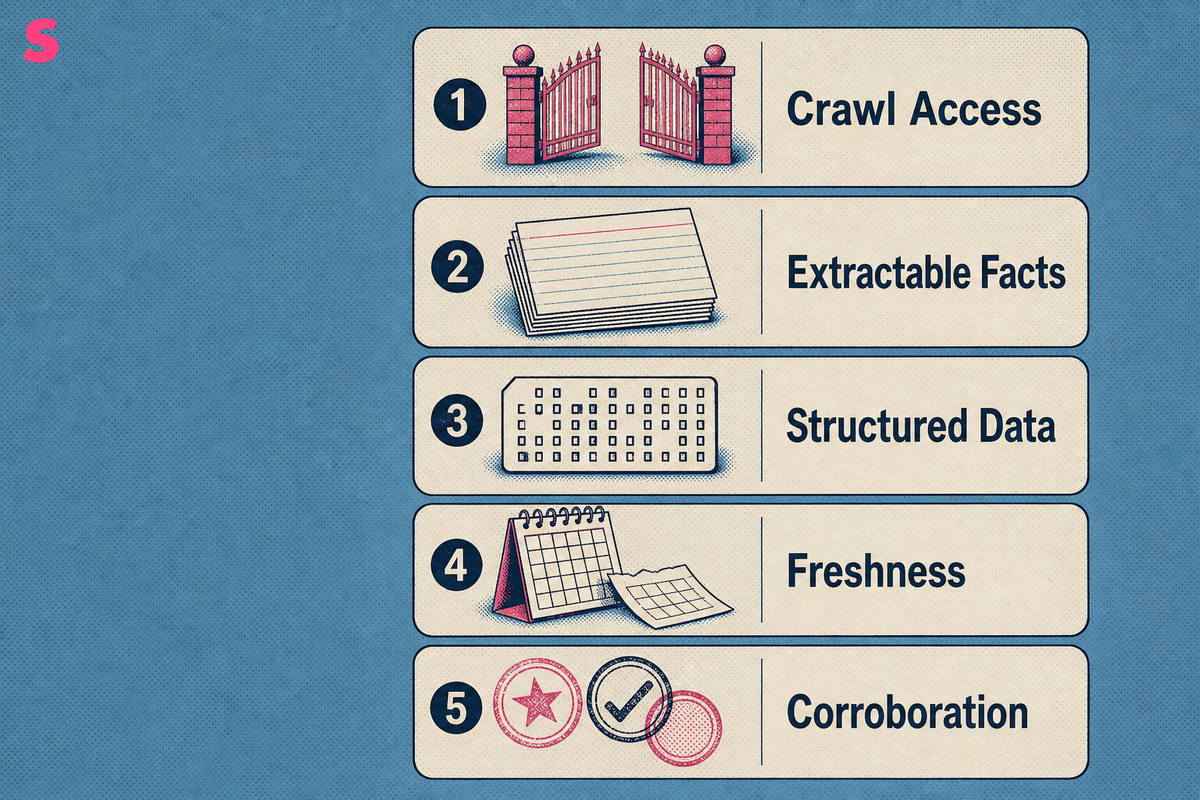
An answer engine cites the company whose page offers the clearest, most verifiable passage for a sub-query, on a page its crawler can reach. Nobody outside the engine knows the exact weights, so these factors are inferred from how retrieval works.
- Crawl access. Retrieval bots must load the page. The Sona AI Crawl Checker tests whether AI crawlers can reach a URL.
- Extractable facts. Pricing, integrations, limits and use cases stated in plain sentences give the engine something to lift.
- Structured data. FAQPage JSON-LD lets an engine extract question-and-answer pairs directly.
- Freshness. Engines with web retrieval weight recency, so a page untouched for months loses to a fresher source.
- Corroboration. Review sites, documentation and credible third-party pages that repeat your claims reinforce them.
Retrieval bots and training bots do different jobs. Retrieval bots decide whether a brand can be cited today. Training bots decide whether a model knows the brand later. A robots.txt file that blocks one group and not the other is a decision, and most sites make it by accident.
What does visibility in an AI-powered answer engine actually mean, and which metrics should you track?
Visibility is the share of answers to a fixed prompt list in which your brand is mentioned or cited. Track it per prompt and per engine, and pair it with metrics that show whether the mention was worth anything.
- Visibility: the percentage of runs in which the brand appears.
- Position: where the brand sits within the answer.
- Share of voice: your mentions against named competitors on the same prompts.
- Citations: which sources the engine cites, yours or third-party.
- Sentiment: how the answer describes you.
- Downstream outcomes: AI-referred visits, accounts and pipeline.
A single brand-level score is not a work item. A prompt-level view is, because it names the question you lose and the source the engine preferred. Sona AI Visibility, through AI Search Insights, shows page by page the prompts a site should appear in but does not, so a team knows which page to fix first.
A score is a dated snapshot. A team reads a trend from the comparable series of those scores over time.
How do AI answer engine monitoring tools compare on price, prompts and engines?
Entry plans in the table run from $29 to $399 per month, with one vendor quote-only. Entry prompt allowances use different units: Sona AI Visibility sells 5,000 credits a month, Otterly.ai counts 15 prompts on Lite, and Scrunch AI splits 350 custom prompts from 1,000 industry prompts on Starter. Price alone therefore misleads.
The table starts with Sona AI Visibility and sets six other tools beside it. Prices were read from each vendor's own pricing page between August and October 2026. The cost per daily tracked prompt divides the entry price by the AI answers the plan buys each day, on one shared denominator: one prompt, one model, once a day. Where a vendor publishes no refresh cadence, the cell says so instead of estimating. It is a unit price, not a ranking.
Limits climb quickly at higher tiers. Per nerdbot.com, September 21, 2026, one AEO platform lists a $499-per-month Growth plan with 8 AI-optimized articles, 150 tracked prompts and 5 selectable platforms, and a $999-per-month Pro plan with 350 tracked prompts.
| Tool | Starting price | Agency Plans? (Yes/No) | # of Answer Engines Tracked | Answer Engines | # of Daily Tracked Prompts (entry plan) | Cost per Daily Tracked Prompt | Differentiation |
|---|---|---|---|---|---|---|---|
| Sona AI Visibility | Brands from $75/month, agencies from $199/month, both billed annually. 14-day free trial, no credit card. Unlimited seats and API/MCP access on every plan | Yes | 11 | ChatGPT, Gemini, Google AI Mode, Google AI Overviews and Perplexity on standard, plus Claude, DeepSeek, Grok, Copilot, Qwen and Mistral on premium | 5,000 credits/month on Starter 5K, which is about 166 prompts tracked daily on one model, or 56 across three. 1 credit = 1 AI answer | $0.45 per daily tracked prompt | Connects AI citations and prompts to pipeline and revenue on one account timeline; tracks AI crawler activity from server logs or an edge worker, with no JavaScript tag |
| Peec AI | From $80/month (Starter), $205 (Pro), $420 (Advanced), Enterprise custom, billed annually. Unlimited users on every plan; 50, 150 and 350 prompts by tier | Not published | 6 | ChatGPT, Google AI Mode, Google AI Overviews, Microsoft Copilot, Perplexity and Gemini | 50 prompts on Starter, 150 on Pro, 350 on Advanced | No refresh cadence published | Prompt-level visibility tracking across six engines; unlimited users on every plan |
| Profound | Quote-only, no public pricing. 7-day free trial: 50 prompts, run daily. No self-serve price is published: a 7-day trial and custom Enterprise pricing only | Not published | 3 | ChatGPT, Gemini and Google AI Overviews | 50 prompts run daily on the 7-day trial; Enterprise allowances are custom | No refresh cadence published | Quote-based tracking across three engines; trial runs 50 prompts daily |
| Otterly.ai | From $29/month (Lite), $189 (Standard), $489 (Premium) billed monthly, or $25, $160 and $422 a month billed annually; Enterprise custom. Free trial, no commitment. 15% off annual; unlimited team members on every plan; Enterprise starts from 1,000 prompts | Not published | 4 | ChatGPT, Google AI Overviews, Perplexity and Microsoft Copilot | 15 prompts on Lite, 100 on Standard, 400 on Premium, checked daily on every plan | $0.48 per daily tracked prompt | Daily prompt checks on every plan; unlimited team members |
| Scrunch AI | From $250/month (Starter) or $300 monthly, $417 (Growth) or $500 monthly, Enterprise custom. 7-day trial of Starter, no credit card. 17% discount on annual billing | Not published | 6 | ChatGPT, Claude, Gemini, Perplexity, Google AI Mode and AI Overviews, and Meta | 350 custom prompts plus 1,000 industry prompts on Starter; 700 plus 2,500 on Growth | No refresh cadence published | Custom prompts alongside a set of industry prompts; 7-day Starter trial, no credit card |
| PromptWatch | Essential $95/month, Professional $245, Business $579. Agency plans from $199/month (Kick-off). | Yes | 4 | ChatGPT, Claude, Gemini and Perplexity | 50 prompts and 6,000 responses/month on Essential, with 500 agent credits | $0.48 per daily tracked prompt | Response-based allowance with agent credits; agency plan from $199/month |
| Goodie | From $399/month (Core), $999 (Pro), Enterprise custom. 7-day free trial on Core. Annual billing gives 2 months free; agency plan from $275/month, billed quarterly or annually | Not published | 5 | ChatGPT, Google AI Overviews, Perplexity, Google AI Mode and Copilot | 120 prompts on Core | No refresh cadence published | Core-tier tracking of 120 prompts across five engines; 7-day trial on Core |
How can you test whether answer engine results are stable enough to trust?
Run the same fixed prompt list every day on the same engines and locations, then check whether visibility holds across repeated runs. Set the persistence threshold, meaning how many consecutive runs a change must hold, before the test starts. A change that clears it is a trend; a movement that does not is unconfirmed.
- Freeze a list of the buyer questions that precede a shortlist, and do not edit it mid-test.
- Run each prompt daily on each engine, in one location, recording mention, position and cited sources.
- Repeat one prompt several times in a single day to measure the spread within that day.
- Flag any move that holds for the persistence threshold you set in advance, and treat shorter swings as unconfirmed.
- Note which collection method produced each result.
A team that runs the same prompt list daily sees patterns a weekly snapshot would have averaged away. Daily runs are standard across the category, not one vendor's feature. Only the prompt list needs that clock; technical re-audits and competitive benchmark reviews belong on a monthly or quarterly one.
Collection method also changes results. Some offerings capture the end-user experience directly, scraping the response the way a person would see it. Others pull data from a vendor's official API, which returns a structured response that need not match the screen. The two methods can capture different answers.
What are the limits of optimizing for AI-powered answer engines?
The main limit is that no team controls what an answer engine says. Optimization raises the odds of a mention and guarantees nothing, so read results as a probability across many runs, never as a ranking you hold.
- Variance. The same prompt returns different answers by run, model, location and retrieval index.
- Proxy demand. Search volume is not prompt volume. Generative demand is inferred from Google demand, an imperfect proxy that under-counts conversational comparison queries.
- Citation is not revenue. A mention can occur with no qualified visit, so it must be connected to accounts and pipeline.
- Weak benchmarks. The 11–18% discovery-traffic figure rests on a single secondary source and needs local validation.
- No paid route. No reliable way exists to buy a citation, and manufactured mentions do not hold up.
Frequently Asked Questions
Is an AI-powered answer engine the same as ChatGPT?
No. ChatGPT is one product that behaves as an answer engine when it searches the web and cites sources. The category also includes Perplexity, Google AI Overviews and Google AI Mode, which differ in how they retrieve passages and display citations.
How is answer engine optimization different from SEO?
SEO aims to rank pages in a results list. AEO aims to get a brand mentioned or cited inside a synthesized answer. The two overlap in content quality and crawlability but are measured differently: SEO by rank and clicks, AEO by mention rate, citations and downstream pipeline.
Does being cited by an answer engine lead to revenue?
Not automatically. A citation can occur without a qualified visit, trial or opportunity. Teams need to connect cited prompts to visits, accounts and pipeline. Sona AI Visibility connects AI citations and prompts to pipeline and revenue on one account timeline.
Why do answer engines give different answers to the same question?
Outputs vary by run, model, location, account and retrieval index. One run proves little. Repeated daily runs against a fixed question set are needed before drawing conclusions, because only a change that persists across repeated runs, past a threshold set in advance, separates a real move from noise.
How many prompts should a SaaS team track?
Plan limits range widely and use different units. Sona AI Visibility's Starter 5K plan sells 5,000 credits a month, Otterly.ai's Lite plan allows 15 prompts, and Goodie's Core plan allows 120 prompts. Start with the buyer questions that precede a shortlist, then expand once the baseline is stable.
Can you pay to be cited in an answer engine?
Not reliably. The defensible route is factual clarity, first-party evidence, structured information and credible third-party sources that corroborate your claims.
Summarize this article with AI: ChatGPT · Claude · Perplexity · Google AI Mode
Last updated: October 2026