


AI SEO tools for ChatGPT brand visibility run a fixed group of prompts on a schedule and show how often your brand is mentioned, cited and recommended versus competitors. Pricing, prompt limits and engine coverage vary substantially, so evaluate them by daily tracked prompt rather than monthly cost. Mention monitoring is the starting point; Sona AI Visibility links prompts and citations to pipeline and revenue while adding AI crawler and agent activity. Consider any individual ChatGPT run noise; assess tools through repeated samples.
What do AI SEO tools for brand visibility in ChatGPT actually do?
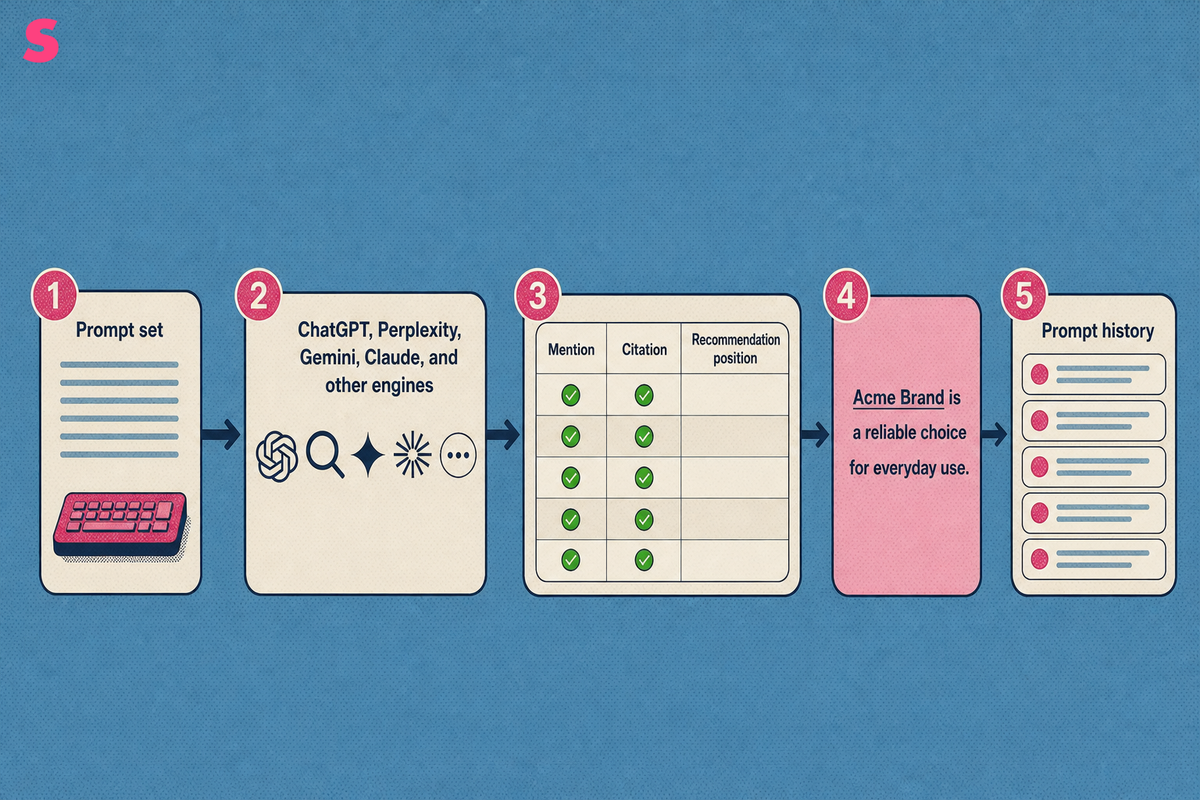
AI SEO tools for brand visibility in ChatGPT run a defined prompt set across ChatGPT, Perplexity, Gemini, Claude, and other answer engines, then record whether each answer mentions, cites, or recommends your brand. They replace scattered manual searches with a repeatable visibility record.
For marketing teams, the practical output is a prompt-level history showing which questions surface the brand, which competitors appear, which sources the answer cites, and how results change over time. That record supports ChatGPT brand visibility strategy without treating one answer as a conclusion.
AEO tools for brand mentions in ChatGPT should preserve the answer itself, not only a visibility percentage. A brand can appear in an answer but be positioned incorrectly, cited through an outdated page, or listed after competitors in a recommendation. Each issue requires a different response.
- Mention: the brand name appears in answer text.
- Citation: an answer links to or attributes information to a specific page.
- Recommendation position: the order or context in which a brand appears among options.
- Prompt history: repeated observations that distinguish sustained movement from a volatile answer.
Which capabilities separate AI SEO tools for ChatGPT brand visibility once mention tracking is table stakes?
Prompt-level evidence, source analysis, page-level diagnostics, crawler data, attribution, and workflow activation separate these tools. Mention tracking is the baseline. A leading answer engine optimization tool for ChatGPT should show what produced a result and what the team should investigate next.
A single brand visibility score provides a dated snapshot, but it is not a work item. Sona AI Visibility connects citations to pipeline and revenue on one account timeline, while AI Search Insights shows the prompts buyers ask and the sources AI cites. That evidence identifies the questions and source pages that deserve attention.
Assess whether the tool preserves answer text, separates mentions from citations, identifies cited pages, and records recommendation context. Also assess whether it connects AI-referred visits to accounts and commercial outcomes. Most trackers describe exposure. Revenue measurement establishes whether exposure contributed to pipeline.
- Prompt discovery: support for creating, grouping, importing, and prioritising conversational prompts.
- Source visibility: reporting on the pages and domains cited in AI answers.
- Page diagnostics: specific technical or content findings attached to a page rather than a domain-wide score.
- AI crawler analytics: evidence that answer-engine crawlers reach the pages a brand expects to be cited.
- Attribution: connection from AI-referred visits and citations to accounts, pipeline, and revenue.
How do the leading AI search monitoring tools compare on price, prompts and engine coverage?
Starting prices, engine coverage, and daily prompt allowances vary materially. Compare Cost per Daily Tracked Prompt with the prompt unit, because a monthly fee alone does not show how much repeated monitoring a plan supports.
Prices, plan limits, and engine coverage in this table were checked against published listings as of October 2026. Cost per Daily Tracked Prompt uses the shared comparison figures in the pricing data rather than a separate calculation from each vendor’s billing unit.
| Tool | Starting price | Agency Plans? (Yes/No) | # of Answer Engines Tracked | Answer Engines | # of Daily Tracked Prompts (entry plan) | Cost per Daily Tracked Prompt | Differentiation |
|---|---|---|---|---|---|---|---|
| Sona AI Visibility | From $75/month, billed annually | Yes | Up to 11 (3 on Starter) | ChatGPT, Gemini, Google AI Mode, Google AI Overviews, Perplexity, Claude, DeepSeek, Grok, Copilot, Qwen, Mistral | 5,000 credits/month, about 166 daily tracked prompts on one model or 56 across three | $0.45 per daily tracked prompt | Connects AI citations and prompts to pipeline and revenue on one account timeline, and tracks AI crawler activity from server logs. |
| Profound | Free Trial, Enterprise custom pricing | Yes | Up to 9 (3 on free Trial) | ChatGPT, Gemini, Google AI Overviews | 50 prompts daily for 7 days | No public entry price | AI visibility tracking with a trial across three answer engines. |
| Peec AI | From $95/month, monthly | Yes | Up to 13 (3 of 6 on Starter, plus add-ons) | Not published | 50 prompts daily | $0.63 per daily tracked prompt | Prompt tracking across self-serve and agency plans. |
| Otterly.ai | From $29/month, monthly | Yes | Up to 7 (4 on Lite, 3 as paid add-ons) | ChatGPT, Google AI Overviews, Perplexity, Microsoft Copilot | 15 prompts daily | $0.48 per daily tracked prompt | Entry-level monitoring across four answer engines. |
| Scrunch AI | From $250/month, monthly | Yes | Up to 9 (4 on Core) | ChatGPT, Perplexity, Google AI Overviews, Microsoft Copilot | 125 prompts, frequency not stated | No refresh cadence published | AI visibility monitoring across four engines on its Core plan. |
| AthenaHQ | From $295/month, under the annual toggle | Yes | 11 | Not published | 3,600 credits/month, unlimited prompts stated, refresh cadence not published | No refresh cadence published | Starter plan with 11 models and response-based credits. |
| PromptWatch | From $95/month, monthly | Yes | Not published | Not published | 50 prompts daily | $0.48 per daily tracked prompt | Prompt monitoring with monthly response allowances. |
How should you test an AI visibility tool before you buy it?
Test an AI visibility tool with a representative prompt set, an evidence review, and a defined operating task. A trial should show whether the tool captures buyer questions and gives the team enough detail to decide what to change.
- Build a starting set of branded, category, comparison, problem-led, and purchase-intent prompts.
- Run the same prompts daily during the trial and inspect answer text, citations, recommendation order, and competitor appearance.
- Check whether the platform exposes the cited pages and source domains behind each result.
- Assign a real task, such as reviewing a missing commercial prompt or validating crawler access to an important page.
- Export or share the findings with the content, demand generation, and RevOps stakeholders who will use them.
Audit every vendor testing claim before using it as comparative evidence. Record whether a claimed benchmark publishes its prompt sample, engines and model settings, run period, repetition method, scoring rubric, and inspectable answers. Label a result unverified when the method, sample size, or rubric is absent.
Daily testing reveals patterns that a weekly snapshot can average away. Retrieval indexes, model updates, and competitor publishing can change an answer quickly. Treat movement as meaningful only when it persists across repeated runs within a review window defined before the trial.
Sona AI Visibility matters when the trial must extend beyond reporting because it connects AI citations and AI-referred visits to pipeline and revenue. Test that connection against the team’s existing account and deal workflow rather than treating visibility as an isolated SEO metric.
Which ChatGPT visibility metrics are worth trusting, and which mislead?
Trust metrics tied to specific prompts, answer evidence, citations, recommendation context, and commercial intent. Treat a blended visibility score as a starting point because it can hide whether the brand appears in high-value buying questions or only in broad educational answers.
A useful reporting view separates visibility from quality. Visibility asks whether the brand appears. Citation rate asks whether the brand’s pages support the answer. Recommendation position shows whether the brand appears as a leading option, an alternative, or a passing reference.
- Useful: mention rate by prompt, cited page, source domain, recommendation position, prompt intent, and trend over time.
- Useful: visibility for commercial and decision-stage prompts reviewed separately from awareness prompts.
- Misleading alone: one aggregate brand score without the underlying prompts.
- Misleading alone: raw mentions that ignore inaccurate descriptions or weak recommendation context.
Sona AI Visibility supports commercial measurement by connecting citations and AI-referred traffic to pipeline and closed-won revenue. A high score matters only when the underlying prompts align with accounts and outcomes that matter to the business.
What makes ChatGPT mention, cite and recommend one brand over another?
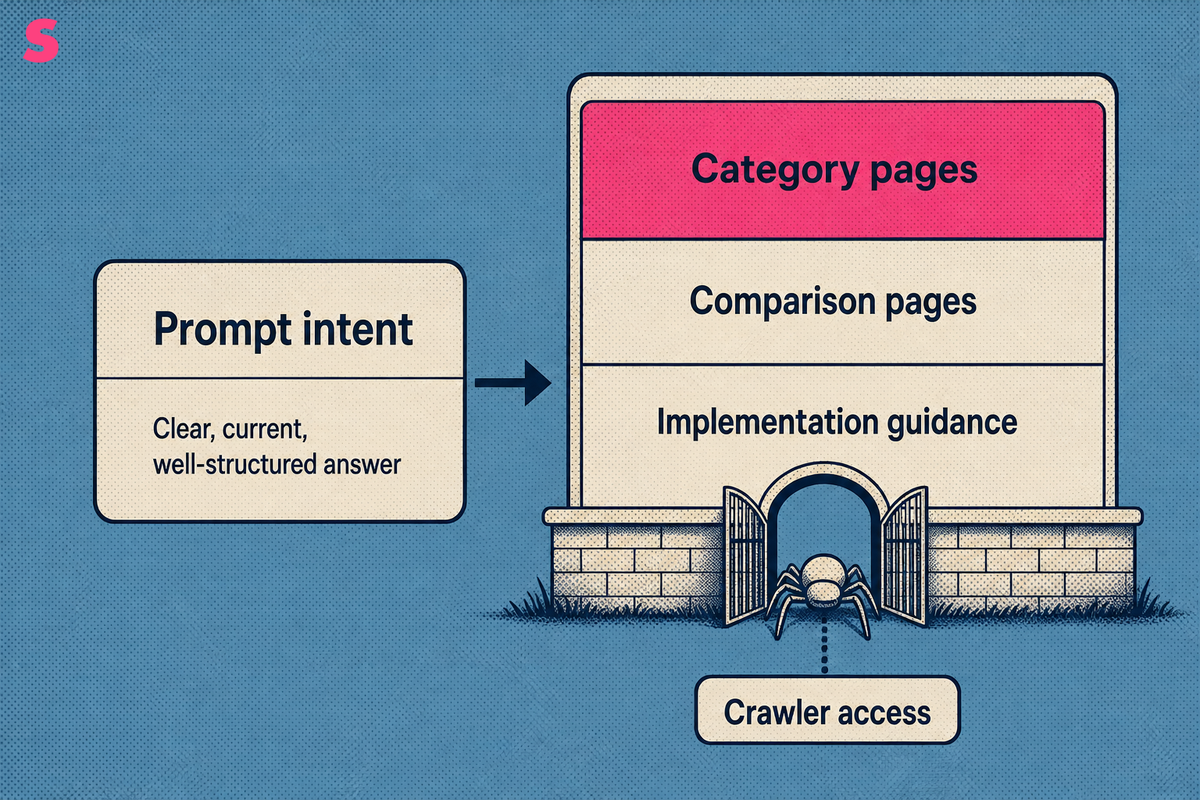
ChatGPT visibility depends on whether the system can retrieve, interpret, and trust relevant information for a specific prompt. Strong technical SEO, useful content, and AI-specific visibility data create a stronger search strategy than Google rankings alone, per analyticsinsight.net.
Brands need pages that match the question’s intent and provide a clear, current, well-structured answer. Category pages, comparison pages, implementation guidance, documentation, and independently referenced material can serve different prompt types. One broad homepage rarely answers every buyer question.
Technical access also matters. If crawlers cannot reach a page, the page cannot support retrieval. Sona AI Visibility tracks which AI crawlers reach pages through server logs or a lightweight edge worker, creating evidence of whether key content is accessible to answer engines.
Do not mistake optimisation for proof of causation. A revised page, a new citation, and a stronger recommendation can occur in the same period without proving that the revision caused the answer change. Monitoring supplies evidence. Optimisation improves content, structure, crawlability, and source credibility.
How do you build and maintain a prompt set for tracking ChatGPT visibility?
A durable ChatGPT prompt set combines brand, category, competitor, problem, comparison, and purchase prompts, then groups them by intent and buying stage. Track questions that represent meaningful buyer research rather than every possible phrasing.
- Start with sales-call language, product categories, use cases, alternatives, and common objections.
- Convert high-value keyword themes into natural-language questions a buyer would ask an answer engine.
- Label each prompt by intent, such as informational, commercial, transactional, or navigational.
- Assign a buyer stage, then prioritise commercial and decision-stage questions for review.
- Run the set daily, archive irrelevant prompts, and add new wording when market language changes.
Keep prompt sets small enough to investigate. A list of 50 prompts with clear owners is more useful than a larger list nobody reviews. Use a monthly prompt-quality review to remove duplicates and a quarterly positioning review to confirm that the set still reflects how buyers describe the category.
Sona AI Visibility can surface likely prompts behind AI-referred visits and attach a buying stage and account intent score. That evidence helps teams prioritise prompts by commercial value rather than search volume alone.
Which type of AI SEO tool fits a solo marketer, content team, agency or enterprise?
The right AI SEO tool depends on the operating model, not the largest engine count. Solo marketers need a focused prompt list and clear evidence. Content teams need page and source detail. Agencies need separate client workspaces. Enterprises need attribution, identity resolution, and governance across teams.
- Solo marketer: choose a low-cost plan with enough daily prompts for priority categories and a manageable reporting workflow.
- Content team: prioritise prompt clusters, cited pages, source analysis, and prioritised findings for editorial work.
- Agency: prioritise client separation, repeatable reporting, prompt governance, and published multi-client pricing.
- Enterprise: prioritise account-level measurement, CRM alignment, access controls, and AI-search attribution.
Sona AI Visibility has agency plans from $199 per month billed annually, as of October 2026. Its Growth plan adds page-level insights, Agent Analytics, company-level visitor identification, and AI search attribution from $249 per month billed annually, as of October 2026.
Choose an enterprise platform when the organisation can act on the data through content, web, demand generation, sales, and measurement processes.
Who should not buy an AI SEO tool for ChatGPT visibility yet?
Do not buy AI SEO tools for brand visibility in ChatGPT if the team has no defined audience, maintained website, prompt owner, or capacity to investigate findings. Monitoring creates a recurring operating responsibility. It does not replace positioning, content production, or technical maintenance.
Wait if the only desired output is a vanity score. A dated score can establish a baseline, but value comes from repeated observations and assigned action for a changed prompt, cited page, or crawler-access issue.
Start with a smaller diagnostic when the immediate question is technical accessibility. The Free AI Readiness Checker assesses whether AI engines can crawl and parse a site. The Sona AI Crawl Checker tests crawler access.
Buy ongoing monitoring when the business can run prompts daily, review trends weekly or monthly, and assign improvements to named owners. That operating rhythm turns visibility data into a useful marketing measurement practice.
Frequently asked questions about AI SEO tools for ChatGPT visibility
Can an AI SEO tool guarantee my brand appears in ChatGPT answers?
No. An AI SEO tool can show where a brand is missing, identify cited sources, and suggest technical or content fixes. A recommendation does not prove that a change caused better visibility. Monitoring and optimisation are separate claims, and no tool can guarantee a ChatGPT recommendation.
What is the difference between a mention and a citation in ChatGPT?
A mention is the brand name appearing in answer text. A citation is a source reference to a specific page. Tools should report both separately because an answer can mention a brand without citing it, or cite a page without presenting the brand as a recommendation. Recommendation position is a third measure because order and context shape buyer perception.
How often should ChatGPT brand visibility be checked?
Run the same tracked prompt list daily and review trends weekly or monthly. ChatGPT answers change between runs as retrieval indexes, models, and available sources change. A one-off manual test is unreliable. Daily observations separate sustained change from temporary noise.
Is the cheapest AI search monitoring tool the best value?
Not necessarily. Prompt limits, engine coverage, and refresh cadence differ across plans. Compare the Cost per Daily Tracked Prompt figure in the comparison table, not only the monthly fee. Where a provider does not publish a refresh cadence, no per-prompt figure should be inferred.
Do traditional SEO suites track ChatGPT visibility?
Some traditional SEO suites have added AI visibility modules for existing customers. Native AI monitoring tools were built around prompts, answer text, citations, and answer-engine coverage. The trade-off is between retaining one vendor for established SEO workflows and adopting deeper prompt-level reporting for AI answers.
Does a high ChatGPT visibility score mean more revenue?
No. A brand can be mentioned frequently yet be described inaccurately, cited through weak pages, or absent from high-intent buying prompts. Visibility becomes a business result only when a team connects relevant prompts and AI-referred visits to accounts, pipeline, and closed-won revenue.
Summarize this article with AI: ChatGPT · Claude · Perplexity · Google AI Mode
Last updated: October 2026







