


Online-to-offline attribution means connecting digital interactions, including ad clicks and form submissions, with results occurring beyond the browser, such as CRM stages, phone calls, in-store visits and closed-won revenue. In B2B SaaS, it functions by retaining a click or identity key when leads are captured and transmitting subsequent CRM events back to ad platforms. This enables revenue-based optimization, although the connection indicates correlation rather than causal proof. The best method depends on sales-cycle length, channel mix and data infrastructure.
What is online to offline attribution, and how does it differ from offline conversion tracking?
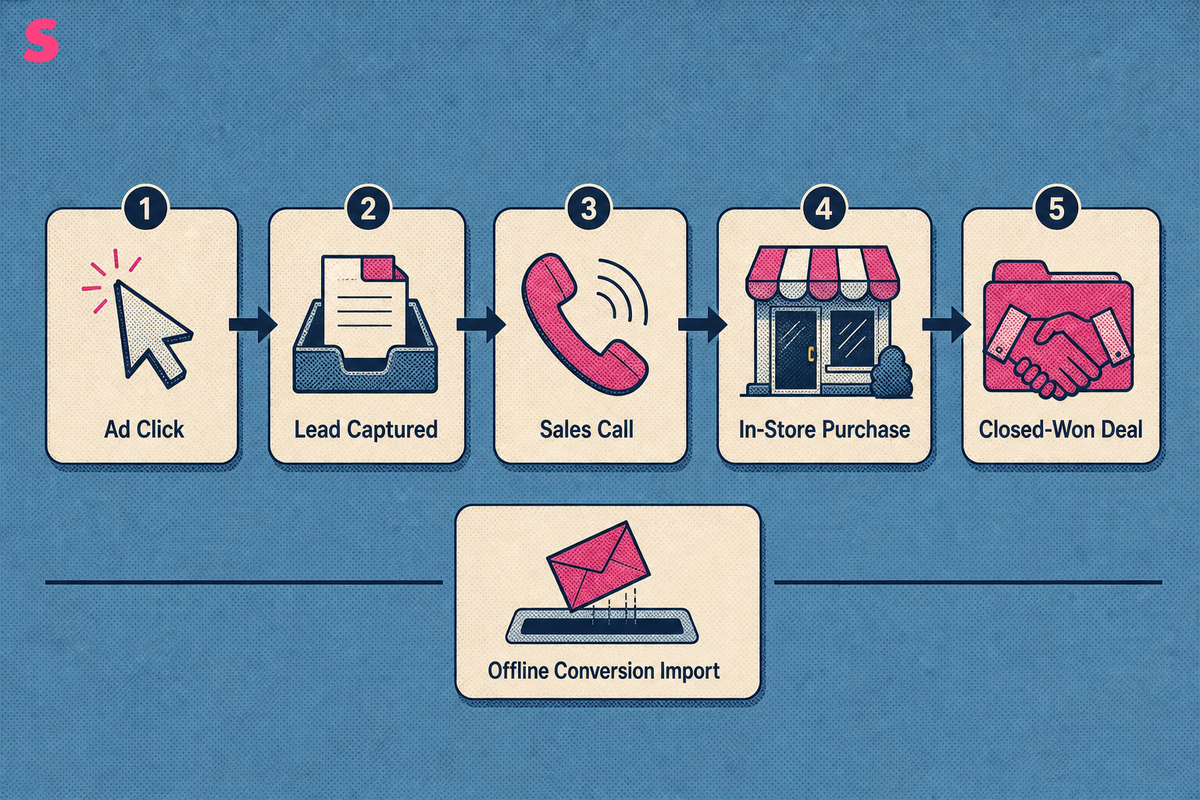
Online to offline attribution links a digital marketing interaction, such as an ad click, to a later business outcome, such as a sales call, CRM opportunity, in-store purchase, or closed-won deal. It assigns credit across the path from media spend to revenue.
Offline conversion tracking is the data transfer behind that process. A team imports a qualified lead, customer, or revenue event into an ad platform or analytics system. Attribution determines which earlier touchpoints receive credit for that outcome.
Online to offline attribution is more than multi-touch modeling. A model can distribute credit across recorded interactions without connecting those interactions to a CRM deal. It is also distinct from incrementality testing, which compares exposed and unexposed groups to test whether marketing caused an outcome. Importing a conversion file is one operational step, not a complete attribution method.
Offline outcomes vary by business model. A retailer may connect search ads to foot traffic or an in-store purchase. A B2B SaaS company may connect paid media to a sales-qualified lead, an opportunity, closed-won revenue, and a renewal. In each case, the task is to join marketing activity to a business event that occurs after the original ad click.
Why does online to offline attribution matter to a marketer who owns pipeline?
Online to offline attribution matters because an ad platform can optimize only toward events it receives. If the platform receives form submissions but never qualified pipeline or revenue, budget allocation follows lead volume rather than commercial value.
A marketing leader who owns pipeline must distinguish cheap inquiries from accounts that become opportunities. Connecting cost data to offline outcomes creates full-funnel visibility and supports budget allocation based on commercial value. The budget question becomes which campaign produced revenue at an acceptable return, rather than which campaign generated the most leads.
The reporting value is practical. Finance can reconcile spend against CRM revenue, demand generation can assess channel quality, and paid media teams can send stronger optimization signals to platforms. A lead-source field cannot provide that chain because it does not preserve every relevant interaction or the resulting revenue.
How does an ad click become a closed-won deal in the CRM?
An ad click becomes a closed-won deal when each system preserves a shared identifier and passes lifecycle events forward. In a B2B SaaS motion, the chain is click, lead, qualified lead, opportunity, closed-won deal, and renewal.
Consider a buyer who clicks a paid search ad, submits a demo form, and enters a sales process. The website captures the click ID and consent state in hidden form fields. The CRM creates the lead, sales updates lifecycle stages, and the payment or billing system confirms revenue. The warehouse can reconcile records across those systems before a selected event returns to the ad platform.
| Stage | Primary system | Data captured | Matching key | Business value | Send back to ad platform? |
|---|---|---|---|---|---|
| Ad click | Ad platform and website | Click ID, campaign, landing page, consent state | Click ID or first-party cookie | Media cost | Retain for matching |
| Lead | Website and CRM | Email, phone number, form timestamp, source fields | Click ID, hashed email, phone number | Initial inquiry | Useful for volume reporting |
| Qualified lead | CRM | Lifecycle stage, qualification date, account | Lead ID and account ID | Sales readiness | Yes, for faster optimization feedback |
| Opportunity | CRM | Opportunity ID, stage, forecast amount | Account ID and opportunity ID | Potential pipeline | Yes, when stage definitions are stable |
| Closed-won deal | CRM and payment system | Close date, revenue value, currency, deal status | Opportunity ID and account ID | Booked revenue | Yes, for revenue-based optimization |
| Renewal | CRM and billing system | Renewal value, renewal date, customer status | Account ID and contract ID | Retained revenue | Use for lifecycle analysis |
Earlier events arrive faster but sit farther from revenue. Closed-won events are commercially stronger but arrive later, slowing platform learning. Many B2B teams begin with a sales-qualified lead or opportunity, then add closed-won revenue after enough deals reach that stage. Deduplicate uploads with a stable event ID and use one revenue-field definition across the CRM, warehouse, and payment system.
Sona Marketing Measurement connects channel activity to pipeline and revenue through identity resolution and attribution, giving marketing and revenue teams one account-level path from spend through the deal record.
Which identifiers link an online interaction to an offline outcome?
Identifiers link an online interaction to an offline outcome by matching a click, visitor, person, or account across systems. No identifier covers every journey, so reliable measurement uses a matching hierarchy and records each match source.
| Identifier | What it matches | Where it is captured | Common gap | Fallback |
|---|---|---|---|---|
| GCLID | Google Ads click to a later conversion | Landing page and form submission | Missing hidden field or consent refusal | Hashed email or CRM source fields |
| FBCLID | Meta click to a later conversion | Landing page and form submission | Parameter removed before submission | Hashed email or phone number |
| Hashed email | Known person across platform and CRM | Form, CRM, customer database | Personal and work emails differ | Phone number or account match |
| Phone number | Caller or lead to CRM record | Call center, form, CRM | Shared or unformatted numbers | Email and account ID |
| Account ID | Contacts, opportunities, and revenue | CRM and warehouse | Multiple accounts or merged records | Validated CRM hierarchy |
| First-party cookie | Browser session and web activity | Website | Cross-device journey or browser limits | Known lead identifiers |
Attribution breaks when customer identity, branch interactions, call center data, and digital journeys remain disconnected. Missing click IDs, cross-device research, and consent refusal create unmatched records. That undercount does not mean the unmatched channel produced no value.
Use a clear match order: click ID when available, then consented hashed email or phone data, then CRM account mapping. Preserve consent state with the lead record. Sona Marketing Measurement supports identity resolution across account and contact journeys, helping teams connect anonymous activity to later CRM evidence without treating every visit as a known person.
How do ad platforms accept offline conversions from a CRM?
Ad platforms accept offline conversions through file uploads, CRM integrations, or server-side event matching. The right method depends on the identifiers captured at lead creation and the lifecycle event the business wants the platform to optimize toward.
An October 5, 2026 listing identifies six platforms that support offline lead, qualified-lead, and closed-won uploads: Google, Meta, LinkedIn, Microsoft, TikTok, and Snapchat. Google Ads also supports CRM data import for Customer Match and offline conversion import, including enhanced conversions for leads, per support.google.com, October 20, 2026.
| Platform | Offline event use | CRM or matching route | Operational note |
|---|---|---|---|
| Google Ads | Lead, qualified lead, closed-won | Offline conversion import, Customer Match, enhanced conversions for leads | Google Ads documents HubSpot integration support, per support.google.com, October 20, 2026 |
| Meta | Lead, qualified lead, closed-won | Lifecycle event sync or server-side event matching | HubSpot can send lifecycle-stage events to Meta, per the October 26, 2026 listing |
| Lead, qualified lead, closed-won | Offline conversion upload | Included in the six-platform October 5, 2026 listing | |
| Microsoft Ads | Lead, qualified lead, closed-won | Offline conversion upload | Included in the six-platform October 5, 2026 listing |
| TikTok | Lead, qualified lead, closed-won | Offline conversion upload | Included in the six-platform October 5, 2026 listing |
| Snapchat | Lead, qualified lead, closed-won | Offline conversion upload | Included in the six-platform October 5, 2026 listing |
Google’s partner connections include HubSpot, Salesforce, Zoho CRM, ActiveCampaign, Shopify, Google Sheets, and BigQuery, seven named data sources in the October 5, 2026 listing. Integration does not remove governance work. Teams still need one event taxonomy, a documented revenue field, deduplication rules, and a process for correcting closed-lost or refunded records.
Which attribution model suits a long B2B sales cycle?
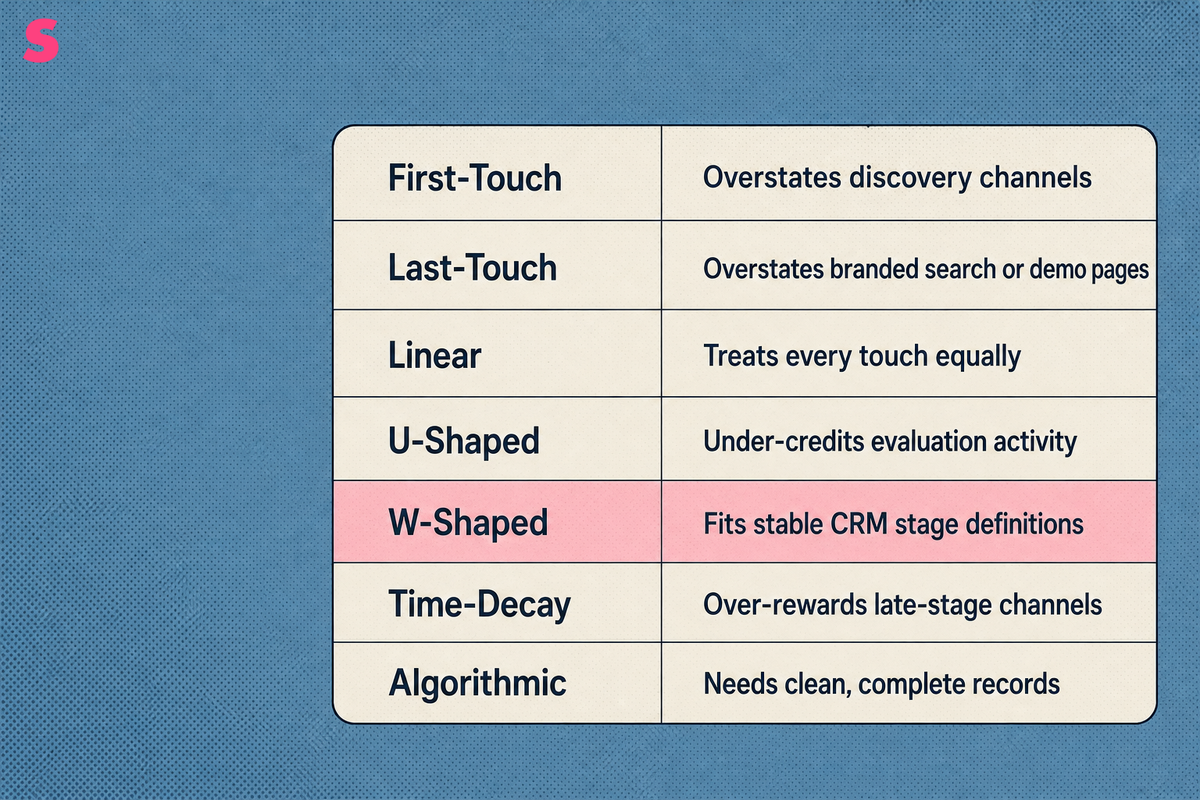
A long B2B sales cycle suits a multi-touch revenue model for strategic reporting, paired with a simpler event signal for ad-platform optimization. Buying committees create many interactions, so first-touch or last-touch alone can distort channel value.
- First-touch rewards the channel that created the known lead. It can overstate discovery channels.
- Last-touch rewards the final recorded interaction before conversion. It can overstate branded search, retargeting, or demo pages.
- Linear gives equal credit to every recorded touch. It is transparent but treats a casual visit and a sales conversation alike.
- U-shaped emphasizes lead creation and conversion. It can under-credit evaluation activity.
- W-shaped emphasizes first touch, lead creation, and opportunity creation. It fits teams with stable CRM stage definitions.
- Time-decay gives more weight to recent interactions. It can over-reward late-stage channels in long cycles.
- Algorithmic uses observed patterns in the available data. It requires clean, sufficiently complete records.
For executive analysis, use W-shaped or another transparent multi-touch revenue model. For platform bidding, use qualified-lead or opportunity uploads. A model is a crediting rule applied to recorded evidence, not proof of causation, so finance and sales should understand its assumptions.
How do you choose an online to offline attribution method for your business?
Choose an online to offline attribution method by starting with the business type and offline outcome. The right method changes when the business needs to measure store purchases, phone calls, fast lead qualification, or account-level revenue.
- Identify the business model and the offline event that defines value: store visit or purchase, completed call, qualified lead, opportunity, or closed-won revenue.
- Confirm the identifier available at that event: transaction or loyalty ID, tracked phone number, click ID, hashed email, lead ID, or CRM account ID.
- Assign one system of record before sending events to an ad platform. Use the POS for store events, the call system and CRM for phone outcomes, the CRM for lifecycle stages, and the warehouse for cross-system revenue reconciliation.
- Choose the optimization event that arrives soon enough for bidding but remains commercially meaningful. Use reporting to connect that event to revenue and test causal impact through holdouts when required.
| Business type | Required identifier | System of record | Optimize toward | Reporting method | Move to a more advanced method when |
|---|---|---|---|---|---|
| Retailer or omnichannel commerce | Transaction, loyalty, or consented customer identifier | POS and ecommerce system | Store event or in-store purchase | POS-to-campaign matching | Customers buy across stores, ecommerce, and several campaigns |
| Phone-led local business | Tracked phone number, caller record, or CRM lead ID | Call system and CRM | Qualified call or booked appointment | Call and CRM matching | Sales follow-up, repeat business, or revenue value must be reconciled |
| High-volume short-cycle lead generation | Click ID, hashed email, or lead ID | CRM | Qualified lead or customer | Native lifecycle upload | Several channels or inconsistent lead quality require multi-touch reporting |
| Long-cycle B2B company | CRM account ID, opportunity ID, and consented lead identifiers | CRM and warehouse | Qualified lead or opportunity, then closed-won revenue | Account identity, CRM stages, multi-touch reporting, and warehouse reconciliation | Account hierarchies, billing data, or renewals require governed cross-system modeling |
Sona Marketing Measurement can support this decision framework by bringing identity resolution, attribution, and intent activation into one measurement foundation with AI search counted as a channel. The method still requires disciplined CRM stages and reconciliation.
How far can you trust online to offline attribution?
Online to offline attribution supports decisions, but it is modeled evidence rather than proof that an ad caused a sale. A CRM deal matched to a click demonstrates association, while a holdout or incrementality experiment tests causation.
Long sales cycles delay feedback. Sending only early-stage events can bias bidding toward leads that qualify but never close. Sending only revenue can leave platforms with slow, sparse signals. Identity matching is also incomplete across devices, personal and work email addresses, calls, consent refusal, and anonymous research.
- Reconcile platform-reported conversions against CRM totals by event date and revenue field.
- Check for duplicate uploads with an event ID and stable lead or opportunity ID.
- Audit lifecycle definitions with sales before using a stage for optimization.
- Compare platform lookback windows before adding channel totals together.
- Run holdout tests when a budget decision requires causal evidence.
Trust increases when the system exposes its assumptions. Keep separate views for matched conversions, unmatched CRM outcomes, platform-reported credit, and finance-recognized revenue. Those views are more useful than a single total that hides uncertainty.
Which kinds of tools handle online to offline attribution, and which need does each serve?
Online-to-offline measurement uses several tool categories because no single system owns every touchpoint, identity record, and revenue event. Start with the reporting or optimization decision, then select the lightest system that can produce a reconciled answer.
| Tool category | Primary need | Typical inputs | Primary output |
|---|---|---|---|
| Native ad-platform integrations | Campaign optimization | Click IDs, hashed identifiers, lifecycle events | Offline conversion signal for bidding |
| CRM automation | Lifecycle-stage synchronization | Lead, account, and opportunity records | Validated sales-stage events |
| B2B revenue attribution | Pipeline and revenue reporting | CRM touchpoints, campaigns, account hierarchy | Channel credit across the buying journey |
| Enterprise data infrastructure | Governed data modeling | CRM, billing, ad, product, and warehouse data | Reconciled revenue analysis |
| Multi-channel measurement | Budget and ROI decisions | Spend, identities, touchpoints, and revenue | Cross-channel performance view |
Sona Marketing Measurement connects ad and channel activity to pipeline and revenue through Cross-Channel Attribution and Identity Resolution. Sona AI Visibility extends that path to AI search by connecting prompts, citations, and AI crawler activity to the same revenue. AI Attribution connects AI citations to accounts, pipeline, and closed-won revenue on one account timeline.
Use native integrations for bidding feedback, CRM automation for stage synchronization, revenue-attribution systems for channel credit, and data infrastructure for governed reconciliation across systems.
What are the frequently asked questions about online to offline attribution?
What is the difference between online to offline attribution and offline conversion tracking?
Offline conversion tracking moves an offline event, such as a closed deal or customer lifecycle stage, into an ad platform or analytics system. Online to offline attribution goes further by assigning credit for that outcome to earlier digital touchpoints, such as paid search, social advertising, or display campaigns.
Does online to offline attribution prove that an ad caused a sale?
No. Attribution links a click or identity to a later business outcome, demonstrating association rather than causation. Holdout tests and incrementality experiments test whether advertising produced sales that would not have happened without the campaign.
Do I need a CRM to track offline conversions from online ads?
For B2B SaaS, practically yes. The CRM holds lifecycle stages, opportunities, closed-won status, and deal revenue that ad platforms cannot observe independently. Without a CRM, a team must match offline outcomes from spreadsheets, billing records, or manual sales reports.
What happens when a click ID is missing from a lead record?
The platform must fall back to other identifiers, such as hashed email or phone number, or the conversion remains unmatched. Capturing the click ID in a hidden form field at submission prevents many gaps. Teams should also preserve consent state so missing identifiers are not mistaken for implementation failures.
Which offline event should a B2B SaaS company send back to ad platforms first?
Start with a qualified lead or sales opportunity. Both events arrive sooner than closed-won revenue and give the platform a usable optimization signal. Add closed-won revenue once enough deals close to support meaningful optimization and revenue reporting.
How does consent affect online to offline attribution?
If a visitor refuses consent, the click ID and other identifiers may not be stored or sent, leaving that journey unmatched. Record consent state alongside each lead, apply the same policy across systems, and treat the resulting undercount as an expected boundary of the measurement model.
Summarize this article with AI: ChatGPT · Claude · Perplexity · Google AI Mode
Last updated: October 2026







