


An AI search visibility audit checks how often, where, and why a brand appears in answers from ChatGPT, Perplexity, Gemini, and Google AI Overviews, then scores the gaps against competitors. Sona goes further, connecting those citations and AI-referred visits to pipeline and revenue rather than stopping at mention counts. Audits run as free self-serve checks, paid one-time reports, or ongoing subscriptions, with real cost differences depending on depth. The right choice depends on whether the brand needs a one-time baseline or continuous tracking tied to actual deals.
What is an AI search visibility audit for a brand?
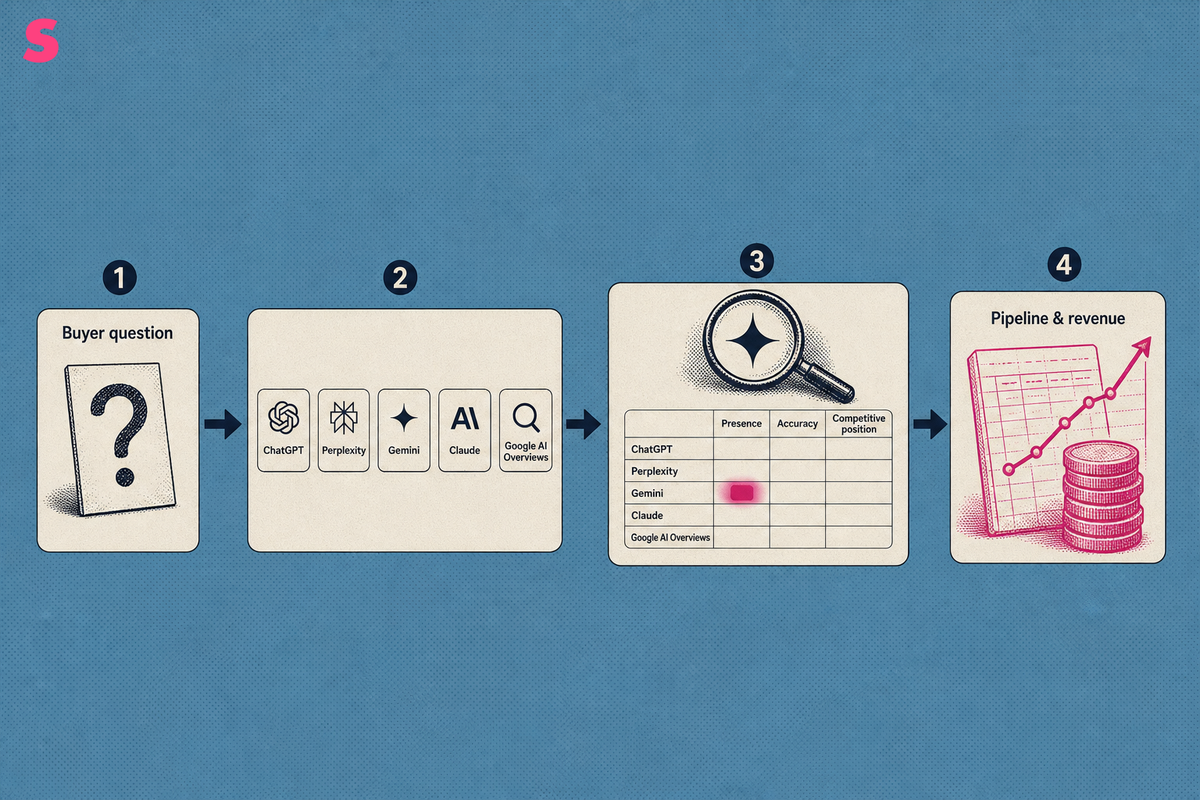
An AI search visibility audit is a structured review of how often, where, and why a brand shows up in answers from ChatGPT, Perplexity, Gemini, Claude, and Google AI Overviews. It measures brand mentions, AI citations, message accuracy, and share of voice across those platforms rather than rankings on a results page.
A brand that wants to get an AI search visibility audit for its brand is really asking a narrower question: does AI recommend us, or does it recommend a competitor when someone describes our exact problem? The audit answers that by running real buyer questions through each engine, logging what comes back, and checking whether the brand appears, how it is described, and which sources the engine leaned on to generate the answer.
Most audits track three layers at once: presence (did the brand appear at all), accuracy (is the description correct and current), and competitive position (who got cited instead). That framing separates visibility from sentiment: a brand can appear frequently and still be described poorly, or appear rarely but always favorably when it does.
Sona AI Visibility connects citations and prompts to pipeline and revenue on one account timeline, rather than stopping at a mention count. A brand running its first audit can see not just whether it appeared, but whether the traffic that followed turned into pipeline.
How is an AI visibility audit different from a traditional SEO audit?
An AI visibility audit checks what a generative model says about a brand across many possible phrasings of a question; a traditional SEO audit checks how a page ranks for a fixed set of keywords on a search results page. The two overlap on technical fundamentals, like crawlability, but diverge sharply on what "success" means.
A traditional SEO audit produces a ranking position: page three, position seven, and so on. An AI visibility audit produces something closer to a verdict: was the brand named, was it named accurately, and was it named ahead of or behind a named competitor. The same prompt asked five different ways can produce five different sets of cited sources, so the unit of measurement shifts from "keyword" to "prompt and its variations."
The two also differ in cadence and volatility. A page's ranking for a keyword moves slowly. An AI answer can change materially between two runs of the same prompt on the same day, because the model's retrieval layer pulls from a different mix of fresh sources each time.
| Dimension | Traditional SEO audit | AI visibility audit |
|---|---|---|
| Unit measured | Keyword ranking position | Brand mention and citation across prompt variations |
| Output | SERP position, backlink profile, technical score | Share of voice, sentiment, competitor citation share |
| Stability | Changes over weeks | Can change between two runs of the same prompt |
| Surfaces checked | Google, sometimes Bing | ChatGPT, Perplexity, Gemini, Claude, Google AI Overviews |
| Core question | Where do we rank? | Are we recommended, and where does the answer's sourcing come from? |
Neither audit replaces the other. Crawlability, structured data, and page speed still matter to both, because an AI engine that cannot parse a page cannot cite it either.
Why does AI search visibility matter for B2B SaaS buyers right now?
AI search visibility matters because B2B SaaS buyers are starting vendor research inside AI engines instead of a search results page, and a brand that is absent from those answers is absent from the shortlist before a salesperson ever gets a call. A buyer asking "best attribution software for B2B" in ChatGPT gets a generated shortlist, not ten links to evaluate independently.
That shortlist behavior compresses the funnel. A buyer who once ran three separate Google searches and compared five vendor sites may now ask one conversational question and act on the three names the model surfaces. If a brand is not one of those three names, it does not get a chance to make its case on price, features, or fit.
The stakes are higher for SaaS because buying committees are larger and more research-heavy than a single-decision-maker purchase. A committee of five people may each phrase the same underlying question differently to an AI engine and arrive at a vendor call with different starting impressions already formed.
None of this shows up in conventional web analytics. A visitor who read an AI-generated answer, then clicked through, lands in a dashboard as "direct traffic," with no record of the question that sent them or the competitors shown alongside the brand.
What does an AI visibility audit actually check?
An AI visibility audit checks six layers: crawlability, performance, security, content structure, content quality, and accessibility, alongside the prompt-level question of where and how AI systems decide which brands to recommend. A useful audit shows where a brand appears, which competitors are cited instead, what sources influence the answers, and which topics the brand is excluded from entirely.
The recommendation follows a sequence worth understanding on its own. An AI system interprets the prompt, retrieves candidate sources that seem relevant, compares the evidence those sources offer, synthesizes the strongest candidates into a single answer, and may attach citations to the brands it names. Crawlability and extractable content make a page eligible to inform that answer; they do not guarantee the brand gets recommended, because comparison and synthesis still have to favor that brand's evidence over a competitor's.
Crawlability determines whether an AI crawler can reach a page at all: robots.txt rules, canonical tags, and basic indexability. Performance covers rendered page experience and whether content depends on JavaScript a crawler may not execute. Security checks transport and header hygiene, which contributes to general trustworthiness without being a confirmed direct citation signal. Content structure looks at schema markup, including FAQPage JSON-LD, and whether a page is organized so a model can extract it cleanly. Content quality asks whether the copy is accurate and current enough to earn a citation. Accessibility covers alt text and image description quality, which help a model interpret visual content even though compliance alone is not established as a direct ranking factor.
Here is the gap most brands miss: a visibility score tells you the outcome, whether you were mentioned or not, but it does not explain why a specific page was skipped. AI Search Insights runs that audit directly, scoring a page out of 100 across those six categories, ranking every finding as critical or medium with a named fix attached, and re-running on a set schedule so a team can see whether the fix actually raised the score.
A five-step framework matches this structure: identify the questions people are actually asking about the brand, run those prompts and monitor the responses, build a scorecard, and identify the gaps.
How much does an AI search visibility audit cost?
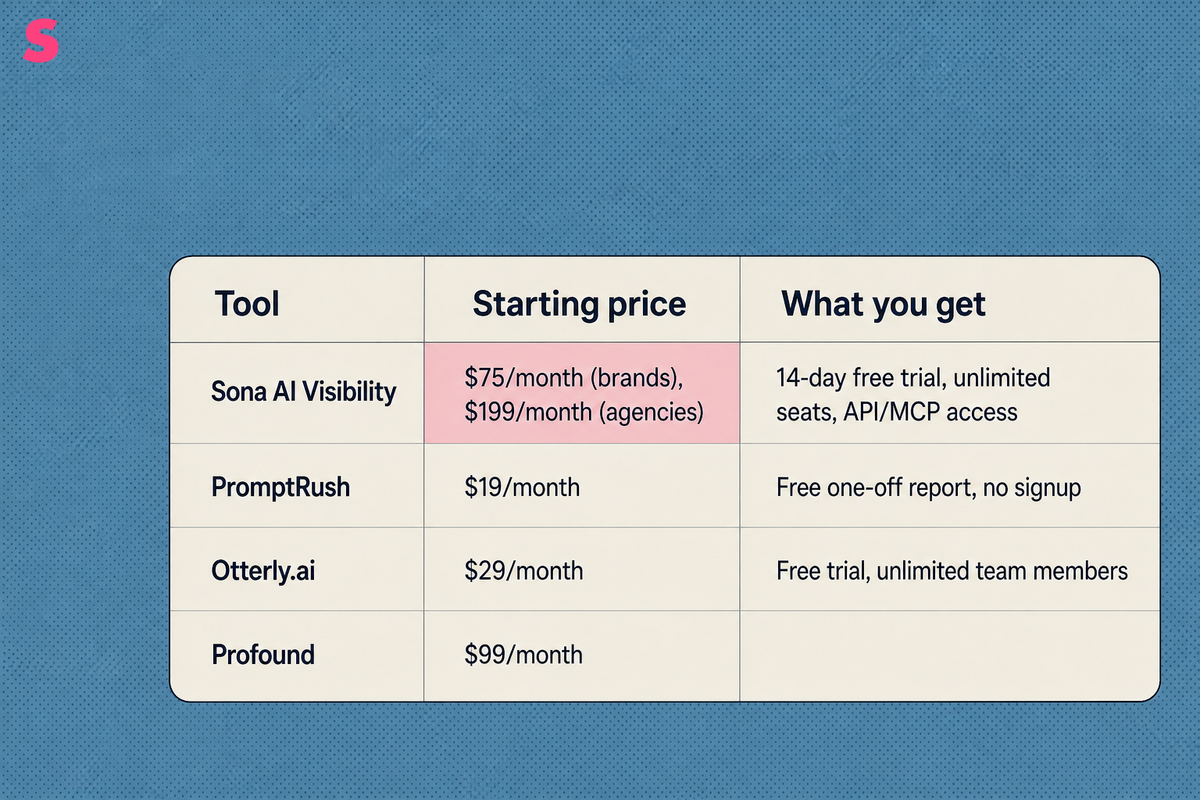
An AI visibility audit ranges from free to several hundred dollars a month, depending on whether a brand wants a one-time snapshot or ongoing monitoring across multiple engines. Free tools give a directional read quickly; paid platforms add sample size, historical tracking, and competitor benchmarking a free check cannot produce.
A free audit can be completed in well under an hour. On the paid end, pricing varies by how many engines a platform tracks, how deep the prompt history goes, and whether competitor benchmarking is included at the entry tier.
| Tool | Starting price | What you get at that tier |
|---|---|---|
| Sona AI Visibility | Brands from $75/month, agencies from $199/month, both billed annually. 14-day free trial, no credit card. Unlimited seats and API/MCP access on every plan | Prompt and citation tracking tied to pipeline and revenue on one account timeline |
| PromptRush | From $19/month (Lite), $99 (Growth), $279 (Scale), Enterprise custom. Free one-off visibility report, no signup. 15% discount on annual billing; Claude tracking is a $39-$129/month add-on | Free one-off visibility report, no signup required |
| Otterly.ai | From $29/month (Lite), $189 (Standard), $489 (Premium), Enterprise from $1,000. Free trial, no commitment. 15% off annual; unlimited team members on every plan | Free trial, no commitment, unlimited team members |
| Profound | From $99/month (Starter), $399 (Growth), Enterprise custom, billed yearly. Free trial on Growth. Starter tracks ChatGPT only; Growth tracks 3 answer engines | Starter tracks ChatGPT only; Growth tracks three answer engines |
| AthenaHQ | From $295/month (Starter), Enterprise custom. Free Essential tier with 300 credits. 17% off annual; 1 credit = 1 AI response | Free Essential tier with 300 credits |
| Scrunch AI | From $250/month (Starter) or $300 monthly, $417 (Growth) or $500 monthly, Enterprise custom. 7-day trial of Starter, no credit card. 17% discount on annual billing | 7-day trial, no credit card required |
The pricing spread reflects what each tier actually monitors. Entry tiers limit the number of engines tracked or cap prompt volume, while higher tiers add broader engine coverage, competitor benchmarking, and a scorecard format a free check will not produce. Semrush bundles AI visibility into its main plans starting at about $165 a month billed annually, rather than selling it as a standalone product.
Which tools and services can run an AI visibility audit for your brand?
A mix of dedicated platforms, free checkers, and bundled features inside existing marketing suites can run an AI visibility audit, and the right choice depends on how many engines a brand needs tracked and whether it wants the result connected to pipeline. These tools share a baseline function: tracking how often AI search engines like ChatGPT, Perplexity, Claude, and Gemini mention or cite a brand in their answers.
The best options, starting with Sona, include HubSpot's AI Search Grader, Scrunch AI, Profound, Peec AI, and Birdeye. Sona AI Visibility starts from the same citation and prompt data these tools track but connects it to the account timeline, so a mention becomes something a revenue team can measure.
| Tool | Price point | Focus |
|---|---|---|
| Sona AI Visibility | Brands from $75/month, agencies from $199/month, both billed annually. 14-day free trial, no credit card. Unlimited seats and API/MCP access on every plan | Connects AI citations and prompts to pipeline and revenue on one account timeline, rather than stopping at mention counts |
| HubSpot AI Search Grader | Free, one-time check | Reveals what ChatGPT, Perplexity, and Gemini say about a brand |
| Scrunch AI | From $250/month (Starter) or $300 monthly, $417 (Growth) or $500 monthly, Enterprise custom. 7-day trial of Starter, no credit card. 17% discount on annual billing | Monitors brand visibility across answer engines for 500-plus brands |
| Profound | From $99/month (Starter), $399 (Growth), Enterprise custom, billed yearly. Free trial on Growth. Starter tracks ChatGPT only; Growth tracks 3 answer engines | Citation and mention tracking across a smaller set of engines at entry tier |
| Peec AI | From $80/month (Starter), $205 (Pro), $420 (Advanced), Enterprise custom, billed annually. Unlimited users on every plan; 50, 150 and 350 prompts by tier | Prompt-based visibility tracking with unlimited users on every plan |
| Birdeye | Quote-only, no public pricing | AI visibility checking priced by number of business locations |
Free tools like the HubSpot grader or the Adobe AI Content Visibility Checker, which requires no signup and no Adobe license, are the right starting point for a brand that has never looked at this before. Paid platforms become worth the cost once a brand needs to track the same prompt set weekly, benchmark against named competitors, and build a case for budget based on trend data.
How can you DIY a baseline AI visibility audit before buying a tool?
A brand can DIY a baseline AI visibility audit by writing down the real questions buyers ask, running them manually across four or five AI engines, and logging the results in a spreadsheet. This costs nothing but time and gives a directional read before any tool purchase.
A five-step framework is a workable structure for this: identify the questions people are asking about the brand, run those prompts and monitor the responses, then build a scorecard and identify the gaps.
- List a manageable set of real buyer questions, phrased the way a prospect would actually type them, not as marketing copy.
- Run each question in ChatGPT, Perplexity, Gemini, Claude, and Google AI Overviews, logging the exact response text.
- Record whether the brand appears, in what position, and whether the description is accurate.
- Note every competitor named and which source the engine cited for each answer.
- Build a simple scorecard: percentage of prompts where the brand appeared, percentage where a competitor appeared instead, and the most common source cited.
- Repeat the same prompt set on a consistent schedule, and again after any major content or PR push, to see whether visibility moved.
This manual approach has real limits. It does not scale well past a small prompt set, it cannot detect answer variation across repeated runs of the same prompt, and it produces no historical trend line without disciplined manual logging. The manual pass is still worth doing first, because it forces a brand to write down the actual questions buyers ask instead of guessing.
What do real AI visibility audits usually find?
Real AI visibility audits find that a brand is invisible on more prompts than expected, that a competitor is being cited from a source the brand does not control, and that the brand's own site is rarely the cited source even when the brand is named. An AI visibility audit can reveal gaps and uncover opportunities for increased visibility, and helps a team see what is actually working, per forbes.com.
The most common finding is a coverage gap: a brand assumes it appears for its core category term, then discovers it only appears on the exact branded query and disappears the moment the prompt is phrased as a comparison or a "best of" list. A second common finding is source mismatch, where the engine cites a review site, a comparison blog, or a competitor's own content instead of the brand's site, even in answers where the brand is named.
A kept archive of recorded answers shows patterns a one-time manual check cannot: which surfaces cite a brand consistently, which never do, and how an answer for the same prompt shifts across repeated collection.
A third recurring finding is accuracy drift: pricing, feature lists, or positioning that the brand corrected on its own site months ago but that AI engines still repeat, because the model draws from an older cached source or a third-party page that was never updated.
How do you turn audit findings into a visibility roadmap?
Turn audit findings into a roadmap by ranking gaps by buying-stage relevance first, then by fix difficulty, and treating the highest-value low-effort items as the first sprint. A finding on a decision-stage prompt where a competitor is cited outranks a finding on an awareness-stage prompt every time, even if the awareness gap looks larger on the scorecard.
Start with the technical fixes an audit flags as critical: missing schema, pages that have not been updated in months, or content a crawler cannot reach at all. These tend to be the fastest wins because they are within a brand's direct control and do not require new content production. Next, prioritize the content gaps where a brand is entirely absent from a topic it should own, since those represent lost share of voice rather than a ranking problem to nudge.
Improvement on this front is not instant. A page fix can shift crawl and index behavior within days, but a change in how an AI engine describes a brand across many prompt variations takes longer. A realistic roadmap treats the baseline audit as month one, schedules a repeat check on a consistent, recurring basis, and tracks the same prompt set each time so the comparison is real rather than anecdotal.
- Fix critical technical findings first: missing schema, stale content, blocked crawlers.
- Target the topics where the brand is fully absent before optimizing topics where it already appears.
- Re-run the identical prompt set at each check, not a new set, so the comparison is valid.
- Track which competitor citations moved and which sources the engine dropped or added.
Assigning ownership matters as much as the sequence. A technical fix that sits in a marketing team's backlog with no engineering sign-off rarely ships on the timeline the roadmap assumes, so the roadmap should name an owner and a date for each item, not just a priority tier.
Frequently Asked Questions
How often should a brand run an AI search visibility audit?
Run a baseline audit once, then repeat the check on a regular recurring schedule or immediately after any major content or PR push. AI answers shift as models update and new sources get cited, so a single audit only describes one moment in time.
Can a free AI visibility check replace a full paid audit?
A free check gives a directional snapshot quickly, which is useful as a first look. A full audit adds sample size, competitor share-of-voice data, and a scorecard format that a free tool typically does not produce.
Which AI platforms should an audit cover?
Cover ChatGPT, Perplexity, Gemini, Claude, and Google AI Overviews at minimum. Buyers use different engines at different stages of research, and coverage varies by platform, so checking only one gives an incomplete picture.
Does a good AI visibility audit require technical SEO access?
Some access helps. Schema markup, crawlability, and page structure all influence whether AI engines can parse and cite a page. But the audit itself starts with prompts, not code, so a brand can begin without engineering access and add technical fixes once gaps are identified.
What is a realistic first output from an AI visibility audit?
Expect a scorecard showing where the brand appears, which competitors get cited instead, and which topics or questions the brand is missing from entirely. That scorecard is the input for everything that follows, not the end deliverable.
Who should own AI visibility audits inside a B2B SaaS company?
Marketing or demand generation usually owns this, since the findings feed content, PR, and schema fixes directly. The roadmap that follows often needs sign-off from whoever owns pipeline reporting, since the fixes are only worth prioritizing if they move accounts closer to revenue.
Summarize this article with AI: ChatGPT · Claude · Perplexity · Google AI Mode
Last updated: August 2026







