


To check AI visibility of your domain, run its URL through a checker that queries ChatGPT, Perplexity, Google AI Overviews, Copilot, Gemini and Claude, then reviews which prompts return your brand as a mention or citation. Most free checkers return a report in under a minute with no signup required. Sona AI Visibility goes further, connecting those citations and the prompts behind them to pipeline and revenue on one account timeline, not just a mention count. The result tells you whether your domain shows up at all, how often, and where competitors are cited instead.
What does it mean to check the AI visibility of your domain?
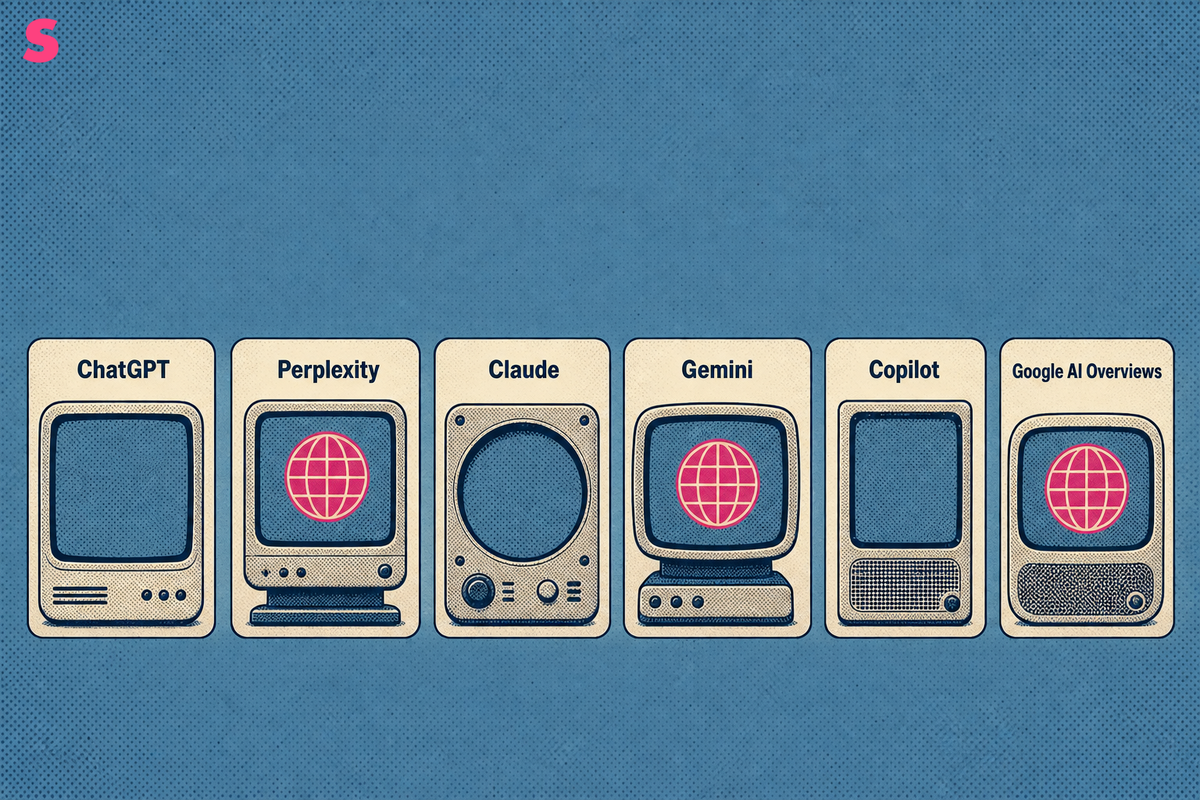
Checking your domain's AI visibility means finding out how often, and in what way, AI language models and AI-powered search features mention or cite your website when someone asks a relevant question. That covers ChatGPT, Perplexity, Claude, Gemini, Copilot, and Google AI Overviews.
In practical terms, checking the AI visibility of your domain means running a set of realistic buyer questions through these engines and recording three things: whether your domain appears at all, where it appears in the answer, and whether it appears as a named citation or just a passing mention. For a B2B SaaS company, that might mean testing "best attribution software for B2B" across five engines and logging the result for each one.
This matters for brand strategy because AI answers are increasingly where research happens before a buyer ever lands on a vendor's site. A buyer who reads a comparison inside ChatGPT and never clicks through still forms an opinion of your brand from that answer. If your domain is absent from that answer, a competitor's is filling the space instead.
Multiple vendors now offer tools that compare visibility across at least six major AI engines and search tools, according to discussion on reddit.com.
How do you run a free AI visibility check on your domain right now?
You can check the AI visibility of your domain in minutes using a free checker: enter your domain, generate a report, and review the branded and non-branded results it returns.
A practical run looks like this:
- Enter your domain or a specific URL into the checker.
- Let the tool generate a report against its built-in prompt set.
- Review branded results, where your company name is already part of the question.
- Review non-branded results, where the question describes a problem or category with no brand named.
- Note which AI engines returned a mention and which returned none.
Sona AI Visibility publishes a free entry point on the same terms: a 14-day free trial with no credit card required, alongside its paid brand and agency tiers.
What shows up in an AI visibility report?
An AI visibility report shows whether your domain was mentioned, where it ranked in the answer, which engines mentioned it, and often the sentiment of the mention. Most reports break results out by AI platform rather than giving one blended score.
A report covering multiple engines lists, per engine, whether your domain appeared and in what position, drawing on platforms such as ChatGPT, Gemini, Perplexity, Copilot, and Claude.
Beyond the raw mention count, a fuller report includes:
- Share of voice against named competitors on the same prompt set.
- Sentiment of the mention: positive, neutral, or negative.
- The specific sources the AI engine cited to generate its answer.
- Whether the reference was a named citation with a link, or a bare mention with no source attached.
The source-tracking layer of a report is often the most useful part, because it shows not just that you were absent but which competing domain the model trusted instead. Seeing that pattern across many prompts is what turns a report into a competitive positioning tool.
Which tools can check your domain's visibility across AI engines, and how do they differ?
Tools that check domain visibility across AI engines differ mainly on three things: how many engines they track, whether they attach revenue data to a mention, and how they price access. Free checkers give a one-time snapshot; paid platforms track visibility on a schedule and layer in competitive and attribution data.
Some offerings capture the end-user experience directly, scraping the prompt response the way a person would see it, ads, formatting, and all. Others pull data from the vendor's official API, which returns a structured response that does not necessarily match what an end user sees on screen. Sona uses both methods to mirror the end-user experience.
Most checkers stop at counting mentions. Sona AI Visibility connects those citations and prompts to pipeline and revenue on one account timeline, and tracks which AI crawlers are reaching your pages.
| Tool | Price point | Engines tracked | Notable detail |
|---|---|---|---|
| Sona AI Visibility | Brands from $75/month, agencies from $199/month, both billed annually. 14-day free trial, no credit card. | ChatGPT, Gemini, Claude, Perplexity, Copilot, Grok, and others | Ties citations and crawler activity to pipeline and revenue, not just mention counts; unlimited seats and API/MCP access on every plan |
| PromptRush | From $19/month (Lite), $99 (Growth), $279 (Scale), Enterprise custom. Free one-off visibility report, no signup. 15% discount on annual billing; Claude tracking is a $39-$129/month add-on. | Core engines plus Claude as a paid add-on | Free one-off visibility report, no signup required |
| Otterly.ai | From $29/month (Lite), $189 (Standard), $489 (Premium), Enterprise from $1,000. Free trial, no commitment. 15% off annual; unlimited team members on every plan. | Multiple AI engines, tier-dependent | Focus: tracking brand mentions and share of voice across AI answers, with unlimited team members on every plan |
| Profound | From $99/month (Starter), $399 (Growth), Enterprise custom, billed yearly. Free trial on Growth. | Starter tracks ChatGPT only; Growth tracks 3 answer engines | Focus: citation tracking scoped to plan tier rather than a flat engine count |
| Scrunch AI | From $250/month (Starter) or $300 monthly, $417 (Growth) or $500 monthly, Enterprise custom. 7-day trial of Starter, no credit card. 17% discount on annual billing. | Multiple AI engines, tier-dependent | Focus: monitoring brand presence and content performance in AI answers |
| Semrush | AI visibility bundled into main plans, from about $165/month billed annually. 7-day trial. | Multiple AI engines via a broader SEO suite | Not sold as a standalone AI visibility product; separate free checker also available |
Buyers comparing these platforms should look past the headline price to what a tier actually includes. Profound's Starter plan, for instance, tracks only ChatGPT, while its Growth plan expands to three engines, so the number that matters is engine coverage per dollar, not the base price alone.
What prompts, sample sizes and scoring rules do AI visibility checkers actually use?
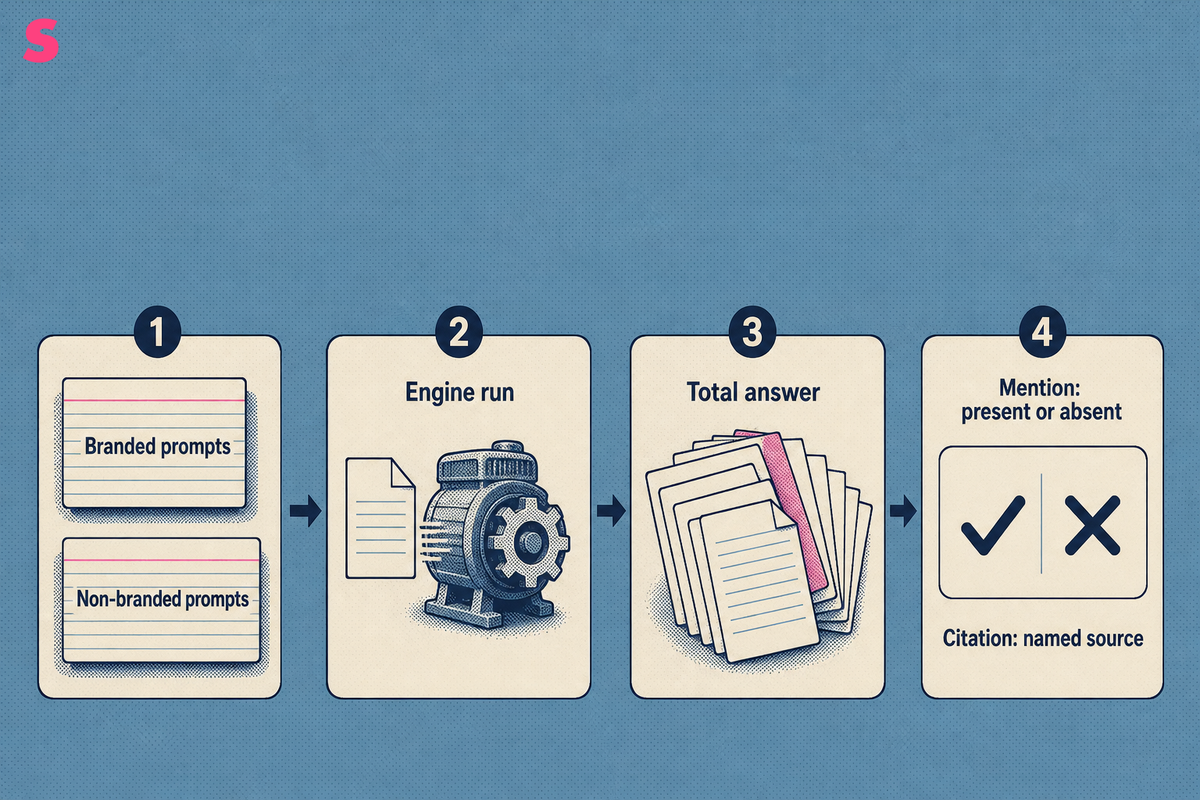
A reproducible AI visibility check depends on three design choices: where the prompts come from, what counts as one sample, and how an observation turns into a score.
Prompts typically come from two sources: a branded set, built around the company's own name and product terms, and a non-branded set, built around the category questions a buyer would ask before knowing which vendors exist. A methodology worth trusting states the mix between the two, because a report built mostly on branded prompts will always look stronger than one built on the category questions a new buyer actually types.
Sample units are not all the same thing. A prompt is a single question. An engine run is that prompt asked once against one engine. A total answer is one recorded response, the unit that accumulates as prompts are repeated across engines and over time. AI answers vary from one run to the next, so a single query against a single engine is not a stable measurement on its own.
Sona's own archive shows what that looks like on the engine side: it covers 8 answer surfaces, ChatGPT, Perplexity, Google AI Mode, Gemini, Mistral, Qwen, Claude and Google AI Overviews, per Sona's own AI visibility data, August 2026. Each of those is a separate place a buyer can ask about a category, and a brand can be present on one and absent from the next.
Scoring then applies fixed rules to that pool of answers. Mentions are scored as present or absent per answer: does the domain appear anywhere in the response. Citations are scored as a stricter subset of mentions: does the domain appear as a named, linked source rather than a passing name-check. Share of voice is scored as a ratio, the domain's mention count divided by the combined mention count of the named competitors on the same prompt set. Sentiment is scored per mention, as positive, neutral, or negative, based on how the response characterizes the domain rather than whether it appears at all.
Every checker has blind spots worth naming:
- A fixed prompt list may not match the actual phrasing your buyers use.
- AI answers vary run to run, so a single query is not a stable measurement.
- A tool that scrapes the visible answer can capture something different from a tool that calls the vendor's API directly, because the two do not always return the same content.
- Sentiment scoring is model-dependent and can disagree between tools testing the same prompt.
A brand-level score alone does not tell you what to fix. Knowing which prompts trigger a mention and which sources the engine trusted instead is the actual work item, not the number. AI Search Insights breaks that score down to the prompt and the source, mapping specific pages to the AI prompts likely to surface them so a low score turns into a list of pages to fix rather than a single figure to worry about.
How can you check AI visibility manually, without a tool?
You can check AI visibility manually by asking each AI engine the same set of buyer questions directly and recording the results yourself in a spreadsheet.
A workable manual process looks like this:
- Write down 10 to 20 questions your buyers would plausibly ask, mixing branded and non-branded phrasing.
- Open ChatGPT, Perplexity, Claude, and Gemini in separate tabs and ask each question in each tool.
- Record whether your domain appears, in what position, and whether it is a named citation or a bare mention.
- Note which competitor domains appear instead, and on which questions.
- Repeat monthly, using the same question set, so results are comparable over time.
For Google AI Overviews specifically, run the same questions through a standard Google search and check whether an AI Overviews panel appears above the organic results, then note whether your domain is cited within it. This differs from testing chat-style engines because Google AI Overviews only appears for a subset of queries.
Programmatic checking is possible too, by querying each vendor's API with your prompt list and parsing responses for domain matches, though this requires development time and API access. The Adobe AI Content Visibility Checker offers a free, no-signup browser diagnostic for a single page as a lighter alternative to building your own script. The AI Visibility Checker is a comparable free option: "The AI Visibility Checker is a free technical tool built by 365i, the publisher of the AI Discovery Files specification," according to the AI-Visibility.org team.
How is AI visibility different from ranking in traditional SEO?
AI visibility measures whether your domain is mentioned or cited inside a generated answer, while traditional SEO measures whether your domain ranks on a results page the user then clicks.
Traditional SEO optimizes for a ranked list of ten blue links plus a click. AI visibility optimizes for inclusion inside a single synthesized answer, where there may be no click at all. A user can read a full answer that cites your competitor by name and never visit either site.
Ranking factors overlap only partly:
- SEO rewards keyword targeting, backlinks, and page authority measured over time.
- AI visibility rewards content structure an engine can extract cleanly, such as FAQPage schema and direct answer formatting.
- SEO position is stable for hours or days; an AI answer can change between two consecutive runs of the same prompt.
- SEO traffic is measurable by click-through; AI-driven traffic often lands in analytics as unattributed or direct, because the referring click never happened.
That last gap, sometimes called dark traffic, is why AI visibility needs its own measurement layer rather than being folded into an existing SEO dashboard. A page can rank first in Google and still never get cited in an AI answer for the same query, and the reverse happens just as often.
How should you interpret an AI visibility score and act on it?
Interpret an AI visibility score by comparing it against direct competitors on the same prompt set, not against an abstract benchmark. A score means little in isolation; what matters is whether you are ahead of or behind the two or three vendors your buyers actually consider.
Read a score alongside three questions: Is our share of voice growing or shrinking against named competitors? Are we cited with a link, or just mentioned by name? Which specific prompts are we losing?
Once you have that breakdown, act on the gaps rather than the headline number:
- If a competitor is cited and you are not, check whether their page answers the question more directly, with clearer structure.
- If your domain appears as a mention but never a citation, your content may lack the schema markup or clear sourcing engines prefer to link.
- If visibility drops after a content refresh, check whether the update accidentally removed a structured answer format the engine had been citing.
Intent Signals turns this from a reporting exercise into a prioritization one, by surfacing which prompts real buyers are putting to AI engines about your category, so content decisions follow actual buyer questions rather than guesses about what might be asked.
How do you confirm AI visibility is actually driving traffic to your domain?
Confirm AI visibility is driving traffic by checking three separate measurements: human visits referred from an AI engine, AI-bot crawl activity on your pages, and zero-click brand influence where no visit happens at all. Only the first of these directly confirms traffic.
GA4 will show human AI referral traffic under standard referral reports if the AI engine passes a referrer header, filtered for domains such as chatgpt.com and perplexity.ai. Server logs are a separate measurement: they confirm that an AI crawler such as GPTBot, ClaudeBot, or PerplexityBot accessed a page, which shows the content was reachable and indexable, but a bot visit does not confirm any human traffic.
Zero-click brand influence is a third measurement again. Many research sessions inside an AI engine never generate a referral, because the user reads a complete answer and never clicks through. That kind of influence cannot be inferred from referral data or crawler logs; it requires a separate attribution signal, such as asking new leads or customers to self-report where they first heard of you.
A practical validation routine:
- Filter GA4 referral traffic for known AI domains over the same window your visibility report covers, to measure human visits.
- Cross-check server logs for crawler activity from bots such as GPTBot, ClaudeBot, and PerplexityBot on the pages your report says were cited, to measure content access rather than visitors.
- Compare the trend over several months rather than a single snapshot, since AI answers change as models retrain.
- Flag pages with high citation counts but zero referral traffic as candidates for self-reported attribution, since the research likely happened without a click.
Agent Analytics addresses the crawler side of this by reading server logs or a lightweight edge worker rather than a JavaScript tag, so it can track which AI bots reach a page even when ad blockers would hide a script-based tracker. AI Attribution then addresses the human-visit side, connecting an AI-referred visit through to pipeline and closed revenue on one account timeline.
Frequently Asked Questions
How often should you check your domain's AI visibility?
Check monthly as a baseline. AI answers change as models retrain and re-crawl sources, so a score from three months ago may no longer reflect current results. Increase frequency around product launches or major content pushes, when you want to see whether new pages are getting picked up.
Can a brand-new domain show up in AI visibility checks at all?
Not at first. Citation depends on the domain having crawlable, indexed content that AI engines have already ingested. A domain published last week has nothing for a model to have found yet, so it will score near zero until content is published, crawled, and given time to surface in answers.
Does a high AI visibility score mean more website traffic?
Not automatically. A citation or mention does not guarantee a click, since many AI answers fully satisfy the user's question without sending them anywhere. Check your visibility score against actual referral traffic in analytics before assuming a mention is translating into visits.
Is being mentioned in an AI answer the same as being cited with a link?
No. A mention is a name-check with no source link attached; a citation names your domain as the actual source and links to it. A good visibility report should count the two separately rather than combining them into one figure.
Do AI visibility checkers cover Google AI Overviews as well as chatbots?
Most do. Checkers query chat-style engines such as ChatGPT, Perplexity, Claude, and Gemini alongside Google AI Overviews, though coverage and update frequency vary by tool. Confirm which specific surfaces a given checker tests before relying on its report for a complete picture.
What is a good AI visibility score for a B2B SaaS domain?
There is no universal good score. What matters is how you compare against the direct competitors your buyers actually consider, on the same set of prompts. A score that looks strong in isolation can still mean you are losing share of voice to a competitor testing the same questions.
Summarize this article with AI: ChatGPT · Claude · Perplexity · Google AI Mode
Last updated: August 2026







