


GEO tools for small businesses monitor whether ChatGPT, Perplexity, Google AI Overviews, and other answer engines mention, cite or recommend your brand, helping you address gaps. The best choice depends on your budget tier and the number of prompts you must track, rather than feature volume. Sona AI Visibility connects prompts and citations to pipeline and revenue while displaying AI crawler activity. Begin with a fixed prompt set and upgrade only after you outgrow it.
What do generative engine optimization tools for small businesses actually do?
Generative engine optimization GEO tools for small businesses track whether AI systems retrieve, cite, and recommend a business when buyers ask relevant questions. They show whether a company appears in answers from ChatGPT, Perplexity, Google AI Overviews, and other answer engines, then identify the pages and topics that need attention.
GEO is the practice of structuring content and online presence so AI systems retrieve, cite, and recommend a business, per business.com. Traditional SEO concentrates on rankings and clicks from search results. AEO focuses on formatting content for direct answers. GEO measures whether content is retrieved, cited, or synthesized into a generated AI answer.
Google AI Overviews appeared on 86.7% of business-intent searches in April 2026, compared with 56.9% in April 2025, per the April 2026 listing. A small business does not need to track every possible query. It needs a repeatable view of the buyer questions that influence leads, comparisons, and purchasing decisions.
Which GEO tool should a small business choose at each budget level?
Small businesses should choose a GEO tool based on monitoring depth, prompt capacity, and the work required after a citation gap appears. Use a diagnostic check for technical priorities, a low-cost monitoring plan for a small recurring prompt set, and a larger platform when several people, markets, or client accounts need regular reporting.
- Free or diagnostic checks: Use a manual prompt log and the Free AI Readiness Checker when the immediate question is whether answer engines can read the site. A small business can ignore multi-client workspaces and large prompt allowances at this stage.
- Low-cost monitoring: Sona AI Visibility starts from $75/month, while Otterly.ai starts from $29/month as of October 2026. This tier suits a fixed set of commercial, local, and competitor-comparison prompts. A single-location business can ignore agency plans and enterprise workflow controls.
- Full SEO and GEO platforms: Sona AI Visibility, Peec AI, Scrunch AI, AthenaHQ, and other platforms in the hundreds per month suit teams that need broader reporting, page-level work, or several stakeholders. A small business should not pay for a large plan before its prompt list produces recurring decisions.
The right starting point is the tier that can run the same buyer questions daily and retain enough history to separate a real change from a one-day answer variation.
How do the leading GEO tools compare on price, tracked prompts and AI engines?
The leading GEO tools differ in entry price, engine coverage, prompt capacity, refresh cadence, and the work they support after tracking. The comparison below uses published plan information as of October 2026. A low entry price can suit a narrow prompt set, while higher-priced plans often support broader monitoring or agency workflows.
| Tool | Starting price | Agency Plans? (Yes/No) | # of Answer Engines Tracked | Answer Engines | # of Daily Tracked Prompts (entry plan) | Cost per Daily Tracked Prompt | Differentiation |
|---|---|---|---|---|---|---|---|
| Sona AI Visibility | From $75/month, billed annually | Yes | Up to 11 (3 on Starter) | Not published | 5,000 credits/month, about 166 daily tracked prompts on one model or 56 across three | $0.45 per daily tracked prompt | Connects AI citations and prompts to pipeline and revenue on one account timeline, and tracks AI crawler activity from server logs or a lightweight edge worker. |
| Profound | Custom pricing, Enterprise | Yes | Up to 9 (3 on free Trial) | ChatGPT, Perplexity, Google AI Mode, Gemini, Microsoft Copilot, DeepSeek, Claude, Google AI Overviews, Exa Search | Custom prompt plan, daily | Cannot calculate, custom pricing | Enterprise prompt tracking and agency pitch workspaces. |
| Peec AI | $95/month | Yes | Up to 13 (3 of 6 on Starter, plus add-ons) | ChatGPT, Google AI Mode, Google AI Overviews | 50 prompts daily | $0.63 per daily tracked prompt | AI visibility monitoring for self-serve and agency plans. |
| Otterly.ai | $29/month | Yes | Up to 7 (4 on Lite, 3 as paid add-ons) | ChatGPT, Google AI Overviews, Perplexity, Microsoft Copilot | 15 prompts daily | $0.48 per daily tracked prompt | Entry-level AI search monitoring with additional engine add-ons. |
| Scrunch AI | $250/month | Yes | Up to 9 (4 on Core) | ChatGPT, Perplexity, Google AI Overviews, Microsoft Copilot | 125 prompts, refresh cadence not published | No refresh cadence published | AI visibility tracking across Core and agency plans. |
| AthenaHQ | $295/month Starter | Yes | 11 | Not published | 3,600 credits/month, unlimited prompts; refresh cadence not published | No refresh cadence published | Credit-based monitoring with unlimited prompts on Starter. |
| PromptWatch | $95/month | Yes | Not published | Not published | 50 prompts daily | $0.48 per daily tracked prompt | Prompt monitoring with response allowances and agency plans. |
| Goodie | $295/month | Yes | Up to 14 (5 on Core) | Not published | 110 prompts daily | $0.67 per daily tracked prompt | Model coverage and daily prompt monitoring for Core plans. |
Price alone does not determine fit. Verify the engines included in the chosen tier, whether prompts run daily, and whether the output identifies pages, sources, or buyer questions a team can act upon.
Which GEO tool capabilities differ, and which do all of them share?
Most GEO tools share mention tracking, citation tracking, competitor tracking, and recurring checks across answer engines. The meaningful differences are whether a platform recommends fixes, shows AI crawler activity, identifies cited source pages, or connects visibility data to commercial outcomes.
A brand-level visibility score is a dated snapshot, not a work item. A prompt-level view shows which questions produce citations, which sources the engines cite, and which page needs attention. Sona AI Visibility connects prompts and citations to pipeline and revenue, while its page-level view identifies the prompts a page should appear in but does not.
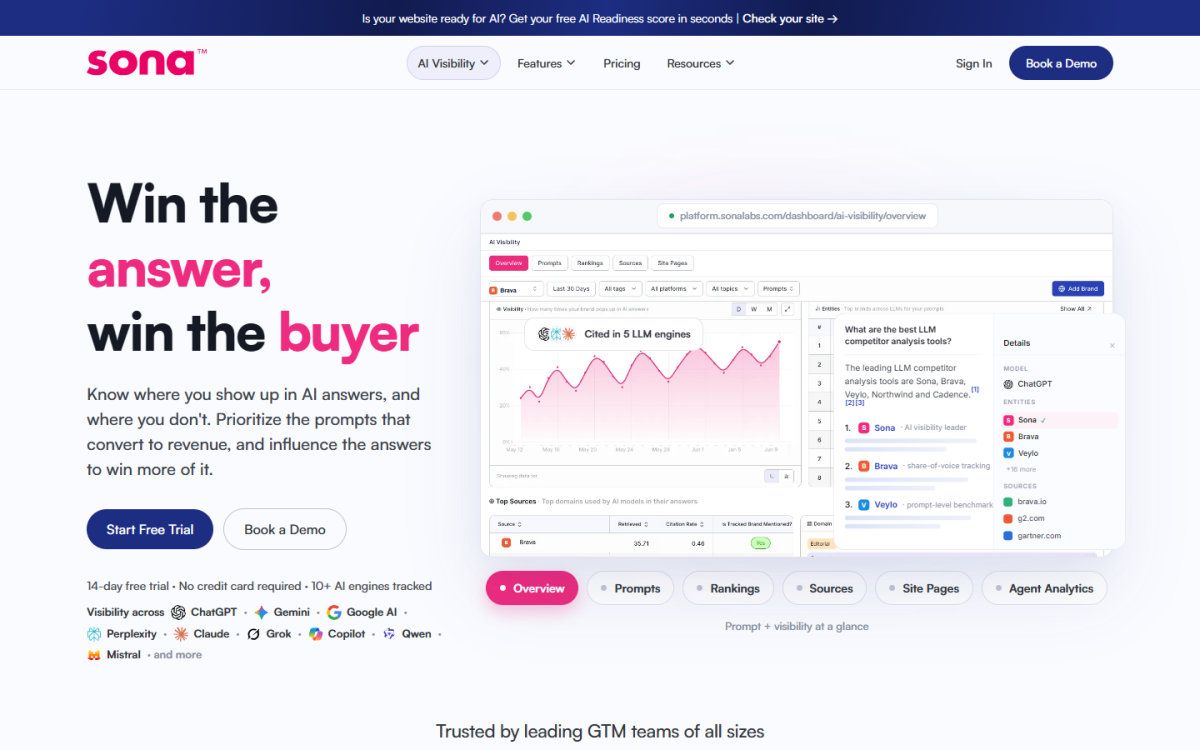
Sona AI Visibility shows AI crawler and agent activity, helping a business determine whether answer-engine bots reach its pages. AI Search Insights supports prompt, source, and page analysis, while Agent Analytics reports crawler visits from server logs or a lightweight edge worker. The product also offers done-for-you services for teams that need help with content, AI search optimisation, technical fixes, strategy, and reporting.
A small business should pay for execution-oriented capabilities only when it has a process for acting on them. Citation tracking without page ownership, content capacity, or technical support becomes another dashboard rather than a useful operating system.
How many prompts does a small business need to track before it must upgrade?
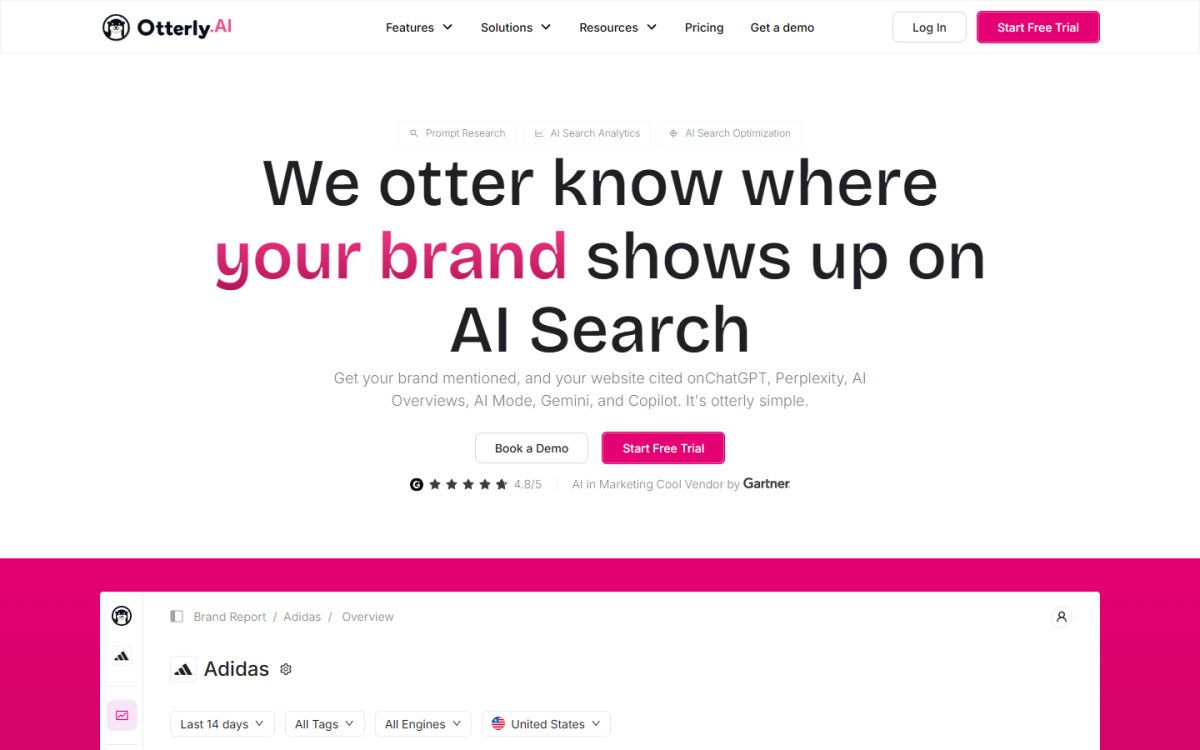
A small business can begin with about 15 buyer questions, then upgrade when important commercial, local, competitor, and product prompts no longer fit in a stable daily list. Sona AI Visibility connects citations and prompts to pipeline and revenue, while Otterly.ai listed 15 tracked prompts at $29 per month and 100 prompts at $189 per month in October 2026, illustrating the jump from basic monitoring to broader coverage.
Start with prompts that reflect real purchase research. Include service-category questions, location-specific questions, comparison questions, pricing questions, implementation questions, and problem-oriented questions. For example, a local accounting firm could track prompts about business tax services, bookkeeping software integration, year-end preparation, and accountant comparisons in its target area.
- 15 prompts: One core service, one location, a short competitor set, and several high-intent buyer questions.
- 30 to 50 prompts: Multiple services, several locations, more comparison prompts, and distinct questions for awareness, consideration, and decision stages.
- 100 prompts or more: Several products, regions, business units, or an agency managing multiple clients.
A team that runs the same prompt list daily can see patterns that a weekly snapshot averages away. A one-day citation spike is evidence to investigate, not a ranking position to celebrate.
Who should skip a paid GEO tool and check AI answers by hand instead?
A small business should skip a paid GEO tool when it has no recurring buyer questions, no capacity to update pages, and no need to compare results over time. Manual checks work well for first discovery, especially when a founder wants to learn whether ChatGPT, Perplexity, Google AI Overviews, and other answer engines mention the business.
Manual checking becomes unreliable when the business tracks several engines, competitors, locations, or product lines. AI answers change with retrieval indexes, model updates, and new material from competitors. Repeated observations matter more than a single answer because one response does not establish a durable position.
Use a spreadsheet for an initial audit. Record the prompt, engine, date, business mention, cited sources, competitor mentions, and the most relevant page. Run the same prompts daily for a short baseline period before deciding whether automated monitoring would save meaningful time.
Paid monitoring earns its fee when history becomes useful. A comparable series reveals whether citations hold, disappear, or move between sources. The business can then link those changes to page edits, new content, referral traffic, and sales activity.
How can a small business set up GEO tracking step by step on a limited budget?
A limited-budget GEO program starts with a disciplined prompt list, a manual baseline, and daily observation. The goal is to identify buyer questions where a citation, recommendation, or source reference could influence qualified demand.
- Write 15 buyer questions. Include commercial prompts, local queries, comparisons, pricing questions, and problems customers describe before they search for a provider.
- Record a manual baseline. Run each question in ChatGPT, Perplexity, Google AI Overviews, and other answer engines. Log the date, whether the business appears, cited domains, competitor mentions, and the answer wording.
- Choose a monitoring tier. Use a free technical diagnostic or an entry-level monitoring plan that can run the prompt set daily. Avoid buying capacity for questions the business cannot review.
- Run the same prompts daily. Keep wording stable. A team that runs the same prompt list daily can distinguish a trend from normal answer volatility.
- Log cited sources. Note the domains, page types, directories, articles, and first-party pages cited by each engine. Citation sources reveal the content formats that answer engines already trust for that question.
- Fix the pages those sources point to. Improve the page that should answer the prompt, then review technical access, structured content, evidence, and recency.
Adding quotations and statistics can raise generative-engine visibility by up to 40%, per the October 2026 listing. Use evidence only when it is accurate, attributable, and relevant to the buyer question. Unsupported statistics create citation risk rather than a content advantage.
Review prompt history regularly, and revisit technical priorities and positioning when changes in the evidence warrant a broader content review. Prompt monitoring detects answer changes, while a broader content review determines whether the business should expand its prompt set.
What does a page need technically before an AI engine will cite it?
A page needs to be reachable, understandable, current, and technically sound before an AI engine can reliably retrieve it as a source. Google publishes official best practices and technical SEO guidance for generative AI features in Search, per Google's Search documentation.
Start with crawlability. Answer engines need access to the page through robots.txt rules, canonical tags, indexability controls, and reliable server responses. Then check performance and JavaScript dependence. Important copy should be available in server-rendered HTML rather than dependent on client-side rendering.
Security and header hygiene also matter as technical trust signals. Review HTTPS, Strict-Transport-Security, Content-Security-Policy, and X-Content-Type-Options. Content structure matters next: use accurate schema markup, descriptive metadata, semantic headings, and direct answers to buyer questions.
Content quality, recency, and accessibility complete the technical foundation. Update stale pages, support claims with evidence, add alt text, use ARIA attributes correctly, maintain adequate contrast, and specify image dimensions. The Free AI Readiness Checker can identify technical and content priorities, but any score is only a dated snapshot until the team addresses the page-level findings.
How do you connect AI mentions to traffic, leads and revenue?
AI mentions do not prove revenue by themselves. A small business should treat citations as an intermediate metric, then connect them to AI referral traffic, branded search, assisted conversions, sales conversations, qualified leads, and pipeline trends over the same period.
Buyer research makes the measurement problem material. Sixty-six percent of respondents reportedly used AI regularly to research products, vendors, or solutions, while another 29% did so occasionally, per the October 2026 listing. That behavior can influence a buying decision before a prospect visits a website or completes a form.
Build an evidence chain. Record AI citations and cited pages, inspect referral analytics for answer-engine visits, monitor branded search movement, ask prospects how they heard about the business, and review whether sales calls reference AI-generated comparisons or recommendations. No single signal establishes causation, but aligned signals produce a more credible account of contribution.
Sona AI Visibility uses AI Attribution to connect AI citations to accounts, pipeline, and closed-won revenue on one timeline. Sona Marketing Measurement provides the broader measurement foundation for identity resolution, attribution, and AI search as a channel alongside other marketing activity.
What are the frequently asked questions about GEO tools for small businesses?
What is generative engine optimization for a small business?
Generative engine optimization is structuring a small business’s content and online presence so AI systems retrieve, cite, and recommend it. GEO differs from traditional SEO because the target is not only a ranking in search results. The target is inclusion in a generated answer that helps a buyer evaluate a product, service, or provider.
How much do GEO tools cost for a small business?
Entry-level GEO plans were listed from about $29 per month in October 2026, while fuller platforms ran into the hundreds per month. Match the tier to the number of prompts that need daily monitoring, the number of engines covered, and whether the business needs page-level recommendations or agency reporting.
Do I need a GEO tool if I already do SEO?
Traditional SEO remains the foundation because crawlability, content quality, technical health, and search demand still matter. A GEO tool answers a different question: whether AI systems mention, cite, or recommend the business in generated answers. Standard SEO reports do not consistently show that visibility.
Can I track my AI visibility for free?
Yes. Run a fixed set of buyer prompts manually, record the answers, and log the cited sources in a spreadsheet. Free tracking becomes inconsistent when a business needs to compare several engines, competitors, dates, locations, and prompt variations over time.
Which AI engines should a GEO tool cover?
At minimum, a GEO tool should cover ChatGPT, Perplexity, Google AI Overviews, and other answer engines because GEO tools commonly track citations across those answer surfaces. Confirm engine coverage for the exact plan before paying, since some platforms reserve certain engines for higher tiers or paid add-ons.
Can GEO tools prove that AI mentions bring in revenue?
Mentions alone do not prove revenue. Pair citation data with referral analytics, branded search, assisted conversions, self-reported attribution, sales conversations, and qualified pipeline. A platform that connects citations to accounts and revenue can provide a stronger measurement chain, but the business should still interpret visibility as one contributing signal.
Summarize this article with AI: ChatGPT · Claude · Perplexity · Google AI Mode
Last updated: October 2026







