


Gemini SEO services are paid efforts designed to increase the chances that a brand is mentioned and cited in Google Gemini responses, using content restructuring, technical markup, entity work and off-site authority. No provider can promise inclusion, since Gemini responses differ by prompt, user context and location. Sona's done-for-you services build on a Sona AI Visibility plan, starting at $5,500/month, and connect citations with pipeline and revenue. Evaluate any offer by measurement scope, rather than promises.
What do Gemini SEO services include, and what do they leave out?
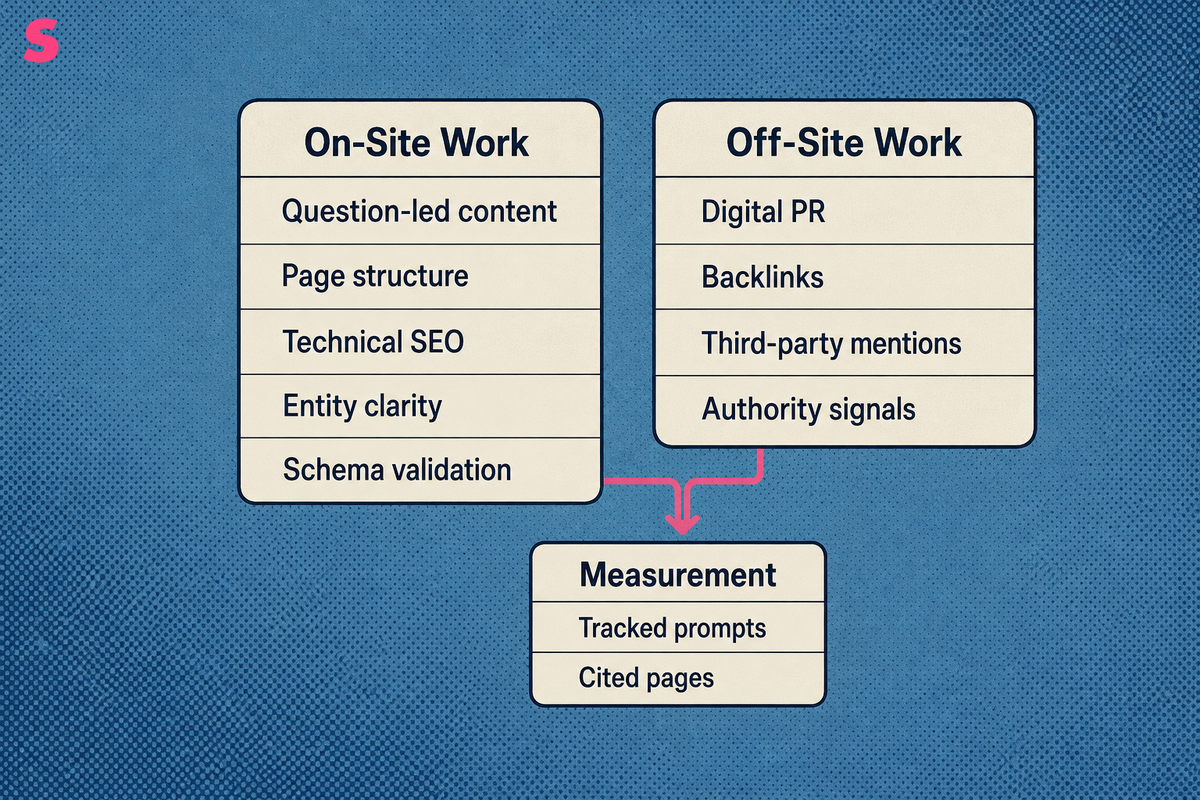
Gemini SEO services restructure pages to answer buyer questions clearly, strengthen technical signals such as structured data, and build the authority signals that support inclusion in AI-generated answers. The work covers on-site content and off-site authority building, rather than a single prompt or schema deployment.
A capable engagement starts with a query map, assigns each priority question to a page, checks whether Gemini can crawl and interpret that page, then revises its evidence, structure, and entities. Technical work can include canonical tags, server-rendered HTML, internal linking, and data markup.
- On-site work: question-led content, page structure, technical SEO, entity clarity, and schema validation.
- Off-site work: digital PR, backlinks, third-party mentions, and other authority signals.
- Measurement: tracked prompts, cited pages, AI-referred visits, and commercial outcomes.
Gemini SEO services cannot provide a reliable formula for inclusion in every answer. They do not replace product positioning, subject-matter expertise, or a useful destination page. An agency can improve the inputs that make a page easier to retrieve and cite, but answer selection remains outside the agency’s control.
How is Gemini SEO different from optimizing for Google AI Overviews, AI Mode and ChatGPT?
Gemini SEO targets Gemini’s answer experience, while Google AI Overviews, Google AI Mode, and ChatGPT are separate retrieval and answer environments. The underlying content work overlaps, but prompt sets, citation patterns, interface behavior, and user context differ by target.
Google AI Overviews appear within Google Search results. Google AI Mode is a separate Google search experience for longer AI-led interactions. Gemini is Google’s assistant environment. ChatGPT is a different answer engine with its own retrieval behavior and answer formatting.
- Build prompt groups by buyer intent, not only by legacy keywords.
- Run each prompt against the answer engine that matters to the business.
- Record brand mentions, cited URLs, competitors, and answer position separately.
- Map repeated citation gaps to a page, entity, or evidence problem.
Sona AI Visibility supports Gemini, ChatGPT, Google AI Mode, Google AI Overviews, Claude, DeepSeek, Grok, Copilot, Qwen, Mistral, and Perplexity across 11 AI engines, per sona.com, October 2026. Multi-engine tracking matters because a page cited in Gemini can be absent from Google AI Overviews for the same commercial question.
How does Gemini SEO differ from traditional SEO, step by step?
Traditional SEO begins with rankings and clicks from search results. Gemini optimization begins with the buyer question, the answer Gemini produces, the sources it cites, and the page that can substantiate a useful answer.
The practical workflow has five steps:
- Identify demand: use keyword research to find commercial topics, then turn priority clusters into natural-language prompts.
- Define the answer: identify the claims, entities, comparisons, and evidence a buyer needs before choosing a vendor.
- Build the source page: publish structured, current, technically accessible content that directly supports those claims.
- Track answer behavior: run the same prompt list daily across Gemini and other relevant answer engines.
- Prioritize commercial gaps: connect missing citations to pages, accounts, and pipeline rather than treating all mentions equally.
For example, traditional SEO may target the commercial keyword best payroll software for mid-market companies with a ranking page that lists products and targets related terms. Gemini SEO converts that topic into a buyer prompt such as Which payroll software is best for a 500-person company with multi-state compliance requirements? The source page would add a comparison table covering employee thresholds, multi-state support, implementation requirements, integrations, and pricing approach, alongside clear definitions of the relevant product categories and evidence for each claim. Traditional measurement tracks ranking movement and organic clicks for the keyword. Gemini measurement tracks whether the answer mentions the brand, cites the comparison page, and produces AI-referred visits or commercial engagement.
Running the same prompt list daily reveals patterns that a weekly snapshot can obscure. Gemini answers shift with retrieval indexes, model changes, and competitor publishing activity. Treat repeated movement across comparable prompt runs as evidence of a durable change, while treating isolated observations as inconclusive.
Traditional rankings remain useful demand evidence. They do not prove that Gemini cites a page. The relevant unit is the answer, its cited sources, and the buyer journey that follows.
Which content, schema, entity and local tactics make Gemini more likely to cite a brand?
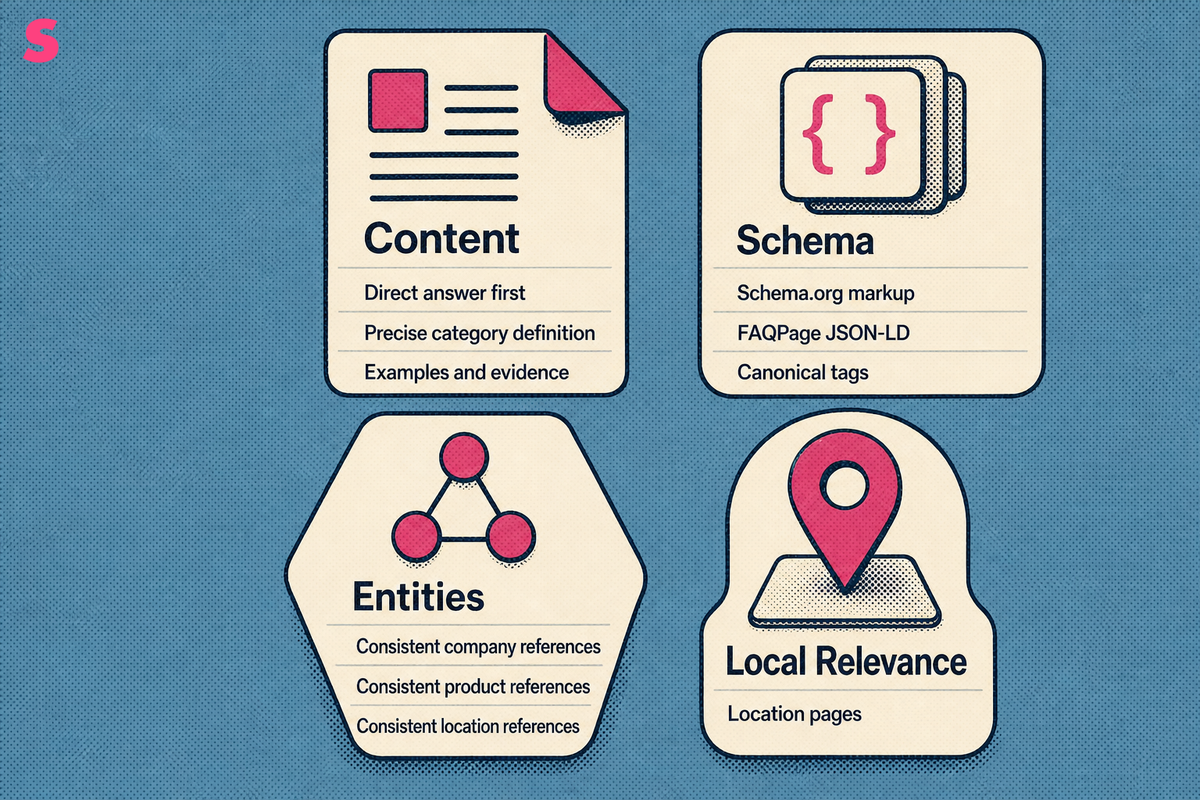
Content that answers a specific question with clear claims, evidence, and well-defined entities gives Gemini a stronger source to retrieve. Gemini SEO should improve page usefulness first, then reinforce it through schema, technical access, and consistent off-site entity signals.
Content pages should lead with a direct answer, define the category precisely, and support important claims with examples, comparison criteria, process details, and current evidence. Thin pages that repeat a keyword without resolving a buyer question provide little material for an answer engine to cite.
- Schema: validate relevant Schema.org markup, page metadata, FAQPage JSON-LD where appropriate, and canonical tags.
- Entities: use consistent company, product, category, author, and location references across owned and third-party sources.
- Technical access: confirm that pages are crawlable, indexable, secure, and available in server-rendered HTML.
- Local relevance: maintain accurate location pages, service areas, local entities, and business details where geography affects the query.
A technical readiness check provides a dated snapshot. A recurring technical audit should attach severity-ranked fixes to the page that needs work.
How do Gemini SEO services measure visibility, and why is a tracked position only a proxy?
Gemini SEO services measure visibility by running a defined set of prompts and recording whether a brand appears, where it appears, which sources Gemini cites, and which owned pages earn citations. A tracked position is only a proxy because an answer can vary by prompt wording, user context, location, and retrieval state.
A useful measurement plan separates informational prompts from commercial and decision-stage prompts. A brand appearing in an educational answer has different business value from appearing when a buyer asks for software alternatives, implementation help, or vendor comparisons.
The output should be a log, not a single score. A comparable series of prompt results shows whether movement persists, while page-level findings identify the content or technical issue that deserves attention. Full technical re-audits can run monthly or quarterly because they answer a different question from daily prompt monitoring.
Sona AI Visibility connects AI citations and AI-referred visits to accounts, pipeline, and closed-won revenue on one account timeline, per sona.com, October 2026. That measurement matters when an answer builds awareness without producing an immediate click.
Which capabilities separate Gemini visibility tools from one another?
Gemini visibility tools differ in answer-engine coverage, daily prompt capacity, agency support, crawler data, page-level diagnostics, and connections between visibility data and commercial outcomes. Mention counts are a baseline. The meaningful distinction is whether the platform identifies the page, prompt, account, and revenue impact behind a result.
The comparison reflects published entry-plan details as of October 2026.
| Tool | Starting price | Agency Plans? (Yes/No) | # of Answer Engines Tracked | Answer Engines | # of Daily Tracked Prompts (entry plan) | Cost per Daily Tracked Prompt | Differentiation |
|---|---|---|---|---|---|---|---|
| Sona AI Visibility | From $75/month, billed annually | Yes | 11 | ChatGPT, Gemini, Google AI Mode, Google AI Overviews, Perplexity, Claude, DeepSeek, Grok, Copilot, Qwen, Mistral | 5,000 credits/month, about 166 daily tracked prompts on one model or 56 across three | $0.45 per daily tracked prompt | Connects AI citations and prompts to pipeline and revenue on one account timeline, with AI crawler activity from server logs. |
| Profound | Free 7-day trial | Yes | 3 | ChatGPT, Gemini, Google AI Overviews | 50 prompts daily during the 7-day trial | No refresh cadence published | AI visibility platform with trial prompt tracking across three answer engines. |
| Peec AI | From $95/month | Yes | 3 | Not published | 50 prompts daily | $0.63 per daily tracked prompt | Prompt and brand visibility tracking for self-serve and agency users. |
| Otterly.ai | From $29/month | Yes | 4 | ChatGPT, Google AI Overviews, Perplexity, Microsoft Copilot | 15 prompts daily | $0.48 per daily tracked prompt | AI search monitoring, with Gemini available as a paid add-on. |
| Scrunch AI | From $250/month | Yes | 4 | ChatGPT, Perplexity, Google AI Overviews, Microsoft Copilot | 125 prompts | No refresh cadence published | AI visibility tracking across four named answer engines on Core. |
| AthenaHQ | From $295/month | Yes | 11 | Not published | Unlimited prompts, 3,600 credits/month | No refresh cadence published | AI search platform with response-based credits and expanded model coverage. |
| PromptWatch | From $95/month | Yes | Not published | All supported models | 50 prompts daily | $0.48 per daily tracked prompt | Prompt monitoring with response allowances and agency tiers. |
Tool selection should start with the commercial question. A content team may need prompt and citation monitoring. A RevOps team needs attribution, account identification, and a way to act on AI-sourced intent. These are different operating requirements.
How do the leading AI SEO agencies compare?
Leading AI SEO agencies differ by delivery model, B2B specialization, content production depth, digital PR capability, and pricing transparency. The right fit depends on whether the business needs an outside team for technical work and content production, or software and a repeatable operating model for an internal team.
The agency details below were read from agency listings in October 2026. Pricing reflects published retainers or published quote-only terms.
| Agency | Focus | What's included | Pricing |
|---|---|---|---|
| Sona | AI visibility measurement and managed execution | done-for-you services handle content, AI search optimization, technical fixes, strategy, and reporting on top of an AI Visibility Growth plan or above. | Launch from $5,500/month, Accelerate $7,500/month, Amplify $9,500/month, plus an AI Visibility plan |
| DerivateX | Full-service SEO and GEO for B2B SaaS | GEO for Gemini and other answer engines, entity optimization, content production, digital PR, backlinks, technical SEO, and migrations | $5,000–$12,000/month; enterprise scoped individually |
| Breaking B2B | SEO and AI search for B2B and SaaS | AEO, GEO, technical SEO, SEO content, link building, Reddit, and YouTube marketing | From $4,000/month; published plans from $5,500–$20,000+/month |
| Discovered Labs | AEO, GEO, and SEO for B2B | Citation work for Gemini and other answer engines, Reddit marketing, technical SEO, content SEO, digital PR, link building, and AI visibility tracking | €6,995/month, €10,995/month, or from €15,995/month for custom work |
| Omniscient Digital | SEO and GEO for B2B software | LLM optimization, citation analysis, GEO technical assessment, content production, digital PR, and visibility monitoring | From $10,000/month |
| iPullRank | AI search and GEO through relevance engineering | Relevance engineering, GEO, content strategy, technical SEO, attribution, measurement, and brand monitoring | Not published (quote only) |
| Foundation | GEO for B2B companies | GEO strategy, technical SEO, LLM advertising, content distribution, thought leadership, digital PR, attribution, and analytics | Not published (quote only) |
Published retainers show the difference between software pricing and execution-heavy services. Managed AI search optimization packages start at $3,000/month and extend to $68,250/month, based on October 2026 listings. Scope expands with site size, existing entity work, content needs, and query competitiveness.
When does an agency make more sense than a self-serve tool or a productized service?
An agency makes more sense when the business lacks internal capacity to ship technical fixes, build expert content, earn authority signals, and maintain prompt-level reporting. A self-serve platform makes more sense when an in-house SEO, content, or demand generation team can execute but needs measurement and prioritization.
Choose an agency when the work requires several disciplines at once:
- Technical debt, migrations, or crawlability issues affect many pages.
- Subject-matter experts need editorial support to turn expertise into citation-ready pages.
- Digital PR, backlinks, and third-party authority work are part of the operating plan.
- The team needs recurring execution, not only reports and recommendations.
Choose a self-serve tool when the organization already has writers, developers, and SEO ownership. The tool should help the team run daily prompts, locate citation gaps, and prioritize pages attached to commercial demand. Productized services sit between the two models, providing defined deliverables without a broad agency retainer.
Pricing provides a rough boundary. Gemini-focused service listings start at $500 per month on month-to-month terms, based on October 2026 listings, while broader SEO retainers range from $1,500 to $5,000 per month, based on October 2026 listings. The relevant question is whether the engagement includes the work needed to remove the actual constraint.
Who should not buy Gemini SEO services?
Gemini SEO services are not for teams without a clear buyer, a usable website, or a commercial reason to measure AI search. A service cannot compensate for weak positioning, unavailable product expertise, or pages that fail to explain what the company sells.
Do not buy a retainer for a one-time AI visibility score. Start with a technical assessment, define priority prompts, and confirm that internal owners can act on the findings. A score is a dated snapshot, not a content strategy.
Do not buy an agency when the main requirement is simple monitoring across a small prompt set. A self-serve platform can suit an internal team that can publish, update pages, and review results daily.
Monitoring which AI answers mention a brand is only half the job. The other half is connecting those mentions to accounts, pipeline, and revenue. Sona AI Visibility closes that loop by connecting AI citations and AI-referred visits to the commercial record on one account timeline, per sona.com, October 2026.
Frequently Asked Questions
How much do Gemini SEO services cost?
Gemini SEO services commonly start at $500 per month on month-to-month terms, based on October 2026 listings. Managed AI search optimization packages start at $3,000 per month and can reach $68,250 per month, based on October 2026 listings. Price reflects site size, existing entity work, required content production, technical scope, and query competitiveness.
Can an agency guarantee my brand will appear in Gemini answers?
No. Google does not publish a reliable formula for earning mentions or citations in Gemini answers. Results vary by prompt, user context, location, retrieval state, and answer format. An agency can improve content quality, technical accessibility, and authority signals, but a guarantee of inclusion cannot be substantiated.
Is Gemini SEO the same as optimizing for Google AI Overviews?
No. Gemini, Google AI Overviews, and Google AI Mode are separate search experiences and should be treated as separate optimization targets. Content, entities, technical access, and authority signals overlap, but each environment requires its own prompt set and visibility measurement.
Can I use Gemini itself to do SEO work?
Yes. Gemini can generate content ideas, organize keywords, and create starting points for SEO tasks, per discuss.ai.google.dev. Gemini can also support advanced troubleshooting of website code and structure. Using Gemini as an assistant differs from earning citations or brand mentions inside Gemini answers.
Does visibility in Gemini turn into leads and revenue?
Not automatically. A mention or citation can build awareness without producing a click, especially when a buyer receives enough information inside the answer. Measurement must connect AI-referred visits and identified accounts to opportunities, pipeline, and closed-won revenue before the spend can be judged.
Do I need a separate tool to track Gemini?
Usually, yes. A conventional rank tracker does not sample Gemini answers as a prompt-based answer engine. Check whether Gemini is included in the plan, sold as an add-on, and refreshed daily. Also check how many prompts the plan supports, because a meaningful program needs enough coverage for commercial, comparison, and decision-stage questions.
Summarize this article with AI: ChatGPT · Claude · Perplexity · Google AI Mode
Last updated: October 2026







