


NLP SEO means creating content that aligns with how search engines apply natural language processing to understand queries, entities and context; it is a sector term, not an official Google ranking category. Its main use is editorial: address the entities and questions a topic needs, present answers clearly, and assess tool recommendations based on audience intent. Content scores show correlation, so evaluate changes against a baseline and an unchanged-page control group instead of relying on the score.
What does NLP SEO mean, and is it an official Google ranking factor?
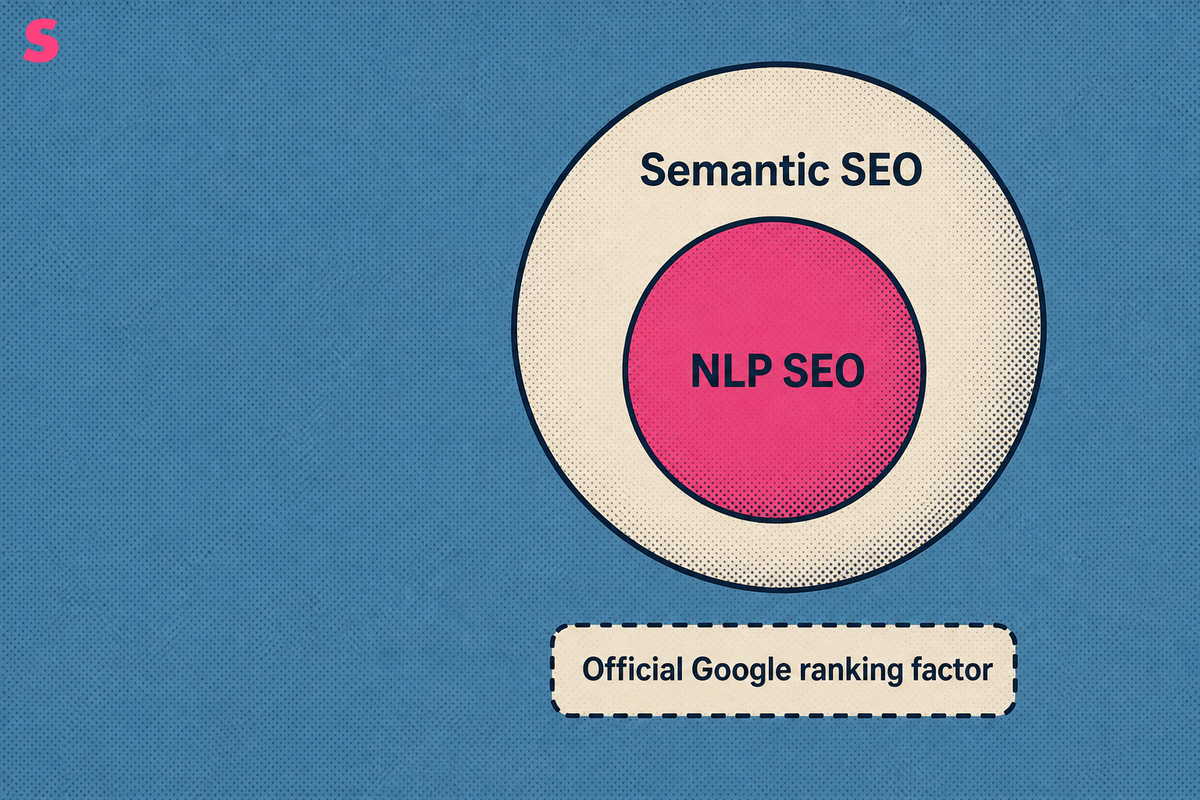
NLP SEO is the practice of writing and structuring content so search engines can interpret meaning, context, entities, and audience. It is an editorial framework, not a proprietary Google ranking factor or separate optimization category.
Natural language processing is the field of AI that analyzes human language, including word meanings and their relationships. In SEO, that understanding helps search engines match a query with content that addresses the underlying need, per searchengineland.com.
NLP SEO is an industry term rather than an official Google optimization category, per searchenginemagazine.com, published August 2026 and updated October 2026. For marketing teams, it supports clearer briefs, fewer thin pages, and a defensible way to assess whether a page answers buyer questions.
Semantic SEO is the broader discipline of covering topics, entities, and relationships. NLP SEO is the working method within that discipline: identify the language and intent behind a query, map the necessary concepts to a page, then test whether the edit improved performance.
How do search engines use natural language processing to interpret a query and a page?
Search engines use natural language processing to interpret searcher intent, connect that meaning to relevant pages, and rank results that best address the query, per searchengineland.com. Four concepts matter for SEO work: entities, relationships, context, and search intent.
- Entities are identifiable things, such as a product, company, location, role, or software category.
- Relationships explain how entities connect, such as a CRM integrating with an attribution platform.
- Context clarifies a word’s meaning within a query.
- Search intent identifies the task behind the search, such as learning, comparing, buying, or troubleshooting.
Consider the query “best pipeline software.” Pipeline could mean sales pipeline management, data pipelines, or industrial equipment. A searcher who also asks about CRM reporting and revenue attribution signals B2B marketing intent. A useful page should explain pipeline stages, account journeys, reporting, and buyer outcomes rather than repeat the word pipeline.
Natural language processing for SEO does not require algorithm-level speculation. The editorial task is to make the subject, audience, relationships, and decision context clear enough for a search engine to distinguish a relevant answer from a page that merely shares vocabulary.
How is NLP SEO different from keyword-based SEO and semantic SEO?
NLP SEO evaluates whether a page explains the intended topic, not merely whether it repeats a target phrase. It overlaps heavily with semantic SEO, but it is not keyword density, schema markup alone, or AI-generated copy.
Keyword research remains useful because it supplies demand evidence. A keyword is not a complete brief. A page can contain an exact-match phrase yet omit the entities, comparisons, constraints, and questions that make it useful to a buyer.
| NLP SEO technique | Traditional SEO equivalent | What the team evaluates | Measurable outcome |
|---|---|---|---|
| Entity coverage | Keyword frequency | Whether the page explains the people, products, concepts, and constraints central to the topic | Relevant query visibility and qualified engagement |
| Intent match | Exact-match targeting | Whether the format answers a learning, comparison, or purchase task | Performance across the intended query set |
| Answer structure | Page length | Whether headings and opening paragraphs provide direct answers | Search performance before and after a controlled edit |
| Entity relationships | Related-keyword lists | Whether the page explains how concepts affect one another | Coverage of relevant subtopics and user tasks |
Schema markup can clarify page structure, but it does not create subject-matter depth. AI-generated copy can accelerate drafting, but it does not prove expertise or intent match. Natural language SEO requires editorial judgment about what the reader needs to know.
How do you apply NLP principles to keyword research, content briefs and topic clusters?
NLP principles turn a seed topic into an intent map, entity list, and content brief. The objective is to define what a page must explain before drafting begins.
- Start with a seed topic, such as “marketing attribution.”
- List the entities and questions recurring across relevant results, including channels, buyer journeys, CRM data, pipeline, and reporting.
- Group queries by intent, separating definitions from implementation questions and vendor comparisons.
- Assign each necessary entity and question to a heading before drafting.
A topic cluster follows shared entities, not just shared keywords. Pages about first-touch attribution, multi-touch attribution, pipeline reporting, and account journeys belong together because they explain connected measurement concepts. A page about spreadsheet formulas might share terms without serving the same reader task.
Keep the first fan-out question narrow. Identify the searcher’s goal, the entities they need to understand, and the relationships that complete the explanation. That method produces a useful brief without treating every related term as necessary copy.
Which on-page signals help search engines and AI answer engines understand a page?
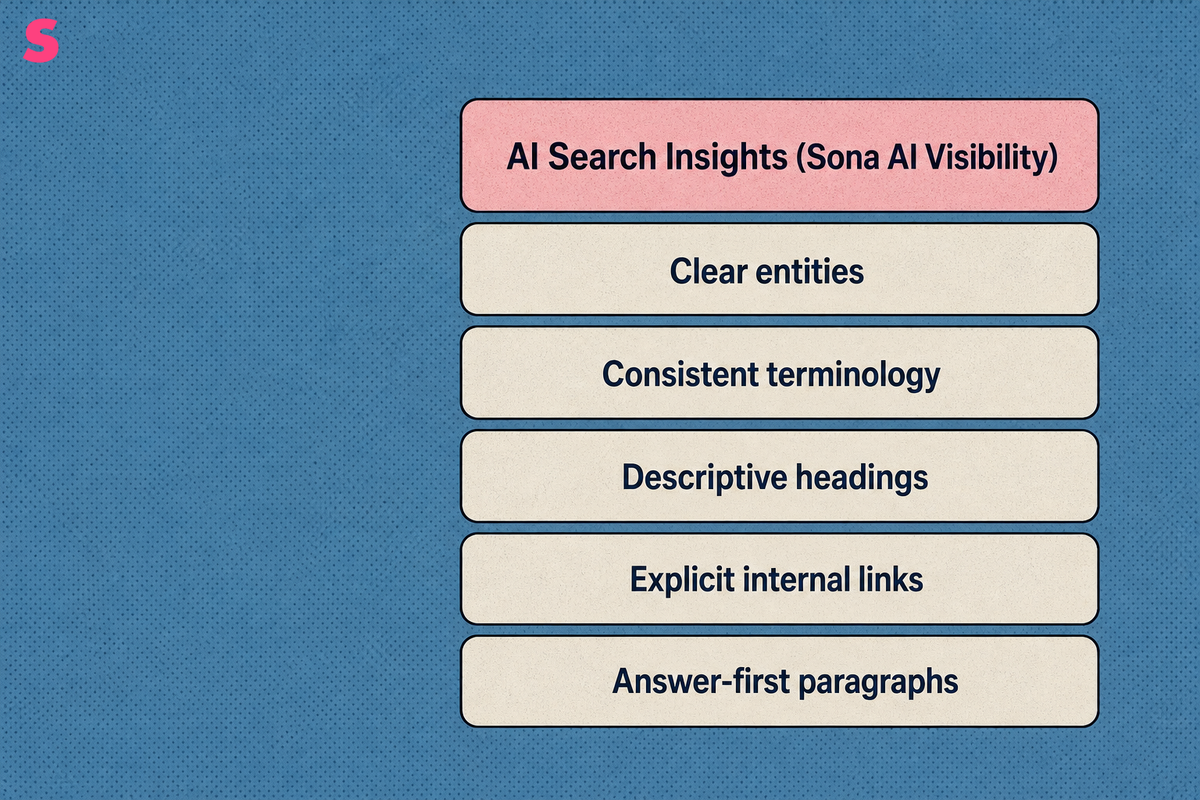
Search engines and AI answer engines can interpret a page more easily when it uses clear entities, consistent terminology, descriptive headings, explicit internal links, answer-first paragraphs, and appropriate structured data. These signals clarify the topic and reduce ambiguity for retrieval systems and readers.
Start each major section with the answer, then explain the conditions and evidence. Use headings that name the reader’s actual question. Internal links should use anchor text that identifies the destination topic rather than generic wording. Consistent terminology matters because loosely related labels can obscure the page’s central subject.
Structured data and formatting support comprehension when they reflect visible page content. They do not substitute for complete explanations. Google AI Overviews and other answer engines can retrieve pages with clear structure and direct answers, but no formatting pattern guarantees a citation.
Sona AI Visibility can support editorial review through AI Search Insights, which shows the prompts buyers ask and how owned pages perform in AI answers. A dated score is only a snapshot, while page-level observations over time give a team material for repeatable review.
How do you follow NLP term recommendations without stuffing keywords?
NLP term recommendations should guide editorial review, not become a checklist forced into every paragraph. Adding every suggested term produces repetitive copy, weakens clarity, and can make a page less useful to its intended audience.
Use a three-part filter for every recommended term:
- Does the term fit the audience’s search intent?
- Does the team have first-hand expertise or evidence to explain it?
- Does the term add a fact, distinction, or action the reader can use?
A stuffed paragraph about attribution might repeat “attribution software,” “marketing attribution,” and “attribution platform” in each sentence without explaining how a buyer evaluates a channel. An edited paragraph would name the relevant entities once, explain how channel data connects to pipeline, and state the reporting decision the reader must make.
Natural language SEO is selective. A term earns inclusion when it completes the explanation. A term used only to imitate competitor vocabulary should remain outside the draft.
How can you test whether an NLP optimization actually changed rankings?
A valid NLP SEO test compares edited pages against a matched control group of untouched pages, using a fixed baseline window, test window, query set, and scoring rule. Without a control set, a ranking change can reflect broader search volatility rather than the editorial change.
This framework describes how to produce evidence rather than reporting results from a completed experiment. An observed ranking effect requires recorded baseline and test measurements for both edited and control pages, followed by a treatment-versus-control comparison.
Choose one class of edit at a time. A team might improve entity coverage on one page group, then test answer-first structure on a later group. Record the pages, queries, target intent, and evaluation rule before publishing edits. Do not change titles, internal links, templates, and content structure simultaneously when the goal is to identify the intervention that mattered.
| Test element | What to fix in advance | What to record | How to read the result |
|---|---|---|---|
| Page groups | Edited pages and comparable untouched controls | URLs, topic, page type, and edit date | Compare movement between the two groups |
| Baseline window | Start and end dates before edits | Query positions, impressions, and clicks | Establish pre-edit variation |
| Edit class | One intervention, such as entity coverage | Exact headings, sections, and terminology changed | Attribute findings to a defined change |
| AI prompt set | Prompts, engines, locations, and schedule | Citations by engine, model, location, and date | Separate sustained movement from one-day variation |
Run the same prompt list daily. Daily tracking can reveal patterns that a weekly snapshot averages away. An answer can shift with the retrieval index, a model update, or a competitor publication. Treat sustained movement as a trend and a one-day spike as noise.
A null result is still a result. If edited pages do not move differently from controls, document the test and avoid claiming a ranking effect. Most AI visibility tools track mentions; Sona AI Visibility connects AI citations to pipeline and revenue, allowing a team to assess whether a sustained citation pattern has commercial relevance.
What are the limits of NLP content scores?
NLP content scores can prioritize editorial work, but they do not prove ranking potential or establish causation. A score reflects the tool’s selected competitors, corpus, model, and weighting, while search results can vary by date, location, and query interpretation.
Correlation is not causation. A high-scoring page can still miss the searcher’s actual task, and a lower-scoring page can perform well because it has stronger evidence, better information architecture, or a more suitable format. Model behavior is opaque, so a content score should never be treated as a search engine instruction.
Entities, relationships, and intent are durable concepts. Tool recommendations change as underlying results change. A score is useful as a dated snapshot, but editorial decisions should rely on first-party performance data and documented page changes.
Use content scores to spot omissions, review terminology, and prioritize a human edit. Do not use them to dictate sentence counts or manufacture topical coverage the audience does not need.
How should a B2B SaaS team evaluate an NLP SEO tool?
B2B SaaS teams should evaluate an NLP SEO tool by workflow depth, reproducibility, and measurement quality rather than monthly price alone. Semantic analysis, competitor comparison, content scoring, entity recommendations, and AI-search tracking address different parts of the content workflow.
Reviewed tools run from about $19 to $165 or more per month in listings read in October 2026, and some AI-search and content products reach $800 per month. Lower-cost tools can support a small editorial workflow, but prompt limits, report limits, integrations, API access, and measurement quality can constrain an expanding program.
| Evaluation criterion | What to ask | Why it matters | Evidence to request |
|---|---|---|---|
| Price and limits | What does the entry tier include? | Low entry pricing can carry restrictive report or prompt allowances | Published allowance and billing terms |
| Semantic analysis | How are entities and relationships surfaced? | Recommendations need editorial context | Example brief and recommendation rationale |
| Reproducibility | Can the team rerun the same analysis? | Comparable reporting requires stable inputs | Saved query sets, dates, and export history |
| AI-search tracking | Which prompts, engines, locations, and dates are recorded? | AI answers vary across all four dimensions | Prompt-level history and citation records |
| Integrations and API access | Can data reach analytics and CRM workflows? | Reporting needs to fit operating systems | Integration list and API documentation |
| Workflow depth | Does the product support action after analysis? | Teams need a repeatable path from finding to edit | Briefing, reporting, and collaboration workflow |
Sona AI Visibility illustrates the measurement criteria for an AI-search workflow. Sona AI Visibility connects AI citations and prompts to pipeline and revenue, while Agent Analytics tracks AI crawler and agent activity. Mention and competitor tracking are the baseline that every tool in this category offers.
Monitoring brand mentions in AI answers is only half the job. Sona AI Visibility connects AI citations and AI-referred visits to the account timeline, allowing AI-search monitoring to be assessed alongside accounts, pipeline, and revenue.
What are the frequently asked questions about NLP SEO?
Is NLP SEO the same as semantic SEO?
NLP SEO and semantic SEO overlap heavily. NLP SEO is best treated as a practical framework within semantic SEO, focused on entities, relationships, intent, and topical coverage. Neither is an official Google optimization category. NLP SEO adds the discipline of testing editorial changes against a documented baseline.
Does Google recommend NLP SEO?
No. NLP SEO is an industry term, not an official Google optimization category, per searchenginemagazine.com, published August 2026 and updated October 2026. NLP principles are one way to improve entities, relationships, intent, and topical coverage without implying Google endorsement.
How many NLP terms should a page include?
There is no fixed number. Include the entities and questions the topic genuinely requires, then remove suggested terms that do not fit audience intent or the team’s expertise. Keyword stuffing makes copy repetitive and can weaken the explanation.
Does NLP SEO help content get cited in ChatGPT and Google AI Overviews?
Clear entities, consistent terminology, and answer-first structure can make a page easier to retrieve and quote. No citation is guaranteed. ChatGPT, Perplexity, Gemini, Claude, Google AI Overviews, and other answer engines can produce different outputs by model, prompt, location, and date, so citations need repeatable tracking.
Do I need a paid tool to do NLP SEO?
Not always. Entry-level tools begin around $19 per month in listings read in October 2026. A manual workflow of entity lists, intent grouping, competitor review, and content briefs needs no tool. Paid tiers matter when prompt limits, integrations, API access, and reproducible reporting become operational constraints.
How long should a before-and-after NLP SEO test run?
Run an NLP SEO test long enough to cover reindexing and a stable baseline, with the test window set before any edits. Compare edited pages with an untouched control group, record the query set in advance, and avoid changing other variables during the test window.
Summarize this article with AI: ChatGPT · Claude · Perplexity · Google AI Mode
Last updated: October 2026







