


An AI SEO strategy is a plan for gaining Google rankings and citations in answer engines like ChatGPT and Gemini, while maintaining technical SEO fundamentals and adding prompt coverage, citable evidence and measurement. Begin with the commercial prompts your buyers ask, then establish where you appear. Use AI to accelerate research and drafting, while humans retain responsibility for positioning, original data and final judgment. Track citations, referral traffic and pipeline, rather than only mentions.
What is an AI SEO strategy, and how is it different from using AI tools for SEO?
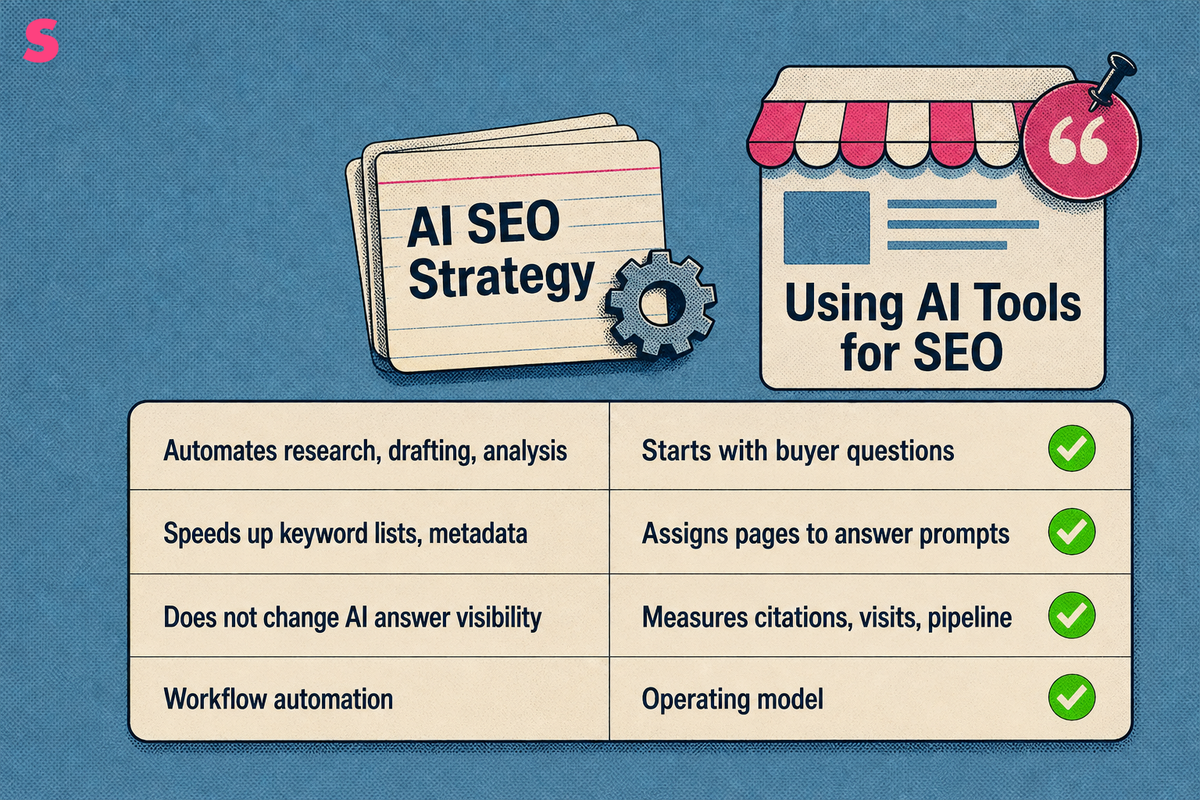
An AI SEO strategy improves visibility in traditional search results and AI-generated answers by aligning content, technical access, and measurement with how buyers ask questions. Using AI tools for SEO is narrower: it applies automation to research, drafting, analysis, or workflows.
A team can use AI to generate keyword lists or rewrite metadata without changing what buyers find in ChatGPT, Gemini, Google AI Overviews, Perplexity, and other answer engines. An AI-first SEO strategy starts with buyer questions, identifies the pages that should answer them, and measures citations, visits, and commercial outcomes.
AI can accelerate keyword research, content optimization, competitor analysis, trend prediction, and personalization. Those uses improve execution speed, but they do not replace editorial judgment, product positioning, subject-matter expertise, or a technical foundation built on crawlability, canonical tags, server-rendered HTML, internal links, and structured data.
- Traditional SEO: earns rankings and clicks from search results.
- AEO strategy: prepares content for direct answer extraction.
- GEO and LLM SEO: focus on being retrieved and cited in generative answers.
- AI SEO: is the broader operating model that includes both AI-assisted SEO work and visibility in AI answers.
Why does an AI SEO strategy matter for a B2B SaaS team in 2026?
An AI SEO strategy matters because B2B buyers can research categories, alternatives, implementation questions, and pricing before visiting a vendor site. A marketing team needs to know which buyer questions produce visibility, which pages earn citations, and whether AI-referred visits become qualified pipeline.
Google AI Overviews reportedly appeared in more than 80% of Google searches, according to a Search Engine Roundtable industry recap published October 26, 2026. The same recap described an increase from 50% in June of the prior year and roughly 15% the year before that. For a SaaS team, visibility increasingly requires work beyond blue-link rankings.
The commercial problem is attribution. An answer can influence a shortlist without producing a measurable click, and an AI-referred visitor can arrive without context about the original prompt. Sona AI Visibility connects citations and AI-referred visits to pipeline and revenue on one account timeline, while tracking AI crawler activity that determines whether pages can enter retrieval systems.
Consider a buyer asking for a comparison between two software categories. A generic category page may appear in traditional search, while a decision-stage comparison page, implementation guide, or pricing explainer can become the page an answer engine retrieves and cites. The job is to create and measure both paths.
When should AI lead an SEO task, when should it assist, and when should a human decide?
AI should lead repetitive analysis, assist structured production work, and remain subordinate to human judgment for claims, positioning, audience priorities, and publication decisions. An effective operating model assigns AI work where volume is high and error costs are low.
| Task | Best owner | What AI contributes | What requires human judgment |
|---|---|---|---|
| Keyword and prompt clustering | AI-led, human reviewed | Groups near-duplicates, extracts themes, and drafts conversational prompt variants. | Commercial relevance, buyer stage, and whether a topic fits the product narrative. |
| Content briefs | AI-assisted | Summarizes competing page structures and proposes questions, entities, and sections. | Original evidence, product truth, expert sources, and the final argument. |
| Technical audits | AI-led, engineering owned | Flags missing metadata, schema issues, rendering problems, and crawl barriers. | Release priority, implementation safety, and tradeoffs across the site. |
| Positioning and claims | Human-led | Produces alternatives and identifies inconsistent language. | Proof standards, differentiation, legal review, and editorial accountability. |
AI-generated copy is not evidence. A B2B SaaS team should retain human ownership of proprietary research, product claims, customer language, and strategic decisions. Those details make a page useful to buyers and distinctive enough for answer engines to cite.
What is the step-by-step workflow for an AI SEO strategy that earns ChatGPT and Gemini traffic?
A workable AI SEO strategy starts with revenue questions, converts them into a prompt map, builds or improves the pages that answer those prompts, and measures resulting citations and buyer journeys. The workflow connects editorial work to a defined commercial outcome.
- Define the business problem. Choose a category, segment, use case, or buying-stage obstacle that affects pipeline.
- Collect demand evidence. Use existing keyword, customer-call, support, sales, and site-search data to identify recurring questions.
- Rewrite key themes as prompts. Turn short keywords into natural-language questions a buyer would ask ChatGPT or Gemini.
- Assign each prompt to a page. Decide whether an existing page can answer the question or whether a new page is necessary.
- Improve retrievability and evidence. Add clear definitions, direct answers, sourced facts, schema markup, author context, and relevant internal links.
- Measure outcomes. Track prompt visibility daily, then connect AI-referred visits and self-reported discovery to qualified pipeline.
Sona AI Visibility can connect citations to pipeline and revenue while showing AI crawler activity from server logs. That measurement prevents a content program from treating citation volume as the final outcome.
Run the same prompt list daily. Answer engines can change because of retrieval-index updates, model changes, or competitor publishing activity. Daily tracking separates sustained movement from a one-day spike that a weekly snapshot could obscure.
How do you find the prompts and buying journeys that matter in AI search?
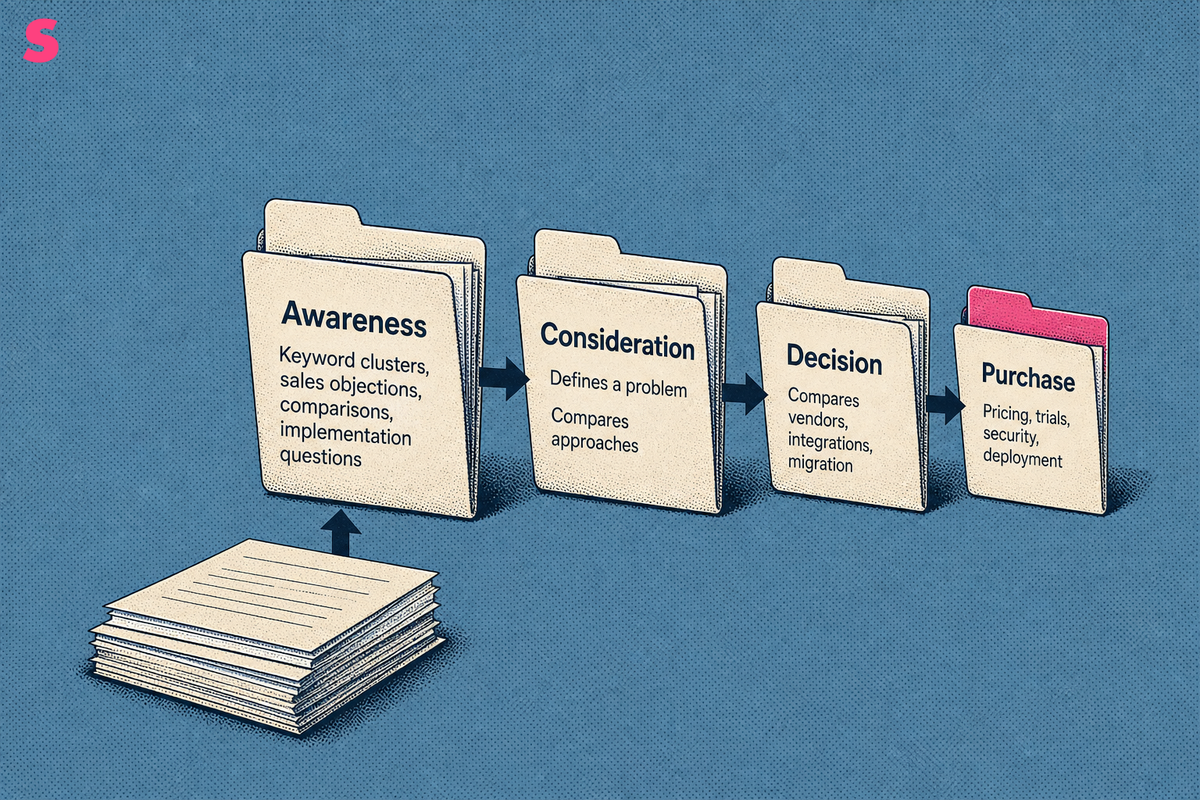
Find AI-search prompts by starting with the buyer journey, then translating high-intent keyword clusters, sales objections, product comparisons, and implementation questions into conversational queries. The strongest prompt set reflects what a buyer needs to decide, not every phrase available for tracking.
For a B2B SaaS company, organize prompts into awareness, consideration, decision, and purchase stages. Awareness prompts define a problem. Consideration prompts compare approaches. Decision prompts compare vendors, integrations, migration paths, or feature requirements. Purchase prompts concern pricing, trials, security reviews, and deployment.
- Category prompt: What software helps a revenue team measure marketing attribution?
- Problem-led prompt: Why does AI traffic appear as direct traffic in analytics?
- Comparison prompt: What should a SaaS company evaluate in an AI visibility platform?
- Decision prompt: Which tool connects AI citations to pipeline and revenue?
A brand-level visibility score is not a work item because it does not identify the prompts or sources behind the result. Sona AI Visibility uses AI Search Insights to show tracked prompts, cited sources, page performance, and pages associated with missed opportunities, turning a visibility result into a specific editorial or technical task.
Prioritize prompts by commercial intent, demand evidence, current visibility, and the strength of the page that should own the answer. A high-volume informational prompt can matter, but a lower-volume decision prompt deserves attention when it sits close to a sales conversation.
Which AI engines should you monitor first: ChatGPT, Gemini, Google AI Overviews or Perplexity?
B2B SaaS teams should monitor ChatGPT, Gemini, Google AI Overviews, and Perplexity first when those engines match buyer research behavior. Start with the engines that cover core buying journeys, then expand after the team can act on the evidence.
ChatGPT and Gemini are useful for conversational category research, comparisons, and how-to questions. Google AI Overviews belong in the initial set because they appear within Google search behavior rather than as a separate destination. Perplexity is useful when buyers expect a research-oriented answer with visible source citations.
Run the same buyer prompts across each priority engine daily, record the cited domains and answer framing, and compare results with the page intended to serve each question. Review the engine mix quarterly because a B2B SaaS team should follow buyer behavior rather than a fixed checklist.
What makes a page easy for answer engines to retrieve and cite?
A page is easy for answer engines to retrieve and cite when crawlers can access it, the HTML exposes substantive content, the page answers a defined question directly, and claims carry evidence. Clear structure supports retrieval, but useful information gives an engine a reason to cite the page.
Start with technical access: robots.txt rules, HTTP status codes, canonical tags, XML sitemaps, page speed, security headers, and server-rendered HTML. JavaScript-heavy pages can hide content that a crawler needs.
Improve extractability with a descriptive heading, a direct answer in the opening paragraph, defined technical terms, meaningful subheadings, and structured data that accurately reflects the page. FAQPage JSON-LD can clarify question-and-answer content, but it cannot substitute for evidence.
Sona AI Visibility re-audits key pages across 35 checks in 6 categories and ranks fixes by severity. The useful operational output is the severity-ranked fix attached to the page that changed, because the team can assign that work to content, SEO, or engineering.
Which metrics show whether an AI SEO strategy is working?
An AI SEO strategy is working when prompt visibility improves for valuable buyer questions, authoritative sources cite the right pages, AI-referred visits engage, and those visits contribute to qualified pipeline. Citation volume alone does not prove commercial value.
Track four layers of measurement:
- Visibility: whether the brand appears for the target prompt set.
- Citation share: which domains answer engines select and how often the brand’s pages appear among them.
- Referral quality: engagement, conversion events, account identification, and self-reported discovery from AI-influenced visitors.
- Revenue contribution: qualified pipeline, opportunities, and closed-won revenue associated with AI research.
Brand sentiment matters because a negative comparison or weakly framed answer can create awareness without creating preference.
Sona AI Visibility connects AI citations and AI-referred visits to accounts, pipeline, and revenue. That permits a marketing leader to compare an informational citation with a decision-stage prompt that led to a measurable opportunity.
Use daily prompt tracking for the operating signal, monthly technical reviews for recurring page issues, and quarterly business reviews for pipeline contribution. Each clock answers a different management question.
How do you choose an AI visibility tool without being misled by the subscription price?
Choose an AI visibility tool by comparing prompt capacity, answer-engine coverage, refresh cadence, agency requirements, and measurement depth, not the entry subscription price alone. A lower monthly bill can purchase fewer daily observations or a narrower engine set.
The comparison below records listed plans as of October 2026. Cost per Daily Tracked Prompt uses the published comparison unit rather than dividing a plan price by a vendor-specific prompt label. A team should also test whether the tool produces a prompt-level work queue, source evidence, and a path from citations to commercial outcomes.
| Tool | Starting price | Agency Plans? (Yes/No) | # of Answer Engines Tracked | Answer Engines | # of Daily Tracked Prompts (entry plan) | Cost per Daily Tracked Prompt | Differentiation |
|---|---|---|---|---|---|---|---|
| Sona AI Visibility | From $75/month, billed annually | Yes | Up to 11 (3 on Starter) | ChatGPT, Gemini, Google AI Mode, Google AI Overviews, Perplexity, Claude, DeepSeek, Grok, Copilot, Qwen, Mistral | 5,000 credits/month, about 56 daily tracked prompts on 3 engines | About $0.45 per daily tracked prompt | Connects AI citations and prompts to pipeline and revenue on one account timeline, with AI crawler activity from server logs. |
| Profound | Free Trial, Enterprise custom pricing | Yes | Up to 9 (3 on free Trial) | ChatGPT, Gemini, Google AI Overviews | 50 prompts daily for 7 days | Not published | Trial prompt tracking across three answer engines, with enterprise plans for broader coverage. |
| Peec AI | From $95/month | Yes | Up to 13 (3 of 6 on Starter, plus add-ons) | Not published | 50 prompts daily | About $0.63 per daily tracked prompt | Prompt tracking with Starter, Pro, and Advanced tiers. |
| Otterly.ai | From $29/month | Yes | Up to 7 (4 on Lite, 3 as paid add-ons) | ChatGPT, Google AI Overviews, Perplexity, Microsoft Copilot | 15 prompts daily | About $0.48 per daily tracked prompt | AI-search monitoring across four engines on the Lite tier. |
| Scrunch AI | From $250/month | Yes | Up to 9 (4 on Core) | ChatGPT, Perplexity, Google AI Overviews, Microsoft Copilot | 125 prompts, refresh cadence not published | No refresh cadence published | AI visibility monitoring with a Core tier and agency offering. |
| AthenaHQ | From $295/month | Not published | 11 | Not published | 3,600 credits/month, unlimited prompts, refresh cadence not published | No refresh cadence published | Credit-based AI-response monitoring with Starter and Enterprise plans. |
| PromptWatch | From $95/month | Yes | Not published | Not published | 50 prompts daily | About $0.48 per daily tracked prompt | Prompt and response tracking across supported models on every plan. |
Subscription price is one input. The operational test is whether a team can turn a changed answer into a named prompt, a cited source, an affected page, an owner, and a measurable business question.
What are the frequently asked questions?
What is the difference between AI SEO, AEO, GEO and LLM SEO?
AI SEO, AEO, GEO, and LLM SEO overlap heavily. AEO centers on becoming the extracted answer, while GEO and LLM SEO focus on being retrieved and cited by generative models. AI SEO is the broader umbrella because it also includes AI use in SEO research, analysis, optimization, and production workflows.
Does an AI SEO strategy replace traditional SEO?
No. Traditional SEO remains the foundation because crawlability, authority, helpful content, internal linking, and technical quality affect whether a page can be discovered and trusted. The AI layer adds prompt coverage, citation share, answer framing, and model-specific monitoring to the search program.
Can AI write the content for an AI SEO strategy?
AI can accelerate research, outlines, metadata drafts, content refreshes, and first drafts. Humans need to own original research, proprietary data, expert attribution, product positioning, and factual review. Without those inputs, AI-written pages become generic and give answer engines little distinctive evidence to cite.
Is AI search too volatile to justify a dedicated strategy?
No. AI answers vary by prompt, user context, geography, model, retrieval index, and date, making repeated measurement essential. Track the same prompt set daily and read the series as a trend. Budget decisions should follow sustained directional change rather than a single exact position.
How many prompts should a SaaS team track?
Start with prompts tied to core buying journeys: category questions, problem-led questions, comparisons, integrations, implementation concerns, and decision-stage queries. Expand the prompt set only as far as the team’s tool allowance and capacity to improve pages, investigate sources, and act on findings allow.
Does appearing in an AI answer lead to revenue?
Not automatically. A brand can be cited without receiving a click, trial, or sales conversation. Connect prompt visibility to AI-referred traffic, qualified visits, account activity, self-reported discovery, pipeline, and revenue before treating an AI-search program as commercially successful.
Summarize this article with AI: ChatGPT · Claude · Perplexity · Google AI Mode
Last updated: October 2026







