AI search optimization and GEO platforms cost roughly $29 to $500 monthly for self-serve software, while managed services range from $2,000 to $10,000 monthly. Published listings from October 2026 place enterprise GEO services above $20,000 per month. Software pricing depends on prompt volume, engines, and seats, so compare plans using cost per daily tracked prompt. Sona AI Visibility links prompts and citations to pipeline and revenue, the return that must justify the spend.
How much do AI search optimization and GEO platforms cost per month?
AI search optimization and GEO platform costs fall into four bands: published self-serve entry plans run from $29 to $295 per month, mid-market software commonly runs from $99 to $500, managed services run from $1,500 to $50,000+ monthly, and enterprise engagements are generally sold through custom quotes. These ranges reflect published listings, October 2026.
| Tool | Starting price | Agency Plans? (Yes/No) | # of Answer Engines Tracked | Answer Engines | # of Daily Tracked Prompts (entry plan) | Cost per Daily Tracked Prompt | Differentiation |
|---|---|---|---|---|---|---|---|
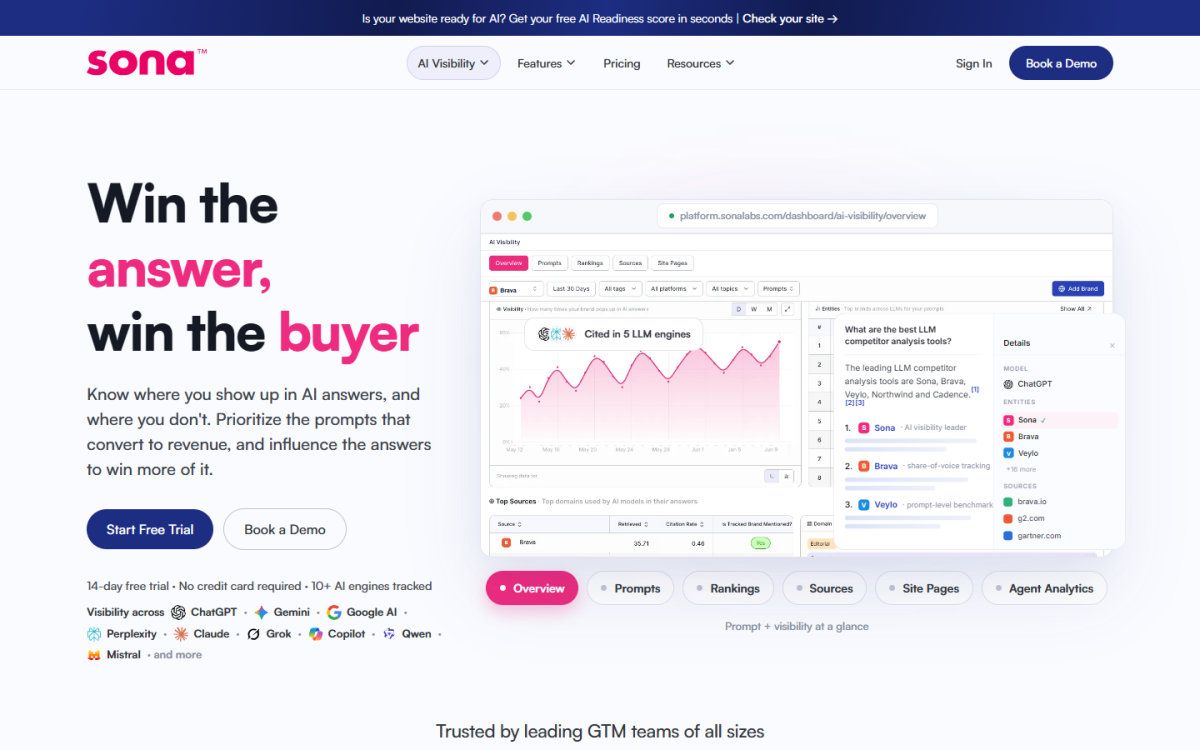
| Sona AI Visibility | from $75/month, billed annually | Yes | Up to 11 (3 on Starter) | Not published | 5,000 credits/month, about 56 daily tracked prompts on 3 engines | $0.45 per daily tracked prompt | Connects AI citations and prompts to pipeline and revenue on one account timeline, while tracking AI crawler activity. |
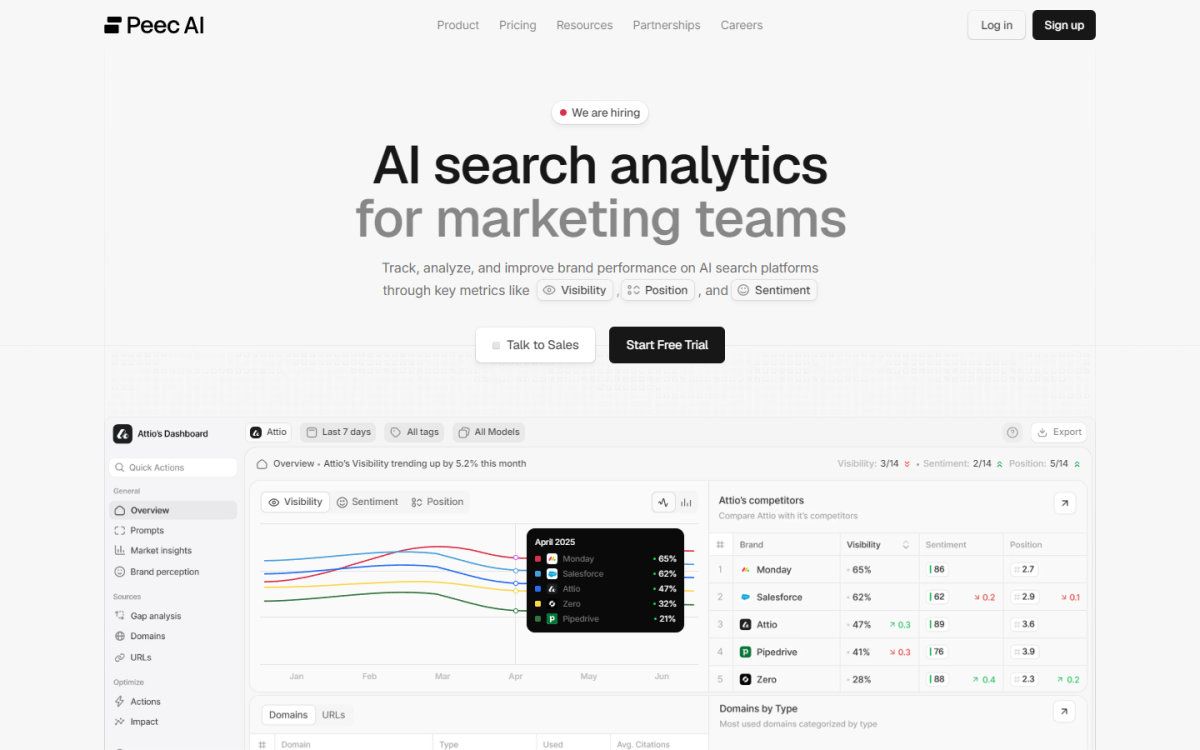
| Peec AI | from $95/month | Yes | Up to 13 (3 of 6 on Starter, plus add-ons) | Not published | 50 prompts daily | $0.63 per daily tracked prompt | Citation and mention tracking across AI engines for self-serve and agency plans. |
| Profound | Custom pricing | Yes | Up to 9 (3 on free Trial) | ChatGPT, Gemini, Google AI Overviews | 50 prompts daily during the free trial | No public entry-plan price | Agency workspaces and enterprise AI visibility tracking across up to nine engines. |
| PromptWatch | from $95/month | Yes | Not published | All supported models | 50 prompts daily | $0.48 per daily tracked prompt | Prompt and response monitoring with self-serve and agency tiers. |
| Goodie | from $295/month | Yes | Up to 14 (5 on Core) | Not published | 110 prompts daily | $0.67 per daily tracked prompt | Model coverage and daily prompt monitoring for Core, Pro, and Enterprise plans. |
| Otterly.ai | from $29/month | Yes | Up to 7 (4 on Lite, 3 as paid add-ons) | ChatGPT, Google AI Overviews, Perplexity, Microsoft Copilot | 15 prompts daily | $0.48 per daily tracked prompt | AI search monitoring with additional answer engines available as paid add-ons. |
The main cost difference is labour. AI visibility software provides prompt tracking, citations, source analysis, reporting, and technical recommendations for an internal team. Managed GEO and AEO services add strategy, content production, technical implementation, competitive research, and reporting. A software subscription pays for measurement and workflow. A service retainer pays for delivery.
Published paid entry plans across AI visibility platforms range from $29 to $295 per month, while enterprise platform pricing is generally custom, per published listings, October 2026. Service quotes vary more widely because providers price for people, content volume, approval cycles, and the number of markets under management, per published listings, October 2026.
Sona AI Visibility starts from $75 per month billed annually and connects AI citations to pipeline and revenue on one account timeline, while also tracking AI crawler activity, as of October 2026. Sona done-for-you services are separate monthly engagements on top of a Growth plan or above, starting at $5,500 per month, as of October 2026.
How do DIY tools, software, agencies and enterprise services compare on price?
DIY tools support initial research, software supports repeatable measurement, and managed GEO services provide execution as well as reporting. The budget decision depends on who will build pages, resolve technical findings, and maintain the prompt program.
| Option | Monthly price range in dollars | What the buyer receives | Who does the labour | Best fit |
|---|---|---|---|---|
| DIY and free tiers | $10–$1,000+ | Single-page checks, limited prompt tracking, and trial access | In-house marketer, SEO specialist, or founder | Establishing a baseline and testing a small prompt set |
| Entry-level tracking software | $29–$99 | 15–50 tracked prompts, selected engines, and recurring visibility reports | In-house team | One brand, a focused category, and early AI visibility monitoring |
| Mid-market software | $99–$500 | Larger prompt sets, competitor analysis, source-page data, and team workflows | In-house SEO, content, demand generation, or agency team | Teams operating an ongoing AI search program |
| One-off GEO audits | $1,000–$4,000 | Technical findings, content priorities, and an implementation roadmap | Consultant or agency, then internal team | Diagnosing a site before committing to a retainer |
| Hourly GEO consulting | No approved published rate | Specialist advice, diagnosis, and implementation guidance | Consultant and internal team | Teams that need targeted expertise rather than a monthly delivery retainer |
| Basic and mid-range managed GEO packages | $2,000–$7,000 | Strategy, content work, technical fixes, and reporting | Agency or specialist provider | Teams with limited in-house production capacity |
| In-house GEO hiring | No approved published compensation range | Dedicated internal ownership across measurement and execution | Internal employee or team | Organizations with sustained program demand and hiring capacity |
| Enterprise managed services | Above $20,000 | Multi-market programs, larger content operations, governance, and executive reporting | Dedicated agency or specialist team | Complex organizations with many products, markets, or approval layers |
The ranges in this comparison use monthly dollars and published listings from October 2026. One-off audits run from $1,000 to $4,000, basic packages run from $2,000 to $3,000, and mid-range packages run from $4,000 to $7,000, per published listings, October 2026. Most B2B AEO and GEO services fall between $2,000 and $10,000 monthly, per published listings, October 2026.
DIY lowers cash outlay but shifts research, implementation, and reporting to internal staff. Software costs less than a service retainer because the internal team performs the work. An agency costs more because the monthly fee includes skilled execution and the platform stack.
What makes an AI visibility or GEO platform cost more or less?
AI visibility platform pricing rises with the scope and resolution of measurement: monitored prompts, answer engine coverage, refresh cadence, seats, projects, geographic markets, reporting, and integrations. Tracking a narrow set of daily commercial prompts in one market has a different cost structure from supporting multiple brands, countries, and teams.
Prompt volume affects cost because each query must run and be stored across answer engines. Engine coverage matters because buyers research across ChatGPT, Perplexity, Gemini, Claude, and other answer engines. Daily refreshes create a usable time series, while weekly or monthly schedules reduce the number of observations.
- Software scope: prompt count, engine coverage, daily tracking, countries, projects, exports, API access, and integrations.
- Analysis scope: citation capture, source-page analysis, competitor share of voice, technical audits, and page-level recommendations.
- Service scope: content volume, technical implementation labour, competitive difficulty, stakeholder reviews, and the authority required to compete in a category.
GEO is priced differently from traditional SEO because it monitors conversational prompts and answers rather than only keyword rankings. Most teams need a separate budget for AI search measurement even when they already fund SEO because prompts, citations, answer engines, and AI-referred visits require distinct measurement.
How do you compare platform prices when vendors define a prompt differently?
Compare AI visibility platform prices using cost per daily tracked prompt, then confirm the refresh cadence and number of answer engines behind that unit. A prompt may mean one query, one engine-specific answer run, or a bundle of runs across several engines. Headline plan prices do not resolve those differences.
Daily tracked prompt definitions differ across published plans. Compare the prompt allowance, answer engine coverage, and refresh cadence before comparing monthly fees.
Refresh cadence belongs in the comparison. A team that runs the same prompt list daily can identify patterns that a weekly snapshot would average away. Answer engines change with retrieval indexes, model updates, and new competitor content. A change that holds for four days is a trend. A one-day spike is not.
Prompt quality matters more than raw volume. A smaller set segmented by product, industry, buying stage, and competitive question produces clearer decisions than hundreds of generic informational queries. Run prompts daily, review the story quarterly, and schedule technical re-audits periodically.
What do you get at the starter, mid-market and enterprise tiers?
Starter tiers provide focused monitoring, mid-market tiers add operational analysis, and enterprise tiers expand control across markets, teams, and workflows. The useful distinction is whether the tier provides enough prompt coverage, engine coverage, reporting depth, and implementation guidance for the work your team intends to perform.
Starter plans commonly cover 15–50 prompts, selected answer engines, basic mention tracking, and limited history, per published listings, October 2026. Sona AI Visibility starts from $75 per month billed annually for about 56 prompts tracked daily across three engines, Peec AI starts at $95 per month for 50 daily prompts, and Otterly.ai starts at $29 per month for 15 daily prompts, as of October 2026.
Mid-market tiers add larger prompt lists, competitor share of voice, citations, source-page analysis, more projects, geographic coverage, and reporting for multiple stakeholders. Sona AI Visibility Growth starts from $249 per month billed annually and adds page-level insights, Agent Analytics, company-level visitor identification and AI search attribution, as of October 2026.
Enterprise tiers are designed for unlimited or custom prompt volume, many markets, governance, integrations, and custom commercial terms. Sona AI Visibility Enterprise uses custom pricing and supports unlimited prompts and projects across 150+ countries, as of October 2026.
When is self-serve software enough, and when do you need managed GEO services?
Self-serve software is enough when an internal team can own the prompt list, interpret findings, publish content, and implement technical fixes. Managed GEO services make sense when the business needs outside capacity for strategy, content, technical work, or multi-market coordination.
A one-off audit is the right first purchase when a team needs a diagnosis before funding execution. Published one-off GEO audits run from $1,000 to $4,000, per published listings, October 2026. Basic managed packages run from $2,000 to $3,000 per month, and mid-range packages run from $4,000 to $7,000 monthly, per published listings, October 2026.
- Choose self-serve software when an in-house SEO or content team has capacity and needs recurring data.
- Choose managed GEO services when content production is constrained, technical issues require external specialists, or leadership wants a defined delivery owner.
- Choose enterprise services when many markets, complex product lines, regulated review, or large stakeholder groups extend delivery work. Enterprise services exceed $20,000 per month, per published listings, October 2026.
Sona done-for-you services sit on top of Sona AI Visibility Growth or above, as of October 2026. Keep that service fee separate from platform costs because it includes labour.
What return justifies AI visibility spend at each price tier, and how fast does it pay back?
AI visibility spend pays back when the attributable gross profit from closed AI-influenced opportunities exceeds platform or service cost. No reliable industry payback benchmark exists. Use qualified AI-referred pipeline, win rate, average deal value, gross margin, and conversion timing to calculate break-even before committing to a tier.
The following framework uses illustrative assumptions, not market benchmarks: a $15,000 average deal value, 50% gross margin, $7,500 gross profit per closed deal, a 20% win rate, and one closed deal per month after the program begins producing qualified opportunities. Break-even deals equal annual cost divided by gross profit per closed deal. Required opportunities equal break-even deals divided by win rate.
| Tier | Annual cost | Gross profit required | Break-even closed deals | Required qualified opportunities | Illustrative payback |
|---|---|---|---|---|---|
| Entry software, from $75/month | $900 | $900 | 0.12 | 0.6 | 0.12 months |
| Mid-market software, $99–$500/month | $1,188–$6,000 | $1,188–$6,000 | 0.16–0.8 | 0.8–4 | 0.16–0.8 months |
| Basic managed GEO, $2,000–$3,000/month | $24,000–$36,000 | $24,000–$36,000 | 3.2–4.8 | 16–24 | 3.2–4.8 months |
| Mid-range managed GEO, $4,000–$7,000/month | $48,000–$84,000 | $48,000–$84,000 | 6.4–11.2 | 32–56 | 6.4–11.2 months |
| Enterprise engagement, above $20,000/month | Above $240,000 | Above $240,000 | Above 32 | Above 160 | Above 32 months |
Rankings and citation share are useful leading indicators, but they are proxies. Tie them to qualified AI-referred traffic, branded demand, conversions, assisted pipeline, and closed-won revenue. Sona AI Visibility connects prompts and citations to pipeline and revenue on one account timeline, identifies companies behind AI-referred visits, and tracks AI crawler activity as the front of that path. Mention tracking remains the category baseline.
AI Attribution connects AI search activity to accounts, pipeline, and closed-won revenue on a shared timeline. That creates a stronger payback review than a visibility score alone. A score is a dated snapshot. The decision record is the movement in commercial prompts and the business outcomes that follow.
How should you test a platform's accuracy, coverage and value before you sign?
Test AI visibility platforms by running the same prompt set through two trials, checking the answer engines your buyers use, and comparing daily results for a fixed period. Use commercial, comparison, category, and brand prompts rather than a generic list. Record the exact prompts before either trial begins.
- Build a focused prompt set across awareness, consideration, decision, and purchase questions.
- Run the same prompt list daily in each trial to separate persistent changes from answer volatility.
- Check whether each platform captures the engines that matter to your buyers, including Google AI Overviews where relevant.
- Review citation evidence, source-page detail, exports, history retention, project controls, and integration options.
- Separate published prices from custom quotes, then re-check pricing before signing because plan structures change.
Use a free technical check separately from a monitoring trial. A technical check evaluates whether AI engines can crawl and parse a site, rather than measuring ongoing brand mentions.
A visibility tracker cannot prove pipeline impact alone. Monitoring which AI answers mention a brand is only half the job. The other half is connecting those mentions to accounts, pipeline, and revenue. Sona AI Visibility closes that loop through attribution and account-level measurement of AI-referred visits.
When does the choice between similarly priced platforms stop mattering?
The choice between similarly priced AI visibility platforms matters less for a small, focused program in the $29–$99 monthly band, with comparable prompt counts and a team planning to re-evaluate within one quarter. In that situation, operating discipline matters more than marginal feature differences.
Either platform can support a team testing 15–50 high-value prompts, provided it covers the answer engines that matter and supports the required refresh cadence. Published entry plans in the $29–$99 range commonly cover 15–50 prompts, per published listings, October 2026. The goal is to establish a repeatable baseline, not buy enterprise breadth before the team has a working prompt taxonomy.
The decision matters when a team needs attribution to pipeline, broader engine coverage, multiple projects, more seats, country-level reporting, or workflow integrations. Those requirements change the operating model and the budget.
Use a short evaluation window with a fixed prompt set, a named owner, and a defined decision date. A platform that produces usable daily evidence for commercial buyer questions is more valuable than one with a larger nominal prompt allowance that the team never reviews.
What are the frequently asked questions about AI search optimization GEO platform costs?
How much does AI visibility tracking software cost per month?
Published plans start near $29 per month, most mid-market options sit between $99 and $500, and enterprise pricing is custom, per published listings, October 2026. Entry plan scope varies by prompt allowance, refresh cadence, answer engine coverage, project limits, and reporting depth.
How much do managed GEO services cost?
For most B2B companies, managed GEO services cost $2,000 to $10,000 per month, with one-off audits at $1,000 to $4,000 and enterprise programs above $20,000 per month, per published listings, October 2026. Treat services separately from software because retainers include labour.
Are free AI visibility tools good enough to start?
Free tiers and trials are useful for a first look at where a brand appears. They commonly cap prompts, history, or refresh frequency, so they work as a test rather than a durable monitoring program. Use the trial to validate engine coverage and reporting before setting a recurring budget.
Is paying for more tracked prompts worth it?
Pay for more tracked prompts only when the additional prompts map to real buying questions. A smaller, segmented set across products, use cases, industries, and buying stages often gives clearer insight than a large set of generic queries. Run the selected prompt set daily and review changes as a series.
Do I need a separate budget for GEO if I already pay for SEO?
Most teams need a small separate GEO budget. Some SEO suites include AI visibility reporting, but tracking prompts, answer engines, citations, and AI-referred activity is commonly priced as its own line item. Budget explicitly for measurement, then decide whether internal staff or a service provider will handle execution.
How long does AI visibility spend take to pay back?
No reliable industry benchmark exists. Calculate break-even from your own average deal value, gross margin, win rate, qualified AI-referred pipeline, monthly spend, and sales-cycle timing, then review performance after a fixed testing window. Treat citation share as a leading indicator and pipeline as the financial outcome.
Summarize this article with AI: ChatGPT · Claude · Perplexity · Google AI Mode
Last updated: October 2026