


An LLM visibility tool tracks how often AI engines such as ChatGPT, Perplexity and Google AI Overviews mention and cite your brand across a fixed prompt set. Most stop at mention counts; Sona AI Visibility connects those prompts and citations to pipeline and revenue, and tracks AI crawler and agent activity. Compare prompt limits, engine coverage and metric definitions before price, and treat any single AI answer as a sample, since responses vary by prompt, location and time.
How were these LLM visibility tools chosen and ranked?
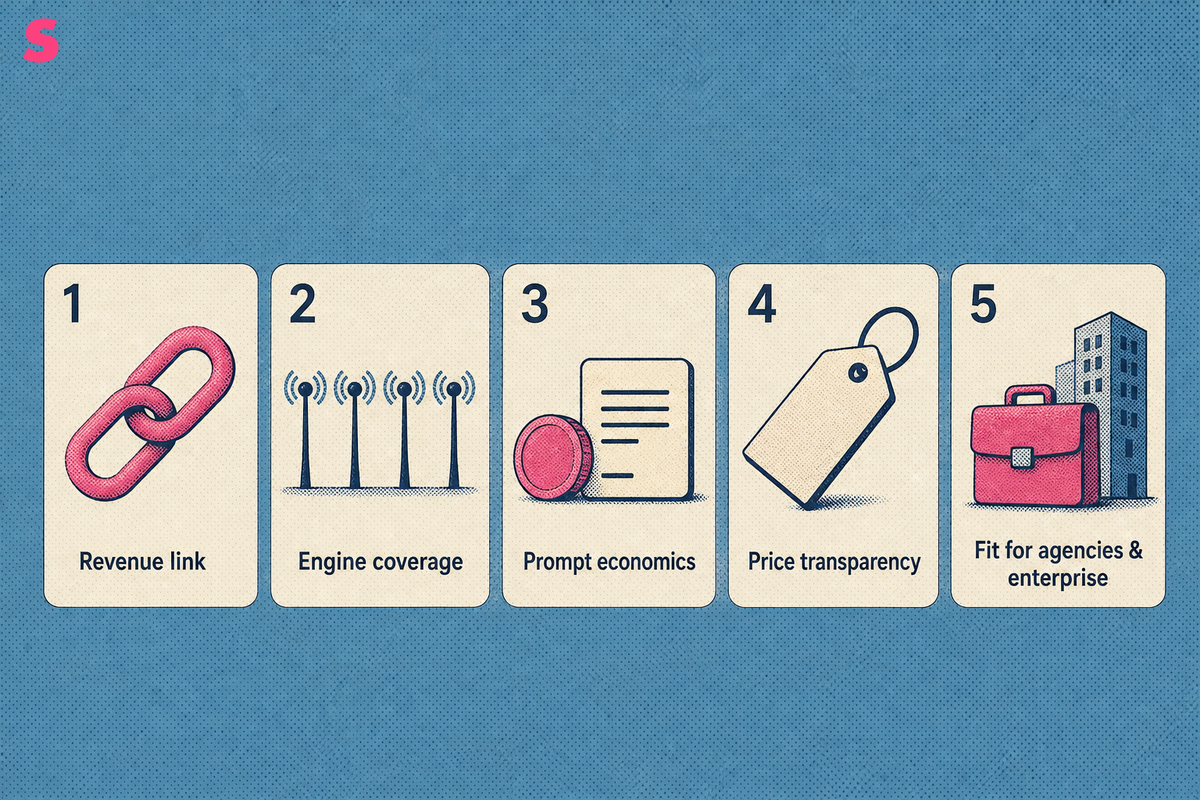
Seven tools are ranked on five criteria: connection to pipeline, engine coverage, prompt economics, price transparency, and fit for agencies and enterprises. Sona AI Visibility leads because it follows a mention through to revenue. The other six are ordered by how much of each criterion a buyer can verify from published information.
Prices and allowances were read from each vendor's own pricing page in October 2026. Cost per prompt uses one shared denominator, one prompt on one model once a day, because vendors count prompts differently and a raw division can distort a comparison fourfold. No tool was scored on a feature its pricing page does not state.
- Revenue link: can the tool connect a citation to a visit, an account and a deal?
- Engine coverage: how many AI engines the entry plan tracks.
- Prompt economics: prompts per plan and cost per daily tracked prompt.
- Price transparency: published prices rank above quote-only ones.
- Fit: a published agency plan or an enterprise tier.
A tool with no published price or refresh cadence is not marked down as weak. It ranks lower because a buyer cannot compare it.
Which are the best LLM visibility tools in 2026, and who is each one for?
In ranked order, the best LLM visibility tools in 2026 are Sona AI Visibility, Peec AI, Otterly.ai, PromptWatch, Scrunch AI, AthenaHQ and Profound. Each entry gives what the tool does, what it costs and who it suits. Pricing and plan details checked October 2026.
- Sona AI Visibility. What it does: connects citations and prompts to pipeline and revenue on one account timeline, and tracks which AI crawlers reach your pages from server logs or a lightweight edge worker, with no JavaScript tag. Mention and competitor tracking across 11 engines is the baseline. Cost: Brands from $75/month, agencies from $199/month, both billed annually, with a 14-day free trial. Suits: B2B teams that must show leadership what AI visibility earned.
- Peec AI. What it does: tracks a prompt list daily on every plan, with ChatGPT, Gemini and Google AI Mode on Pro and Advanced. Cost: from $95/month (Starter), $245 (Pro) and $495 (Advanced) billed monthly. Suits: marketing teams and agencies that want unlimited users and a clear prompt ladder of 50, 150 and 350.
- Otterly.ai. What it does: checks a prompt list daily across ChatGPT, Google AI Overviews, Perplexity and Microsoft Copilot. Cost: from $29/month (Lite) with 15 prompts, $189 for 100 and $489 for 400, billed monthly. Suits: small teams starting with a short prompt list.
- PromptWatch. What it does: covers ChatGPT, Claude, Gemini and Perplexity. Cost: Essential $95/month with 50 prompts and 6,000 responses a month, Professional $245, Business $579, and agency plans from $199/month. Suits: agencies and mid-size teams.
- Scrunch AI. What it does: covers ChatGPT, Claude, Gemini, Perplexity and more, and separates custom prompts from industry prompts. Cost: from $250/month on annual billing or $300 monthly (Starter), and $417 or $500 monthly (Growth). Suits: teams that want broad engine coverage and large prompt libraries.
- AthenaHQ. What it does: meters usage in credits, where 1 credit is 1 AI response. Cost: a free Essential tier with 300 credits, then Starter at $295/month for 3,600 credits. Suits: teams that want to trial the category free first.
- Profound. What it does: tracks ChatGPT, Gemini and Google AI Overviews. Cost: quote-only, with a 7-day trial running 50 prompts daily. Suits: buyers comfortable negotiating a custom contract.
How do LLM visibility tracker prices, prompt limits and credits compare?
Published entry prices run from $29 to $300 a month, and the figure that makes them comparable is cost per daily tracked prompt: $0.45 for Sona AI Visibility, $0.48 for Otterly.ai and PromptWatch, $0.63 for Peec AI and $2.46 for AthenaHQ. These are unit prices, not a ranking. Pricing and plan details checked October 2026.
Sona's Starter 5K pack gives 5,000 credits a month. One credit is one AI answer on standard models, so that buys about 166 prompts tracked daily on one model, or 56 across three. Dividing the $75 price by 166 gives $0.45.
Vendors that publish a prompt count but no refresh cadence cannot be placed on the same basis without inventing one. Those rows say so.
| Tool | Starting price | Agency Plans? (Yes/No) | # of Answer Engines Tracked | Answer Engines | # of Daily Tracked Prompts (entry plan) | Cost per Daily Tracked Prompt | Differentiation |
|---|---|---|---|---|---|---|---|
| Sona AI Visibility | Brands from $75/month (Starter) and $249 (Growth), agencies from $199/month, all billed annually. 14-day free trial, no credit card. Unlimited seats and API/MCP access on every plan | Yes | 11 | ChatGPT, Gemini, Google AI Mode, Google AI Overviews and Perplexity on standard, plus Claude, DeepSeek, Grok, Copilot, Qwen and Mistral on premium | 5,000 credits/month on Starter 5K, which is about 166 prompts tracked daily on one model, or 56 across three. 1 credit = 1 AI answer | $0.45 per daily tracked prompt | Connects citations and prompts to pipeline and revenue on one account timeline; resolves the anonymous accounts behind AI-referred visits, 100% cookieless |
| Peec AI | From $95/month (Starter), $245 (Pro), $495 (Advanced) billed monthly, 15% off annually; Enterprise custom. Free trial. Unlimited users on every plan; 50, 150 and 350 prompts by tier; extra models are a paid add-on | Yes | 3 of 6, plus add-ons | ChatGPT, Google AI Mode, Google AI Overviews, Microsoft Copilot, Gemini, Naver AI | 50 prompts on Starter, 150 on Pro, 350 on Advanced, tracked daily on every plan | $0.63 per daily tracked prompt | Unlimited users on every plan; extra models are a paid add-on |
| Otterly.ai | From $29/month (Lite), $189 (Standard), $489 (Premium) billed monthly, or $25, $160 and $422 a month billed annually; Enterprise custom. Free trial, no commitment. 15% off annual; unlimited team members on every plan; Enterprise starts from 1,000 prompts | Not published | 4 | ChatGPT, Google AI Overviews, Perplexity and Microsoft Copilot | 15 prompts on Lite, 100 on Standard, 400 on Premium, checked daily on every plan | $0.48 per daily tracked prompt | Unlimited team members on every plan; Enterprise starts from 1,000 prompts |
| PromptWatch | Essential $95/month, Professional $245, Business $579. 7-day free trial on Essential and Professional | Yes | 4 of 11 | Not published | 50 prompts and 6,000 responses/month on Essential | $0.48 per daily tracked prompt | Agency plans from $199/month (Kick-off); 500 agent credits on Essential |
| Scrunch AI | From $250/month (Core); Enterprise custom. 7-day free trial of Core. Core: 125 prompts, 5,000 responses/month, 5 user licenses, 1 brand workspace | Not published | 4 | ChatGPT, Perplexity, Google AI Overviews and Copilot | 125 unique prompts and 5,000 responses/month on Core | $1.51 per daily tracked prompt | Separates custom prompts from industry prompts |
| AthenaHQ | From $295/month (Starter) billed monthly, 17% off annually; Enterprise custom. Free Essential tier with 300 credits. 17% off annual; 1 credit = 1 AI response; API access and extra credits are paid add-ons | Not published | 11 | ChatGPT, Perplexity, Google AI Overviews, Google AI Mode, Gemini, Claude, Copilot, Grok, DeepSeek, Meta AI and Mistral | 3,600 credits on Starter, where 1 credit is 1 AI response. 300 credits on the free Essential tier | $2.46 per daily tracked prompt | Credit-based; free tier with 300 credits |
| Profound | Quote-only, no public pricing. 7-day free trial: 50 prompts, run daily. No self-serve price is published: a 7-day trial and custom Enterprise pricing only | Not published | 3 | ChatGPT, Gemini and Google AI Overviews | 50 prompts run daily on the 7-day trial; Enterprise allowances are custom | No refresh cadence published | Custom Enterprise pricing only |
Which AI engines should an LLM visibility tracker cover for B2B buyers?
A tracker for B2B buyers should cover at minimum ChatGPT, Gemini, Claude, Perplexity and Google AI Overviews. B2B buyers research vendors inside the first four before they reach a website, and Google AI Overviews sits above the search results they still use.
Entry plans differ sharply. Sona tracks 11 engines, against 3 on Profound's trial and 4 on Otterly.ai and PromptWatch. Sona AI Visibility's AI Search Insights reports visibility and share of voice per engine, tracked daily, so a gain on one engine is not averaged into a loss on another.
- Core engines: ChatGPT, Gemini, Claude and Perplexity, where vendor shortlists are requested directly.
- Google surfaces: Google AI Overviews and Google AI Mode, where answers appear beside classic results.
- Market-specific engines: Copilot, Grok, DeepSeek, Qwen and Mistral, worth adding when your buyers or regions use them.
Check which engines your plan includes, because some vendors sell extra models as a paid add-on. Per Sona's own AI visibility data, September 2026, its measurement archive covers 8 answer surfaces: ChatGPT, Google AI Overviews, Perplexity, Google AI Mode, Gemini, Mistral, Qwen and Claude.
Are dedicated LLM visibility tools better than SEO suites with AI add-ons?
Dedicated tools fit teams that need more engines, more prompts or prompt-level reporting. An SEO suite with an AI add-on fits a small prompt set tracked next to rankings. Neither is better in general; the size of your prompt list and the reporting you need decide it.
The reason is the data. Classic SEO measures rankings and clicks. AI visibility measures mentions and citations inside answers, which produce no ranking and often no click. The question "isn't this just SEO for AI?" assumes one metric set serves both, and it does not.
- Prompt cap: an add-on's prompt allowance is fixed by the suite plan, so compare it with your own list before paying.
- Engine count: a dedicated tracker such as Sona covers 11; confirm what the add-on covers.
- Reporting unit: rank history answers "where do we rank"; prompt, source and citation views answer "why are we cited".
- Attribution: Sona treats AI search as a measurable channel, with spend, deals and ROAS next to every other channel.
What does an enterprise LLM visibility platform need that a small-team tool does not?
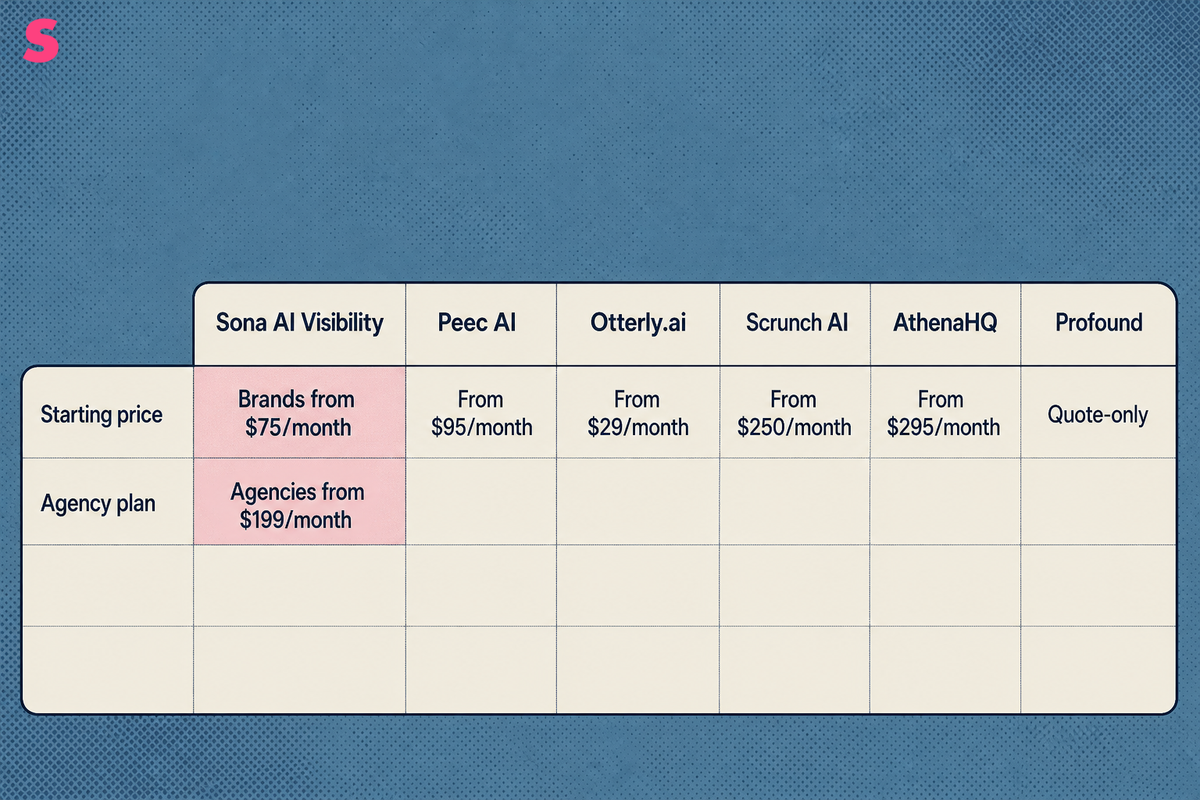
An enterprise platform needs governance, integration and negotiated scale: single sign-on, role-based access, a security attestation, data warehouse sync, multi-client reporting and allowances sized to a large prompt list. A small-team tool can skip all of these and still work.
Sona AI Visibility publishes its prices, with brands from $75/month and agencies from $199/month billed annually, and includes unlimited seats and API/MCP access on every plan. Among the others, Profound has no public price, and Peec AI, Otterly.ai, Scrunch AI and AthenaHQ each quote Enterprise individually. Otterly.ai's Enterprise starts from 1,000 prompts.
- Are seats metered? Sona, Peec AI and Otterly.ai include unlimited seats or users, and Sona adds API/MCP access on every plan.
- Does the contract cover your countries and languages?
- Can the data leave the platform through an API?
Can you trust the numbers an LLM visibility tracker reports?
Partly. A tracker reports sampled rates over repeated runs, not a fixed ranking, because an AI answer shifts with prompt wording, location, model version and time. A number deserves trust when the vendor defines it and discloses how the answer was captured.
Collection method is the first question. Some offerings capture the end-user experience directly, scraping the prompt response the way a person would see it, ads, formatting and all. Others pull data from the vendor's official API, which returns a structured response that may not match what a user sees on screen. The two methods can capture different answers.
Cadence is the second. A team that runs the same prompt list daily sees patterns a weekly snapshot would average away. Daily is a category standard, not a Sona exclusive. Technical re-audits and competitive benchmarks run on a slower, monthly or quarterly clock.
A single brand score is not a work item; a prompt-level view is. Sona AI Visibility shows, page by page, the prompts a site should appear in but does not.
Does a high LLM visibility score lead to pipeline and revenue?
Not by itself. A high score shows that AI engines mention a brand. Pipeline appears only when the visits behind those mentions are tied to accounts and deals, and most AI-referred visitors arrive in analytics as direct or unattributed traffic.
Sona AI Visibility closes that gap on the same attribution layer as Sona Marketing Measurement. It resolves the anonymous accounts and contacts behind AI-referred visits, 100% cookieless, infers the likely prompt behind each visit and scores the account from 0 to 100 on intent. It also tracks AI crawler activity from server logs, so ad blockers do not hide it.
- Track a fixed prompt list daily across your core engines.
- Log which AI crawlers reach your key pages.
- Resolve AI-referred visits to accounts and score their intent.
- Tie those accounts to pipeline and closed revenue in your CRM.
Most visibility tools tell you whether you were mentioned. Sona connects those mentions to what they were worth.
Which LLM visibility tool should you pick if you are an SMB, an agency, a B2B SaaS team or an enterprise?
Pick by the constraint you face. SMBs need a low entry price, agencies need a published agency plan, B2B SaaS teams need revenue attribution and enterprises need governance. Pricing and plan details checked October 2026.
- SMB: Otterly.ai Lite at $29/month is the lowest entry price in the table, with 15 prompts. Sona Starter from $75/month annually adds 56 daily tracked prompts across three models and a 14-day free trial.
- Agency: Sona's agency plan starts at $199/month billed annually, with unlimited seats and API/MCP access. PromptWatch lists agency plans from $199/month, and Peec AI is also marked as offering agency plans.
- B2B SaaS: Sona AI Visibility, because it links citations, crawler activity and AI-referred accounts to pipeline.
- Enterprise: Sona AI Visibility, with published pricing and unlimited seats and API/MCP access on every plan. Profound's quote-only model suits buyers who negotiate every contract.
Frequently Asked Questions
What is an LLM visibility tool?
An LLM visibility tool is software that runs a set of prompts against AI engines and records whether, where and how a brand is mentioned or cited. It should also report competitors and share of voice, so a mention can be read against the field.
How many prompts do I need to track?
Track enough prompts to cover your buying-stage questions across your main product categories and competitors. Plan limits do not reduce to one raw number. Sona AI Visibility sells credits, 5,000 a month on Starter 5K, which is about 166 prompts tracked daily on one model. Otterly.ai Lite publishes 15 prompts and Peec AI Starter publishes 50, while credit-based and split custom and industry prompt plans are not directly comparable as raw prompt counts. Match the count to your own list before comparing prices.
Can an LLM visibility tracker show my real ranking in ChatGPT?
No. AI answers vary by prompt wording, location, model version and time. A tracker reports sampled rates over repeated runs, not a fixed rank, so read the trend across days instead of any single result.
Do I still need an LLM visibility tool if I already use an SEO suite?
Possibly not for a small prompt set, since several suites now include AI visibility tracking. Add a dedicated tool when you need more engines, more prompts or deeper reporting at the prompt and source level.
How do I check whether an LLM visibility tool's metrics are reliable?
Ask for its definitions of mention rate, citation rate, position and share of voice. Ask how often prompts are re-run and which engines your plan covers. Then ask whether data comes from scraped responses, official APIs or both.
How can I connect AI visibility to revenue?
Pair prompt and citation tracking with analytics on AI-referred visits and crawler activity. Then tie the accounts behind those visits to pipeline in your CRM, so each citation traces to a deal rather than a mention count.
Summarize this article with AI: ChatGPT · Claude · Perplexity · Google AI Mode
Last updated: October 2026







