AEO vs SEO comes down to the outcome: SEO earns rankings and clicks, while AEO earns inclusion in direct answers and GEO earns citations in generated responses. All three rest on the same foundations of crawlable, authoritative, well-structured content, so budget them as one investment rather than three. Sona AI Visibility connects prompts and citations to pipeline and revenue, which is the measure that should decide where the next dollar goes.
What actually separates AEO, SEO and GEO?
SEO earns ranked clicks from a results page. AEO earns the direct answer, the passage an engine extracts and displays. GEO earns selection and citation inside a response that an AI engine generates. The three differ in the output being optimised and the metric that counts as a win. The underlying page work overlaps heavily.
| Dimension | SEO | AEO | GEO |
|---|---|---|---|
| Goal | Rank a page for a query | Be extracted as the direct answer | Be cited inside a generated response |
| Surface | Search results page | Featured snippets, voice answers, Google AI Overviews | ChatGPT, Perplexity, Gemini, Claude |
| Unit won | The page | The passage or answer block | The brand mention and cited source |
| Success metric | Position, clicks, conversions | Answer inclusion | Citations, share of voice, sentiment |
| Core levers | Crawlability, relevance, links | Direct answer first, schema markup | Entity clarity, authority, third-party mentions |
| Check cadence | Rank reports | Daily prompt runs | Daily prompt runs |
Two differences matter in practice. A ranked page can be absent from a generated answer, because an AI engine retrieves passages, not positions. And a citation often produces no click, so session counts understate the result. The AEO vs SEO split is therefore mostly a measurement question.
What do AEO and GEO each mean?
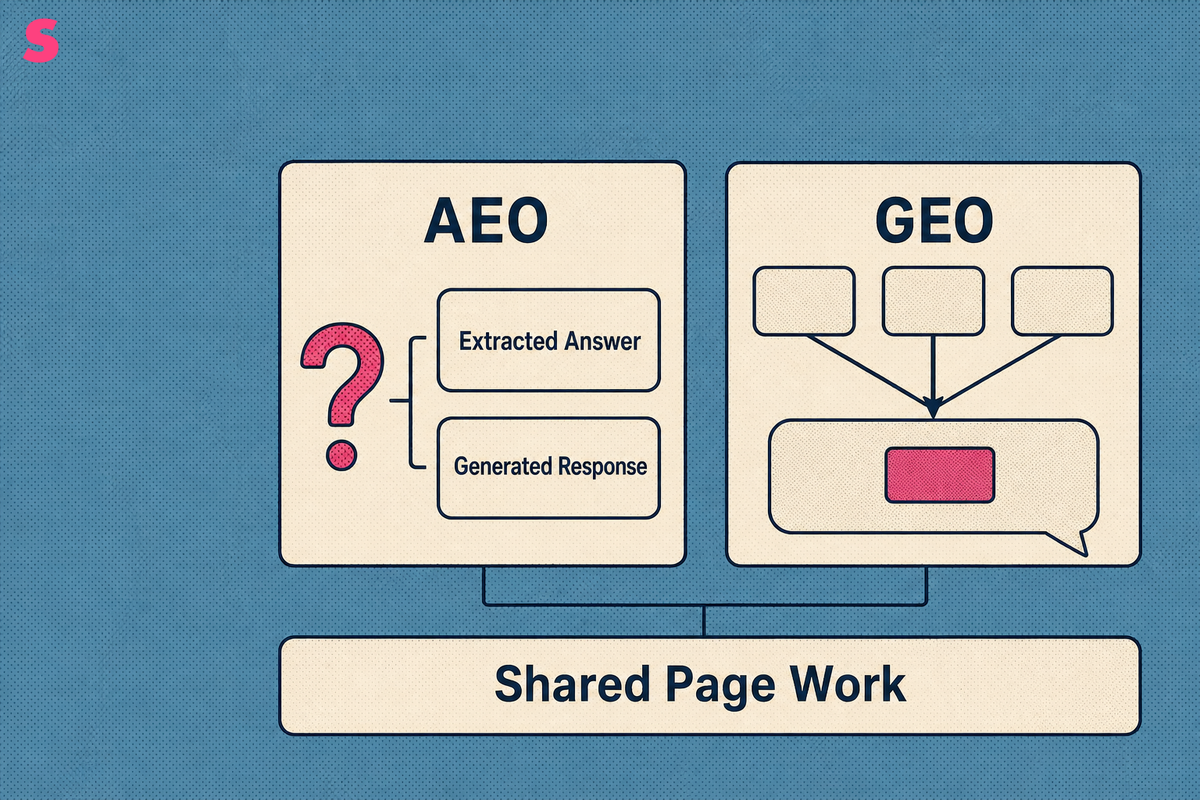
Answer engine optimization (AEO) is the practice of shaping a page so that a search or answer system extracts it as the direct response to a question. Generative engine optimization (GEO) is the practice of making a brand's content likely to be selected, summarised and cited inside a response that an AI engine composes itself.
The difference is the mechanism. AEO targets extraction: one passage lifted whole into a featured snippet, a voice reply or a Google AI Overviews summary. GEO targets synthesis: an engine such as ChatGPT or Perplexity blends several sources and names a few of them.
Each has an output a team can inspect.
- AEO output: a question-led heading, a two-sentence answer beneath it, and FAQPage schema around both.
- GEO output: the brand named in a generated answer, with a citation to a page it owns.
AEO is the older label and often stretches to cover both. GEO arrived to describe generative engines specifically, so many teams now write "AEO and GEO" as one phrase.
Are AEO and GEO different things, or one discipline with two names?
AEO and GEO are one discipline with two emphases. The page-level work is identical. The difference is what the engine does with the page afterwards: extract a passage or synthesise across sources. A team needs one playbook and two lenses on the same results.
The shared work:
- A direct answer in the opening sentences under each question-shaped heading.
- Schema markup, including FAQPage JSON-LD.
- Crawlable, server-rendered HTML and an accurate update date.
- Consistent naming, so the brand and each product carry the same name everywhere.
The two diverge in the evidence the engine weighs. An extracted answer comes from one page, so on-page structure decides. A generated answer draws on many sources, so review sites, comparison pages and community threads carry more weight. That is why GEO pushes a team beyond its own domain and AEO does not.
A team that funds them as separate programs pays twice for the same page rewrite.
Is AEO part of SEO, or a separate job?
AEO is part of SEO in method and a separate job in measurement. Crawlability, relevance, authority and structured content are SEO foundations that AEO builds on, so dropping SEO weakens it. Answer-shaped writing and prompt-level tracking are the new parts, and rank reports do not cover them.
The AEO vs SEO question settles once you list what carries over and what is added.
- Carries over: keyword and intent research, internal linking, canonical tags, page speed, backlinks and topical authority.
- Added: answer blocks written for extraction, schema coverage, a tracked prompt list per topic, and citation monitoring.
- Changes owner: third-party presence, such as review profiles and community discussions, sits with PR or product marketing more often than with the SEO team.
In a small team, one person covers all of it. In a larger one, put AEO under the SEO lead so keyword research feeds the prompt list. Keywords are demand evidence; prompts are the fuller, conversational questions buyers put to an AI engine. Split ownership produces conflicting briefs for the same page.
Which signals decide whether an AI engine can find, parse and trust a page?
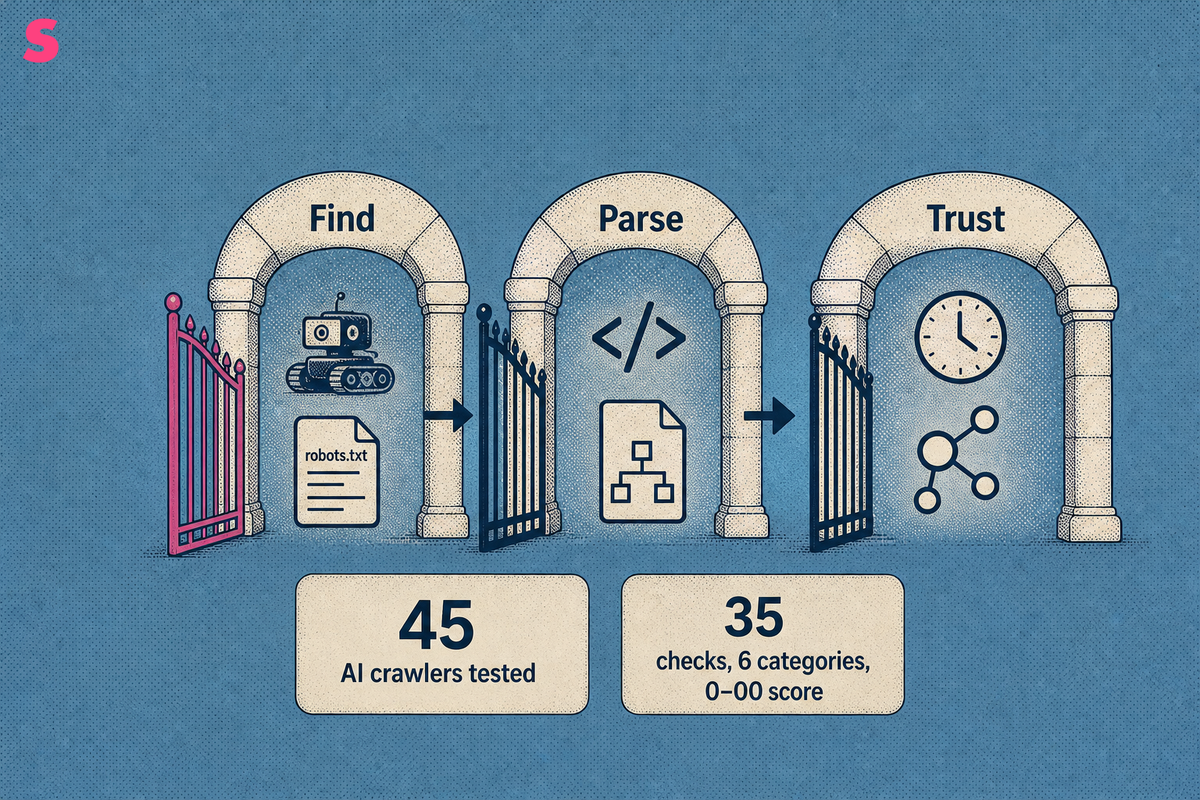
Three groups of signals decide it: access signals (can a crawler fetch the page), structure signals (can an engine extract an answer) and trust signals (is the source worth citing). A page that fails the first group never reaches the other two.
- Find: robots.txt rules that admit AI crawlers, a canonical tag, indexable status, no WAF block, and an optional llms.txt file.
- Parse: server-rendered HTML rather than JavaScript-dependent content, descriptive headings, Schema.org markup including FAQPage JSON-LD, and alt text on images.
- Trust: a recent update date, consistent entity naming, and corroborating mentions on third-party sites.
Crawler type matters. Retrieval bots fetch pages to feed a live answer, and user-triggered agents fetch because a person asked in session; both decide whether a brand can be cited today. Training bots decide whether a model knows the brand later. A robots.txt that blocks one tier and not the other is a decision, and most sites make it by accident.
The Sona AI Crawl Checker tests whether 45 AI crawlers can reach a URL and returns the exact reason each blocked bot fails. The Free AI Readiness Checker runs 35 checks across 6 categories and returns a 0–100 score with a letter grade. Both return a snapshot; a score is where the work starts.
How do you measure AEO and GEO results next to SEO results?
Measure on three layers: rank and click data for SEO, prompt-level citations and mentions for AEO and GEO, and pipeline for all three. The analytics a team already runs cover the first layer and part of the third. The middle layer needs a tracked prompt list run against the engines buyers use.
- Build a prompt list per topic, tagged by intent and buying stage.
- Run the whole list daily across the chosen engines.
- Record visibility, position, mentions and cited pages for each prompt.
- Read the series, not the day: a change that holds four days running is a trend.
- Join the cited pages to AI-referred sessions, accounts and deals.
Daily resolution matters because an engine's answer to the same prompt shifts with its retrieval index, a model update and whatever a competitor published last week. A weekly sample cannot separate that noise from a real move. Several tools run daily checks; what matters is the resolution your team needs.
Sona's own data, September 2026, covers 8 answer surfaces: ChatGPT, Google AI Overviews, Perplexity, Google AI Mode, Gemini, Mistral, Qwen and Claude. Sona AI Visibility includes AI Attribution, which places every AI touchpoint on one account timeline beside ads, web and CRM data and reports AI search as a channel with spend, deals and ROAS.
Where does the difference between AEO, SEO and GEO stop mattering?
The difference stops mattering for page production and for most label choices. One page with a direct answer up front, clear headings, schema markup and a recent update date serves all three disciplines, so each label hands a writer the same brief.
Either answer is fine in these cases:
- Writing a new page: the brief is the same whether the goal is a snippet, a citation or a ranking.
- Choosing a job title or agency label: the work behind AEO, GEO and "AI SEO" overlaps almost entirely.
- Fixing technical access: a crawler blocked by a WAF is blocked for all three.
- Running a small site on a small budget: the shared base is the whole plan.
The difference still matters in three places. Measurement needs separate reports, because citations and rankings move independently. Off-site work matters more for GEO, because it depends on third-party mentions. And any topic where buyers' prompts differ from the queries they type into Google deserves its own page. Beyond those, arguing over AEO vs GEO wastes a planning meeting.
How should a B2B SaaS team split investment between SEO, AEO and GEO?
Keep SEO as the largest line, fund the shared base first, and give AEO and GEO a defined, separately measured slice. Buyers now research vendors inside ChatGPT, Gemini, Claude and Perplexity before visiting a site, so a team with no AEO or GEO line cannot see that research. A team that cuts SEO to pay for it weakens both.
Fund in this order:
- Technical access: crawler permissions, server-rendered HTML and schema. Cheap, and shared by all three disciplines.
- Page rewrites: the pages that already rank and sell, each opening with a direct answer.
- Prompt monitoring on the Commercial and Decision-stage prompts in the category.
- Off-site citations: review profiles, comparison pages and community threads that engines draw on.
- Attribution, so the spend in steps 3 and 4 can be defended against pipeline.
Weight prompts by intent. A Decision-stage prompt where a competitor is named and you are not is worth more than a high-visibility Informational one. Run the prompt list daily; review the allocation and the positioning story quarterly.
What do AEO and GEO tools and services cost per month, and should you buy software or hire help?
Monitoring software starts at $75 a month for Brands on Sona AI Visibility, and the entry plans in the table below run from $29 to $295 a month. Done-for-you services are priced in thousands: Sona's start at $5,500 a month on top of an AI Visibility plan.
Prices were read from each vendor's own pricing page in September and October 2026. The cost column prices one prompt, on one model, once a day, so a credit plan and a prompt-slot plan compare on the same unit. It is a unit price, not a ranking. Where a vendor publishes no refresh cadence, no figure is given.
| Tool | Starting price | Agency Plans? (Yes/No) | # of Answer Engines Tracked | Answer Engines | # of Daily Tracked Prompts (entry plan) | Cost per Daily Tracked Prompt | Differentiation |
|---|---|---|---|---|---|---|---|
| Sona AI Visibility | Brands from $75/month, agencies from $199/month, both billed annually. 14-day free trial, no credit card | Yes | 11 | ChatGPT, Gemini, Google AI Mode, Google AI Overviews, Perplexity, plus Claude, DeepSeek, Grok, Copilot, Qwen, Mistral on premium | 5,000 credits/month on Starter 5K, about 166 daily tracked prompts on one model or 56 across three | $0.45 per daily tracked prompt | Connects AI citations and prompts to pipeline and revenue on one account timeline; resolves the anonymous accounts behind AI-referred visits, 100% cookieless |
| Peec AI | From $95/month (Starter), $245 (Pro), $495 (Advanced) billed monthly; Enterprise custom. Free trial | Yes | 3 | Pro and Advanced: ChatGPT, Google AI Mode, Google AI Overviews, Microsoft Copilot, Gemini and Naver AI | 50 prompts on Starter, 150 on Pro, 350 on Advanced, tracked daily | $0.63 per daily tracked prompt | Unlimited users on every plan; extra models are a paid add-on |
| Otterly.ai | From $29/month (Lite), $189 (Standard), $489 (Premium) billed monthly; Enterprise custom. Free trial | Not published | 4 | ChatGPT, Google AI Overviews, Perplexity and Microsoft Copilot | 15 prompts on Lite, 100 on Standard, 400 on Premium, checked daily | $0.48 per daily tracked prompt | Unlimited team members on every plan; Enterprise starts from 1,000 prompts |
| PromptWatch | Essential $95/month, Professional $245, Business $579. Agency plans from $199/month (Kick-off) | Yes | 4 | ChatGPT, Claude, Gemini and Perplexity | 50 prompts and 6,000 responses/month on Essential, with 500 agent credits | $0.48 per daily tracked prompt | Publishes a named agency tier alongside brand plans |
| Scrunch AI | From $250/month (Starter) or $300 monthly, $417 (Growth) or $500 monthly; Enterprise custom. 7-day trial, no credit card | Not published | 6 | ChatGPT, Claude, Gemini, Perplexity, Google AI Mode, Google AI Overviews and Meta | 350 custom prompts plus 1,000 industry prompts on Starter | No refresh cadence published | Splits custom prompts from industry prompts |
| AthenaHQ | From $295/month (Starter) billed monthly, 17% off annually; Enterprise custom. Free Essential tier | Not published | Not published | Not published | 3,600 credits on Starter, where 1 credit is 1 AI response; 300 credits on the free tier | $2.46 per daily tracked prompt | Credit-based plans, with a free entry tier |
| Profound | Quote-only, no public pricing. 7-day free trial | Not published | 3 | ChatGPT, Gemini and Google AI Overviews | 50 prompts run daily on the 7-day trial; Enterprise allowances custom | No refresh cadence published | Custom Enterprise pricing and a 7-day trial; no self-serve price |
Sona's done-for-you services come in three plans: Launch at $5,500 a month, Accelerate at $7,500 and Amplify at $9,500. Each puts a team on top of the software to ship pages, technical fixes and reporting. Each requires an AI Visibility plan on Growth or above and is billed monthly.
Buy software alone when your writers and engineers can ship the fixes. Add services when production is the bottleneck, because a tracker shows the gap without closing it.
Monitoring which AI answers mention a brand is only half the job. The other half is connecting those mentions to accounts, pipeline and revenue. Sona AI Visibility closes that loop by following AI-referred visits into the buyer journey and tracking which AI crawlers reach a site's pages, so a mention becomes something a team can measure rather than a number to report.
Frequently Asked Questions
Is AEO the same as GEO?
They overlap heavily. AEO targets being extracted as the direct answer; GEO targets being selected and cited inside generated responses. The same content and technical work supports both, so one program can report two sets of results.
Does AEO replace SEO?
No. Crawlability, authority, relevance and structured content remain the base that AEO and GEO build on. Dropping SEO weakens the other two, because an engine that cannot crawl or trust a page cannot extract or cite it.
Do I need separate content for AEO and GEO?
Rarely. One page with a direct answer up front, clear structure, schema markup and a recent update date serves both. Build a separate page only where buyers' prompts differ from the search queries they type, such as a long comparison question no keyword captures.
Which AI engines should a B2B SaaS company monitor?
Start with ChatGPT, Google AI Overviews, Perplexity and Gemini. Add Claude, Copilot and others where buyers in your segment research. Tie the choice to your audience: ask new customers which engines they used, then drop any engine that never appears in their answers.
Can I measure AEO and GEO with the analytics I already have?
Only in part. Standard analytics shows AI-referred sessions at best, and many land as direct traffic. Prompt-level citations, crawler activity and the accounts behind AI-referred visits need dedicated tracking.
How much should I budget for AEO and GEO?
Cost depends on whether you buy monitoring software, an SEO suite add-on or done-for-you services. The pricing table in the cost section shows each tracked tool's entry tier on a monthly basis, from $29 to $295, and Sona's done-for-you services start at $5,500 a month on top of a software plan.
Summarize this article with AI: ChatGPT · Claude · Perplexity · Google AI Mode
Last updated: October 2026