


AI visibility optimization in the United States involves making a brand understood, cited and recommended within AI responses from ChatGPT, Google AI Overviews, Gemini, Perplexity, and other answer engines. Rather than SEO, it is measured through mentions, citations and share of voice in generated answers, not page rankings. Tracking by itself changes nothing, so this work combines monitoring with content, entity and third-party citation improvements. Sona AI Visibility links prompts and citations with pipeline and revenue, while showing AI crawler and agent activity at the start of that path.
What is AI visibility optimization, and how is it different from SEO?
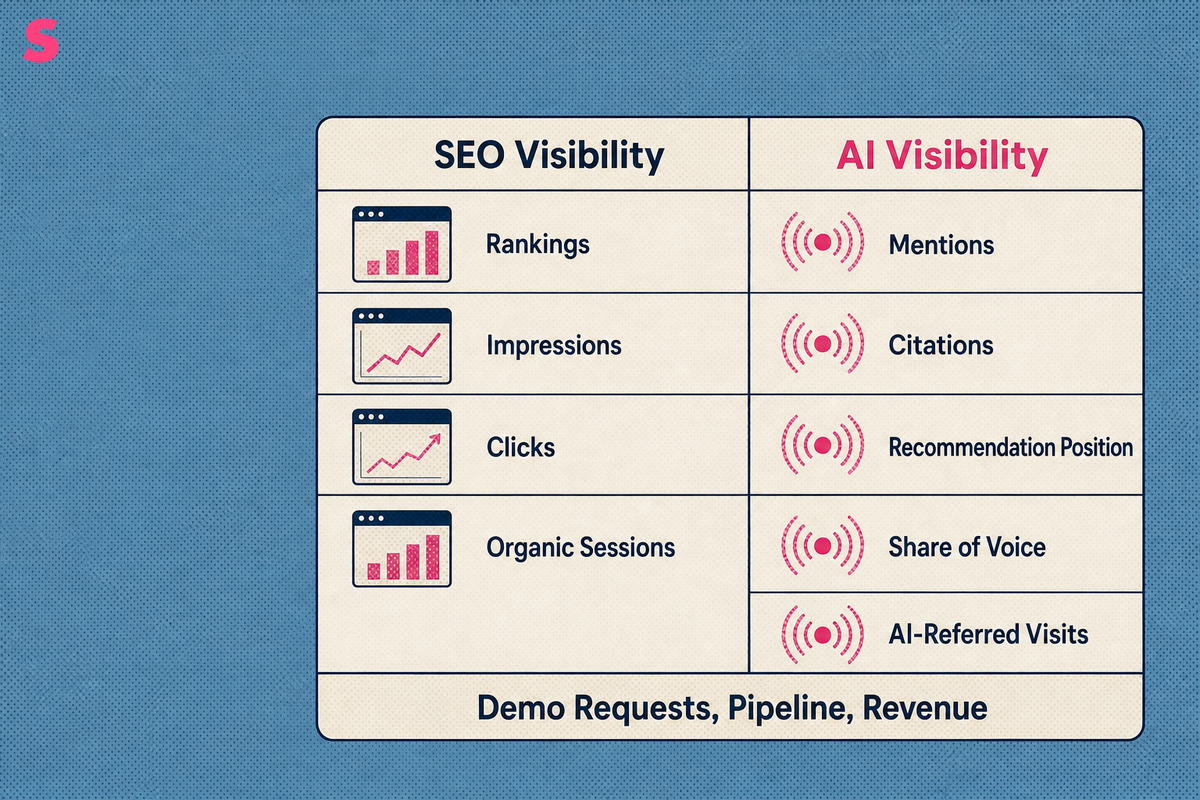
AI visibility optimization in the United States improves how often and how accurately AI-powered search systems understand, cite, and recommend a brand. It focuses on AI answers, cited sources, and recommendation patterns, not conventional organic rankings alone.
AI visibility optimization is not rank tracking, a one-time prompt check, or a replacement for SEO. SEO remains essential for crawlability, technical quality, authoritative content, and organic discovery. AI visibility work builds on those foundations but measures different channels, tools, and outcomes across AI and web platforms.
AEO, or answer engine optimization, and GEO, or generative engine optimization, are overlapping labels for much of the same work. A US SaaS company might optimize a comparison page so an assistant can identify the category, explain buyer criteria, and cite the page when someone asks for vendor options.
- Traditional SEO visibility: rankings, impressions, clicks, and organic sessions.
- AI visibility: mentions, citations, recommendation position, share of voice, and AI-referred visits.
- Business measurement: whether AI-assisted research contributes to demo requests, accounts, pipeline, or revenue.
Why does AI visibility matter for a US B2B SaaS company?
AI visibility matters because US B2B buyers use answer engines for category discovery, vendor comparison, and shortlist creation. A SaaS company absent from those answers loses an opportunity to define the category, displace a competitor, or become the cited source behind a buyer’s next step.
The United States has high competitive density in AI brand visibility optimization, and ChatGPT has a larger market share in the US than in most regions. Category-level prompts are therefore more contested, especially when buyers ask for alternatives, implementation guidance, pricing context, or recommendations for a specific use case.
Mentions do not equal pipeline. A brand mention remains an upper-funnel signal until the team connects the underlying prompt and citation to referral traffic, demo requests, CRM activity, influenced pipeline, or closed-won revenue. The operating question is whether an appearance changes the buyer journey.
For example, a buyer may ask an assistant for enterprise billing software with workflow controls, visit a cited implementation guide, and then request a demo. The citation has commercial value only when the company can connect that sequence to an account and opportunity.
Which AI engines and answer surfaces should US companies monitor?
US B2B SaaS companies should monitor ChatGPT, Google AI Overviews, Gemini, Perplexity, Claude, and other answer engines that match buyer research habits. The priority is coverage of the surfaces where target accounts discover categories and compare vendors.
Awareness prompts ask for definitions, frameworks, and implementation guidance. Consideration prompts compare approaches and requirements. Decision prompts ask for alternatives, pricing, integration fit, or vendor recommendations. A useful monitoring program assigns prompts to buying stages rather than treating every mention as equally valuable.
- Awareness: category explanations, educational guides, and how-to answers.
- Consideration: evaluation criteria, workflow comparisons, and implementation options.
- Decision: vendor shortlists, alternatives, pricing questions, and product comparisons.
- Purchase: trial, demo, migration, security, and procurement questions.
Engine coverage needs normalization during tool evaluation. A platform tracking five engines with daily runs cannot be compared directly with one tracking three engines weekly. Compare the same prompt set, US geography, engine mix, run frequency, and citation definition before treating share of voice as comparable.
How do AI systems decide which sources to cite?
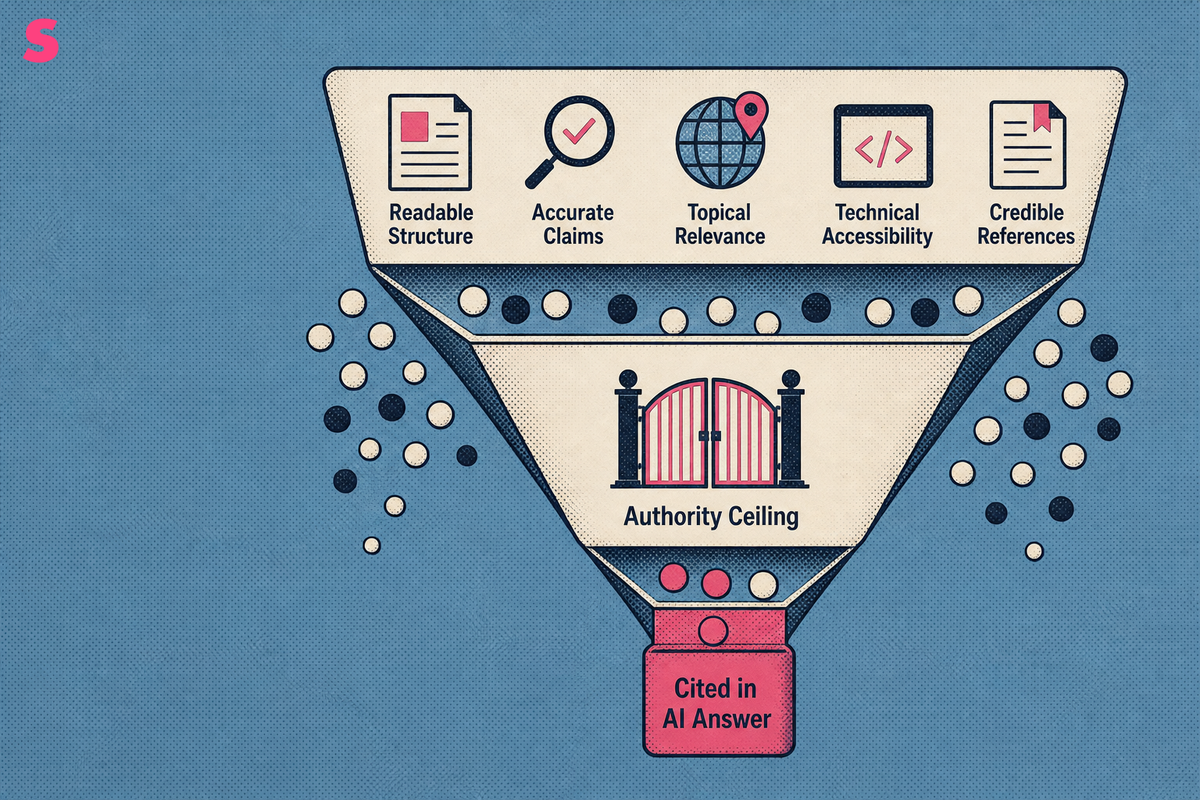
AI systems cite sources they can access, parse, associate with an entity, and use to answer a specific question. Readable structure, accurate claims, topical relevance, technical accessibility, and credible third-party references affect whether a page becomes useful in an AI-generated answer.
Google provides best practices and technical SEO guidance for generative AI features in Search, per Google’s developer documentation. The same foundations apply to AI visibility work: crawlable pages, server-rendered HTML, valid canonical tags, clear headings, structured data where appropriate, and content that answers a defined buyer question.
Single tactics fail because citation selection depends on more than one variable. Publishing an FAQ page without technical accessibility, consistent entity information, supporting evidence, or a clear answer rarely creates durable visibility. AI visibility optimization combines technical work, content design, brand consistency, and external authority.
The authority ceiling is the point where page-level improvements stop compensating for weak category evidence. If an assistant cannot find reliable signals that a company belongs in a category, even a well-structured page has limited potential to earn citations for competitive prompts.
Which content formats do AI systems cite most often, and how can you test them?
How-to articles, guides, original research, reviews, and comparison pages are useful formats to test because each serves a different buyer question. Evidence for a universal format ranking remains thin, so US teams should measure citation patterns in their own category rather than assume one format wins.
Run a controlled content-format test with a fixed US prompt set. Use matched prompts, repeat each run daily, change one format variable at a time, and log every cited source. Daily runs reveal patterns that weekly snapshots can obscure.
- Select prompts with the same topic, buying stage, and target audience.
- Choose one page to restructure, without changing its central claim or offer.
- Record mention status, citation status, cited URL, source type, engine, date, and competitor citations.
- Compare repeated runs before and after publication, then review the pattern rather than one result.
Consider an illustrative example. A SaaS company changes a broad product page into a comparison guide with defined evaluation criteria, implementation steps, source citations, and a short decision framework. The team then rechecks the same prompts, records whether the guide appears as a cited source, and separates a one-day appearance from a sustained change.
A brand-level score is not a work item. A prompt-level view is. Sona AI Visibility connects citations to pipeline and revenue on one account timeline, while AI Search Insights shows tracked prompts and the sources AI systems cite for those prompts.
How do AI visibility platforms measure mentions, citations, and share of voice?
AI visibility platforms run tracked prompts across answer engines, capture brand mentions and cited sources, then calculate visibility, position, and share of voice across the prompt set. A credible baseline includes buyer prompts, named competitors, target geography, engines, and a documented run cadence.
Start with 25 targeted prompts rather than hundreds of generic queries. Prompt quantity alone misleads because a commercial comparison prompt can matter more than dozens of broad informational prompts. Segment each prompt by intent, buying stage, geography, engine, and business priority.
AI answers are unstable but measurable. Outputs change with the model, location, personalization, prompt wording, retrieval index, and time. Demand repeated runs, transparent sampling, and disclosed refresh frequency from any platform used for AI visibility optimization in the United States.
Daily prompt tracking provides measurement resolution. A change that holds for four daily runs is a trend, while a one-day spike is noise. A full technical re-audit belongs on a different schedule, such as monthly or quarterly, because crawlability and page-level findings change more slowly than answer outputs.
The useful output is a log, not just a score. A score is a dated snapshot, while a comparable series lets a team identify sustained movement and investigate the page, prompt, citation source, or competitor change behind it.
Does tracking AI visibility actually improve it?
Tracking AI visibility does not improve it by itself. Monitoring identifies where a brand appears, which sources receive citations, and which prompts create gaps. Improvement comes from acting on those findings through content changes, entity consistency, third-party references, technical accessibility, and controlled experiments.
A practical optimization cycle starts with a prompt gap, maps the cited sources, assesses the page that should answer the question, and makes one clear change. That change could be a stronger comparison section, a more complete implementation explanation, clearer authorship, refreshed evidence, or a technical fix that allows AI crawlers to reach the page.
Sona AI Visibility connects citations and AI-referred visits to pipeline and revenue, and reads AI crawler activity from server logs or a lightweight edge worker without a JavaScript tag. Tracking an AI answer begins the path from buyer prompt to account activity and commercial outcome.
Teams should separate monitoring from execution. The platform can identify a missing prompt or a cited competitor source. Content, SEO, product marketing, and RevOps teams still need to decide what to publish, fix, test, and measure next.
Should a US company handle AI visibility in-house, with an agency, or with a platform?
US companies should choose an in-house, agency, or platform-led model based on internal expertise, content capacity, and the need for revenue measurement. In-house work provides control, agencies provide execution capacity, and software platforms provide prompt, citation, and reporting infrastructure.
| Execution model | Who does the work | Internal effort | Speed of feedback | Cost implications |
|---|---|---|---|---|
| In-house | SEO, content, product marketing, and RevOps teams | High, because the company owns research, implementation, and reporting | Fast when teams share data and publishing access | Software and labor costs, with internal staffing as the main investment |
| Agency | External strategists, writers, technical specialists, and account leads | Moderate, focused on approvals, subject-matter input, and data access | Depends on retainer workflow and approval cycles | Median entry pricing is $750 per month, with the middle half of 52 monthly price lists ranging from $461 to $2,000, per lohud.com, October 2026 |
| Software platform | Internal team using a measurement system | Moderate, because the team acts on findings | Fast for prompt monitoring and reporting | Software-led AI search plans can cost under $100 per month, while enterprise solutions can reach tens of thousands per month, per theoryroad.com, October 2026 |
| Hybrid | Internal owner supported by a platform and specialist services | Moderate, with internal accountability retained | Fast for measurement, structured for execution | Combines platform fees with service or agency fees |
Sona done-for-you services provide a Sona team for content, AI search optimization, technical fixes, strategy, and reporting on top of an AI Visibility Growth plan or above. Launch starts at $5,500 monthly, Accelerate at $7,500 monthly, and Amplify at $9,500 monthly, per Sona pricing, October 2026.
Detailed product pricing requires separate evaluation because prompt allowances, engine coverage, and refresh cadence use different units. The immediate decision is operational: who owns the work, who approves it, and how results reach the revenue team.
What should a US buyer compare, and what are the limits of vendor rankings?
US buyers should compare answer-engine coverage, prompt capacity, refresh frequency, citation detail, competitor tracking, integrations, reporting, and the ability to connect AI activity to business outcomes. Vendor rankings are directional research, not independent proof, unless they disclose methodology, sample prompts, scoring rules, and verification dates.
Prices and product details below were read in October 2026 and can change often. Ask every vendor how it handles location, personalization, prompt variation, data retention, crawler access, account identification, and privacy controls. Also ask whether results come from rendered answers, APIs, or both, because collection methods can produce different outputs.
| Tool | Starting price | Agency Plans? (Yes/No) | # of Answer Engines Tracked | Answer Engines | # of Daily Tracked Prompts (entry plan) | Cost per Daily Tracked Prompt | Differentiation |
|---|---|---|---|---|---|---|---|
| Sona AI Visibility | From $75/month, billed annually | Yes | Up to 11 (3 on Starter) | ChatGPT, Gemini, Google AI Mode, Google AI Overviews, Perplexity, Claude, DeepSeek, Grok, Copilot, Qwen, Mistral | 5,000 credits/month, about 166 daily tracked prompts on one model or 56 across three | $0.45 per daily tracked prompt | Connects AI citations and prompts to pipeline and revenue on one account timeline, and tracks AI crawler activity from server logs or a lightweight edge worker |
| Peec AI | From $95/month | Yes | Up to 13 (3 of 6 on Starter, plus add-ons) | ChatGPT, Google AI Mode, Google AI Overviews | 50 prompts daily | $0.63 per daily tracked prompt | AI visibility tracking across self-serve and agency plans |
| Otterly.ai | From $29/month | Yes | Up to 7 (4 on Lite, 3 as paid add-ons) | ChatGPT, Google AI Overviews, Perplexity, Microsoft Copilot | 15 prompts daily | $0.48 per daily tracked prompt | Prompt and brand tracking across listed answer engines |
| Scrunch AI | From $250/month | Yes | Up to 9 (4 on Core) | ChatGPT, Perplexity, Google AI Overviews, Microsoft Copilot | 125 prompts, refresh frequency not published | No refresh cadence published | AI search visibility tracking for brands and agencies |
| PromptWatch | From $95/month | Yes | Not published | Not published | 50 prompts daily | $0.48 per daily tracked prompt | Prompt monitoring with monthly response allowances |
Most AI visibility tools tell you whether you were mentioned. Few can show what that mention was worth. Sona AI Visibility treats AI search as a measurable channel by connecting citations, accounts, pipeline, and revenue rather than stopping at mention counts.
What are the frequently asked questions about AI visibility optimization?
What is AI visibility optimization in the United States?
AI visibility optimization in the United States improves how often and how accurately AI assistants understand, cite, and recommend a US brand. It is measured through mentions, citations, source ownership, and share of voice rather than conventional rankings alone.
Is AI visibility optimization the same as AEO or GEO?
AEO and GEO are overlapping labels for largely the same work. AI visibility optimization is the broader term because it includes improving brand inclusion in AI answers and measuring results across AI answer surfaces.
Does AI visibility optimization replace SEO?
No. AI visibility optimization runs alongside SEO and shares groundwork such as crawlability, technical accessibility, authoritative content, and entity consistency. The channels and metrics differ because AI systems produce answers and citations rather than a conventional list of ranked results.
How can I tell if my brand appears in ChatGPT or Google AI Overviews answers?
Build a fixed prompt set around buyer questions, competitors, and buying stages. Run that set daily across ChatGPT, Google AI Overviews, Gemini, Perplexity, Claude, and other answer engines, then log mentions, cited sources, position, and competing brands as a baseline.
Can AI visibility be tied to pipeline and revenue?
Yes, when a platform links prompts and citations to AI-referred traffic, demo requests, CRM activity, accounts, pipeline, and closed-won revenue. Mention counts alone cannot establish commercial impact because they do not show what happened after the answer.
Why do AI answers differ from one run to the next?
AI answers vary by model, location, personalization, prompt wording, retrieval sources, and time. Credible measurement uses repeated runs, a stable prompt set, disclosed sampling, and a daily history that distinguishes a sustained trend from a one-day change.
Summarize this article with AI: ChatGPT · Claude · Perplexity · Google AI Mode
Last updated: October 2026







