


An AI SEO specialist uses AI tools and answer-engine strategies to increase a company’s presence in both standard search results and AI-generated responses. The role combines SEO, content and PR, so the key issue is identifying the gap your team cannot cover. Software can track mentions and citations, but people remain necessary for entity building, content updates and technical repairs. Choose the hire, whether an internal manager, consultancy or agency, based on that gap.
What does an AI SEO specialist actually do?
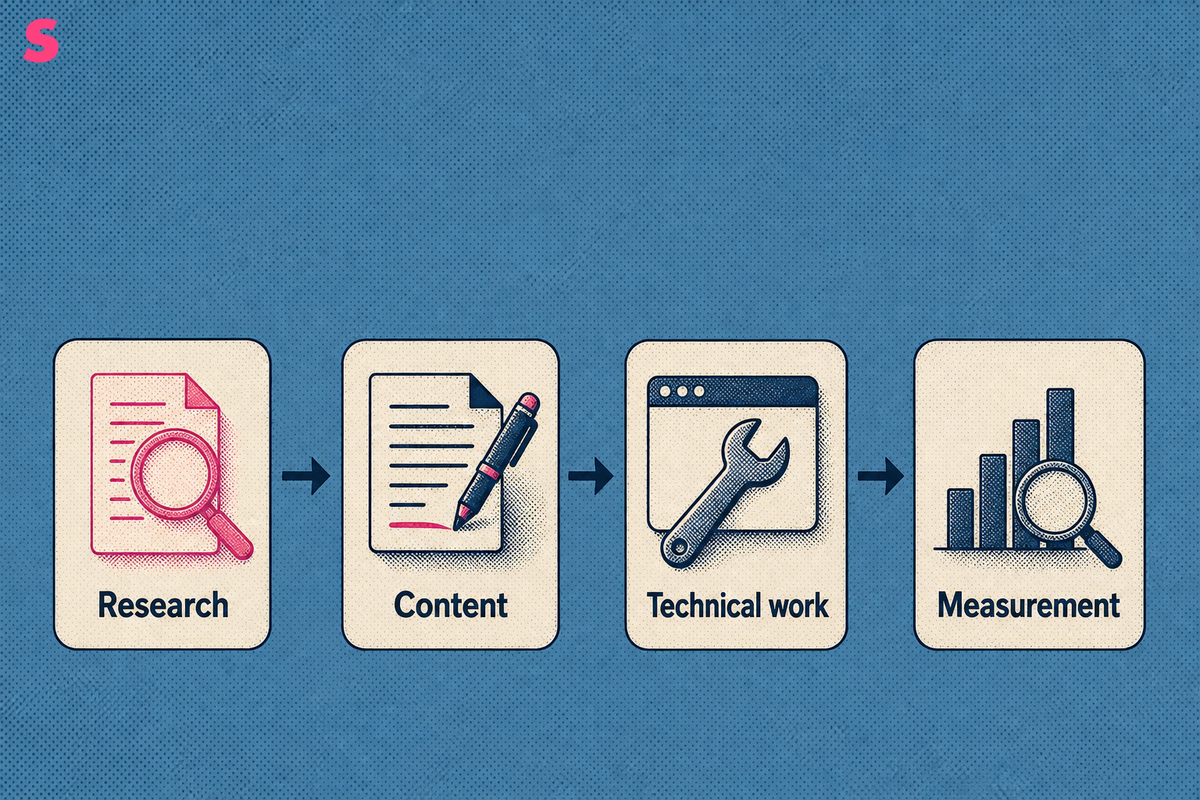
An AI SEO specialist improves how a website appears in traditional search results and AI-generated answers. The work combines keyword research, content optimization, technical audits, entity optimization, AI content engineering, topical authority, and generative engine optimization (GEO).
The role helps marketing teams make their expertise discoverable in answer engines while protecting conventional organic search performance. The specialist turns visibility goals into work that content, web, PR, and demand teams can execute.
A practical assignment starts with a commercial topic. An AI SEO specialist might map buyer questions about attribution software, identify pages an answer engine could cite, assess whether those pages provide clear definitions and supporting evidence, then prioritize crawlability, canonical tags, schema markup, and server-rendered HTML.
- Research: identify high-value topics, entities, buyer questions, and competitor sources.
- Content: revise pages so they answer a defined prompt with evidence and clear structure.
- Technical work: audit crawl access, indexability, page rendering, metadata, and structured data.
- Measurement: track citations, mentions, AI-referred visits, and the business outcomes attached to them.
The role is not prompt writing or a replacement for an SEO team. It combines conventional SEO with GEO, answer-engine measurement, and the editorial and technical work required to improve visibility.
How do an AI SEO specialist, AEO manager, AEO strategist and AI search visibility consultant differ?
The titles overlap, but ownership differs. An AI SEO specialist executes optimization work, an AEO manager runs the internal program, an AEO strategist sets priorities and methods, and an AI search visibility consultant diagnoses a problem or guides a defined engagement.
An AEO manager suits a company that needs an accountable owner across content, technical SEO, PR, analytics, and leadership reporting. An AEO strategist can sit inside that function or support it externally, but should define the prompt taxonomy, measurement rules, and prioritization model before execution begins.
| Role | Primary ownership | Typical outputs | Best fit |
|---|---|---|---|
| AI SEO specialist | Optimization execution across search and AI answers | Content briefs, technical findings, entity plans, prompt tracking | A team with a defined backlog |
| AEO manager | Internal answer engine optimization (AEO) program | Prompt set, reporting cadence, cross-functional priorities | A company building a durable capability |
| AEO strategist | Strategy, sequencing, and measurement design | Opportunity model, operating plan, testing rules | A team that needs direction before execution |
| AI search visibility consultant | Diagnosis or specialist guidance | Audit, recommendations, implementation roadmap | A company with a focused problem or short engagement |
An AI SEO consultancy can provide several of these roles. Before hiring, establish who owns implementation, validates results, and resolves conflicts involving product messaging, editorial standards, or engineering capacity.
Is AEO just SEO under a new name?
No. AEO overlaps with SEO, but it addresses how answer engines synthesize and cite information rather than only how a page ranks for a keyword. An AI SEO specialist should retain conventional SEO fundamentals while adding prompt research, entity work, citation analysis, and AI crawler access.
SEO still matters because answer engines retrieve from the web, and a weak site offers fewer credible pages for retrieval. A keyword ranking is not the same as appearing in an AI answer. Buyers can ask long, comparative questions that do not map neatly to one traditional keyword.
AEO does not mean stuffing pages with AI terminology, publishing large volumes of generated copy, or trying to force a single model response. It also extends beyond reputation management. The practical goal is accurate, crawlable, well-supported pages that answer relevant buyer questions.
- Traditional SEO: keywords, rankings, organic traffic, technical health, and links.
- AEO and GEO: prompts, citations, sources, entity relationships, answer coverage, and AI-referred visits.
- Shared work: useful content, crawlability, information architecture, authority, and measurement.
A good AEO strategist treats SEO, AEO, and GEO as connected systems. The page remains the unit of work, but evaluation expands from whether Google ranks it to whether an answer engine can retrieve, understand, and cite it for a meaningful question.
Which AI search tasks can a specialist do that software cannot?
An AI SEO specialist makes judgment calls, coordinates people, and changes the underlying website. Software can monitor answers and surface patterns, but it cannot independently determine whether a weak citation reflects positioning, evidence quality, product gaps, technical access, or editorial quality.
A specialist can interview subject-matter experts, reconcile contradictory claims, create a source policy, revise a product page, commission digital PR, and work with engineers on rendering or robots.txt. Those tasks require business context and accountability.
- Define the buyer question and the commercial audience behind it.
- Inspect the answer, its cited sources, and the page currently representing the brand.
- Choose the intervention, such as a content revision, entity clarification, technical remediation, or external evidence plan.
- Run the same prompt list daily and review the resulting log for durable movement.
Daily prompt tracking reveals patterns that weekly snapshots can obscure. Answers can shift because of retrieval-index changes, model updates, or a competitor’s new page. Sustained movement provides more useful evidence than a one-day spike.
Software makes monitoring repeatable. The specialist decides what the evidence means and which work deserves editorial and engineering capacity.
Which AI engines and metrics should an AI SEO specialist report on?
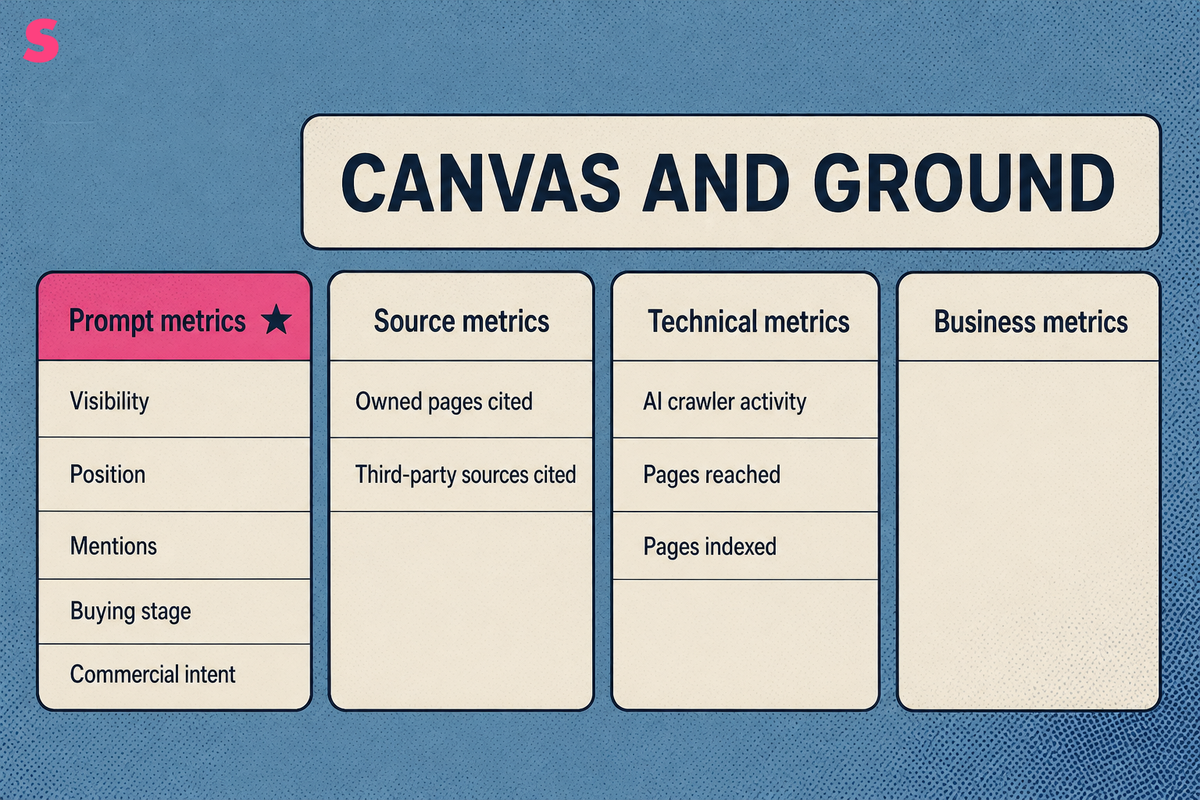
An AEO manager should report on the answer engines that matter to the company’s buyers, then connect prompt-level visibility to citations, sources, AI-referred visits, pipeline, and revenue. Google AI Overviews require separate treatment because they are a Google Search feature, not a general AI assistant.
A useful report separates visibility from business value. Visibility metrics include brand presence, position within an answer, share of voice, cited pages, cited third-party sources, and competitor presence. Business metrics include AI-referred visits, identified accounts, opportunities, pipeline, and closed-won revenue where measurement permits.
A single brand-level visibility score is a dated snapshot rather than a work item. A prompt-level view identifies the prompts behind the score and the sources that influenced the answer. Sona AI Visibility connects citations and AI-referred visits to pipeline and revenue, while showing prompt and source-level evidence for investigation.
- Prompt metrics: visibility, position, mentions, buying stage, and commercial intent.
- Source metrics: which owned and third-party pages answer engines cite.
- Technical metrics: AI crawler activity, pages reached, and pages indexed.
- Business metrics: visits, accounts, pipeline, revenue, spend, and ROAS.
Sona AI Visibility tracks 11 answer engines, as of October 2026. The reporting set should reflect real buyer behavior rather than every available model.
What tools does an AI SEO specialist use, and where does monitoring stop?
An AI SEO specialist uses research, technical audit, crawl-analysis, content, analytics, and AI visibility tools. Monitoring ends when a team identifies a change but has not assigned an owner, revised the page, or verified effects on citations, traffic, or commercial outcomes.
Prices, engine coverage, and prompt allowances below are current as of October 2026. The table compares published entry plans, but a buying decision should also assess prompt quality, reporting needs, data access, agency workflow, and measurement beyond mention counts.
| Tool | Starting price | Agency Plans? (Yes/No) | # of Answer Engines Tracked | Answer Engines | # of Daily Tracked Prompts (entry plan) | Cost per Daily Tracked Prompt | Differentiation |
|---|---|---|---|---|---|---|---|
| Sona AI Visibility | From $75/month, billed annually | Yes | Up to 11 (3 on Starter) | Not published | 5,000 credits/month, about 166 daily tracked prompts on one model or 56 across three | $0.45 per daily tracked prompt | Connects AI citations and prompts to pipeline and revenue |
| Peec AI | From $95/month | Yes | Up to 13 (3 on Starter) | Not published | 50 prompts daily | $0.63 per daily tracked prompt | Daily prompt tracking across active AI models |
| Otterly.ai | From $29/month | Yes | Up to 7 (4 on Lite, 3 as paid add-ons) | ChatGPT, Google AI Overviews, Perplexity, Microsoft Copilot | 15 prompts daily | $0.48 per daily tracked prompt | Prompt tracking across four answer engines on Lite |
| PromptWatch | From $95/month | Yes | Not published | Not published | 50 prompts daily | $0.48 per daily tracked prompt | 50 prompts and 6,000 responses per month on Essential |
Sona pricing and product facts are current as of October 2026. Competitor pricing, allowances, and unit costs are based on published plan information checked in October 2026. The comparison shows monitoring capacity, not the quality of a specialist’s strategy or implementation.
How do you decide whether you need an AI SEO specialist or can build the skill in-house?
Use a bounded internal assessment before deciding whether to build the skill in-house or hire external help. The assessment should produce evidence about ownership, capacity, diagnosis, implementation, and commercial measurement rather than relying on a visibility score.
- Assign ownership: name the person responsible for prompt research, content changes, technical remediation, and reporting. If no accountable owner exists, assess a specialist or AEO manager.
- Inventory capacity: confirm that editorial, web, analytics, PR, and subject-matter resources can complete the work. Record the backlog, dependencies, and approval constraints.
- Test diagnosis: ask the team to connect a weak prompt result to a page, source gap, technical issue, or market-message problem. A consultant fits when diagnosis is the primary gap.
- Run an internal pilot: implement a defined set of prompt, page, source, and technical changes, then retain the prompt outputs and implementation record.
- Review completion and business measurement: determine whether changes were completed, whether visibility moved on commercially relevant prompts, and whether AI-referred visits and qualified pipeline can be measured.
- Choose the operating model: build internally when the team can repeatedly diagnose, implement, and measure work. Hire a specialist for persistent execution gaps, a consultant for diagnosis, or a consultancy when several disciplines need coordinated support.
| Operating model | Best when | Primary requirement | Main output |
|---|---|---|---|
| Extend the SEO team | Existing teams have technical and editorial capacity | Training and clear measurement rules | Integrated search and AEO backlog |
| Hire a specialist | Execution gaps persist across technical and content work | Defined scope and accountable owner | Prompt, page, and source plan |
| Use a consultant | The organization needs diagnosis or a roadmap | Access to analytics, CMS, and stakeholders | Audit and prioritized recommendations |
| Use a consultancy | Several disciplines need coordinated external support | Governance and internal implementation partner | Program design and execution support |
The decision should not rest on a visibility score alone. The internal assessment should establish whether the team can turn evidence into completed changes and connect the results to commercially relevant outcomes.
Sona AI Visibility can support an internal owner by connecting AI citations and AI-referred visits to pipeline and revenue. The platform supplies measurement evidence, but an internal team or external specialist still owns decisions and site changes.
When does an individual specialist, a consultancy, an agency or an in-house AEO manager fit best?
An individual specialist suits a narrow, high-skill need. An AI SEO consultancy suits a multi-disciplinary program. An agency suits teams that need ongoing execution capacity, while an in-house AEO manager suits companies that need long-term ownership across marketing, product, web, and revenue operations.
Choose an individual for an audit, technical problem, content system, or measurement design. Choose a consultancy when the business needs strategy and coordinated expertise across content, technical SEO, entity work, analytics, and PR.
An agency is appropriate when the internal team can set direction but cannot sustain production and optimization work. Published GEO retainers range from $390 to $10,000 per month, based on five vendors’ published pricing pages checked in October 2026. One-off AI search optimization audits and fixed-scope projects start at $8,000 to $10,000, based on published vendor pricing checked in October 2026.
Evaluate ROI by recording the pre-engagement baseline and all attributable costs, including specialist or agency fees, software, and internal implementation. Separate visibility movement from AI-referred visits and qualified pipeline, then compare the resulting commercial outcomes with the total investment. An engagement has stronger evidence of value when it improves commercially relevant prompts, citations, visits, or revenue and the implementation record shows how those outcomes developed.
An in-house AEO manager fits when AI search reporting must inform product marketing, demand generation, CRM workflows, and executive planning. Sona done-for-you services are available monthly on top of Growth or above, with Launch at $5,500, Accelerate at $7,500, and Amplify at $9,500, as of October 2026.
The hiring model should match the operating burden. A provider can recommend work, but the company still needs a decision-maker who can approve claims, supply subject-matter expertise, and allocate engineering and editorial resources.
How do you check a specialist's claim that their AI search recommendations are tested?
Check an AI search visibility consultant’s testing claim by asking for the prompt set, sample size, answer engines, dates, scoring rule, and raw before-and-after outputs. A result that cannot be repeated under the same conditions is marketing, not a reliable operating method.
A credible test defines what counts as a mention, citation, position, or successful answer before work begins. It separates branded prompts from non-branded prompts, informational questions from commercial questions, and isolated changes from bundled page revisions.
- Request the exact prompts and prompt variants used in the test.
- Ask which answer engines ran the prompts and on which dates.
- Ask how the provider scored citations, position, and source inclusion.
- Review the changed pages, technical changes, and supporting evidence.
- Run the prompt list daily after implementation and retain the outputs as a comparable log.
Daily tracking helps distinguish noise from durable movement. A weekly snapshot can hide a model update or retrieval change that reverses the next day. Technical re-audits and positioning reviews can run monthly or quarterly because they answer different questions.
What are the frequently asked questions?
What is an AI SEO specialist?
An AI SEO specialist uses AI tools and answer-engine tactics, including generative engine optimization (GEO), to improve visibility in traditional search and AI answers. Core outputs include prompt research, content briefs, entity recommendations, technical audits, citation tracking, and reporting on AI-referred business outcomes.
What does an AEO manager do?
An AEO manager owns answer engine optimization (AEO) inside a company. The role sets prompt sets, tracks mentions and citations, coordinates content, PR, and technical fixes, and reports results to marketing leadership. The manager turns AI search visibility into an accountable operating program.
How much does an AI SEO specialist cost?
Published salary-listing data checked in October 2026 puts AI SEO specialist pay at $67,000 to $102,000. Published GEO retainers checked in October 2026 range from $390 to $10,000 per month. A full cost comparison should also account for scope, internal implementation capacity, software, and engagement duration.
Do I need an AI SEO specialist if I already have an SEO team?
Often not at first. Extend the existing SEO team when it can handle entity work, content revision, technical remediation, and measurement across AI engines. Bring in a specialist when those gaps persist, no one owns answer-engine reporting, or the team lacks capacity for sustained implementation.
Can AI visibility software replace an AI SEO specialist?
No. AI visibility software monitors mentions, citations, sources, prompts, and AI-referred traffic. People still carry out content changes, digital PR, entity building, stakeholder alignment, and technical remediation. Software provides evidence, while the specialist chooses and executes the work.
How can I tell if an AI SEO consultant's results are real?
Ask for the prompt set, sample size, engines, dates, and scoring rule behind every claimed result. Review the underlying outputs and the pages changed during the test. Treat rankings or citations that cannot be reproduced under the same conditions as marketing rather than dependable evidence.
Summarize this article with AI: ChatGPT · Claude · Perplexity · Google AI Mode
Last updated: November 2026







