


AI SEO services bundle conventional search work, keyword research, technical audits, content production and internal linking, with visibility work aimed at Google AI Overviews, ChatGPT, Perplexity and Gemini, sold either as software you run or as a managed retainer. Productized monitoring subscriptions start near $29 per month, while mid-market managed engagements commonly run $2,500 to $10,000 per month. Most of the category stops at rankings and mention counts; Sona AI Visibility ties those citations, and the prompts behind them, to pipeline and revenue on one account timeline.
What do AI SEO services actually do beyond conventional SEO software?
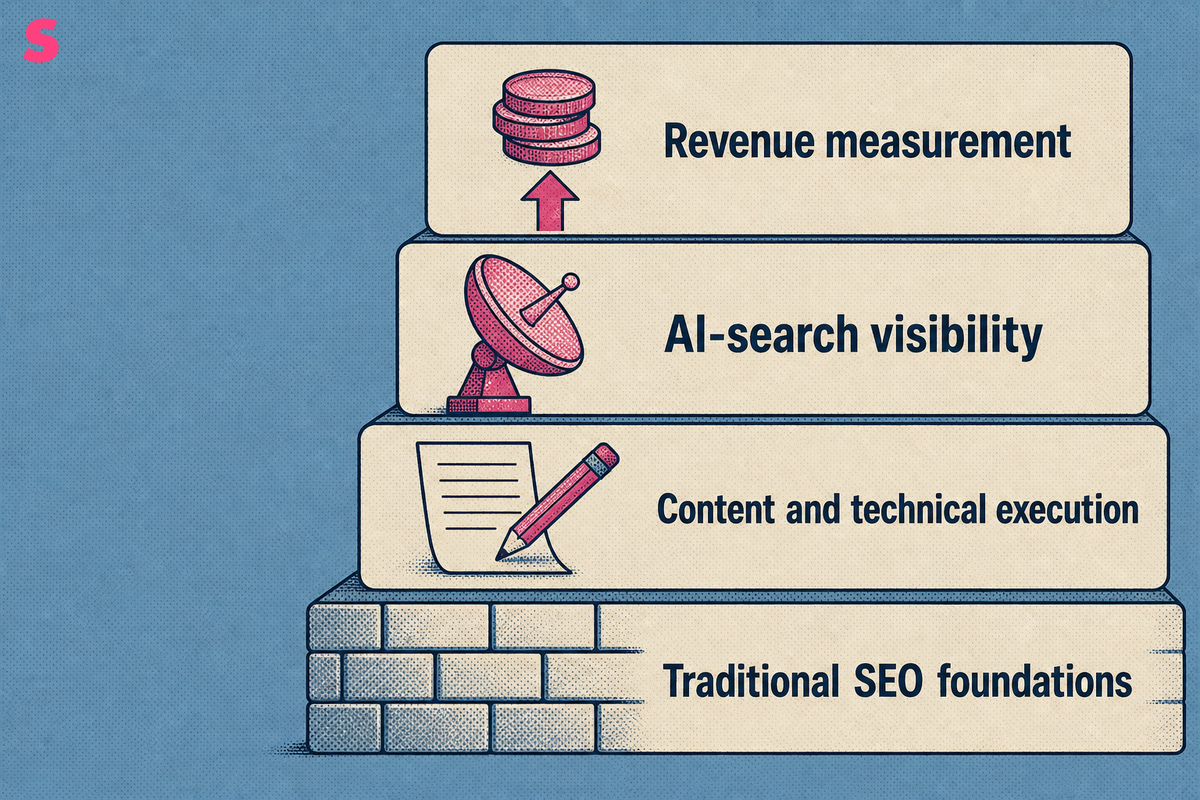
An AI SEO service runs two jobs at once: the classic organic search programme, and the work of making a brand retrievable and quotable inside AI answers from ChatGPT, Google AI Overviews, Perplexity and Gemini. Early in a competent engagement the deliverables are a technical crawl audit, a keyword-to-prompt map, a baseline visibility measurement against a named prompt set, and a fix list ranked by severity.
Part of that is software and part is labour. Software watches, scores and logs. Labour writes, edits, approves and ships. Buyers who confuse the two pay for a dashboard, then wonder why nothing on the site changed.
Most engagements operate on four layers:
- Traditional SEO foundations: crawlability, indexation, internal linking, canonical tags, server-rendered HTML.
- Content and technical execution: briefs, drafts, schema markup, page fixes actually deployed.
- AI-search visibility: prompt-level tracking across named engines, citation and share-of-answer measurement.
- Revenue measurement: tying AI-referred sessions to accounts, pipeline and closed deals.
The "repackaged SEO tool" objection is fair against much of the market, and the test is specific. AI-assisted reporting restates an existing audit in prettier language. Genuine automation either implements changes autonomously or monitors prompts, not keywords, on a daily schedule against engines you can name.
Which capabilities actually separate one AI SEO service from another?
Skip the shared baseline. Rank tracking, site audits, content briefs and keyword clusters ship in every product at every price, and comparing them wastes an evaluation cycle. Seven axes genuinely vary, and each one changes what the service costs your team to operate.
- Ships fixes or recommends them. Some platforms push changes to the site or serve an agent-ready version of a page. Others produce a list someone on your side has to implement.
- Prompts versus keywords. A prompt set is a list of buyer questions run against engines. A keyword list is a different input and produces a different answer.
- Named engine coverage. Entry tiers differ widely in how many engines they reach, and a plan that tracks ChatGPT alone says nothing about Google AI Overviews.
- Refresh cadence. Daily prompt checks are the category standard on most entry plans; weekly sampling cannot separate a trend from noise.
- Account resolution. Whether the service identifies the companies behind AI-referred visits or stops at session counts.
- Crawler capture method. Server logs and lightweight edge workers record bot traffic that a JavaScript tag never sees.
- CRM and ad-platform integrations. Whether visibility data reaches Salesforce, HubSpot or LinkedIn Ads without a manual export.
Most of the category reports whether a brand was mentioned. Sona AI Visibility connects those prompts and citations to pipeline and revenue on one account timeline, and tracks which AI crawlers reach each page from server logs or a lightweight edge worker with no JavaScript tag, so ad blockers do not hide the traffic.
How do leading AI-search visibility platforms compare in 2026?
The table below compares AI-search visibility software, the monitoring layer used inside an AI SEO programme, rather than complete managed services. None of these rows buys strategy, content production or technical implementation. Prices, engine counts and prompt allowances were read from each vendor's own pricing page in August and September 2026. The cost-per-prompt column normalises every row to one prompt, on one model, checked once a day, because vendors count prompts on different denominators.
| Tool | Starting price | Agency Plans? (Yes/No) | # of Answer Engines Tracked | Answer Engines | # of Daily Tracked Prompts (entry plan) | Cost per Daily Tracked Prompt | Differentiation |
|---|---|---|---|---|---|---|---|
| Sona AI Visibility | Brands from $75/month, agencies from $199/month, both billed annually. 14-day free trial, no credit card. Unlimited seats and API/MCP access on every plan | Yes | 11 | ChatGPT, Gemini, Google AI Mode, Google AI Overviews and Perplexity on standard, plus Claude, DeepSeek, Grok, Copilot, Qwen and Mistral on premium | 5,000 credits/month on Starter 5K, about 166 prompts daily on one model or 56 across three | $0.45 per daily tracked prompt | Connects AI citations and prompts to pipeline and revenue on one account timeline, and tracks AI crawler activity from server logs or a lightweight edge worker with no JavaScript tag |
| Profound | From $99/month (Starter), $399 (Growth), Enterprise custom, billed yearly. Free trial on Growth. Starter tracks ChatGPT only; Growth tracks 3 answer engines | Yes | 1 | ChatGPT only | 50 prompts and 1,500 responses/month on Starter | $1.98 per daily tracked prompt | Focus: AI answer visibility monitoring, with engine coverage widening on Growth |
| Peec AI | From $80/month (Starter), $205 (Pro), $420 (Advanced), Enterprise custom. Annual billing. | Yes | 3 | ChatGPT, Google AI Mode, Google AI Overviews, Microsoft Copilot, Perplexity, Gemini | 50 prompts on Starter, tracked daily on 3 chosen models | $0.53 per daily tracked prompt | Focus: prompt-level visibility and competitor benchmarking on a buyer-chosen model set |
| Otterly.ai | From $29/month (Lite), $189 (Standard), $489 (Premium), Enterprise from $1,000. Free trial, no commitment. 15% off annual; unlimited team members on every plan | Yes | 4 | ChatGPT, Google AI Overviews, Perplexity and Microsoft Copilot | 15 prompts on Lite, checked daily on every plan | $0.48 per daily tracked prompt | Focus: daily prompt and citation checks, with unlimited team members on every plan |
| Scrunch AI | Core $250/month for brands, Agency Core $500/month, Enterprise custom. 7-day trial of Starter, no credit card | Yes | 4 | ChatGPT, Perplexity, Google AIO and Copilot | 125 unique prompts on Core, 250 on Agency Core | $1.50 per daily tracked prompt | Focus: brand and multi-client AI search monitoring with a dedicated agency tier |
| AthenaHQ | From $295/month (Starter), Enterprise custom. Free Essential tier with 300 credits. 17% off annual; 1 credit = 1 AI response | Yes | 10 | ChatGPT, Perplexity, Google AI Overviews, Google AI Mode, Gemini, Claude, Copilot, Grok and DeepSeek | 3,600 credits on Starter, where 1 credit is 1 AI response | $2.46 per daily tracked prompt | Focus: broad engine coverage metered by AI responses |
| PromptWatch | Essential $95/month, Professional $245, Business $579. Agency plans from $199/month (Kick-off). | Yes | 4 | ChatGPT, Claude, Gemini and Perplexity | 50 prompts and 6,000 responses/month on Essential, with 500 agent credits | $0.48 per daily tracked prompt | Focus: prompt monitoring with agent credits and a separate agency ladder |
Match the row to the buyer, then decide separately who implements. Monitoring software, implementation support and managed execution are three distinct purchases, and a monitoring licence covers only the first. A solo marketer testing whether AI search matters at all wants the cheapest daily prompt check and nothing more. An agency needs a published multi-client tier and white-label reporting, which narrows the field fast. A brand that already appears in AI answers needs engine breadth, because a one-engine plan cannot answer a question about Gemini.
B2B SaaS teams sit somewhere else entirely. Their deal cycles run for months, their buying committees hold several stakeholders, and their AI-referred traffic lands in analytics as direct. For that profile the deciding capability is account resolution and revenue attribution, which is where Sona AI Visibility closes the gap between a citation and a closed deal.
How do AI SEO services improve visibility in Google AI Overviews and AI assistants?
Retrieval is not ranking. Google AI Overviews, ChatGPT, Perplexity and Gemini assemble an answer from passages they can fetch, parse and trust, then cite a handful of sources. The work splits into four mechanisms, and only the first resembles classic SEO.
- Be crawlable. Retrieval bots and user-triggered agent bots have to reach the page. A robots.txt disallow, a WAF 403 or a JavaScript dependency removes the page from consideration before quality matters.
- Be quotable at passage level. Engines lift paragraphs, not pages. Self-contained sections, explicit definitions and FAQPage JSON-LD make extraction cleaner.
- Be corroborated. A claim repeated across third-party sources is safer for a model to cite than one that appears on a single vendor site.
- Be fresh. Engines with web retrieval weight recency, so a page untouched for a year loses to a fresher source on the same topic.
Structured data, genuinely useful page content and server-rendered HTML are the levers that govern crawlability and passage-level extraction. Judge any provider's method against whether a page can be fetched, parsed and quoted, rather than against marketing language about optimising for AI.
Answers vary by model, prompt wording, location, account context and retrieval source, so a single ranking number means nothing, while engine coverage plus a documented prompt set means a great deal. Sona's own AI visibility data, September 2026, counts eight answer surfaces in the archive: ChatGPT, Google AI Overviews, Perplexity, Google AI Mode, Gemini, Mistral, Qwen and Claude. A brand cited on a couple of those surfaces sits in a very different position from one cited across most of them.
How much do AI SEO services cost at software, productized, agency and enterprise tiers?
Four purchasing tiers exist, and the distance between the cheapest and the most expensive is enormous. Data quality is not what separates them. The variable is how much strategy, implementation and editorial review comes attached.
| Tier | Typical monthly cost | What the money buys | Who implements | Best suited to |
|---|---|---|---|---|
| Self-serve SEO software | Roughly $20 to $499 per month | Crawls, rank data, keyword research, content scoring | Your team, entirely | Teams with in-house SEO and engineering capacity |
| Productized AI-search monitoring | About $29 to $295 per month | Daily prompt tracking, citation and share-of-answer reporting | Your team, entirely | Anyone establishing a baseline before committing budget |
| Managed agency retainer | $1,000–$5,000 per month for small and local businesses (available June 9, 2026); $5,000–$15,000 per month for mid-market companies (available June 9, 2026); $2,500 to $10,000 per month commonly reported for mid-market engagements (available June 9, 2026); approximately $2,500 per month at entry level (available June 23, 2026) | Strategy, content production, technical fixes, monthly reporting | Shared between agency and client | Companies with budget but no internal SEO owner |
| Enterprise or full-service | $15,000 or more per month for enterprise organizations (available June 9, 2026); $12,000 or more per month for premium enterprise or full-service engagements (available June 23, 2026) | Dedicated team, migration support, multi-market programmes, custom reporting | Largely the provider | Large sites, multiple regions, regulated review cycles |
Moving up a tier buys five things: senior strategy time, implementation capacity, editorial review of every published word, technical resource that can actually deploy schema and header changes, and reporting depth beyond a dashboard screenshot. A monitoring subscription and a managed retainer are not competing purchases. One tells you where you stand; the other changes where you stand.
Should a B2B SaaS team buy AI SEO software, a managed retainer, or run both?
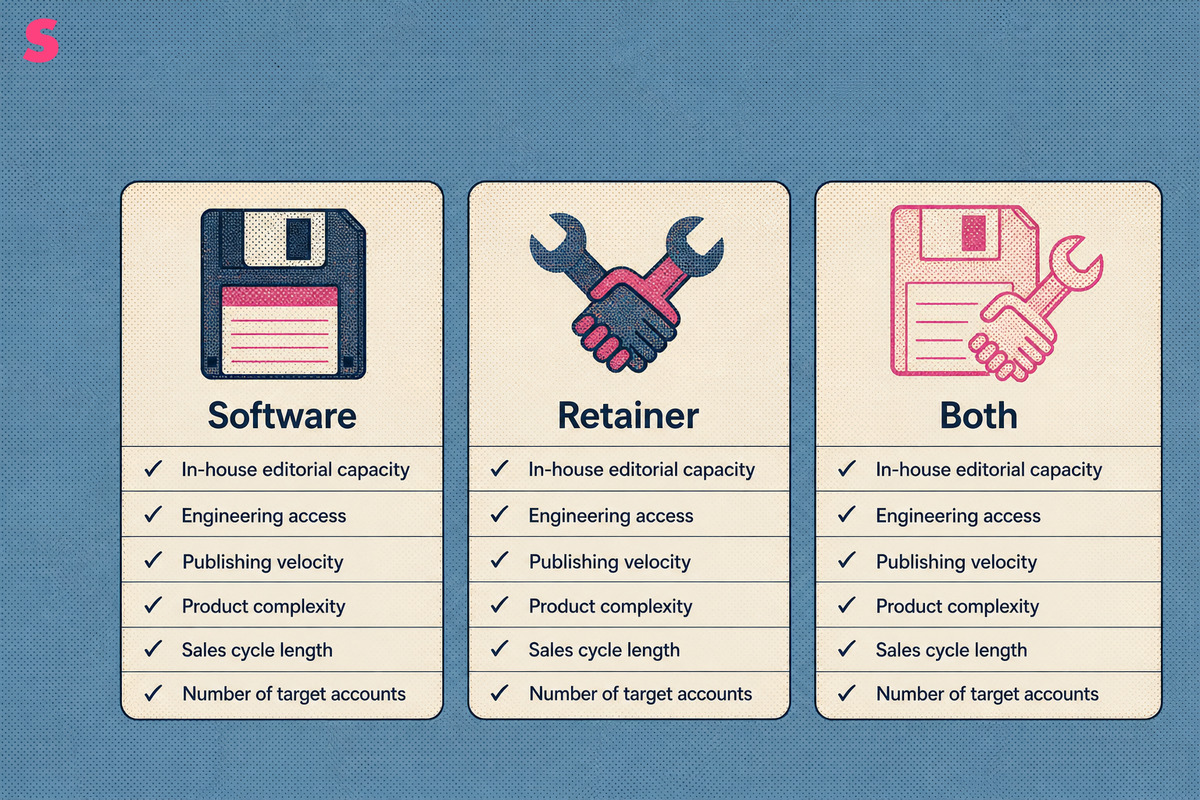
Buy software if you have an in-house writer, an SEO owner and access to the engineering queue. Buy a retainer if you have none of those and a quarterly pipeline target. Run both when publishing velocity outruns what the internal team can research and edit, and someone internal still owns product accuracy. The decision turns on operating model, not on a product shortlist.
Six criteria settle it: in-house editorial capacity, engineering access, publishing velocity, product complexity, sales cycle length, and the number of target accounts. A technical SaaS product with a long sales cycle and a finite named-account list needs precision more than volume, and precision requires someone who understands the product.
The objection that retainers are overpriced against software compares the wrong numbers. A software licence buys data. A managed retainer buys data plus the working hours of a strategist and a writer. Compare the total cost of the outcome, including the salary of whoever would otherwise do the work, and the gap narrows considerably.
The useful mental model for SaaS is a compounding search programme rather than a sequence of campaign bursts, paired with reporting that separates real demand from ranking vanity metrics. That second discipline is exactly what AI-search reporting needs, because share of answer is easy to report and hard to connect to revenue.
How do you verify that an AI SEO service moves pipeline and not just rankings?
Put the measurement terms in the contract before work starts. AI-search visibility is measurable; it is simply measured differently from rankings, and a provider who resists specifics is declining to be measured. Five items belong in the scope document.
- A documented prompt set agreed before the engagement, with the commercial and decision-stage prompts named individually.
- A repeatable sampling process with stated frequency and geography. Run the prompt list daily: a team checking the same prompts every day sees a pattern that a weekly snapshot would have averaged away, because a move holding four days running is a trend and a one-day spike is not.
- Citation and share-of-answer tracking per engine, not a single blended score.
- Defined reporting windows with a baseline captured before any change ships.
- A named link from AI-referred sessions to accounts, opportunities and closed revenue.
Intent and measurement discipline matter more than ranking counts, and that principle applies harder inside AI answers, where there is often no click to count. Ask what the provider does about zero-click research.
Sona AI Attribution handles that fifth item by crediting AI search fairly across the account timeline rather than at last click, and by reconciling self-reported attribution on demo forms against click data. Sona Marketing Measurement is the layer that data feeds, so AI search appears as a channel with spend, deals and ROAS beside every other channel.
What are the limits and risks of AI-generated content and automated SEO fixes?
Four risks are material, and three of them are editorial rather than technical. Content produced at volume primarily to manipulate rankings is a policy problem in its own right, regardless of whether a human or a model wrote it, and scale makes the exposure worse rather than better.
Product inaccuracy is the sharpest risk for technical B2B SaaS. A model that has never used your product will describe a feature that does not exist, and the prospect reading that page finds out during the trial. Generic generated text carries a second cost: a page that reads like every competitor's page gives an answer engine no reason to cite yours specifically. Authorship and trust signals matter here, and named authorship backed by genuine first-hand detail is what separates a page worth citing from filler.
Automated site changes deserve a staging environment and a human approver. A tool that edits titles, canonical tags or redirects without review will eventually do something expensive.
Comparison pages carry their own bias risk. Before trusting a ranking, check five things: whether sponsorship or affiliate relationships are disclosed, whether prices were verified against vendor pricing pages, how many sites and niches were tested, what the scoring dimensions were, and whether live revenue-generating sites were used over a stated window. A ranking assembled from feature pages describes marketing copy, not implementation quality.
Who should not buy AI SEO services?
This category is the wrong purchase for several profiles, and recognising yours saves a year of retainer fees.
- Pre-product-market-fit companies with no defined buyer, no positioning and almost nothing published. There is nothing yet to make visible.
- Businesses whose demand is local walk-in or paid social. A restaurant or a DTC brand living on Meta Ads gets less from AI search than from the channel already working.
- Teams with nobody to implement. Recommendations that no one ships are an expensive PDF.
- Very small sites, where an audit surfaces nothing a developer could not fix quickly.
- Companies needing leads this quarter. Buy paid media. Organic and AI-search gains are judged over quarters, not weeks.
- Regulated organisations whose legal review cycle runs longer than the reporting window, so nothing publishes inside the measurement period.
A low-cost monitoring subscription is sufficient, and a retainer is not justified, when you publish rarely, track a short prompt list, and only need to know whether AI engines mention you before committing real budget. Upgrade when the answer is yes and the work shifts to improving that position.
Tracking which AI answers mention a brand is half the job. The other half is connecting those mentions to accounts, pipeline and closed revenue, which is what Sona AI Visibility does on one account timeline alongside ads, web and CRM data.
Frequently Asked Questions
What is the difference between an AI SEO service and an AEO or GEO service?
AI SEO services usually cover the whole search programme, including classic organic rankings and technical work. AEO and GEO describe the subset aimed specifically at being cited inside AI answers. Most 2026 providers sell both under one contract, so read the scope document rather than the label and check which deliverables are actually named.
How long does an AI SEO engagement take to show results?
Technical fixes and structured data can change crawler behaviour and citation patterns within weeks, because retrieval responds quickly once a page becomes reachable and parseable. Content-led organic gains are judged over quarters rather than weeks. Ask for a stated reporting window and a baseline measurement captured before any work begins.
Can any AI SEO service guarantee citations in ChatGPT or Google AI Overviews?
No. Answers vary by model, prompt wording, location, account context and retrieval freshness, so no provider controls placement. A guarantee is a reason to disqualify a vendor outright. Ask instead for share-of-answer tracking against a fixed prompt set, sampled daily, with per-engine results rather than one blended score.
How much should a B2B SaaS company budget for AI SEO in 2026?
Software-only stacks are the cheapest layer, and productized AI-search monitoring sits close to them. Managed mid-market engagements cost materially more, and enterprise or full-service programmes more again; the published ranges for each tier appear in the pricing table above this section. Budget for implementation capacity as well, not only for licences, because a licence nobody acts on changes nothing.
How can you tell whether a best AI SEO services ranking was actually tested?
Look for a stated test window, the number of sites and niches used, the scoring dimensions, prices verified against vendor pricing pages, and a sponsorship disclosure. Rankings assembled from feature pages alone describe marketing copy and say nothing about implementation quality, diagnostic speed or whether fixes actually deployed.
Does an AI SEO service replace an in-house SEO or content hire?
Rarely. Software removes reporting and diagnostic labour, and agencies add strategy and execution capacity. Someone internal still has to own product accuracy, approve editorial, and move fixes through the engineering queue. Teams that buy a service expecting it to replace that ownership tend to accumulate recommendations nobody ships.
Summarize this article with AI: ChatGPT · Claude · Perplexity · Google AI Mode
Last updated: September 2026







