


AI search analytics gauges how often and how prominently a brand appears and is cited in AI-generated responses, then links those appearances to traffic and revenue. Monitor mention rate, share of voice, citation frequency, AI referral sessions and assisted conversions across a fixed prompt set sampled repeatedly, since answers vary. Sona AI Visibility links those prompts and citations to pipeline and revenue, while displaying the AI crawler activity at the start of that path. Referral data is undercounted, so report ranges.
What is AI search analytics and how does it differ from SEO analytics?
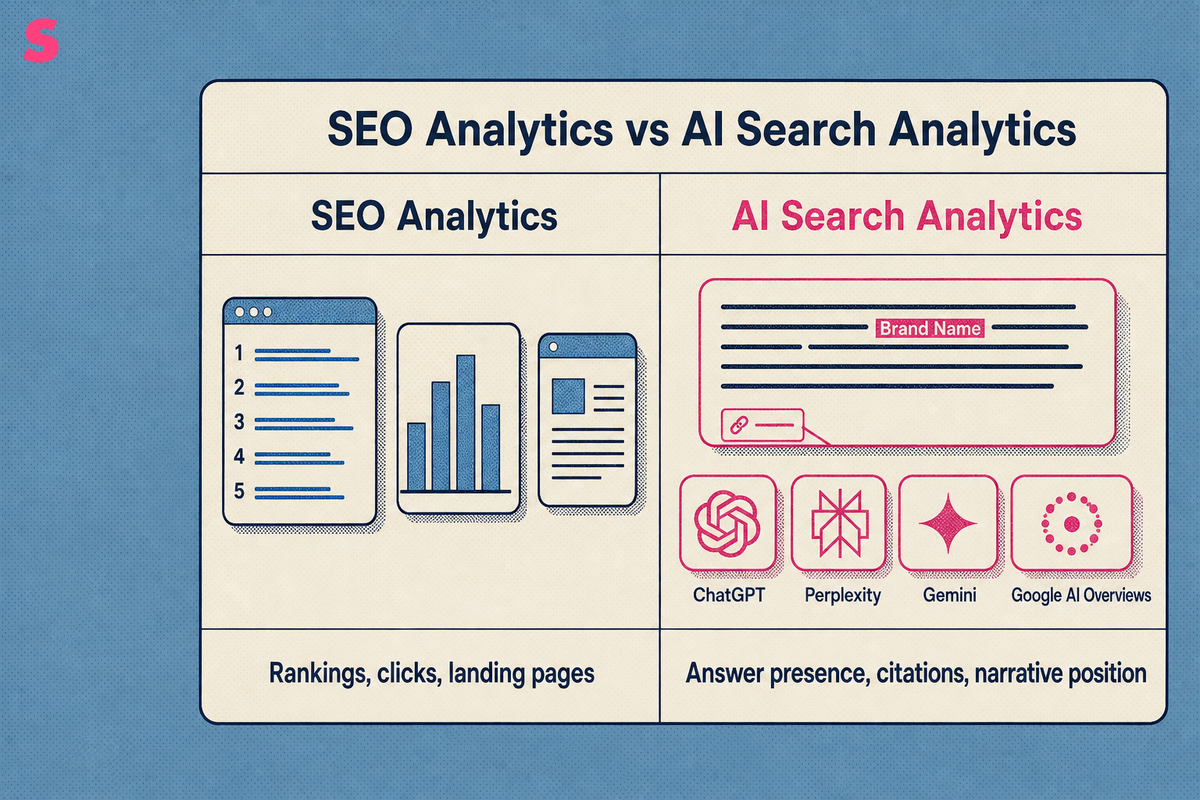
AI search analytics measures whether a brand appears in AI-generated answers, how the answer describes it, which sources it cites, and what those appearances produce in traffic or revenue. It covers ChatGPT, Perplexity, Gemini, Google AI Overviews, and other answer engines.
SEO analytics measures rankings, impressions, clicks, and landing-page performance in conventional search results. AI search analytics evaluates generated answers rather than lists of links. A brand can be recommended without a click, cited through a third-party source, or omitted despite strong Google rankings.
The difference matters because AI answers prioritize contextual recommendations. A buyer asking for a vendor comparison may receive named companies, a short rationale, and cited sources. Traditional rank tracking shows whether a page ranks for a related keyword. AI search visibility analytics records whether the brand appears in the answer, its narrative position, and the sources shaping the response.
AI search analytics does not replace SEO analytics or reduce to a visibility score or traffic report. It combines answer-level observation, citation analysis, crawler access, referral data, and conversion measurement to explain how AI-mediated discovery affects a business.
Why does AI search analytics matter to a marketing or PR team?
AI search analytics shows marketing and PR teams whether AI recommendations influence pipeline, reputation, and buyer research. A mention provides context, but budget owners need evidence of visits, qualified accounts, or commercial activity.
For marketing teams, the operational question is which prompts create valuable exposure. A brand may appear frequently in educational answers while remaining absent from comparison prompts used during vendor selection. Prompt-level reporting separates broad awareness from commercially relevant demand.
For PR teams, the question is which publications, review pages, partner content, and owned pages are cited, and whether generated answers describe the brand accurately. Citation footprint analysis maps brand narratives, source locations, and competitor overlap within the same answers.
Sona AI Visibility connects citations and AI-referred visits to pipeline and revenue on one account timeline, while tracking AI crawler activity that explains whether answer engines can reach relevant pages. That record gives demand generation, content, PR, and RevOps teams shared commercial evidence.
Which metrics measure visibility in AI search, and how are they calculated?
The most useful AI search metrics measure answer presence, citation ownership, narrative prominence, referral behavior, and commercial outcomes. A complete model separates visibility from value because an answer appearance does not necessarily influence a buying decision.
| Metric | What it measures | Calculation | Why it matters |
|---|---|---|---|
| Answer visibility | Whether the brand appears in sampled answers | Answers mentioning the brand divided by total sampled answers | Shows baseline inclusion across a fixed prompt set |
| Citation share | How often owned or earned sources are cited | Brand-related citations divided by all citations in sampled answers | Shows which sources shape AI responses |
| Narrative position | How prominently the brand appears in an answer | Classify first recommendation, later recommendation, source-only citation, or omission | Distinguishes a recommendation from a passing mention |
| AI referral conversion rate | Commercial behavior from identifiable AI-referred sessions | Conversions divided by AI-referred sessions | Connects answer exposure to measurable outcomes |
| Pipeline influenced | Pipeline associated with AI-assisted discovery | Sum qualified opportunities with an attributed AI interaction under the chosen attribution rules | Lets leadership compare AI search with other channels |
Use a fixed denominator. Run 100 selected prompts across the same engines and record answers that mention the brand, cite an owned page, or name a competitor first. Repeat the prompts because retrieval indexes, model updates, and newly published material can change answers.
A brand-level visibility score is a dated snapshot, not a work item. Teams need the prompts behind the score and the sources behind each answer. Sona AI Visibility shows prompts, cited sources, and page-level performance so teams can identify the page or prompt requiring attention instead of reacting to an aggregate number.
How do you judge citation quality instead of just counting citations?
Citation quality depends on relevance, authority, message accuracy, commercial proximity, and repeatability across prompts. A high citation count can still be weak when the source is outdated, describes the brand incorrectly, or appears only in low-intent educational answers.
Classify each citation into four source types: owned pages, earned media, review or directory pages, and third-party editorial sources. Then record whether the citation supports a positive recommendation, neutral factual description, competitor comparison, or unfavorable claim. The classification creates a practical PR and content backlog.
- Relevance: Does the cited source answer the buyer's exact question?
- Accuracy: Does the answer use correct positioning, pricing context, and product claims?
- Prominence: Is the source central to the answer or listed as supporting material?
- Intent: Does the prompt indicate awareness, consideration, decision, or purchase activity?
- Durability: Does the citation recur across repeated runs and related prompt variants?
A citation from a respected publication in a vendor-selection answer carries more commercial weight than a citation from a generic glossary page. Citation analytics should report source quality and answer context beside raw counts. Buyer intent makes citations materially different.
How do you build a prompt set that gives reliable AI search numbers?
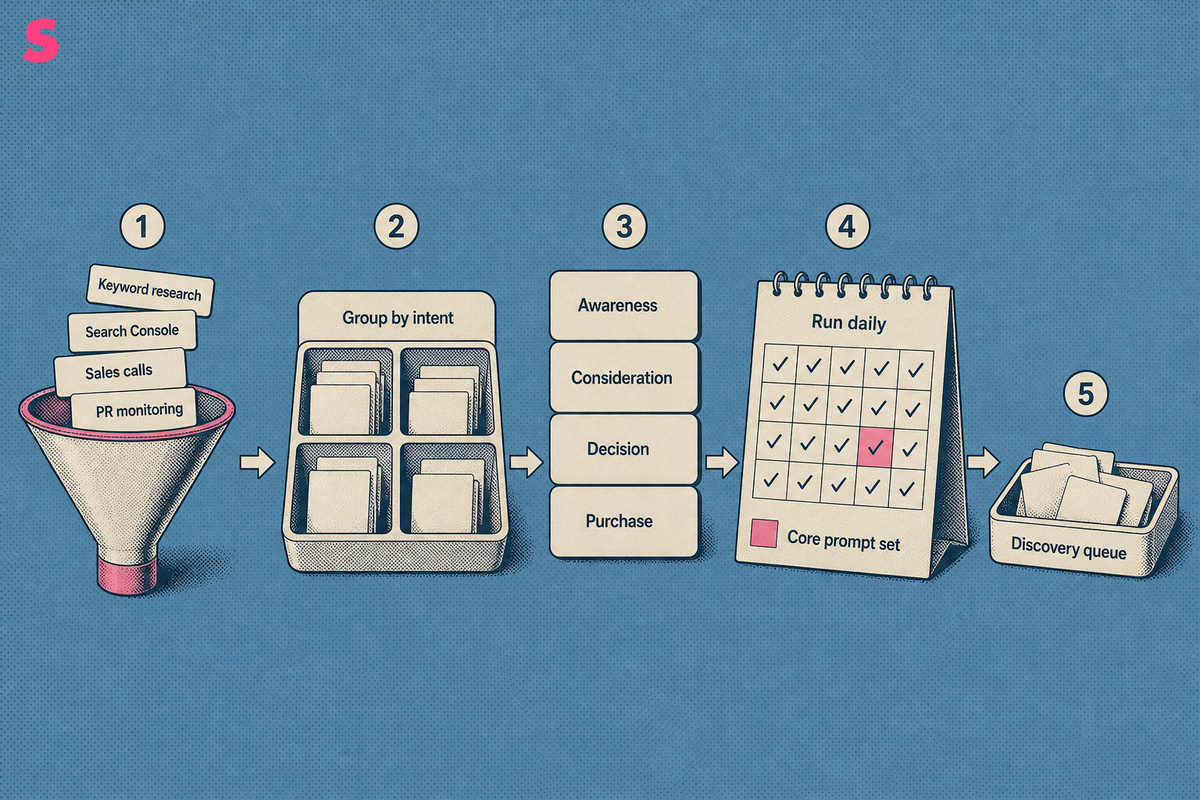
A reliable prompt set represents real buyer questions, covers the buying journey, and remains unchanged long enough to reveal patterns. Build prompts from commercial keywords, sales calls, support questions, competitor comparisons, product categories, and language from forms or CRM notes.
- Collect candidate topics from keyword research, Search Console, sales conversations, and PR monitoring.
- Group near-duplicate questions by intent rather than wording alone.
- Create natural-language prompts for awareness, consideration, decision, and purchase stages.
- Add branded, unbranded, comparison, alternative, integration, and implementation prompts.
- Run the same prompt list daily and retain the answer history.
Daily runs reveal patterns that weekly snapshots can obscure. The same answer can shift after a retrieval-index change, model update, or competitor publication. A movement that holds for four days is a trend. A one-day spike is noise.
Keep the core prompt set stable, then maintain a separate discovery queue for emerging questions. One buyer question can trigger several related research paths, so discovery prompts should capture adjacent concerns without changing the core measurement set.
How do you measure AI search traffic and conversions when referral data is incomplete?
Measure AI search traffic by combining referral sessions, server-side evidence, self-reported attribution, identity resolution, and CRM outcomes. Referral data alone is incomplete because buyers can research in an answer engine, receive a recommendation, and later visit directly or through another channel.
Start with web analytics and Search Console. Google Analytics and Search Console can surface AI referral sessions and some Google AI Overviews-related query signals without specialized tools, but they cannot reveal unclicked mentions or the wording of an answer that produced no referral.
Add a self-reported field such as “How did you hear about us?” to demo and signup forms, then map AI-engine responses into a consistent channel taxonomy. Reconcile stated sources with referral data, account activity, campaign history, and opportunity creation dates. This captures zero-click research that click-level analytics cannot observe.
Sona AI Visibility uses AI Attribution to connect AI citations to accounts, pipeline, and closed-won revenue on one account timeline. The report should distinguish observed AI referrals from self-reported AI influence because the signals answer different attribution questions.
What do the three AI search measurement layers see, and what do they miss?
AI search measurement requires three layers: server-side crawls, platform citation reports, and answer-level intelligence. Each layer answers a different question, and none independently explains whether a brand is visible, accessible, accurately represented, and commercially effective.
| Measurement layer | What it sees | Typical evidence | What it misses |
|---|---|---|---|
| Server-side crawl data | Whether AI crawlers reach pages and which pages they request | Server logs, edge-worker data, crawler user agents | How the final generated answer describes the brand |
| Platform citation reports | Sources cited in available engine outputs | Cited URLs, domains, source frequency | Uncited brand mentions and downstream revenue |
| Answer-level intelligence | Brand mentions, competitor context, narrative position, and prompt-level variation | Captured answers from fixed prompts | Whether anonymous visitors later become known accounts |
The commercial-outcome layer connects the three AI search observation layers to pipeline and revenue through referral data, form fields, identity resolution, accounts, and opportunities. It is commercial evidence rather than a fourth AI search observation layer.
Sona AI Visibility combines answer observation with crawler data and account-level measurement, allowing teams to trace AI-referred visits toward pipeline and revenue. Crawler access, citation presence, and conversion evidence remain separate forms of proof.
Use each layer for its intended decision. Crawl data informs technical access. Answer-level analysis informs content and PR. Attribution data informs channel investment. A dashboard that compresses all three into one score hides the action required from each team.
How do AI search analytics tools compare on price, engine coverage, prompt allowances, and agency support?
AI search analytics software differs in engine coverage, reporting depth, prompt cadence, agency support, and the connection between answer data and commercial outcomes. The right dashboard depends on whether a team needs client reporting, benchmark monitoring, citation analysis, or pipeline attribution.
The comparison below uses public plan information as of October 2026. Prices are starting prices, and the per-prompt figures use the stated comparable unit rather than a separate calculation.
| Tool | Starting price | Agency Plans? (Yes/No) | # of Answer Engines Tracked | Answer Engines | # of Daily Tracked Prompts (entry plan) | Cost per Daily Tracked Prompt | Differentiation |
|---|---|---|---|---|---|---|---|
| Sona AI Visibility | From $75/month | Yes | Up to 11 (3 on Starter) | Not published | 5,000 credits/month, about 56 prompts tracked daily on 3 engines | $0.45 per daily tracked prompt | Connects AI citations and prompts to pipeline and revenue on one account timeline |
| Profound | Custom pricing | Yes | Up to 9 (3 on free Trial) | ChatGPT, Perplexity, Google AI Mode, Gemini, Microsoft Copilot, DeepSeek, Claude, Google AI Overviews, Exa Search | Custom prompt plan, daily | Custom pricing | Enterprise prompt tracking and agency pitch workspaces |
| Peec AI | From $95/month | Yes | Up to 13 (3 of 6 on Starter, plus add-ons) | Not published | 50 prompts daily | $0.63 per daily tracked prompt | Self-serve AI visibility tracking with agency tiers |
| Otterly.ai | From $29/month | Yes | Up to 7 (4 on Lite, 3 as paid add-ons) | ChatGPT, Google AI Overviews, Perplexity, Microsoft Copilot | 15 prompts daily | $0.48 per daily tracked prompt | AI search monitoring with engine add-ons |
| Scrunch AI | From $250/month | Yes | Up to 9 (4 on Core) | ChatGPT, Perplexity, Google AI Overviews, Copilot | 125 prompts, frequency not published | No refresh cadence published | Core and agency plans for AI search monitoring |
| AthenaHQ | From $295/month | Yes | 11 | Not published | 3,600 credits/month, unlimited prompts, frequency not published | No refresh cadence published | Credit-based AI response monitoring |
| PromptWatch | From $95/month | Yes | Not published | Not published | 50 prompts daily | $0.48 per daily tracked prompt | Prompt and response allowances with agency plans |
For agency reporting, confirm whether the plan includes client workspaces, white-label reports, exportable data, and a stable reporting cadence. Sona AI Visibility agency plans start from $199 per month billed annually, as of October 2026, and include one workspace per client with white-label reports.
What should an AI search dashboard and reporting cadence include?
An AI search dashboard should show prompt-level visibility, citation sources, answer context, competitor overlap, AI referral behavior, and commercial outcomes. The report should identify the changing metric, the cause of the change, and the team responsible for the next action.
- Daily prompt log: visibility, narrative position, citations, and answer changes for a fixed prompt set.
- Weekly operating view: new prompt gaps, source changes, competitor overlap, and affected pages.
- Monthly technical review: crawler access, page readiness, server-rendered HTML, canonical tags, and content issues.
- Quarterly leadership report: citation trends, AI-referred accounts, pipeline, revenue, and priorities for PR or content investment.
A score provides a dated snapshot. A dashboard becomes actionable when it preserves a comparable series and attaches a severity-ranked fix to the page that changed. That structure gives content, PR, web, and demand generation teams shared evidence without treating one score as a strategy.
Use daily tracking for prompts, monthly reviews for technical issues, and quarterly reviews for positioning and competitive benchmarks. Google AI Overviews should appear as a separate reporting dimension when relevant because Google AI Overviews, ChatGPT, Perplexity, Gemini, Claude, and other answer engines can produce different citation patterns and buyer journeys.
What are the frequently asked questions about AI search analytics?
What is AI search analytics in simple terms?
AI search analytics measures whether and how a brand appears in AI-generated answers from ChatGPT, Perplexity, Gemini, Google AI Overviews, and other answer engines. It also measures the citations, referral traffic, qualified accounts, pipeline, and revenue associated with those appearances.
Is AI search analytics the same as rank tracking?
No. Rank tracking records a page’s position in a list of links. AI search analytics records whether a brand is mentioned or cited in a generated answer, how the answer describes it, and which sources support the response. Results can vary between runs because answer engines use changing context and retrieval inputs.
Can Google Analytics and Search Console track AI search visibility?
Partly. Google Analytics and Search Console can surface AI referral sessions and some Google AI Overviews-related query information without a specialized platform. They do not show unclicked brand mentions, the full wording of generated answers, citation context, or competitor mentions within those answers.
How often should AI search visibility be measured?
Run a fixed prompt set daily, repeat prompts, and report trends over weeks rather than single observations. Daily runs help teams distinguish a change that holds for four days from a one-day spike caused by answer variation.
How much does AI search analytics software cost?
As of October 2026, public starting prices in this comparison run from $29 per month to $295 per month, while Profound uses custom pricing. Pricing varies with engine coverage, reporting depth, prompt cadence, and agency requirements.
Does AI search analytics matter for PR teams?
Yes. PR teams use AI search reporting to identify which sources answer engines cite about a brand, whether those sources describe the company accurately, and which competitors appear in the same responses. That evidence helps prioritize earned media, source corrections, expert commentary, and content updates.
Summarize this article with AI: ChatGPT · Claude · Perplexity · Google AI Mode
Last updated: October 2026







