Generative engine optimization services generally fit two tiers: self-service tracking platforms costing roughly $20 to $295 monthly, and managed agency retainers beginning around $4,000 to $5,000 a month, based on 2026 listings. Tools primarily track visibility, while implementation costs more. Sona’s done-for-you offerings, starting at $5,500 monthly, build on a Sona AI Visibility plan and provide a team to handle the work. No trustworthy provider promises citations, so allocate budget for measurement and prioritized improvements.
What do affordable generative engine optimization services actually do?
Affordable generative engine optimization services help B2B companies improve how their brands appear in AI-generated answers, including ChatGPT, Gemini, Google AI Overviews, Perplexity, Claude, and other answer engines. The work combines SEO, structured data, entity optimization, and digital PR to earn citations and visibility in AI-powered search.
A budget GEO plan should start with a focused prompt set, a baseline of current brand mentions and cited pages, and a prioritized work queue. The goal is not a generic visibility score. It is knowing which buyer questions matter, which pages AI systems can retrieve, and what evidence supports stronger citation opportunities.
- Prompt and competitor tracking across the answer engines buyers use.
- Technical checks for crawlability, canonical tags, server-rendered HTML, structured data, and page quality.
- Content and entity recommendations tied to commercial buyer questions.
- Digital PR or citation-building work when a managed scope includes off-site activity.
- Reporting that distinguishes a dated score from a repeatable record of change.
GEO extends conventional SEO rather than replacing it. SEO supplies crawlable pages, authoritative entities, useful content, and technical hygiene. GEO shifts the measurement target from blue-link rankings and clicks to citations, mentions, AI-referred visits, and buyer intent behind those visits.
What do the cheapest GEO tools cost for a small B2B SaaS team?
A small B2B SaaS team can begin AI visibility tracking from $29 per month, but the practical starting point is a plan that covers buyer prompts and answer engines relevant to the category. Sona AI Visibility starts from $75 per month billed annually, while entry plans in the comparison below range from $29 to $295 per month as of October 2026.
Price alone does not determine fit. A 15-prompt plan can establish a baseline for one product category, while a larger allowance supports comparison, alternatives, integration, pricing, and use-case queries. The table separates prompt capacity from engine coverage because both limits define usable scope.
| Tool | Starting price | Agency Plans? (Yes/No) | # of Answer Engines Tracked | Answer Engines | # of Daily Tracked Prompts (entry plan) | Cost per Daily Tracked Prompt | Differentiation |
|---|---|---|---|---|---|---|---|
| Sona AI Visibility | From $75/month, billed annually | Yes | Up to 11 (3 on Starter) | ChatGPT, Gemini, Google AI Mode, Google AI Overviews, Perplexity, Claude, DeepSeek, Grok, Copilot, Qwen, Mistral | 5,000 credits/month, about 56 daily tracked prompts across three engines | $0.45 per daily tracked prompt | Connects AI citations and AI-referred visits to pipeline and revenue on one account timeline. |
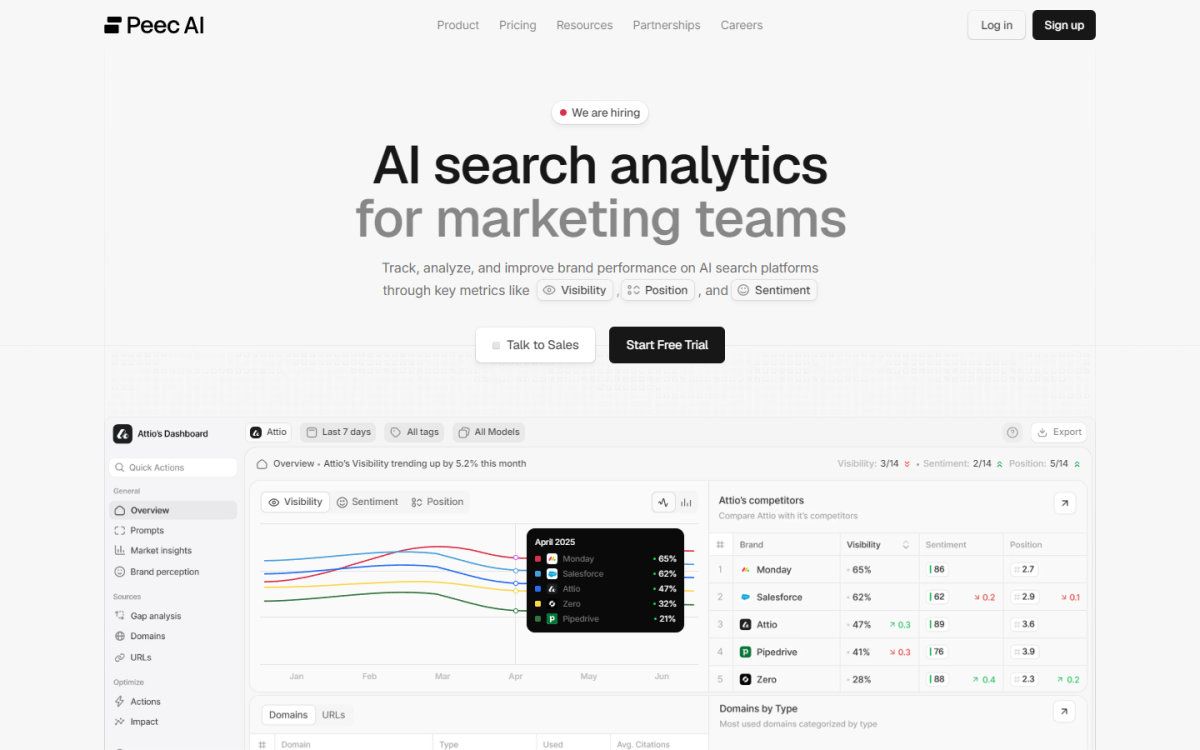
| Peec AI | From $95/month | Yes | Up to 13 (3 of 6 on Starter, plus add-ons) | ChatGPT, Google AI Mode, Google AI Overviews, Microsoft Copilot, Gemini, Naver AI | 50 prompts daily | $0.63 per daily tracked prompt | AI visibility tracking across selected answer engines. |
| Otterly.ai | From $29/month | Yes | Up to 7 (4 on Lite, 3 as paid add-ons) | ChatGPT, Google AI Overviews, Perplexity, Microsoft Copilot | 15 prompts daily | $0.48 per daily tracked prompt | Prompt tracking and brand visibility monitoring on its Lite plan. |
| Scrunch AI | From $250/month | Yes | Up to 9 (4 on Core) | ChatGPT, Perplexity, Google AI Overviews, Microsoft Copilot | 125 prompts, refresh cadence not published | No refresh cadence published | AI visibility monitoring and citation analysis for brands. |
| AthenaHQ | From $295/month | Not published | 11 | Not published | 3,600 credits/month, unlimited prompts; refresh cadence not published | No refresh cadence published | Credit-based AI visibility analysis with a free Essential plan. |
Published pricing and plan allowances in this table are stated as of October 2026. Start with prompts that represent revenue questions, not broad informational phrases that create impressive-looking visibility without commercial purpose.
How do billing terms, prompt caps and add-ons change the real monthly price?
Billing terms, prompt caps, engine add-ons, and response credits can make a low advertised price differ materially from operating cost. Compare monthly billing with monthly billing, annual billing with annual billing, and daily tracked prompts with daily tracked prompts.
Sona AI Visibility Starter is from $75 per month billed annually and $99 monthly, as of October 2026. Peec AI starts at $95 monthly with a 15% annual discount, while Otterly.ai starts at $29 monthly with a 15% annual discount, as of October 2026. Those prices cover different prompt allowances and engine access.
- List prompts that map to category, comparison, use-case, and purchase-stage research.
- Confirm whether every required answer engine is included or sold as an add-on.
- Check whether the allowance covers prompts, responses, or credits, then confirm the refresh cadence.
- Separate software fees from content production, digital PR, technical implementation, and reporting labor.
Budget plans work when the scope is deliberately narrow. They become misleading, and the risks of using generative engine optimization grow, when teams expect a tracking subscription to fund content refreshes, schema implementation, citation outreach, and technical remediation. Those workstreams require internal specialists or an external service.
Which capabilities separate GEO tools beyond basic mention tracking?
GEO tools differ in attribution, crawler evidence, prompt-level diagnostics, technical auditing, and activation of high-intent AI traffic. Basic mention tracking shows whether a brand appeared. A more operational system identifies the cited page, relevant prompt, source, and business consequence.
Technical readiness matters because retrieval systems must reach and parse a page before they can cite it. A serious review covers crawlability, performance, security, content structure, content quality, and accessibility. The Free AI Readiness Checker assesses 35 checks across those six categories and returns a 0–100 score with a letter grade in about 30 seconds, according to Sona product information, October 2026.
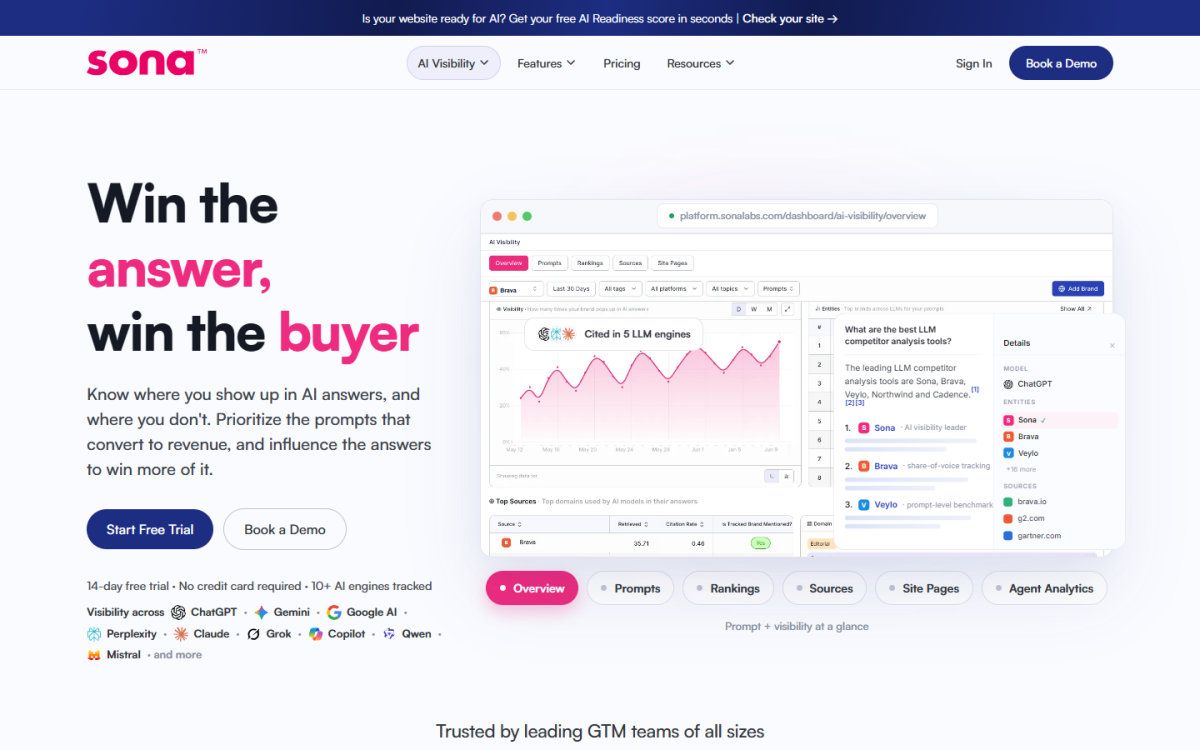
A brand-level visibility score is not a work item. Teams need the prompts and sources behind the score, the pages AI systems cited, and the gaps they can address. Sona AI Visibility connects prompt-level citation data to pages, AI-referred visits, pipeline, and revenue, while its page analysis identifies prompts where a page should appear but does not.
- Prompt coverage: whether the plan supports buyer questions.
- Source analysis: which third-party and owned pages AI answers cite.
- Crawler analytics: whether AI crawlers reach important pages.
- Technical audit: severity-ranked fixes for retrievability and parseability.
- Attribution: whether AI-referred activity can be tied to accounts, pipeline, and revenue.
For a lean SaaS team, a practical low-cost workflow tracks prompts daily and conducts deeper technical reviews monthly or quarterly. Daily tracking reveals patterns that weekly snapshots can obscure.
How do the leading AI SEO agencies compare?
Managed GEO agencies suit companies that need strategy, technical implementation, content, digital PR, and reporting rather than software alone. Published retainers begin at $4,000 per month for a narrower B2B scope and extend beyond $20,000 per month for larger programs, as of October 2026.
The agency comparison below separates a monthly retainer from a tool subscription. Retainers fund labor and defined scope. Buyers should ask whether the quoted fee includes off-site citation activity, content production, technical fixes, and reporting.
| Agency | Focus | What's included | Pricing |
|---|---|---|---|
| Sona | AI visibility measurement connected to pipeline and revenue | done-for-you services handle content and AI search optimisation on top of an AI Visibility Growth plan or above. | Launch from $5,500/month, Accelerate $7,500/month, Amplify $9,500/month, plus an eligible AI Visibility plan |
| DerivateX | Full-service SEO and GEO for B2B SaaS | LLM SEO, entity optimization, content production, digital PR, backlinks, technical SEO, and migrations | $5,000–$12,000/month; Enterprise scoped individually |
| Breaking B2B | SEO and AI search for B2B and SaaS | AEO, GEO, technical SEO, content, link building, Reddit, and YouTube marketing | From $4,000/month for tailored scope; growth plans $5,500–$9,700/month |
| Discovered Labs | AEO, GEO, and SEO for B2B | AI citations, Reddit marketing, technical SEO, content SEO, digital PR, and visibility tracking | From €6,995/month month-to-month |
| Omniscient Digital | SEO and GEO for B2B software brands | LLM optimization, citation analysis, technical roadmap, content, digital PR, and monitoring | From $10,000/month |
| iPullRank | AI search and GEO through relevance engineering | Relevance engineering, GEO, content engineering, technical SEO, attribution, and monitoring | Not published (quote only) |
| Foundation | GEO for B2B companies | GEO strategy, technical SEO, content distribution, thought leadership, digital PR, and analytics | Not published (quote only) |
| TripleDart | AI-native organic growth for B2B SaaS | AI visibility, technical and on-page SEO, content refreshes, programmatic optimization, and paid media | From $5K/month |
Agency pricing and scope shown in the table were read in October 2026. An external partner makes sense when a company has an established content backlog, a technical owner, and sufficient commercial upside for recurring implementation work.
Which affordability tier actually delivers measurable results at each budget?
The right affordability tier produces a usable measurement loop, not merely the lowest sticker price. Startups can measure a focused prompt set with software, while larger teams need funding for implementation, content, and reporting tied to business outcomes.
| Monthly budget | Best fit | Realistic scope | What can be measured |
|---|---|---|---|
| Under $100 | Early-stage startup with internal SEO ownership | Focused prompt tracking and baseline technical checks | Mentions, citations, prompt movement, and cited pages |
| $100–$500 | Small B2B SaaS team with repeatable content production | Broader prompt set, more engines, recurring audits, and competitor review | Prompt trends, source patterns, technical findings, and AI-referred visits |
| $500–$2,000 | Marketing team with specialist implementation capacity | Software plus internal technical, content, and digital PR work | Priority pages, recurring audit history, and commercial prompt coverage |
| $5,500 and above | Company buying managed execution | Strategy, implementation, content, and reporting under a defined retainer | Visibility progress and, with appropriate attribution, pipeline and revenue |
Sona AI Visibility is relevant when a B2B company needs AI search treated as a measurable acquisition channel. It connects citations and AI-referred visits to pipeline and revenue rather than treating AI visibility as an isolated reporting metric.
The useful output is a log, not a score. A score is a dated snapshot, while repeated measurements reveal whether prompt movement holds over time. Teams can then prioritize the highest-value pages and prompts instead of reacting to a single favorable or unfavorable answer.
When should a startup choose software instead of a managed GEO service?
A startup should choose GEO software when someone can own prompt research, technical fixes, content updates, and weekly operating decisions. A managed service suits companies that need external execution across those workstreams and can support a recurring retainer.
The minimum viable software setup includes a small commercial prompt set, a shortlist of core pages, and a recurring review rhythm. Begin with product-category, vendor-comparison, integration, and use-case prompts. Avoid using the full allowance on branded prompts with obvious answers.
- Choose answer engines that match customer research behavior.
- Track the same prompts daily and review meaningful changes weekly.
- Assign technical findings to an owner with authority to publish fixes.
- Refresh cited pages, strengthen entity evidence, and improve structured data.
- Review the commercial story quarterly, including pipeline where attribution is available.
Sona AI Visibility can suit a startup that needs an account-level view of AI-referred activity because it connects citations to pipeline and revenue and tracks AI crawler activity from server logs or a lightweight edge worker. A startup without an internal owner should not assume that a software subscription provides implementation labor.
Is AI visibility tracking reliable enough to judge a cheap GEO plan?
AI visibility tracking can judge a budget GEO plan when the team uses a fixed prompt set, runs it daily, records the engines and sources checked, and evaluates sustained movement rather than isolated answers. No provider can guarantee a citation because answer engines control retrieval and generation.
Daily tracking reveals patterns that weekly snapshots can obscure. Retrieval indexes change, models change, and competitors publish. Movement that holds for four days provides more useful evidence than a one-day spike.
Prompt tracking and technical auditing operate on different schedules. Run prompts daily for measurement resolution. Review a full technical audit monthly or quarterly because crawlability, schema, page performance, security headers, content freshness, and accessibility do not require daily review.
Sona AI Visibility provides 6 months of history on Starter and 12 months on Growth, according to Sona product information, October 2026. Historical series help teams distinguish noise from sustained change, then prioritize the page-level fix attached to that movement.
Who are affordable GEO services not a good fit for?
Affordable generative engine optimization services do not suit companies that need guaranteed citations, immediate lead volume, full-service content production without internal involvement, or enterprise-wide implementation on a starter budget. Low-cost plans are measurement systems and focused optimization programs, not substitutes for an entire demand generation function.
A budget plan also fits poorly when the business cannot define commercial prompts. If a team sells into several industries, countries, languages, and product lines, a small prompt allowance produces an incomplete picture. Expand coverage after identifying prompt groups that connect to qualified demand.
- Companies without a technical or content owner to act on findings.
- Teams seeking a guarantee of inclusion in Google AI Overviews or other AI answers.
- Businesses with a broad international footprint but a plan capped at a few engines or prompts.
- Organizations that need full attribution but lack CRM discipline or campaign data.
- Buyers who need extensive digital PR, original research, and content production within a tracking-only budget.
Affordable GEO is useful when a company has a narrow initial question, such as whether core decision-stage prompts cite the right pages. It is less useful when the company wants outsourced execution but cannot fund a managed scope.
Frequently Asked Questions
How much do affordable generative engine optimization services cost?
As of October 2026, self-serve GEO tools begin from roughly $29 to $295 per month among the published plans compared here. Managed retainers in the agency listings begin from $4,000 per month for a narrower scope, while Sona managed services start at $5,500 per month on top of an eligible AI Visibility plan. Confirm whether pricing is monthly or billed annually.
Can a startup do GEO for under $100 a month?
Yes. A startup can track a focused set of commercial prompts under $100 per month with an entry-level tool. The startup must still choose prompts, audit key pages, implement technical fixes, update content, develop entity evidence, and pursue digital PR where appropriate.
Which AI engines should an affordable GEO plan monitor?
Monitor answer engines that buyers use, beginning with ChatGPT, Google AI Overviews, Gemini, Perplexity, Claude, and other answer engines relevant to the category. Entry plans often cap engine coverage, so confirm included engines and paid add-ons before committing.
Do GEO services guarantee citations in AI answers?
No. AI systems determine retrieval and generation, so credible GEO providers offer measurement, diagnosis, and prioritized improvements rather than guaranteed citations, rankings, or leads. Evaluate a provider on prompt methodology, technical scope, reporting cadence, and its ability to connect work to commercial outcomes.
Is generative engine optimization different from SEO?
GEO builds on SEO, structured data, entity optimization, and digital PR, but it targets citations and visibility inside AI-generated answers. SEO remains essential because AI systems need crawlable, authoritative, well-structured pages and trustworthy third-party evidence.
How long before affordable GEO shows results?
A reliable answer requires repeated runs of a fixed prompt set over several weeks. Single scores are unreliable because AI answers change with retrieval indexes, model updates, and new content. Track prompts daily, evaluate sustained trends, and use page-level findings to determine the next improvement.
Summarize this article with AI: ChatGPT · Claude · Perplexity · Google AI Mode
Last updated: October 2026