Answer engine optimization for local business searches means making your company easy for AI systems to find, verify, and cite when someone asks for a nearby provider. Begin with an accurate Google Business Profile, recent reviews, and clear location pages, then track a fixed set of prompts instead of one answer. Sona AI Visibility connects those prompts and citations to pipeline and revenue, so performance is measured by deals rather than mentions. Treat AEO as an extension of local SEO, not a replacement.
What is answer engine optimization for local business searches, and how is it different from local SEO?
Answer engine optimization (AEO) for local business searches means structuring a local business’s information, reviews, and website pages so AI-driven search systems can understand, trust, and cite the business in a generated recommendation. It extends local SEO rather than replacing it.
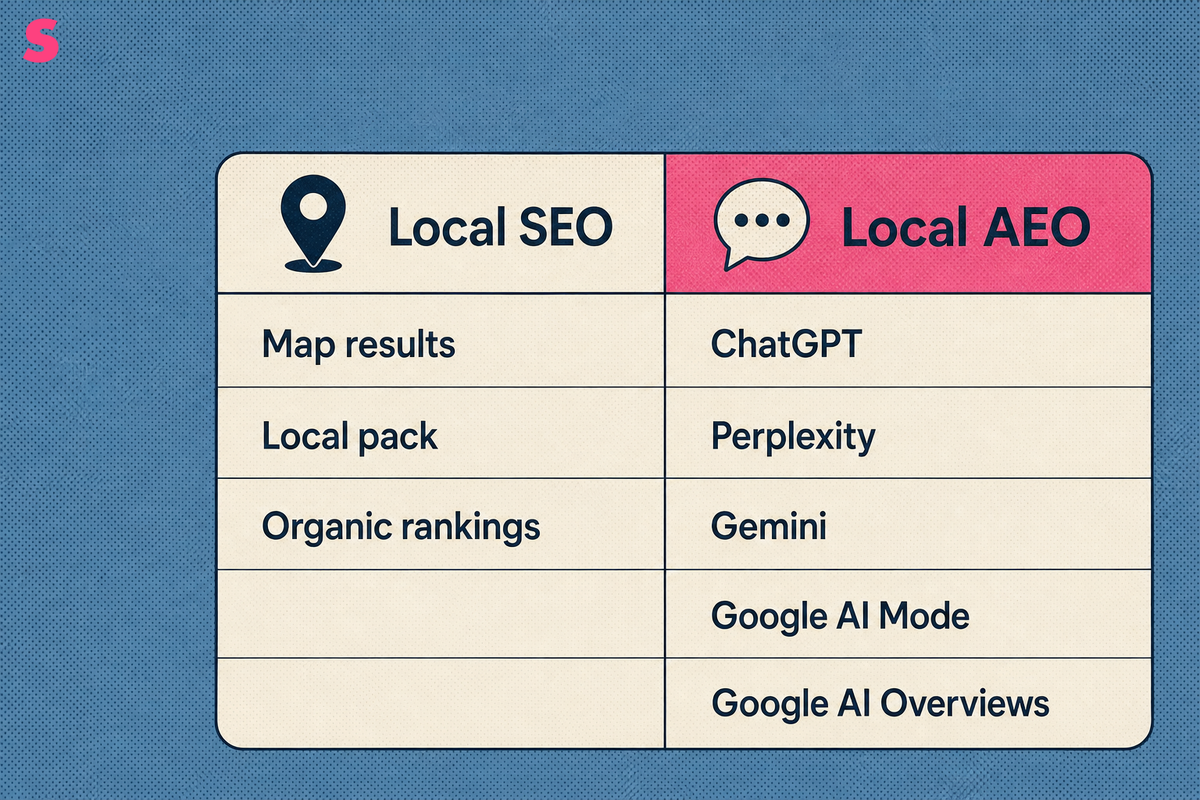
Local SEO focuses on visibility in map results, the local pack, and organic rankings. Local AEO focuses on selection and description within AI-generated answers from ChatGPT, Perplexity, Gemini, Google AI Mode, Google AI Overviews, and other answer engines. The work overlaps, but the result differs.
AI search reached a tipping point in 2025, changing business discovery from ranking for clicks alone to being selected and cited in generated answers. For local businesses, this shift made zero-click discovery and recommendation prompts commercially relevant alongside map results and organic listings.
For example, a dentist ranking in Google Maps for cosmetic dentistry in Austin has local SEO visibility. If an answer engine responds to a patient asking for a cosmetic dentist near downtown Austin by naming that practice, describing its services, and citing its profile or site, that is an AEO outcome.
Discovery increasingly ends before a website visit. USA Today reported in October 2026 that 68% of U.S. Google searches ended without a website click during the first four months of 2026. A local business still needs calls, bookings, direction requests, and qualified visits when search delivers the answer directly.
How do AI engines decide which local businesses to recommend for a query like best dentist near me?
AI engines recommend local businesses by assembling evidence about relevance, location, reputation, and consistency across business profiles, maps, reviews, directories, and web pages. A recommendation is an evidence-selection task, not simply a traditional ranking result.
For a query such as best dentist near me for emergency appointments, an answer engine must establish that a practice serves the searcher’s area, offers emergency dentistry, has credible review evidence, and presents consistent information across sources. A complete Google Business Profile, service page, review pattern, and third-party references reduce ambiguity.
Google Maps and Google Business Profile data carried substantial weight in local AI results. An October 2026 analysis of approximately 8,000 queries across 50 U.S. metros found that 79.8% of citations in Google AI Mode responses for local-intent searches pointed to Google Maps or Google Business Profile data.
Website content explains details that a profile cannot hold. Sona AI Visibility connects citations to pipeline and revenue on one account timeline, and tracks which AI crawlers reach pages, so a local team can distinguish a visible recommendation from an AI search interaction with commercial value.
Which local signals matter most for AEO: Google Business Profile, reviews, citations or off-site mentions?
Google Business Profile, reviews, consistent citations, and off-site mentions all matter for local AEO because answer engines triangulate business facts across sources. Google Business Profile provides the operational foundation, while reviews and independent mentions provide reputation evidence.
An October 2026 analysis found Google Business Profile data represented 28.5% of citations in local answers across Google AI Overviews, Google AI Mode, and ChatGPT. Profile accuracy is therefore a practical first priority: category, services, address, hours, phone number, website, and appointment details should match the business website.
Reviews serve a separate trust function. USA Today reported in October 2026 that 97% of consumers read reviews for local businesses. A review naming a service, neighbourhood, outcome, or customer need gives an answer engine more specific evidence than a star rating alone.
- Google Business Profile: establishes core identity, location, categories, and operating details.
- Reviews: provide corroboration about service quality and customer experience.
- Directory citations: reinforce consistent name, address, phone number, and service information.
- Off-site mentions: provide third-party context from forums, publications, videos, and local resources.
Off-site sources require active monitoring. A July 2026 analysis of more than 23,000 citations found that approximately 77% of sources cited in AI answers about a brand came from off-page sources such as directories, reviews, forums, and video rather than the brand’s own website.
How should a local business set up its Google Business Profile and reviews to appear in AI answers?
A local business should treat its Google Business Profile as a maintained source of record, then use a review process that captures specific service and location context without scripting customer opinions. Accuracy and consistency come before volume.
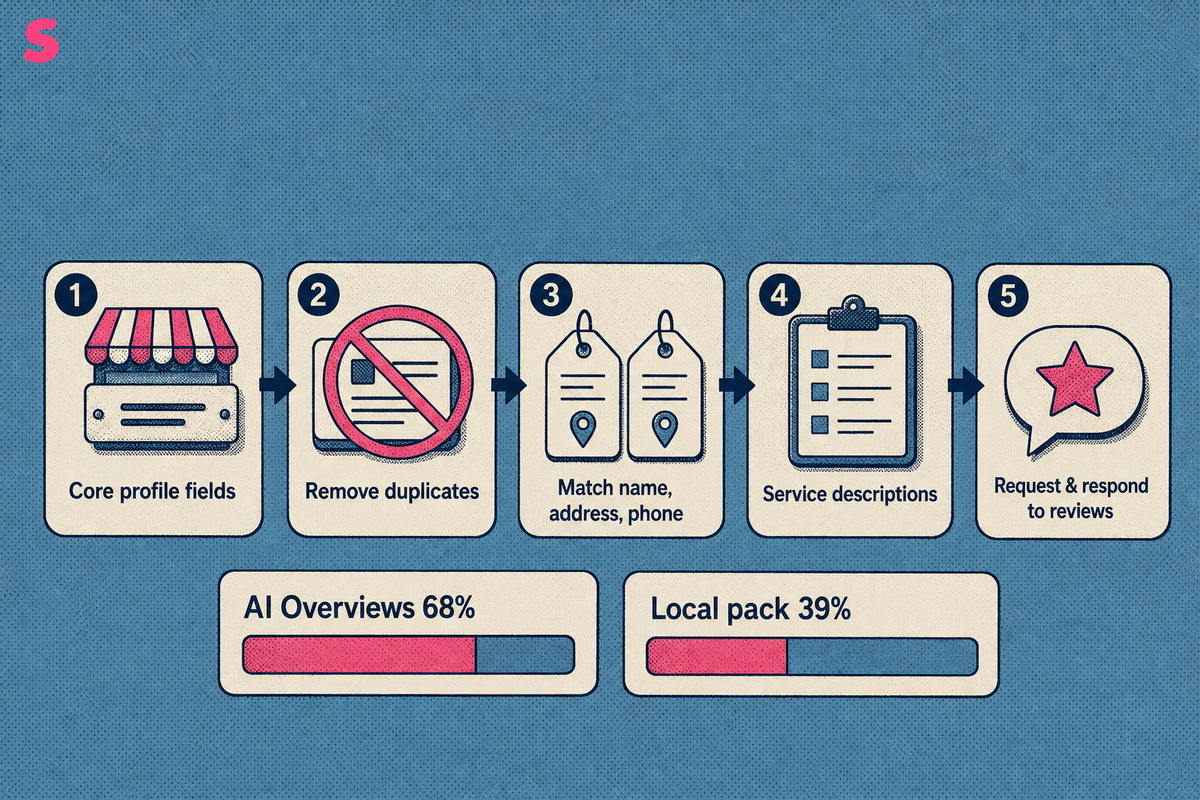
Start with the fields that establish identity. Use the business’s real name, correct primary category, complete service list, accurate hours, local phone number, website, booking path, and address or service area. Remove outdated categories, duplicate listings, and conflicting location details before expanding content.
- Verify that the business name, address, phone number, and website match across the profile and website.
- Choose categories that describe the business’s actual services rather than broad aspiration terms.
- Add service descriptions that reflect what customers ask for, including emergency, repair, consultation, delivery, or installation needs.
- Request reviews after completed work and encourage customers to describe the service they received.
- Respond to reviews with factual service and location detail, while protecting customer privacy.
Local AI results extend beyond map-pack searches. A September 2026 study of 540 local queries across three U.S. cities and six industries found Google AI Overviews on 68% of local-business-type queries, compared with 39% for the traditional local pack. A complete profile supports both map discovery and generated answers.
How should location, service and FAQ pages be written so answer engines can cite them?
Location, service, and FAQ pages should answer one local customer need clearly, with direct facts that an answer engine can extract and attribute to the correct business. Each page needs a distinct purpose, not a city name inserted into duplicated copy.
A service page should state what the business does, who the service serves, where it is available, what the customer can expect, and how to take the next step. A location page should establish the physical office or service area, nearby landmarks, local contact details, hours, and relevant services.
For example, an HVAC company can build a page for emergency furnace repair in Minneapolis that explains service coverage, same-day availability, the types of failures addressed, and the booking process. An FAQ can answer narrow questions such as whether technicians repair gas furnaces, which neighbourhoods receive service, and when an emergency call is appropriate.
Direct, segmented content is easier for answer engines to extract. Do not manufacture thin city pages. Each page needs business-specific evidence and useful local detail. ChatGPT and Perplexity can cite a brand’s content in answers even when the reader does not click through, according to Medium.
Sona AI Visibility can show, page by page, the prompts a site should appear in but does not, turning a local content gap into a specific page and prompt work item rather than a general visibility score.
What technical checks decide whether AI crawlers can read and trust a local business website?
AI crawlers need access to a local business website, readable HTML, clear canonical tags, and structured page signals before an answer engine can reliably use the site as evidence. A polished page that cannot be fetched or parsed cannot support a citation.
Review robots.txt rules, web application firewall behaviour, canonical tags, indexability, server-rendered HTML, page performance, security headers, metadata, schema markup, image alt text, and JavaScript dependency. These checks determine whether a crawler can retrieve the page and interpret its business information.
LocalBusiness schema gives machines explicit business identity, location, contact, hours, and service information. Align those properties with the Google Business Profile and visible page content, connect relevant location or service entities, validate the markup, and correct conflicts rather than using schema to introduce claims absent from the page.
Test essential location and service pages for robots.txt restrictions, WAF behaviour, rate limiting, canonicalization, indexability, and rendered HTML. Confirm that a crawler receives the same substantive business information that a customer sees, especially where JavaScript supplies service details, hours, or booking information.
How do you measure local AEO when AI answers change with every prompt?
Local AEO measurement starts with a fixed prompt set organised by service, location, and customer need. Track whether the business appears, how it is described, and which sources the engine cites. A single answer is an observation. A series reveals a pattern.
Build prompts around commercial and informational intent. A plumber might track emergency plumber in Tacoma, who repairs tankless water heaters in Tacoma, best local plumber for a burst pipe, and how quickly can a Tacoma plumber respond. Include branded prompts because customers often ask whether a specific provider serves a need.
- Create prompt groups for each priority service and location.
- Run the same prompt list daily across the answer engines that matter to customers.
- Record business mentions, citation sources, competitors named, answer position, and wording.
- Review prompt-level changes monthly and conduct a broader competitive review quarterly.
Running the same prompt list daily reveals patterns that a weekly snapshot can average away. An answer can shift because of a retrieval-index change, model update, or competitor publication. Sustained movement across repeated observations indicates a trend. An isolated spike is noise.
A brand-level visibility score does not identify the prompt or source behind a movement. Sona AI Visibility tracks prompt-level appearances and cited sources, while AI Attribution connects AI citations to accounts, pipeline, and closed-won revenue on one account timeline.
Should a local business invest in AEO now or keep doubling down on traditional SEO?
A local business should continue investing in traditional SEO and add AEO to the same operating plan. Traditional SEO supplies crawlable pages, local relevance, and map visibility. AEO adapts those assets for generated recommendations, citations, and zero-click discovery.
The choice is not SEO versus AEO. A location page that ranks well but fails to explain services clearly can miss AI citations. A well-written service page with no local authority can also struggle. The useful question is whether the business has evidence that works in both formats.
| Area | Traditional local SEO | Local AEO | Shared operating requirement |
|---|---|---|---|
| Primary outcome | Map-pack and organic visibility | Selection and citation in generated answers | Accurate local business information |
| Core unit | Keyword and landing page | Prompt, answer, and citation source | Relevant service and location pages |
| Reputation evidence | Reviews and local authority | Reviews, profiles, directories, and third-party mentions | Consistent business facts |
| Measurement | Rankings, traffic, calls, and conversions | Mentions, citations, AI-referred visits, and commercial outcomes | Trend reporting over time |
Prioritise SEO fundamentals when the Google Business Profile, crawlability, location pages, citations, or reviews remain weak. The action is to fix those assets before funding dedicated AEO work. Add AEO when those assets are established but recommendation prompts omit the brand. Fund dedicated tracking only when prompt-level visibility can be tied to commercial outcomes such as qualified visits, leads, pipeline, or revenue.
Prioritise AEO when customers ask recommendation-heavy questions, when the business competes in a crowded local category, or when map and review information exists but AI answers do not mention the brand. Only 13% of U.S. small-business owners said they were actively optimizing for AI search in an October 2026 survey, leaving an execution gap for businesses with strong local evidence.
Which AI visibility tools suit a local or ecommerce business, and what do they cost?
Local and ecommerce businesses should choose an AI visibility tool based on prompt volume, engine coverage, daily tracking cadence, and whether they need to connect AI discovery to revenue. Local teams need prompts by service and location. Ecommerce teams need prompts by product, category, use case, and comparison query.
The comparison below covers selected tools with published entry-plan details as of October 2026. Sona AI Visibility appears first because it connects AI citations and prompts to pipeline and revenue, while the other tools focus on their published tracking and reporting configurations.
| Tool | Starting price | Agency Plans? | # of Answer Engines Tracked | Answer Engines | # of Daily Tracked Prompts (entry plan) | Cost per Daily Tracked Prompt | Differentiation |
|---|---|---|---|---|---|---|---|
| Sona AI Visibility | from $75/month, billed annually | Yes | 11 | Not published | 5,000 credits/month, about 166 daily tracked prompts on one model or 56 across three | $0.45 per daily tracked prompt | Connects AI citations and prompts to pipeline and revenue on one account timeline |
| Otterly.ai | From $29/month | Yes | 4 | ChatGPT, Google AI Overviews, Perplexity, Microsoft Copilot | 15 prompts daily | $0.48 per daily tracked prompt | AI search monitoring across its published entry-plan engines |
| Scrunch AI | From $250/month | Yes | 4 | ChatGPT, Perplexity, Google AI Overviews, Copilot | 125 prompts, refresh cadence not published | No refresh cadence published | AI visibility tracking across four published Core-plan engines |
AI-visibility trackers started at approximately $25 per month in June 2026. Otterly.ai’s cited Lite plan tracked 15 prompts per day, while its Standard plan tracked 100 prompts for approximately $160 per month. A small local business can begin with a narrow daily prompt set and Google Search Console, then expand when the team has clear service, location, and revenue questions.
What are the frequently asked questions about local AEO?
What is answer engine optimization for a local business?
Answer engine optimization for a local business structures business information, reviews, and pages so AI systems can understand, trust, and cite the business when users ask for local recommendations. It extends local SEO rather than replacing it. Local SEO supplies the location, service, and reputation evidence that AI systems use.
Is AEO different from local SEO?
The tactics overlap, but the target changes. Local SEO aims to rank in a list, map result, or organic result. AEO aims to be selected, described, and cited inside a generated answer. Measurement also expands from rankings and traffic to prompts, mentions, sources, AI-referred visits, and commercial outcomes.
Does a Google Business Profile matter for AI answers?
Yes. An October 2026 analysis found Google Business Profile data represented 28.5% of citations across Google AI Overviews, Google AI Mode, and ChatGPT local answers. The same October 2026 research reviewed approximately 8,000 queries across 50 U.S. metros and found Google Maps or Google Business Profile data in 79.8% of Google AI Mode citations for local-intent searches. Off-page sources also matter heavily.
How do I track whether AI engines recommend my business?
Build a fixed prompt set by service, location, and customer need. Run the same prompts daily across the answer engines relevant to customers, then record whether the business is named and which sources are cited. Treat trends, rather than single answers, as the signal. A daily record separates a durable change from a one-day variation.
How much do AI visibility trackers cost?
Entry-level AI visibility trackers started at roughly $25 per month in June 2026. Plans covering 100 prompts were available at around $160 per month in the same period. A small business often needs only a focused prompt set plus Google Search Console before adding broader tracking coverage.
How does local AEO differ from ecommerce GEO?
Local AEO helps answer engines choose a nearby provider for a location-specific need. Ecommerce GEO helps answer engines identify and recommend specific products. The signals differ: local work depends heavily on profiles, reviews, and service areas, while ecommerce work centres on product pages, specifications, availability, and category comparisons.
Summarize this article with AI: ChatGPT · Claude · Perplexity · Google AI Mode
Last updated: October 2026